









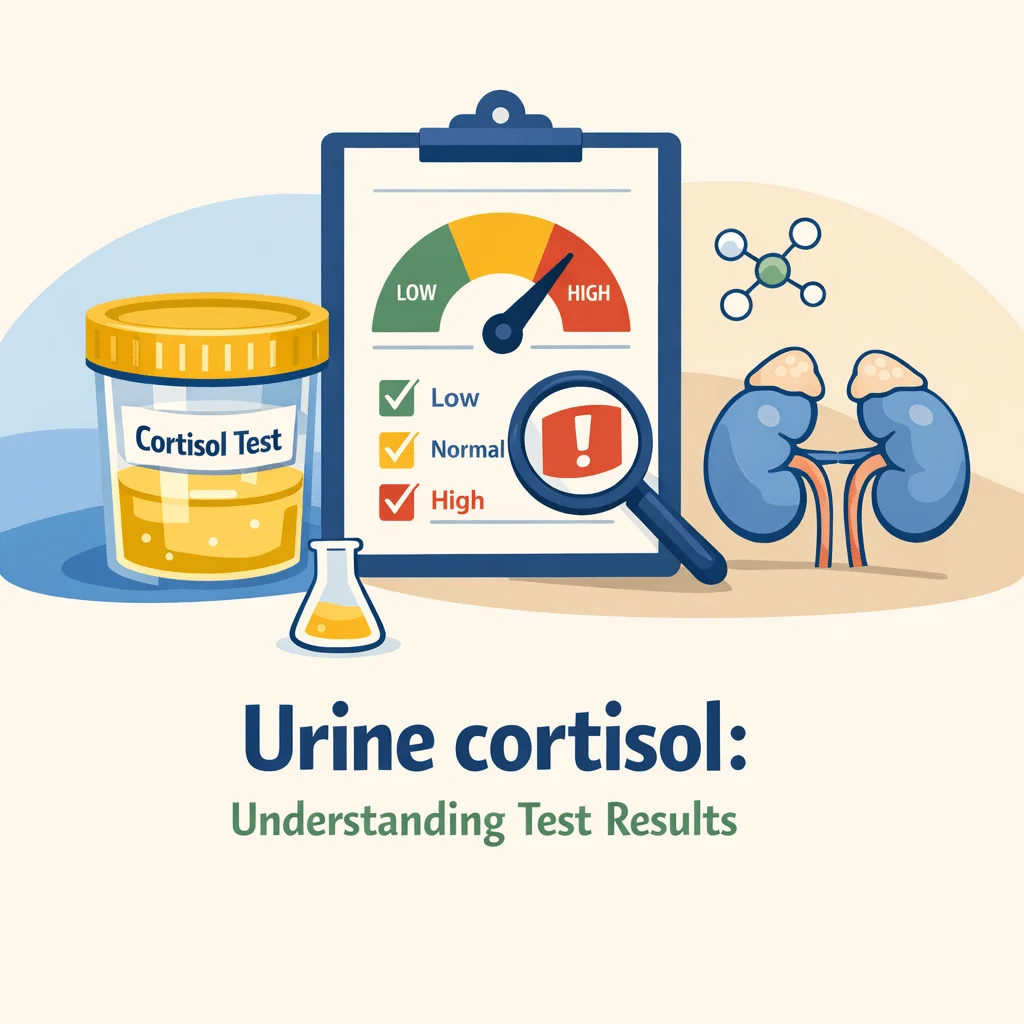
A urine cortisol test measures how much of the stress hormone cortisol your kidneys filtered out across a full day, and it is one of the first tests doctors reach for when they suspect the body is making too much of it. Unlike a blood draw that captures a single moment, a 24-hour collection averages the peaks and dips of an entire day and night. That makes it genuinely useful, and also easy to get wrong, because the number depends on how completely you collected the sample. In this article you’ll learn what the test measures, how to complete the collection correctly, what high and low results point to, how urine cortisol compares with the two other screening tests, and which medicines distort the figure on your report.
What a urine cortisol test actually measures
Cortisol is made by the adrenal glands, two small organs that sit on top of the kidneys. It helps regulate blood sugar, blood pressure, inflammation and the way the body handles physical and emotional strain. Its production follows a daily rhythm: it peaks in the early morning, falls through the afternoon, and reaches its lowest point around midnight. Because a single blood sample lands somewhere on that curve, one number can mislead. A urine cortisol collection sidesteps the problem by pooling everything the kidneys excreted over a full cycle.
Free cortisol versus total cortisol
Most of the cortisol circulating in your blood is bound to a carrier protein and is biologically inactive. Only the small unbound fraction, called free cortisol, can enter cells and do work. The kidneys filter that free fraction into urine, which is why your report usually says urinary free cortisol rather than simply cortisol. That is the practical advantage of a urine cortisol test: it reflects the hormone actually available to your tissues, not the portion parked on a protein.
Why urine, blood and saliva answer different questions
The three sample types are not interchangeable. A blood test taken at 8 a.m. asks whether the morning surge is present. A saliva sample taken near bedtime asks whether cortisol drops the way it should at night. A urine cortisol collection asks a third question: across an entire day, was total free cortisol output higher than it should be? Each suits a different clinical suspicion, which is why your doctor may order more than one.
How a 24-hour urine cortisol collection is done correctly
The most common reason a urine cortisol result is unusable is an incomplete collection. Miss part of the day and the total falls artificially low; add a void from outside the window and it rises. The steps below match those published by MedlinePlus and major hospital laboratories, but follow the sheet your own lab gives you, because preservatives and timing vary.
The collection sequence, step by step
- Pick a day at home, or one where the container travels with you. Avoid unusual exertion, travel across time zones, or an overnight shift.
- On waking, urinate into the toilet as usual and do not collect that first void. Write down the exact time. That moment starts your 24-hour window.
- For the next 24 hours, collect every single void into the container the laboratory supplied, including overnight trips to the bathroom.
- Keep the container refrigerated, or in a cooler with ice, for the whole period. Cortisol and the preservatives in the jug are temperature sensitive.
- Exactly 24 hours after the start time, urinate one final time and add it to the container, even without a strong urge. That sample closes the window.
- Return the container promptly, and tell the staff about any void you missed or spilled. An honest note beats a quietly incomplete jug.
Mistakes that ruin a 24-hour sample
Six errors account for most unusable urine cortisol results. Missing the last void truncates the day and lowers the total. Including the first morning void adds urine made before the window opened and raises it. Room-temperature storage allows degradation. Drinking very large volumes, well beyond thirst, can push free cortisol excretion upward in some people. Collecting while acutely ill, in pain, or shortly after surgery captures a genuine stress response rather than your baseline. Collecting during night shifts scrambles the daily rhythm the test assumes.
Laboratories often measure creatinine alongside cortisol because creatinine output is fairly steady day to day, so an unexpectedly low creatinine flags a short collection. Our library explains the meaning of a 24-hour urine creatinine result, and our guide covers urine specific gravity and sample concentration.
What a high urine cortisol result can mean
A raised result means the body excreted more free cortisol than expected. It is a signal to investigate, not a diagnosis. Size matters: values just above the reference limit have many benign explanations, while values several times the upper limit are much harder to explain away.
Cushing’s syndrome
Cushing’s syndrome is the condition doctors are chiefly screening for with a urine cortisol test. It describes prolonged exposure to too much cortisol, whether from a pituitary tumor driving the adrenal glands, an adrenal tumor acting on its own, or a hormone-producing tumor elsewhere. Typical features include weight gain on the trunk and face, purple stretch marks, thin skin that bruises easily, muscle weakness in the thighs and shoulders, high blood pressure and new or worsening diabetes. We describe the full picture of Cushing’s syndrome separately, and it also helps to recognize the everyday symptoms of high cortisol levels.
Steroid medicines
Taking glucocorticoid medication is the most common cause of cortisol excess overall. Prednisone, hydrocortisone, dexamethasone and their relatives come as tablets, inhalers, skin creams, eye drops or joint injections, and patients often forget the non-tablet forms. Some of these drugs are not detected by the assay itself, so they suppress your own production and make a urine cortisol result look low, while others cross-react and push it up. Never stop, reduce or start a steroid on your own, including inhaled, topical and injected forms, because abrupt withdrawal can be dangerous. Bring the full list to your prescriber and let them decide.
Pseudo-Cushing states and other look-alikes
Several situations raise cortisol genuinely, without any tumor. Doctors group them as pseudo-Cushing states. Severe or prolonged stress, poorly controlled diabetes, heavy alcohol use, severe obesity, untreated obstructive sleep apnea, depression and eating disorders can all lift daily output. Pregnancy raises it through normal physiology, which is why reference ranges differ then. The elevation is usually modest and settles once the underlying issue is treated. We explore the daily rhythm of cortisol and burnout in more detail.
What a low urine cortisol result can mean
Here the honest answer is unusual for a lab article: a low urine cortisol result should mostly be ignored. The test was designed and validated to detect excess, not deficiency. Its lower boundary overlaps heavily with the range seen in healthy people, and an incomplete collection produces exactly the same picture as a genuinely low output. A single low figure therefore proves very little on its own.
The right tests for suspected adrenal insufficiency
When a doctor suspects the adrenal glands are underactive, the workup does not start with urine. It starts with a cortisol level drawn in the early morning, when healthy glands should be at their busiest. If that is borderline, it moves to an ACTH stimulation test, in which a synthetic pituitary signal is injected and cortisol is measured before and after to see whether the glands respond. Your doctor will usually order a morning blood cortisol test first, and will often add an ACTH blood test. Our library covers the causes of a low morning cortisol result, and your doctor may request a broader adrenal hormone panel.
Urine cortisol compared with the other two screening tests
Three tests share the job of screening for cortisol excess. None is a gold standard, and each fails in a different way, which is exactly why they are used together rather than ranked.
| Test | What it measures | How it is done | What trips it up | When doctors prefer it |
|---|---|---|---|---|
| 24-hour urinary free cortisol | Total unbound cortisol excreted across a whole day and night | You collect every void for 24 hours into a refrigerated container | Missed voids, room-temperature storage, very high fluid intake, illness, shift work, pregnancy | When symptoms come and go, or a day-long average beats a snapshot |
| Late-night salivary cortisol | Whether cortisol falls to its normal low around midnight | You hold a small swab in the mouth at bedtime, usually on two separate nights | Night-shift schedules, smoking or chewing tobacco, licorice, bleeding gums, eating or brushing just before sampling | When the question is whether the nightly dip is lost, and for easy repeat testing at home |
| Overnight 1 mg dexamethasone suppression test | Whether a small steroid dose can switch off cortisol production as it should | You take one 1 mg tablet around 11 p.m. and have blood drawn the next morning | Drugs that speed up or slow down dexamethasone breakdown, estrogen therapy, poor absorption, forgetting or mistiming the tablet | When mild, quiet cortisol excess is suspected, such as after an adrenal nodule shows on a scan |
A practical consequence: a normal urine cortisol result does not close the investigation. If your symptoms are convincing, expect a second and sometimes a third test.
Drugs, supplements and situations that change the result
Interference is common enough that most laboratories ask for a medication list before a urine cortisol collection. Bring the complete list, including anything bought without a prescription.
- Glucocorticoid medicines in any form, including inhalers, nasal sprays, skin and eye preparations, and joint injections. Some are measured by the assay and raise the number; others suppress your own production and lower it.
- Estrogen-containing contraceptives and hormone therapy, which change the carrier protein in blood.
- Carbamazepine and other drugs that speed up liver clearance, which have caused documented false results in cortisol testing.
- Licorice and licorice-containing teas or candies, which interfere with the enzyme converting cortisol to its inactive partner cortisone.
- Very high fluid intake on the collection day, well beyond normal thirst.
- Acute illness, injury, major surgery, uncontrolled pain, night-shift work, recent travel across time zones, and pregnancy.
Because cortisol excess and metabolic problems travel together, doctors often check a blood potassium level at the same visit, and may review a fasting blood glucose result or a long-term blood sugar marker called HbA1c. Sustained excess also drives up blood pressure, and we outline the causes of persistently high blood pressure.
Why doctors want two abnormal tests before acting
Because each screening test has its own blind spot, guidance from the National Institute of Diabetes and Digestive and Kidney Diseases describes doctors performing two of the three tests before concluding that cortisol excess is present. A single abnormal urine cortisol result is a reason to look further, not a verdict. Your doctor weighs the size of the elevation, the completeness of the collection, your symptoms, your medication list, and at least one other test.
Reference ranges also differ between laboratories because different analyzers need different cutoffs. Compare your value with the range printed on your own report, not with a number found online.
When to speak with your doctor
Book an appointment rather than waiting for a routine review if you notice rapid weight gain around the trunk and face, wide purple stretch marks, skin that bruises from minor knocks, muscle weakness climbing stairs, new or suddenly harder-to-control high blood pressure or diabetes, unexplained bone thinning, or in women new facial hair with irregular periods. Seek prompt advice for severe weakness, vomiting, dizziness on standing or confusion, which can signal a serious drop in cortisol and needs same-day assessment.
Latest scientific advances
Research from the last three years has sharpened how the urine cortisol test is used, and been candid about its limits.
The urine test works best as part of a set
A 2024 review of records from an Oxford endocrine unit compared the three screening tests in patients under investigation for cortisol excess. In one sentence: the saliva and dexamethasone tests each performed reasonably alone, combining them worked considerably better, and the urine test added little by itself. What this means for you is simple. If your urine cortisol comes back normal but your symptoms are persuasive, that is not a dead end, and your doctor is following the evidence by ordering another test rather than stopping.
A larger 2025 analysis of more than 650 people found that all three tests performed well overall, and the dexamethasone and urine cortisol tests were slightly ahead of the saliva test. The same study showed that the threshold for calling a result abnormal should shift depending on why you were tested. Your number is read against your situation, not a single universal cutoff.
Why lab machines and reference ranges differ
A 2025 laboratory study compared four newer automated cortisol analyzers against mass spectrometry, the reference method that identifies a molecule by its exact weight. All four tracked it closely, but each needed its own cutoff, and those cutoffs varied by roughly a third from lowest to highest. What this means for you is that a urine cortisol value labeled high by one laboratory could sit inside the range of another, which is a concrete reason to compare your result only with the range on your own report.
Measuring cortisone alongside cortisol
A 2026 Amsterdam hospital study tested whether measuring cortisone, the inactive partner molecule cortisol converts into, improves the urine cortisol test. The two together performed slightly better than cortisol alone, identifying most people who genuinely had cortisol-producing tumors while clearing most of those who did not. Participants collected urine on two consecutive days. What this means for you is that being asked to repeat a 24-hour collection is normal good practice, not a sign something went wrong.
Mild cortisol excess found by accident
A 2025 study of 171 people with an adrenal incidentaloma, a nodule on the adrenal gland found by chance on a scan done for another reason, compared those whose nodule quietly made a little extra cortisol with those whose nodule made none. The mild-excess group had modestly higher 24-hour urine cortisol, and more often had abnormal cholesterol and anxiety or depressive symptoms. What this means for you is that a mildly raised urine cortisol found after an incidental scan usually points toward this slow, low-grade picture rather than classic Cushing’s syndrome.
Hair cortisol as an emerging alternative
A 2025 expert review asked directly whether blood, saliva, urine or hair is the best sample for detecting cortisol excess. Its answer: no single sample type wins outright, and hair cortisol, measured along a strand that grows at a steady rate and acts like a slow record of the preceding months, is a promising addition rather than a replacement. What this means for you is that hair testing is not yet routine in most clinics, and the urine cortisol collection remains one of the standard first steps.
Frequently asked questions
What is a normal urine free cortisol range?
There is no single universal range. Typical adult reference intervals for 24-hour urinary free cortisol vary between laboratories because different analyzers and different measurement techniques require different cutoffs, and research comparing modern analyzers has confirmed that the cutoffs genuinely differ from machine to machine. Ranges also differ in pregnancy and in children. The only range that applies to your result is the one printed beside it on your own laboratory report. If the report does not show one, ask the laboratory or the clinician who ordered the test.
What should I do if I miss a sample during the 24 hours?
Tell the laboratory. A missed void makes the total lower than reality, and a low result caused by a gap in collection looks identical to a genuinely low result. Most laboratories will simply ask you to restart on another day, which costs a day but protects you from a misleading number and from unnecessary follow-up testing. Do not try to compensate by adding an extra sample after the window closed, and do not guess at the missing volume. An honest note on the container is always the better option.
Does a high 24-hour urine cortisol always mean Cushing’s syndrome?
No. A raised result is a reason to investigate further, not a diagnosis. Modest elevations are common in severe or long-lasting stress, heavy alcohol use, poorly controlled diagnosed diabetes, severe obesity, untreated sleep apnea, depression and pregnancy, and steroid medicines in any form can shift the number in either direction. Very large elevations, several times the upper limit, are much harder to explain by these causes. Doctors normally look for a second abnormal test, alongside your symptoms and medication list, before drawing conclusions.
Can I do a urine cortisol test at home?
The collection itself happens at home, since gathering a full day of urine in a clinic is impractical. What differs is the ordering and the analysis. Direct-to-consumer kits exist, but the results arrive without the clinical context that makes them meaningful, reference ranges vary by laboratory, and an abnormal figure with no clinician attached tends to generate anxiety rather than answers. If you have symptoms that concern you, the more useful route is asking a clinician to order the test so the result lands with someone who can interpret it.
Does drinking a lot of water change the result?
Drinking normally to satisfy thirst is fine and expected. Drinking very large volumes well beyond thirst is worth avoiding on collection day, because a sustained high fluid intake can raise measured free cortisol excretion in some people and may push a borderline result over the line. There is no need to restrict fluids either, which brings its own risks. Aim for your usual pattern, and mention any unusual intake, such as a long training session, to the laboratory or your clinician.
Why does my report show creatinine next to cortisol?
Creatinine is a waste product that your muscles release at a fairly constant rate, so the amount excreted over 24 hours is reasonably predictable for a given person. Laboratories use it as a quality check on the collection: if the creatinine total is much lower than expected for your size and sex, the collection was probably incomplete and the cortisol result cannot be trusted. Some laboratories also report cortisol as a ratio to creatinine for the same reason. It is a safeguard, not a separate problem to worry about.
Glossary of key terms
| Term | Definition |
|---|---|
| ACTH (adrenocorticotropic hormone) | The hormone released by the pituitary gland that tells the adrenal glands to make cortisol. Measuring it helps locate where a cortisol problem originates. |
| Adrenal glands | Two small hormone-producing organs sitting on top of the kidneys. They make cortisol, aldosterone and several other hormones. |
| Adrenal incidentaloma | A nodule on an adrenal gland found by chance on a scan performed for an unrelated reason. Most are harmless, but some make small amounts of extra hormone. |
| Cortisone | The inactive molecule that cortisol converts into and back from. Some laboratories now measure it in urine alongside cortisol. |
| Cushing’s syndrome | The set of problems caused by prolonged exposure to too much cortisol, whether from a tumor or from steroid medication. |
| Dexamethasone suppression test | A test in which a small steroid tablet is taken late at night to see whether it switches off cortisol production by the next morning, as it should. |
| Free cortisol | The unbound fraction of cortisol that is not attached to a carrier protein. It is the part that can enter cells, and the part the kidneys filter into urine. |
| Glucocorticoid | The drug family that mimics cortisol, including prednisone, hydrocortisone and dexamethasone, available as tablets, inhalers, creams, drops and injections. |
| Late-night salivary cortisol | A saliva sample collected around bedtime to check whether cortisol falls to its normal overnight low. |
| Pseudo-Cushing state | A situation such as severe stress, heavy alcohol use or untreated sleep apnea that genuinely raises cortisol without any hormone-producing tumor being present. |
Sources
- National Institute of Diabetes and Digestive and Kidney Diseases — Cushing’s Syndrome — NIDDK, National Institutes of Health. niddk.nih.gov
- MedlinePlus — Cortisol Test — National Library of Medicine. medlineplus.gov
- Cleveland Clinic — Cortisol Test: What It Is, Purpose, Types and Results. my.clevelandclinic.org
- Efthymiadis A, Loo H, Shine B, et al. — Development of diagnostic algorithm for Cushing’s syndrome: a tertiary centre experience — Journal of Endocrinological Investigation, 2024. PubMed
- Ceccato F, Bavaresco A, Ragazzi E, et al. — Clinical and Biochemical Data for the Diagnosis of Endogenous Hypercortisolism: The “Cushingomic” Approach — The Journal of Clinical Endocrinology and Metabolism, 2025. PubMed
- Zhang Q, Mu D, Ma Y, et al. — Comparative evaluation of four new immunoassays and LC-MS/MS for the measurement of urinary free cortisol in Cushing’s syndrome diagnosis — Practical Laboratory Medicine, 2025. PubMed
- Koops K, Hillebrand JJ, Heijboer AC, et al. — Cut-off values of urinary free cortisol and cortisone for diagnosing neoplastic hypercortisolism — Clinica Chimica Acta, 2026. PubMed
- Prinzi A, Lombardo AM, Finocchiaro S, et al. — Expanding the Clinical Profile of Mild Autonomous Cortisol Secretion: New Diagnostic Markers and Emerging Complications — Endocrine Practice, 2025. PubMed
- Ferriere A, Tabarin A — Current challenges in Cushing’s syndrome testing: blood, saliva, urine, or hair? — Current Opinion in Endocrinology, Diabetes and Obesity, 2025. PubMed
Further reading
- How to read a standard urinalysis panel line by line
- What urine electrolytes reveal about salt and fluid balance
- Why urine color shifts from one day to the next
- What a laboratory looks for when it examines urine cells under a microscope
- How a urine drug screen is run and reported
Understand your lab results with AI DiagMe
A urine cortisol value on its own rarely tells the whole story. It becomes far more useful once you can see it beside the other numbers doctors read with it: a morning blood cortisol, ACTH, urine creatinine as a check on the collection, and metabolic markers such as blood glucose, HbA1c and potassium. AI DiagMe reads your laboratory report and explains, in plain language, what each value means and which ones sit outside the range printed on your own report. It helps you understand your results and prepare better questions; it does not diagnose, and it does not replace your doctor.
Get your results interpreted in minutes