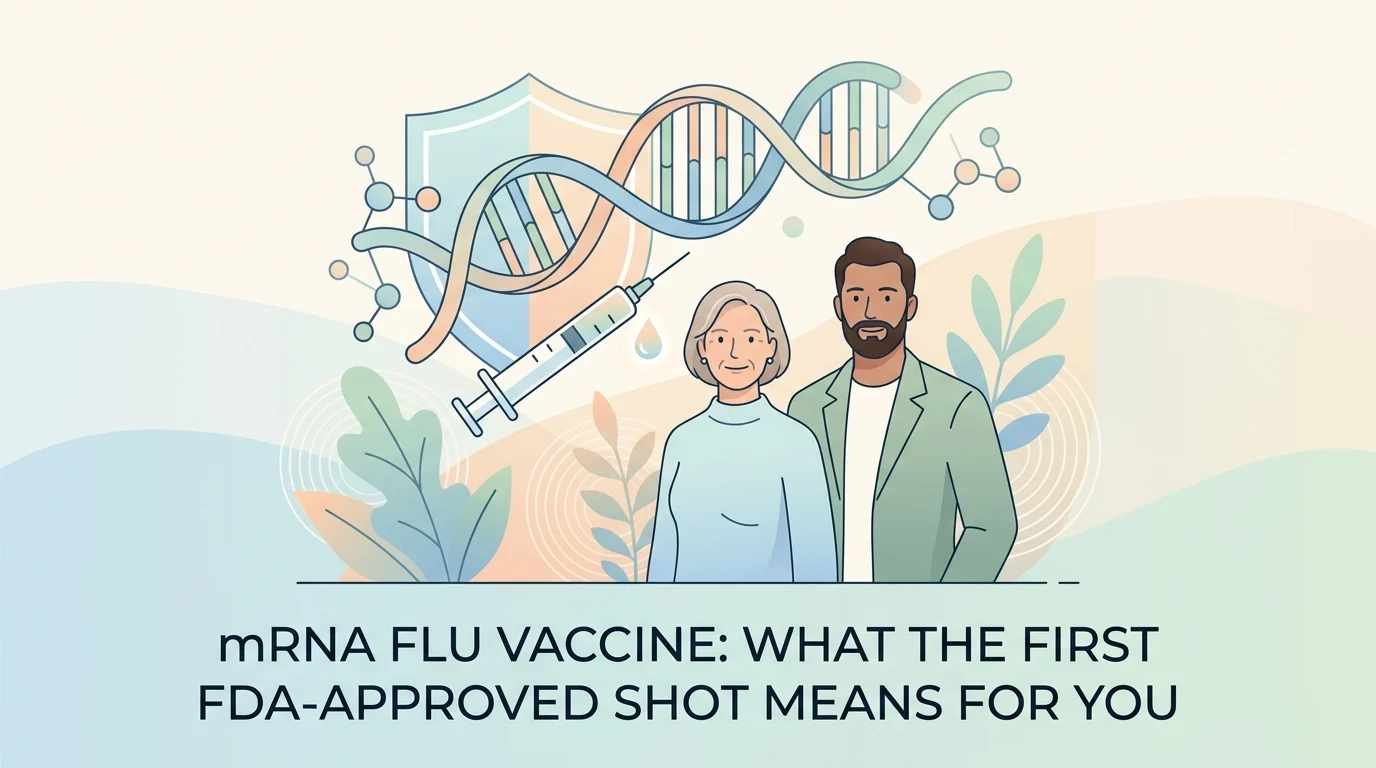
The first mRNA flu vaccine has been approved in the United States, and it changes how the annual flu jab could look in the years ahead. In early August 2026 the FDA approved Moderna’s mFlusiva for adults aged 50 and older. Unlike most seasonal vaccines, which are still grown in eggs, an mRNA flu vaccine gives your cells short instructions to build a harmless piece of the flu virus so your immune system learns to recognise it. This article explains what the approval covers, what the main trial found, what it cannot yet tell us, and where blood tests fit into flu season for people who follow their health numbers.
What the FDA approved, and for whom
According to the FDA, mFlusiva is indicated to prevent influenza disease caused by influenza A and B viruses in people aged 50 and older. It is a trivalent vaccine, meaning it targets three flu strains chosen each year from World Health Organization recommendations. Trade press covering the approval reports that protection in the 65 and older age group was granted through an accelerated pathway, with a follow-up study required across two flu seasons.
The manufacturer said it expects the vaccine to be available for the 2026–2027 season. Availability, pricing and pharmacy stocking can vary, so the practical step is to ask your clinician or pharmacist what is on offer near you.
How an mRNA flu vaccine differs from a traditional flu jab
Traditional flu vaccines contain inactivated virus proteins that usually have to be manufactured months before the season. An mRNA vaccine delivers instructions for a viral protein called haemagglutinin, and your own cells make it briefly. The mRNA itself breaks down quickly. Researchers see the platform as a way to update strains faster, although real-world speed gains still have to be demonstrated.
What the main trial showed
The approval rests largely on a large phase 3 trial published in the New England Journal of Medicine. Around 40,000 adults aged 50 and older were randomly assigned, without knowing which vaccine they received, to the mRNA vaccine or to a licensed standard-dose flu jab. The key point is that the comparison was against an existing vaccine, not against no vaccine at all.
Lab-confirmed flu-like illness was less common in the mRNA group. The authors calculated a relative efficacy of about 27 per cent, which means roughly a quarter fewer cases than with the standard-dose vaccine. Reactions such as arm pain, tiredness, headache and muscle aches were more frequent after the mRNA vaccine, though most were mild to moderate and short-lived.
| Outcome in the trial | mRNA vaccine | Standard-dose vaccine |
|---|---|---|
| Lab-confirmed flu-like illness | 2.0% of participants | 2.8% of participants |
| Pain at the injection site | 65.8% | 29.8% |
| Fatigue | 45.1% | 20.3% |
| Headache | 37.8% | 18.0% |
| Muscle aches | 35.4% | 11.6% |
| Serious adverse events | 2.2% | 1.9% |
Reading the side effects fairly
More reactions do not automatically mean a less safe vaccine, but they matter for planning. If you feel unwell for a day or two after vaccination, that pattern is consistent with what the trial reported. Serious events were similar in both groups, and only a handful were judged by investigators to be related to the vaccine.
What the trial cannot tell us yet
In several countries, adults 65 and older are steered towards enhanced vaccines such as high-dose, adjuvanted or recombinant products. Whether an mRNA vaccine adds benefit beyond those options has not been established in a head-to-head trial. Manufacturer-authored analyses suggest results comparable to enhanced vaccines, but they rely on indirect comparisons and should be read with that in mind. Real-world data from the 2026–2027 season will help answer the question.
Who should consider it, and who should ask first
The NHS recommends a flu vaccine every season for almost everyone aged six months and older, and adults 65 and older, pregnant women, young children and people with conditions such as diabetes or heart disease are among those at higher risk of severe flu. The mRNA option is one more choice for adults 50 and older, not a replacement for existing vaccines. Check the NHS’s current guidance for how this specific product is being recommended.
Medical News Today’s coverage notes that people with a severe allergic reaction to a vaccine ingredient, a history of Guillain-Barré syndrome after a flu vaccine, or a weakened immune system should speak with a clinician before choosing it. That advice applies to any vaccine decision.
Flu season and your lab results: where blood tests fit
A flu jab is not normally preceded by a blood test. The decision rests on age, health conditions and allergy history. Lab tests come into play in other ways during flu season.
If you get flu anyway
Flu is confirmed with a nose or throat swab, either a rapid antigen test or a PCR test, not with routine blood work. Blood tests are sometimes added when a doctor wants to check for complications. An infection can temporarily shift inflammation markers and white blood cell counts, which is why doctors may order the CRP blood test and a complete blood count. A result taken during an illness needs context and is best compared with your baseline once you recover.
If you live with a chronic condition
People with diabetes, kidney disease or heart disease are the ones for whom flu vaccination matters most. Keeping routine monitoring up to date, such as a HbA1c test for blood sugar control, helps your care team see the full picture. For the illness itself, read our guide to influenza symptoms, treatment, and prevention.
Latest scientific advances
Based on articles retrieved from PubMed, the evidence on mRNA flu vaccines grew quickly in 2026. The phase 3 trial in adults 50 and older is the anchor. A September 2026 review of mRNA seasonal vaccines confirms that reactions are higher than with conventional jabs but mostly mild and brief, and it points out that another manufacturer’s candidate did not match standard vaccines in adults 65 and older, so results are not the same for every mRNA product. A perspective article stresses continued safety monitoring after approval.
Two manufacturer-authored analyses look at adults 65 and older compared with enhanced vaccines. One estimates a modest advantage over a high-dose vaccine from antibody responses, the other finds comparable protection in an indirect comparison. What this changes for you: the new vaccine looks at least as good as standard jabs for people 50 and older, but the case for choosing it over a high-dose or adjuvanted vaccine after 65 is still open. Ask your clinician which option fits your situation.
When to talk to your doctor
Speak with a clinician before vaccination if you have had a severe allergic reaction to a vaccine, if you have a weakened immune system, or if you are unsure which vaccine suits you. Seek care promptly if flu symptoms come with difficulty breathing, chest pain, confusion or symptoms that improve and then return with fever. Only a healthcare professional can interpret your own test results and health history.
Glossary
- mRNA (messenger RNA): a short-lived set of instructions that tells cells to make a specific protein.
- Hemagglutinin: the protein on the surface of the flu virus that vaccines train the immune system to recognise.
- Relative efficacy: how much better one vaccine performs compared with another vaccine, rather than compared with no vaccine.
- Trivalent vaccine: a vaccine that protects against three flu strains.
- Accelerated approval: a regulatory pathway that allows earlier approval, with further studies required afterwards.
- PCR test: a laboratory test that detects the genetic material of a virus.
Frequently asked questions
Is the mRNA flu vaccine safe?
In the main trial, serious adverse events were similar to the standard-dose vaccine, and reactions were more frequent but mostly mild to moderate. Post-approval monitoring will add real-world safety data.
Is the mRNA flu vaccine better than the regular flu jab?
Against a standard-dose vaccine in adults aged 50 and over, it prevented around a quarter more cases of lab-confirmed flu-like illness. Compared with high-dose or adjuvanted vaccines, direct evidence is not yet available.
Who can have the mRNA flu vaccine?
The FDA approval covers adults aged 50 and over. Ask your clinician or pharmacist whether it is available where you live.
Do I need a blood test before a flu jab?
Not routinely. The choice of vaccine depends on age, health conditions and allergy history.
Sources
- U.S. Food and Drug Administration, MFLUSIVA product page (approval August 5, 2026).
- Centers for Disease Control and Prevention, Flu vaccination basics.
- National Library of Medicine, MedlinePlus: Flu.
- Leroux-Roels I, et al. Efficacy and safety of an mRNA seasonal influenza vaccine in adults. N Engl J Med 2026. PubMed: 10.1056/NEJMoa2516491.
- Domnich A, Orsi A. mRNA-based seasonal influenza vaccines: an overview of immunogenicity, efficacy, and safety. Front Immunol 2026. PubMed: 10.3389/fimmu.2026.1965512.
- Panagiotopoulos AP, et al. mRNA-1010 and the future of seasonal influenza prevention. Vaccines 2026. PubMed: 10.3390/vaccines14080709.
- Nguyen VH, et al. Estimating the relative vaccine efficacy of mRNA-1010 to high-dose influenza vaccine in adults 65 years and older. Vaccines 2026. PubMed: 10.3390/vaccines14090750.
- Joshi K, et al. Indirect comparison of mRNA-1010 versus enhanced influenza vaccines in adults aged 65 years and older. J Med Econ 2026. PubMed: 10.1080/13696998.2026.2706361.
- Healthcare Dive, FDA approves Moderna’s mRNA flu vaccine.
- Medical News Today, Moderna’s mRNA flu vaccine approved by FDA: when will it be available.
Other articles
- Influenza (Flu): Symptoms, Treatment, and Prevention
- CRP Blood Test: How to Read Your Inflammation Results
- Full blood count (FBC) guide
- HbA1c test: what your blood sugar results mean
Understand your own blood test results with AI DiagMe
Flu season is a good moment to keep an eye on your health numbers. Understand your lab results with AI DiagMe.