








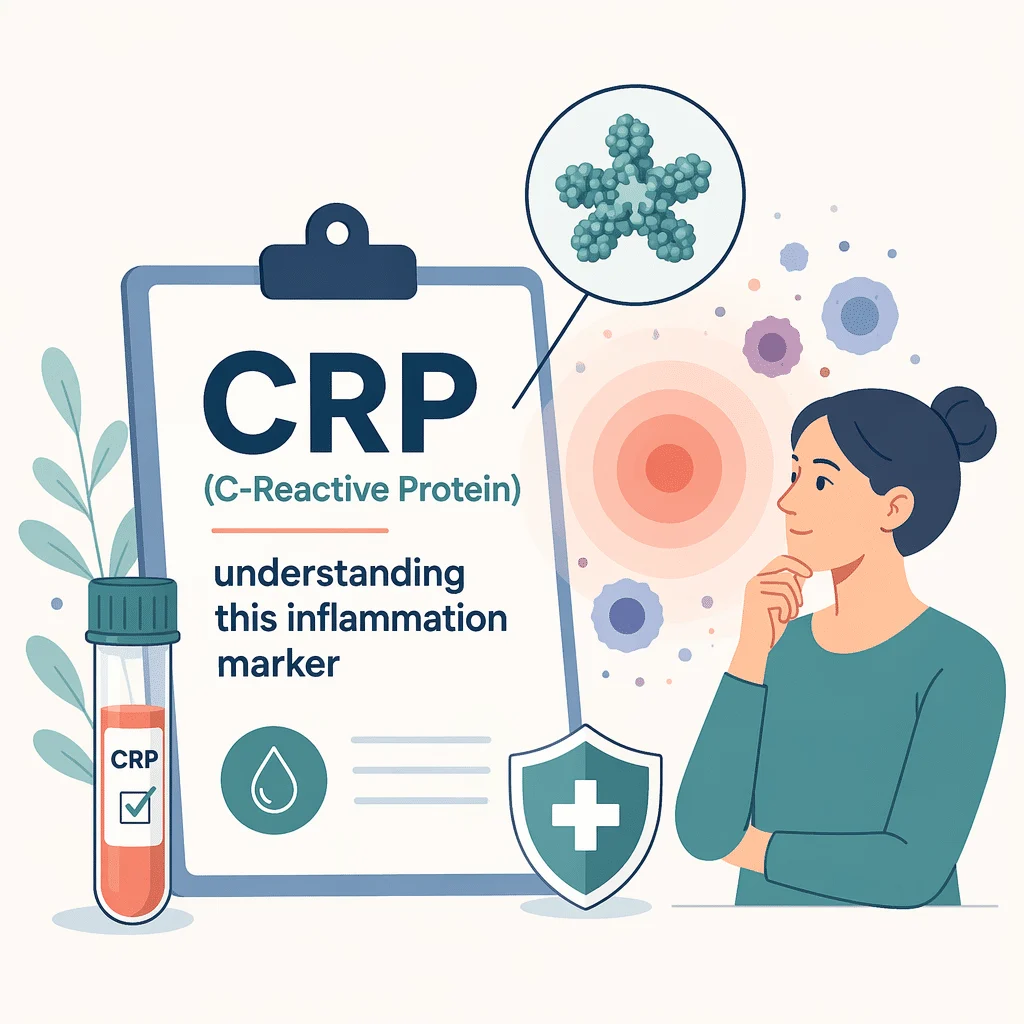
A CRP blood test measures C-reactive protein, a substance your liver releases into the bloodstream whenever there is inflammation somewhere in the body. Doctors order it to help detect an infection, to monitor a known inflammatory condition, or to check whether a treatment is working. A more sensitive version, called high-sensitivity CRP (hs-CRP), is also used to estimate the risk of heart disease. Seeing a high or unfamiliar number on a lab report can be unsettling, especially when the result arrives with little explanation. In this article you’ll learn what the test measures, how to read your CRP results, what can raise or lower the number, how CRP compares with other inflammation tests, and when a raised level is worth discussing with your doctor.
What a CRP blood test measures
C-reactive protein is a ring-shaped protein made by the liver. When your immune system detects infection, injury, or tissue damage, it releases chemical signals that tell the liver to produce more CRP. Within hours, the amount circulating in your blood can climb sharply, which is why CRP is described as an acute-phase protein. Once the underlying problem settles, the level falls again fairly quickly.
CRP does not tell you where inflammation is coming from or what is causing it. It works more like a smoke detector than a diagnosis: a high reading tells your doctor that something is stirring up the immune system, but not whether the trigger is a chest infection, a joint flare, or a recent operation. That is why a CRP result is almost always read alongside your symptoms, your history, and other tests.
CRP also has a job beyond signalling. It binds to the surface of dead or dying cells and to some bacteria, tagging them so that other parts of the immune system can clear them away. This helper role is one reason the body raises CRP so quickly: it is part of the early clean-up crew, not simply a warning light. For you as a patient, though, the practical value of the test lies in that speed and in how the number changes over time.
Standard CRP and high-sensitivity CRP (hs-CRP)
There are two ways to measure the same protein. A standard CRP test captures the larger swings seen with infections and active inflammation. A high-sensitivity CRP test, or hs-CRP, detects much smaller changes at the low end of the scale. Doctors use hs-CRP mainly to help estimate long-term cardiovascular risk, whilst standard CRP is better suited to spotting and following an active illness.
How the sample is taken
A CRP test needs only a routine blood sample, usually drawn from a vein in your arm, and most people do not need to fast beforehand. Results are often available within a day. If your doctor has asked for a high-sensitivity CRP test to look at heart risk, it is best taken when you feel well, because a cold or another short-lived illness can temporarily raise the number and cloud the picture.
Why doctors order a CRP test
Your doctor may request a CRP blood test for several practical reasons. Because the protein rises and falls quickly, it is useful both for raising a first alert and for tracking change over time.
- To look for infection when you have a fever, pain, or other unexplained symptoms.
- To gauge how severe an infection or inflammation appears to be.
- To monitor a chronic condition such as rheumatoid arthritis or inflammatory bowel disease.
- To follow recovery after surgery or a serious injury.
- To check whether an anti-inflammatory or antibiotic treatment is working.
CRP is rarely interpreted on its own. To build a fuller picture, your doctor may pair it with a full blood count (FBC), which counts the different blood cells. A bacterial infection, for example, often raises high neutrophil counts at the same time that CRP climbs.
Tracking the trend is often more useful than any single figure. If you are being treated for an infection, a CRP that falls over a few days suggests the treatment is working, whilst a level that keeps climbing may prompt a change of plan. In long-term conditions, a rising CRP can be an early hint that a flare is building before you feel much worse.
How to read your CRP blood test results
CRP is usually reported in milligrams per litre (mg/L). A few laboratories use milligrams per decilitre (mg/dL); to convert one into the other, multiply an mg/dL figure by ten. The table below gives a general guide to standard CRP results. Exact cut-offs differ between laboratories, and only a clinician can interpret your number in context.
| CRP level (mg/L) | General interpretation | Common context |
|---|---|---|
| Below 3 | Normal | Little or no measurable inflammation |
| 3 to 10 | Mild elevation | Low-grade or early inflammation, excess weight, smoking, or older age |
| 10 to 100 | Moderate elevation | An active infection or a flare of an inflammatory condition |
| Above 100 | Marked elevation | Often a serious bacterial infection or major tissue injury |
Treat these bands as a rough guide rather than a verdict. Many laboratories report a standard CRP under about 10 mg/L as normal, and a single value matters far less than the trend across several tests. If the reference intervals on your report look unfamiliar, you can compare them with typical normal blood test ranges, and our team also explains, step by step, how to read your blood test results.
One reading is a snapshot, not a diagnosis. A borderline result in someone who feels well often means very little, whilst the same number in someone with a fever and pain may prompt urgent action. Doctors therefore look at the size of the change, the direction of travel across repeated tests, and the whole clinical picture before drawing conclusions.
hs-CRP and your cardiovascular risk
Inflammation plays a part in atherosclerosis, the slow build-up of fatty plaque inside artery walls. Because hs-CRP can detect very low levels of inflammation, it is used as one signal among several to estimate the risk of heart disease. Major heart organisations group hs-CRP results into three broad bands. For more detail, you can read the Mayo Clinic’s explanation of hs-CRP and heart risk.
| hs-CRP level (mg/L) | Cardiovascular risk category |
|---|---|
| Below 1 | Lower risk |
| 1 to 3 | Average risk |
| Above 3 | Higher risk |
An hs-CRP result only adds useful information when you are otherwise well. A reading above about 10 mg/L usually reflects a temporary infection or injury rather than heart risk, so the test is normally repeated once you have recovered. Because inflammation and cholesterol act through different pathways, clinicians rarely read hs-CRP in isolation and usually review it alongside the lipid panel.
On its own, an hs-CRP number cannot predict a heart attack, and a low result does not guarantee safety. Doctors combine it with blood pressure, cholesterol, blood sugar, smoking history, age, and family history to build an overall estimate. Seen this way, hs-CRP is one useful input that can tip a borderline decision, such as whether to start a statin, rather than a stand-alone verdict.
What can push your CRP up
A raised CRP has many possible explanations, from a passing infection to a long-standing condition. The level itself gives a clue to how much inflammation is present, but not to its source.
Common and temporary causes
Everyday triggers include viral and bacterial infections, a recent injury, dental or gum problems, and the normal healing that follows surgery. Intense exercise can lift CRP for a day or two, and higher readings are also linked with smoking, excess weight, and older age. Some of the same triggers raise other stored proteins, which is why inflammation can also raise high ferritin levels.
Chronic and long-term causes
When CRP stays elevated for weeks or months, doctors look for an ongoing process. Autoimmune diseases such as rheumatoid arthritis and lupus, inflammatory bowel disease, and some long-term metabolic conditions can all keep the number up. If a lasting cause is suspected, your doctor may request an autoimmune panel, and for persistent elevation you can read our detailed guide to high CRP levels.
The size of the rise offers a rough clue. Very high readings, especially in the hundreds, point more often towards a significant bacterial infection or major tissue damage, whilst modest increases have a wider and usually less worrying range of causes. Even so, the number never names the cause by itself, which is why doctors match it to your symptoms and, when needed, order further tests.
CRP compared with other inflammation tests
CRP is not the only marker of inflammation, and each test has its strengths. When results are hard to interpret, doctors often order the erythrocyte sedimentation rate (ESR) test, which changes more slowly and can confirm a longer-running process. To help separate bacterial infection from other causes, they may add the procalcitonin (PCT) test. Some laboratories also measure the serum amyloid A (SAA) protein, another fast-moving acute-phase marker. The table below compares three of the most common options.
| Test | What it reflects | How quickly it changes | Often used to |
|---|---|---|---|
| CRP | A protein released by the liver during inflammation | Rises within hours, falls within days | Detect and monitor infection or inflammation |
| ESR | How quickly red blood cells settle in a tube | Changes slowly, over days to weeks | Follow chronic or autoimmune inflammation |
| Procalcitonin (PCT) | A peptide that rises mainly with bacterial infection | Rises within hours | Help tell bacterial infection from other causes |
When to see a doctor
A CRP result should always be discussed with the clinician who ordered it. Some situations, though, deserve prompt attention.
- A very high CRP together with fever, severe pain, confusion, or a rapid heartbeat, which can signal a serious infection.
- A CRP that stays elevated across repeated tests without an obvious cause.
- Any raised result that comes with symptoms your doctor has asked you to watch for.
- Chest pain, breathlessness, or other heart-related symptoms, which need urgent care regardless of your CRP.
CRP cannot diagnose a heart attack on its own; when heart muscle damage is a concern, a doctor will act on your symptoms first and, if needed, check the cardiac markers panel.
Latest scientific advances in CRP and inflammation
Research over the past few years has sharpened the picture of what CRP, and especially hs-CRP, can tell us about the heart. The findings below are reassuring rather than alarming, and they are still being confirmed, but they explain why doctors are paying closer attention to inflammation.
Inflammation can matter as much as cholesterol
In a 2023 analysis in The Lancet that pooled more than 31,000 people already taking statins, inflammation measured by hs-CRP predicted future heart attacks, strokes, and death at least as strongly as LDL, the so-called bad cholesterol. What this means for you: even when cholesterol is well controlled, lingering inflammation may still carry information, and it can be worth asking your doctor whether an hs-CRP test fits your situation.
A single reading can look decades ahead
A 2024 study in the New England Journal of Medicine followed nearly 28,000 initially healthy women in the US for 30 years. A single early hs-CRP measurement helped predict cardiovascular events many years later, both on its own and alongside cholesterol. What this means for you: one result can hold long-term clues, which is a strong argument for starting heart-healthy habits early rather than waiting.
Inflammation that lingers after heart procedures
A 2026 review that combined five studies and more than 13,000 patients treated with a coronary stent found that those whose hs-CRP stayed high about a month after the procedure had clearly worse outcomes than those whose inflammation settled. What this means for you: if you have had a stent, a CRP that refuses to come down is a signal your care team may want to watch and address.
New treatments that target inflammation
Because inflammation appears to matter, researchers are testing whether lowering it directly protects the heart. Low-dose colchicine, a long-established anti-inflammatory, and newer medicines that block an immune signal called interleukin-6 are under study; a large international trial known as ZEUS is testing one such drug in people who have heart disease alongside ongoing inflammation. What this means for you: these approaches are promising but not yet routine, and any treatment decision belongs with your doctor.
Glossary
| Term | Definition |
|---|---|
| C-reactive protein (CRP) | A protein made by the liver that rises in the blood during inflammation. |
| Acute-phase protein | A protein whose level changes quickly in response to inflammation or infection. |
| High-sensitivity CRP (hs-CRP) | A refined version of the CRP test that detects very low levels, used mainly to assess heart risk. |
| Inflammation | The immune system’s response to infection, injury, or irritation. |
| Biomarker | A measurable sign in the body, such as a blood protein, used to assess health. |
| Milligrams per litre (mg/L) | The unit most laboratories use to report a CRP result. |
| Erythrocyte sedimentation rate (ESR) | A test that measures how quickly red blood cells settle, reflecting slower inflammation. |
| Atherosclerosis | The build-up of fatty plaque inside artery walls. |
| Residual inflammatory risk | Heart risk that remains from inflammation after cholesterol has been treated. |
Frequently asked questions
What is a normal CRP level?
For a standard CRP test, most laboratories treat a result under about 3 mg/L as normal, and many report anything under 10 mg/L as unremarkable in the absence of symptoms. Reference cut-offs vary between labs, so read your value against the range printed on your own report. A single number matters less than the trend and how you feel, and your doctor interprets it alongside your symptoms and other results.
Can I have an infection with a normal CRP?
Yes. CRP takes several hours to rise, so a test done very early in an illness can still look normal. Some viral infections also produce only modest increases, and certain medicines can blunt the response. If your symptoms suggest an infection, your doctor will weigh them alongside the result rather than relying on CRP alone, and may repeat the test a little later.
Does a high CRP always mean something serious?
Not necessarily. CRP simply signals inflammation, and everyday causes such as a cold, a recent injury, dental problems, or intense exercise can lift it temporarily. A very high level, or one that stays up over repeated tests, deserves closer attention. The key is context: the same number can be harmless in one person and important in another.
What is the difference between CRP and hs-CRP?
They measure the same protein with different sensitivity. A standard CRP test is designed for the larger rises seen with infection and active inflammation. A high-sensitivity CRP test reads the low end of the scale precisely, which makes it useful for estimating long-term heart risk when you are otherwise well. Your doctor chooses the version that fits the question being asked.
Can diet and lifestyle lower my CRP?
Habits that reduce inflammation tend to lower CRP over time. Not smoking, keeping a healthy weight, staying physically active, sleeping well, and eating plenty of vegetables, fruit, and wholegrains all help. These steps support general health rather than targeting a single number, and any persistent elevation should still be investigated by a clinician instead of managed on your own.
Do medications affect CRP results?
Yes. Anti-inflammatory drugs such as NSAIDs and corticosteroids can lower CRP, and statins reduce it as part of their effect on the arteries. Oestrogen-containing contraceptives can nudge it up slightly. None of this changes what the test measures, but it does affect the reading, so tell the person interpreting your result about the medicines you take.
Sources
- MedlinePlus, U.S. National Library of Medicine — C-Reactive Protein (CRP) Test (2024)
- Mayo Clinic — C-reactive protein test (2024)
- Cleveland Clinic — C-Reactive Protein (CRP) Test (2024)
- Ridker PM, Bhatt DL, Pradhan AD, et al. — Inflammation and cholesterol as predictors of cardiovascular events among patients receiving statin therapy: a collaborative analysis of three randomised trials — The Lancet, 2023 — doi.org/10.1016/S0140-6736(23)00215-5
- Ridker PM, Moorthy MV, Cook NR, et al. — Inflammation, Cholesterol, Lipoprotein(a), and 30-Year Cardiovascular Outcomes in Women — New England Journal of Medicine, 2024 — doi.org/10.1056/NEJMoa2405182
- Romeo FJ, Golino M, Morello M, et al. — Residual inflammatory risk and clinical outcomes after contemporary percutaneous coronary intervention: a systematic review and meta-analysis — Scientific Reports, 2026 — doi.org/10.1038/s41598-026-39691-1
- Katamine M, Minami Y, Ako J — High-Sensitivity C-Reactive Protein and Residual Inflammatory Risk in Coronary Artery Disease: Pathophysiology, Prognosis, and Emerging Therapies — Journal of Atherosclerosis and Thrombosis, 2025 — doi.org/10.5551/jat.RV22044
- ClinicalTrials.gov — ZEUS: Effects of Ziltivekimab Versus Placebo on Cardiovascular Outcomes in Participants With Established Atherosclerotic Cardiovascular Disease, Chronic Kidney Disease and Systemic Inflammation (NCT05021835), 2021–2026 — clinicaltrials.gov/study/NCT05021835
Further reading
- How to read your blood test results
- Erythrocyte sedimentation rate (ESR)
- Procalcitonin (PCT): an infection marker
- Serum amyloid A (SAA) blood test
- Lipid panel (cholesterol test)
Understand your lab results with AI DiagMe
A CRP result is easier to act on when you can see it alongside the rest of your blood work. AI DiagMe helps you understand what markers like C-reactive protein, the erythrocyte sedimentation rate, a full blood count, and ferritin mean together, in clear everyday language. It is built to help you understand your results and prepare better questions for your appointment, not to diagnose you or replace your doctor.
Get your results interpreted in minutes