




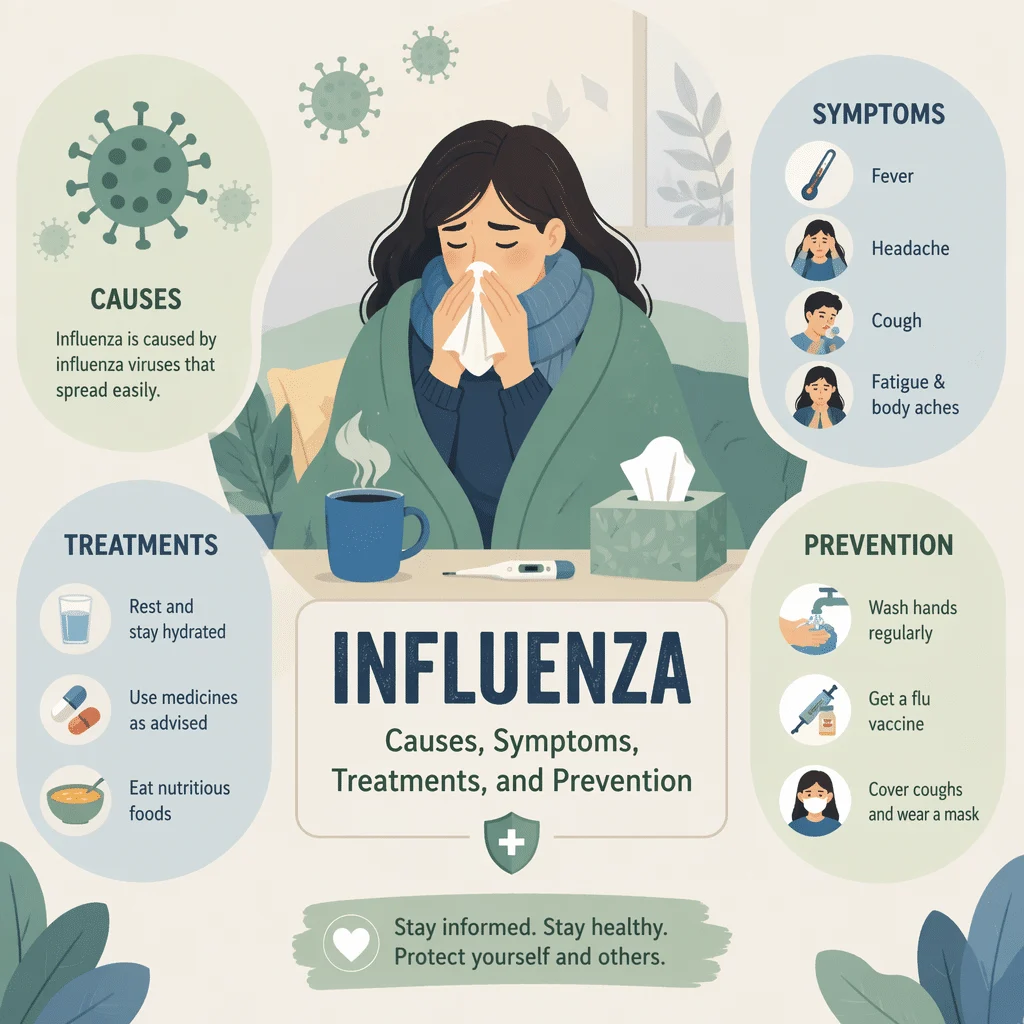
Influenza, commonly called the flu, is a contagious respiratory infection caused by influenza viruses that circulate every year, mostly in autumn and winter. For most healthy people it brings a week or so of fever, aches, and deep fatigue, but for young children, older adults, pregnant people, and anyone with a chronic illness it can turn serious. Knowing how the flu spreads, how to tell it apart from a common cold or COVID-19, and when symptoms need medical attention helps you act early and recover safely. In this article you will learn what causes influenza, its main symptoms, how it is diagnosed and treated, the newest research on antivirals and vaccines, and the everyday habits that lower your risk during flu season.
What is influenza, and what are types A and B?
Influenza is an infection of the nose, throat, and sometimes the lungs. It is caused by influenza viruses, which are different from the many viruses that cause the common cold and from the coronavirus that causes COVID-19. Four types of influenza virus exist, labelled A, B, C, and D, but only two drive the seasonal epidemics you hear about each winter.
Influenza A
Influenza A viruses infect people and several animal species. They are divided into subtypes based on two surface proteins, hemagglutinin (H) and neuraminidase (N), which is why you see names such as H1N1 and H3N2. Type A viruses change quickly and are the main cause of large seasonal outbreaks and, rarely, pandemics.
Influenza B
Influenza B viruses circulate almost only in humans and change more slowly than type A. They still cause substantial illness, especially in children, and they often appear later in the season. Types C and D matter far less for public health: type C usually causes mild illness, and type D mainly affects cattle.
Why the flu comes back every year
Influenza viruses constantly make small changes to their surface proteins, a process called antigenic drift. Because the viruses look slightly different each season, the protection you built last year fades, and the vaccine is updated to match the strains expected to circulate. This is the core reason a yearly flu jab is recommended rather than a one-time dose.
How influenza spreads
The flu spreads mainly through respiratory droplets released when an infected person coughs, sneezes, or talks. You can breathe these droplets in, or you can pick up the virus by touching a contaminated surface and then your mouth, nose, or eyes. Crowded indoor spaces with poor ventilation raise the risk, which is why cases climb in winter when people gather inside.
An important and often overlooked point is timing: people with influenza can pass the virus to others about one day before their own symptoms begin and for roughly five to seven days after falling ill. Young children and people with weakened immune systems may remain contagious even longer. This early, symptom-free window is a major reason the flu spreads so efficiently.
Some groups face a higher chance of complications: adults aged 65 and older, children younger than five, pregnant people, residents of long-term care facilities, and anyone with heart disease, lung disease such as asthma, diabetes, obesity, or a weakened immune system. For these groups, early recognition and prompt care matter most.
Symptoms of influenza
Influenza tends to arrive suddenly, often within a few hours. Typical symptoms include a fever above 38°C (100.4°F), chills, body and muscle aches, headache, a dry cough, sore throat, a runny or blocked nose, and marked tiredness. Children may also have vomiting and diarrhoea, which is uncommon in adults. Not everyone with the flu runs a fever, and some people feel exhausted long after other symptoms fade.
Most healthy adults start to improve within five to seven days, although a lingering cough and fatigue can persist for another week or two. To soothe a sore throat while you recover, many people use throat lozenges, and simple rest and fluids do much of the healing.
Flu vs. cold vs. COVID-19
Because these three infections share symptoms, telling them apart by feel alone is difficult. The comparison below highlights the patterns that usually distinguish them, but only testing can confirm the cause. The U.S. Centers for Disease Control and Prevention also publishes detailed signs and symptoms of flu for reference.
| Feature | Common cold | Influenza (flu) | COVID-19 |
|---|---|---|---|
| Onset | Gradual, over days | Sudden, within hours | Gradual or sudden |
| Fever | Rare or mild | Common, often high | Common |
| Body aches | Mild | Often intense | Common |
| Fatigue | Mild | Marked, can last weeks | Common, can be prolonged |
| Loss of taste or smell | Occasional, from congestion | Uncommon | More typical |
| Typical course | 7–10 days, mild | 5–7 days, can be severe | Variable, mild to severe |
How influenza is diagnosed and tested
During flu season, a clinician can often make a confident diagnosis from your symptoms and an examination, especially when the flu is widespread in the community. When confirmation changes the plan, such as for people at high risk, hospitalised patients, or during outbreaks in care facilities, a laboratory test identifies the virus. Testing also helps separate influenza from COVID-19 and respiratory syncytial virus (RSV), which need different management.
Types of flu tests
Not all flu tests work the same way. Some trade a little accuracy for speed, whilst others are highly precise but take longer. The table below summarises the main options a doctor might use.
| Test type | What it detects | Time to result | Accuracy and best use |
|---|---|---|---|
| Rapid antigen test (RIDT) | Viral proteins from flu A and B | About 10–15 minutes | Lower sensitivity; can miss cases, so a negative result may need confirming |
| Rapid molecular test (NAAT) | Viral genetic material | About 15–30 minutes | High accuracy at the point of care |
| RT-PCR (laboratory) | Viral RNA | Several hours to a day | Reference standard; used for hospitalised or high-risk patients |
| Multiplex respiratory panel | Flu, COVID-19, and RSV together | 30 minutes to a few hours | High accuracy; separates look-alike infections in one sample |
What blood tests can add
Blood work does not diagnose the flu itself, but it helps doctors judge how your body is responding and whether a complication is developing. In a severe case, a physician may order a complete blood count, which shows whether your white cells are reacting to infection. Viral illnesses like influenza often show high lymphocytes, whilst a new bacterial complication can push up high neutrophils. To gauge inflammation, clinicians frequently check a C-reactive protein level, and some laboratories also measure the erythrocyte sedimentation rate.
When it is important to tell a viral infection from a bacterial one, doctors sometimes order a procalcitonin test, a marker that tends to rise more with bacterial infections. The immune response leaves other footprints too: early in an infection the body first makes immunoglobulin M, and the immune system later produces immunoglobulin G, the antibody behind longer-lasting protection. These markers, read together with your symptoms, help your care team decide whether antibiotics are truly needed.
How influenza is treated
For most people, the flu is managed at home with supportive care: rest, plenty of fluids, and fever or pain relievers such as paracetamol or ibuprofen. Aspirin should not be given to children or teenagers with a viral illness because of the risk of Reye syndrome, a rare but serious condition. Antibiotics do not work against influenza because it is caused by a virus, not bacteria; they are reserved for a confirmed bacterial complication such as pneumonia.
Antiviral medicines
Prescription antiviral drugs can shorten the illness and lower the risk of complications, and they work best when started within about 48 hours of the first symptoms. Options include oseltamivir (Tamiflu), zanamivir, and peramivir, which belong to a class called neuraminidase inhibitors, and baloxavir marboxil (Xofluza), a single-dose pill that works differently. The CDC explains who benefits most from flu antiviral treatment, and doctors especially consider it for people at high risk of severe disease. Antivirals are not a substitute for vaccination, but they are a valuable tool when the flu strikes.
How to prevent influenza
The single most effective step is annual vaccination. The CDC recommends a yearly flu vaccine for almost everyone aged six months and older, ideally by the end of October, though getting vaccinated later still helps. The vaccine cannot give you the flu, and even when it does not fully prevent illness it tends to make a case milder and less likely to require hospital care.
For adults aged 65 and older, U.S. immunisation advisers preferentially recommend enhanced options, namely high-dose, adjuvanted, or recombinant vaccines, which are designed to prompt a stronger response in older immune systems. Everyday habits add another layer of protection: wash your hands often, cover coughs and sneezes, avoid touching your face, clean shared surfaces, improve indoor ventilation, and stay at home when you are ill to protect others.
Complications and when to see a doctor
Most people recover fully, but influenza can lead to complications, particularly in high-risk groups. The lungs are the biggest concern: a severe bout of flu can inflame the airways, cause breathing difficulties, and even bring on pneumonia-related back pain, sometimes from the virus itself and sometimes from a bacterial infection that follows. The flu can also worsen chronic conditions such as asthma, heart failure, or diabetes.
Other complications are usually milder. Influenza can trigger a sinus infection, and in children it can cause an ear infection. Rarely, the flu inflames the heart or brain. A returning fever, a cough that produces coloured phlegm, or symptoms that improve and then suddenly worsen can signal a secondary bacterial infection and deserve prompt medical review.
When to see a doctor: emergency warning signs
Seek emergency care right away if an adult has any of the following:
- Difficulty breathing or shortness of breath
- Persistent pain or pressure in the chest or abdomen
- Ongoing dizziness, confusion, or trouble staying awake
- Seizures
- Not urinating, or other signs of dehydration
- Severe muscle pain or weakness
- Fever or cough that improves and then returns or worsens
For children, also seek urgent care for fast or laboured breathing, bluish lips or face, ribs pulling in with each breath, no tears when crying, or a fever above 104°F (40°C) that is not controlled. Infants who cannot feed, have trouble breathing, or are unusually hard to wake need immediate attention.
Latest scientific advances in influenza
Flu care keeps improving. The findings below come from recent peer-reviewed studies indexed in PubMed; full references appear in the Sources section, and each result is written in plain language with a note on what it means for you.
Newer antivirals and how they compare
A large 2025 network meta-analysis in JAMA Internal Medicine pooled 73 trials and found that baloxavir, the single-dose pill, probably shortened the time to feeling better by about a day and, in high-risk patients, may have lowered the chance of hospital admission, without adding side effects. Older antivirals such as oseltamivir had a smaller effect on symptom length and did not clearly reduce hospital stays. What this means for you: starting an antiviral early still matters most, and for some patients a newer single-dose option may be a convenient, well-tolerated choice worth discussing with a doctor.
Treating one person to protect the household
Antiviral treatment may also help the people around a patient. In a 2024 analysis of the BLOCKSTONE household study, when the first sick person was treated with baloxavir, fewer household contacts caught the flu than when the patient took oseltamivir (about 11 per cent versus 18 per cent of contacts). What this means for you: promptly treating the first case at home, alongside good hygiene, may lower the odds that the rest of the family gets sick, though this remains an area of ongoing research.
Stronger vaccines for older adults
Standard flu jabs protect less well in older people, whose immune systems respond more weakly, so researchers have developed enhanced formulas. A 2025 systematic review in Reviews in Medical Virology reported that high-dose, adjuvanted, cell-based, and recombinant vaccines generally offered older adults somewhat better protection than standard vaccines, with reassuring safety. A separate 2025 trial published in Vaccine found that an adjuvanted cell-based vaccine produced a strong immune response in adults aged 50 and over. What this means for you: if you are 65 or older, ask which enhanced flu vaccine is available to you this season.
One swab, several answers
Flu, COVID-19, and RSV can feel almost identical, and telling them apart guides treatment. A 2024 laboratory evaluation in Clinical Laboratory showed that a combined rapid test detected influenza A, influenza B, and the virus that causes COVID-19 from a single nasal swab with high accuracy. What this means for you: a single quick test can increasingly sort out which infection you have, so the right care, including antivirals when appropriate, can begin sooner.
Glossary
| Term | Definition |
|---|---|
| Influenza (flu) | A contagious respiratory infection caused by influenza viruses, most common in autumn and winter. |
| Influenza A | The virus type that changes quickly and causes most large seasonal outbreaks; includes subtypes such as H1N1 and H3N2. |
| Influenza B | A virus type that circulates mainly in humans, changes more slowly, and often affects children. |
| Antigenic drift | The small, ongoing changes in flu virus surface proteins that make yearly vaccine updates necessary. |
| Neuraminidase inhibitor | A class of antiviral drugs, including oseltamivir, that blocks the enzyme flu viruses use to spread between cells. |
| Baloxavir marboxil | A single-dose antiviral that stops the flu virus from copying its genetic material. |
| RT-PCR | A highly accurate laboratory test that detects a virus by its genetic material. |
| Antigen test | A rapid test that looks for viral proteins; faster but less sensitive than molecular tests. |
| Secondary bacterial infection | A bacterial illness, such as some pneumonias, that can develop after the flu weakens the airways. |
Frequently asked questions
How long does the flu last?
Most healthy adults feel the worst symptoms for three to four days and largely recover within five to seven days. A dry cough and tiredness can linger for another one to two weeks. If you feel better and then suddenly get worse, or if a fever returns, contact a healthcare professional, as this can signal a complication.
Is the flu contagious, and for how long?
Yes. People with influenza can spread it starting about one day before symptoms appear and for roughly five to seven days after becoming ill. Young children and people with weakened immune systems may be contagious for longer. Staying at home whilst you have a fever, and for at least 24 hours after it resolves without medicine, helps protect others.
What is the difference between the flu and a cold?
A cold usually comes on gradually with a runny nose, sneezing, and mild symptoms, and rarely causes a high fever. The flu tends to start suddenly with fever, body aches, headache, and strong fatigue. Colds are milder and shorter, whilst the flu is more likely to keep you in bed and, in some people, lead to complications.
Can antibiotics treat the flu?
No. Antibiotics fight bacteria, and the flu is caused by a virus, so they will not help and may cause side effects or contribute to antibiotic resistance. A doctor may prescribe antibiotics only if a bacterial complication, such as certain pneumonias, sinus infections, or ear infections, develops alongside the flu.
Do I need a flu jab every year?
Yes. Flu viruses change from season to season, and the protection from a previous jab fades over time. A yearly vaccine, updated to match the strains expected to circulate, is recommended for almost everyone aged six months and older. It is the most reliable way to reduce your risk of getting the flu and of having a severe case.
How can you tell the flu from COVID-19?
You often cannot tell them apart by symptoms alone, because both can cause fever, cough, aches, and fatigue. Loss of taste or smell is more typical of COVID-19. Because they need different management, a test, including a combined panel that checks for both at once, is the reliable way to know which infection you have.
Sources
- Centers for Disease Control and Prevention (CDC) — Flu: Signs, Symptoms, and Antiviral Treatment, 2026 — cdc.gov/flu/treatment
- MedlinePlus, U.S. National Library of Medicine — Influenza (Flu), 2026 — medlineplus.gov/flu.html
- Mayo Clinic — Influenza (Flu): Symptoms and Causes, 2024 — mayoclinic.org
- Gao Y, et al. — Antiviral Medications for Treatment of Nonsevere Influenza: A Systematic Review and Network Meta-Analysis — JAMA Internal Medicine, 2025 — doi.org/10.1001/jamainternmed.2024.7193
- Ikematsu H, et al. — Baloxavir Marboxil and Oseltamivir in Reducing Household Transmission of Influenza (BLOCKSTONE analysis) — Influenza and Other Respiratory Viruses, 2024 — doi.org/10.1111/irv.13302
- Askar M, et al. — Relative Efficacy, Effectiveness and Safety of Newer and Enhanced Seasonal Influenza Vaccines — Reviews in Medical Virology, 2025 — doi.org/10.1002/rmv.70020
- Essink BJ, et al. — Immunogenicity and Safety of an Adjuvanted Quadrivalent Cell-Derived Influenza Vaccine in Adults Aged 50 and Older — Vaccine, 2025 — doi.org/10.1016/j.vaccine.2025.126791
- Kang T, et al. — Evaluation of a Multiplex Rapid Antigen Test for SARS-CoV-2 and Influenza A/B — Clinical Laboratory, 2024 — doi.org/10.7754/Clin.Lab.2023.231003
Further reading
- Low Absolute Neutrophils: Causes, Symptoms, and Treatment
- Immunoglobulin A (IgA): Understanding Your Blood Test
- Low Lymphocytes: Causes, Symptoms, and Risks
- Serum Amyloid A (SAA): Understanding This Inflammation Marker
- Cough Drops: Benefits, Uses, and Risks
Understand your lab results with AI DiagMe
When the flu turns severe, doctors often look beyond your symptoms to your blood work. A full blood count and a C-reactive protein level can show whether your body is fighting a secondary infection or heading towards a complication such as pneumonia. AI DiagMe helps you understand what those numbers mean in plain language, so you can have a better-informed conversation with your clinician. It is designed to help you understand your results, not to diagnose you, and it never replaces your doctor.
Get your results interpreted in minutes