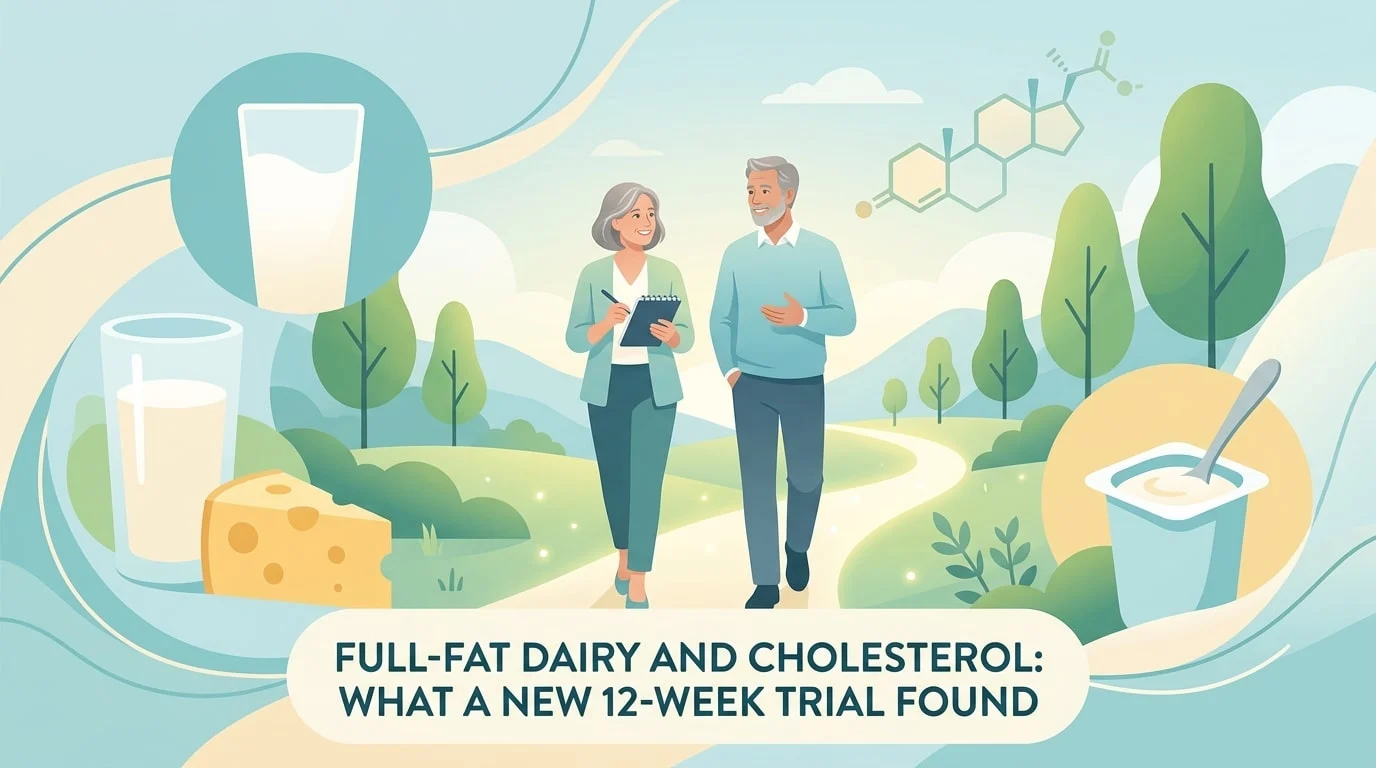
Full-fat dairy and cholesterol have been linked in dietary advice for four decades, so a Canadian trial reported on 9 August 2026 attracted attention: three daily servings of full-fat dairy for 12 weeks did not raise fasting blood lipids in adults with overweight or obesity. The study, led by University of Toronto professor Harvey Anderson and published in The Journal of Nutrition, followed 74 people and tracked weight, body composition, blood pressure and blood fats. In this article you will learn what the trial measured, which numbers changed on the lab report, which stayed flat, and how to read your own results in light of a single 12-week study.
What the trial actually tested
This was a 12-week, single-blinded, randomised study in 74 adults with an average age of about 37 and an average body mass index of 29. Participants were assigned to one of three diets:
- a low-dairy group on a 500-calorie daily restriction, limited to one serving of low-fat dairy or less;
- an energy-neutral group in which three servings of full-fat dairy replaced that 500-calorie restriction;
- an unrestricted group that added three daily servings of full-fat dairy with no calorie limit.
All participants were advised to follow Canada’s Food Guide, and the two dairy groups were supplied with the products. The trial was registered as NCT04399460. It was funded in part by Dairy Research Cluster 3 under the Canadian Agricultural Partnership and by the Mitacs Accelerate programme, which readers should bear in mind when interpreting a result favourable to dairy.
What changed in the blood work, and what did not
The central finding is a negative one, and negative findings matter: adding dairy fat did not push the lipid numbers in the wrong direction over three months. Our reference guide explains the standard lipid panel used to track these values.
| Measure | What the trial reported at 12 weeks |
|---|---|
| Fasting blood cholesterol | No change, whichever diet the participants followed |
| Triglycerides | Rose in all three groups at week 4, then returned to starting values by week 12 |
| Systolic blood pressure | Fell by roughly 3 mmHg in the unrestricted dairy group, and also fell in the low-dairy group |
| Body weight and BMI | Fell only in the calorie-restricted low-dairy group |
| Waist circumference, fat mass, fat-free mass | Unchanged in every group |
| Resting metabolic rate | Unchanged |
| Calcium and protein intake | Higher in both full-fat dairy groups |
Two details deserve emphasis. Weight loss came from the calorie restriction, not from the dairy. And the temporary triglyceride bump at week 4 is a reminder that a single measurement taken during a diet change can mislead. A separate guide details the triglycerides blood test and why the value swings so much.
Why dairy fat may not behave like saturated fat alone
Dairy is a leading source of saturated fat, and saturated fat raises LDL cholesterol in controlled feeding studies. Yet trials that feed whole dairy foods often fail to show that rise. Researchers call the proposed explanation the dairy matrix: the idea that the physical structure of a food changes how its nutrients are digested and absorbed. In milk and cheese, casein and whey proteins are bound together with fat globules and minerals, so the fat is not released in the same way as an equivalent dose of butter or beef tallow. Our reference article explains LDL cholesterol and its blood test, and a companion guide covers the HDL cholesterol test.
Latest scientific advances
The Toronto trial sits inside a wider body of recent work. Here is what the past three years have added, in plain terms.
Whole-milk foods and heart risk markers
A 2023 review in Advances in Nutrition gathered the biological reasons why whole-milk foods may not behave as their saturated fat content predicts, pointing to altered fat digestion, effects on gut bacteria, and changes in inflammation. What this means for you: the food you eat is not the same thing as the nutrient it contains, and guidelines built on single nutrients are being re-examined.
Cheese versus its separated parts
A 2025 analysis in Atherosclerosis pooled two randomised trials in 197 middle-aged adults. Participants ate either cheese or a deconstructed version delivering the same fat as butter plus separate protein and calcium. Cheese lowered total and LDL cholesterol compared with the deconstructed version, and the effect looked stronger in women. What this means for you: the form of the dairy food may matter as much as the amount of fat, though this is one pooled analysis and not a reason to change medication or diet on its own.
Full-fat versus non-fat yogurt
A small crossover trial in adults with prediabetes compared three daily servings of full-fat yogurt with non-fat yogurt for three weeks each. Fasting triglycerides came out roughly a tenth lower on the full-fat yogurt, and the triglyceride-to-HDL ratio was lower too. This was an exploratory analysis in 13 people, so it is a signal, not a conclusion. What this means for you: results like this are worth watching, not acting on. One article breaks down the cholesterol ratio and how it is calculated.
The limits of these studies
A 2024 review in the Proceedings of the Nutrition Society argues that total LDL cholesterol may be too blunt a marker to capture what dairy fat does, and points towards particle-level measures. Our dedicated guide presents the advanced lipid panel with ApoB for readers who want that level of detail.
What this means for your next lipid panel
None of this changes how a lipid panel is performed or interpreted. A few practical points hold regardless of what you eat:
- Most laboratories still ask for a 9 to 12 hour fast before the test. Our practical guide covers fasting before a blood test.
- Cholesterol is reported in millimoles per litre in the United Kingdom, and the target that applies to you depends on your age, sex and overall cardiovascular risk rather than a single universal cut-off. We list normal LDL levels as a starting reference.
- A trial average is not a personal prediction. Some people are strong responders to dietary saturated fat and some are not.
- Use the same laboratory over time where possible, since methods vary slightly between sites.
- If a diet change is under way, wait at least eight to twelve weeks before retesting, as the week-4 triglyceride rise in this trial illustrates.
Our overview covers high cholesterol, and a further article explains the total cholesterol test. Because dairy also contributes calcium and vitamin D, some readers consult the vitamin D 25-OH blood test alongside their lipids, and those tracking metabolic health may also review the HOMA-IR insulin resistance score.
When to talk to a doctor
Speak with a healthcare professional if your LDL cholesterol is above your personal target, if you have a family history of early heart disease, if you have diabetes, chronic kidney disease or high blood pressure, or if you are already taking a lipid-lowering medicine and are considering a diet change. Do not adjust or stop a prescribed treatment on the basis of a nutrition study.
Glossary
| Term | Definition |
|---|---|
| Lipid panel | A blood test measuring total cholesterol, LDL, HDL and triglycerides, usually after fasting. |
| LDL cholesterol | Low-density lipoprotein, the fraction that deposits cholesterol in artery walls. Often called bad cholesterol. |
| HDL cholesterol | High-density lipoprotein, which carries cholesterol back to the liver. Often called good cholesterol. |
| Triglycerides | The main storage form of fat in the blood. Levels react quickly to recent meals, alcohol and weight change. |
| Saturated fat | A type of dietary fat found in butter, cheese, meat and some plant oils. |
| Dairy matrix | The physical structure of a dairy food, in which fat, protein and minerals are packaged together and digested as a whole. |
| Randomised trial | A study in which participants are allocated to groups by chance, which limits bias. |
| Systolic blood pressure | The higher of the two blood pressure numbers, measured when the heart contracts. |
| Insulin resistance | A state in which cells respond poorly to insulin, so more of it is needed to keep blood sugar stable. |
Frequently asked questions
Does whole milk raise cholesterol?
In this 12-week trial, three daily servings of full-fat dairy did not raise fasting blood cholesterol compared with a low-dairy diet. That said, the study included 74 adults over three months and cannot rule out effects in other groups or over longer periods. Whole milk does contain saturated fat, and national guidelines in the United Kingdom still recommend low-fat and fat-free options for most adults.
Is skimmed milk better than whole milk for cholesterol?
Skimmed milk contains less saturated fat, which is why guidelines have favoured it. Recent trials comparing whole and reduced-fat dairy have often found smaller differences in blood lipids than expected. The gap between the two may matter less than overall diet quality, total calories and the rest of your cardiovascular risk profile.
How long after changing my diet should I retest my cholesterol?
Most clinicians wait at least eight to twelve weeks. Lipids need time to settle after a change in eating pattern, and this trial showed triglycerides rising at week 4 before returning to baseline at week 12. Testing too early can produce a value that does not reflect the new steady state.
Does cheese affect cholesterol differently from butter?
Some randomised evidence suggests it does. A pooled analysis of two trials found that cheese lowered total and LDL cholesterol compared with a deconstructed version supplying the same fat as butter. The proposed reason is the dairy matrix, meaning the way fat, protein and calcium are packaged together. The finding is promising but not yet settled.
Should I stop my statin because of this study?
No. This was a nutrition trial in people without a stated lipid-lowering indication, and it measured what happens over 12 weeks. Prescribed lipid-lowering treatment is based on your overall cardiovascular risk. Any change should be discussed with the prescribing clinician.
Does full-fat dairy affect blood pressure?
Systolic blood pressure fell by roughly 3 mmHg in the group adding full-fat dairy without calorie restriction, but it also fell in the calorie-restricted low-dairy group. With two groups improving for different reasons, this trial cannot attribute the change to dairy alone.
Sources
- Anderson GH, Chen Zhou CZ, Vien S, et al. The Effect of Three Daily Servings of Full-Fat Dairy for 12 Weeks on Body Weight, Body Composition, Energy Metabolism, Blood Lipids, and Dietary Intake of Adults with Overweight and Obesity. The Journal of Nutrition, 2026. https://doi.org/10.1016/j.tjnut.2026.101373
- Taormina VM, Eisenhardt S, Gilbert MP, et al. Full-fat yogurt compared with non-fat yogurt reduces blood triacylglycerol concentrations in adults with prediabetes. Lipids in Health and Disease, 2025. https://doi.org/10.1186/s12944-025-02616-4
- Torres-Gonzalez M, et al. Whole-Milk Dairy Foods: Biological Mechanisms Underlying Beneficial Effects on Risk Markers for Cardiometabolic Health. Advances in Nutrition, 2023.
- Rooney M, et al. The impact of sex and the cheese matrix on cholesterol metabolism in middle-aged adults. Atherosclerosis, 2025.
- Dunne S, et al. The effects of saturated fat intake from dairy on CVD markers: the role of food matrices. Proceedings of the Nutrition Society, 2024.
- National Heart, Lung, and Blood Institute. Blood Cholesterol. National Institutes of Health. https://www.nhlbi.nih.gov/health/blood-cholesterol
- MedlinePlus. Cholesterol Levels: What You Need to Know. National Library of Medicine. https://medlineplus.gov/cholesterollevelswhatyouneedtoknow.html
- Harvard T.H. Chan School of Public Health. Dairy. The Nutrition Source. https://nutritionsource.hsph.harvard.edu/dairy/
Further reading
- LDL particle number explained
- ApoB blood test and heart disease risk
- Lipoprotein(a) as a cardiovascular risk marker
- Normal triglyceride levels and ranges
- Insulin resistance without obesity
Understand your lab results with AI DiagMe
A lipid panel is easier to act on when you understand what each line means. AI DiagMe turns your total cholesterol, LDL, HDL and triglyceride values into plain language, and puts them in context alongside related markers such as fasting glucose or vitamin D. It helps you understand your results and prepare better questions for your appointment. It does not make a diagnosis and does not replace your doctor.
Get your results interpreted in minutes