
































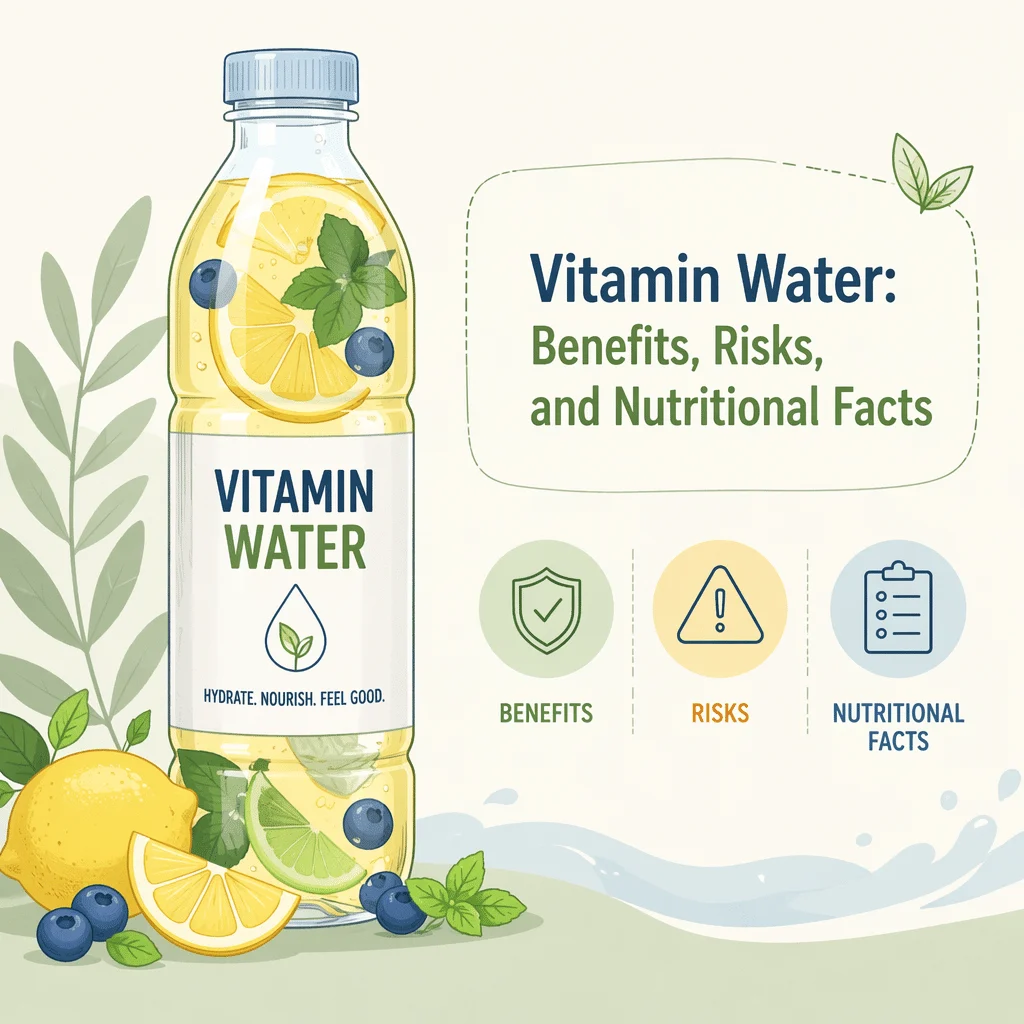
Vitamin water sits in almost every cooler and vending machine, promising a splash of nutrients with your hydration. It is water flavored and marketed with added vitamins, minerals, and often sweeteners, positioned as a healthier step up from soda. But is vitamin water good for you, or is it mostly clever packaging around sugar water? This guide walks through what vitamin water actually contains, how much sugar and how many calories a typical bottle adds, which health claims hold up, where the real risks lie, and how it compares with plain water. The goal is simple: give you the facts so you can decide whether it earns a place in your day, or whether a glass of water does the same job for free.
What is vitamin water?
Vitamin water is a broad label for bottled beverages that combine water with added micronutrients and flavor. Most brands start with purified water, then add a mix of water-soluble vitamins such as vitamin C and several B vitamins, small amounts of minerals or electrolytes, natural or artificial flavors, coloring, and a sweetener. The exact recipe varies widely from one product and flavor to the next, which is why two bottles that look almost identical can have very different nutrition labels.
The category grew out of the idea that people who dislike plain water might drink more fluid if the water tasted good and carried a wellness message. That message is powerful marketing, but it is worth remembering that this is a manufactured drink, not a medicine or a substitute for food.
Regular versus zero-sugar vitamin water
Broadly, you will find two families. The regular version is sweetened with sugar and carries real calories. The zero-sugar or “zero” version swaps that out for low- or no-calorie sweeteners such as stevia, erythritol, or sucralose, so it has few or no calories. Both usually carry a similar cast of added vitamins. The difference that matters most for your health is what makes the drink taste sweet, so reading the label is the only reliable way to know which one you are holding.
What is really inside vitamin water
To judge the drink fairly, separate it into its parts: the vitamins and minerals it advertises, and the sugar and calories it may quietly add. The advertised nutrients are the reason people reach for it; the sugar is the reason nutrition experts urge caution.
The vitamins and minerals
The added nutrients in vitamin water are usually water-soluble vitamins, most often vitamin C and B-group vitamins such as B3, B5, B6, and B12. Some products also list small amounts of minerals like potassium, magnesium, or zinc. A single bottle can supply a meaningful share of the daily target for a few of these, especially vitamin C. That sounds impressive, but here is the catch: if you already eat a reasonably varied diet, you are probably meeting these needs. Water-soluble vitamins are not stored in large amounts, so any surplus your body does not need is filtered out by the kidneys and passed in urine rather than banked for later. In practice, the extra vitamins in a well-nourished person often end up as expensive urine.
The sugar and the calories
The nutrient that deserves the closest look is added sugar. A regular 20-ounce bottle of vitamin water commonly contains around 120 calories and roughly 27 to 32 grams of added sugar. For context, United States dietary guidance suggests capping added sugar at about 50 grams a day on a 2,000-calorie diet, so one bottle can use up well over half of that allowance before you have eaten anything. Public-health experts at Harvard’s Nutrition Source review the health effects of sugary drinks and place beverages like this firmly in the sugar-sweetened category, alongside soda and sweetened iced tea. The added vitamins do not change that classification. If you want a quick reality check on any drink, the CDC runs a public campaign called Rethink Your Drink that shows just how many teaspoons of sugar hide in common beverages.
The benefits of vitamin water
Vitamin water is not all marketing. It offers a few genuine, if modest, benefits, and being honest about them makes it easier to see where the drink fits and where it does not.
It can help some people drink more fluid
The clearest benefit is behavioral. If you find plain water boring and routinely fall short on fluids, a flavored option you enjoy can nudge you to drink more. Adequate hydration supports everything from concentration to kidney function, and for people who struggle to reach for water, a pleasant-tasting alternative beats staying under-hydrated. Many people track hydration by watching the color of their urine, which sits in a pale straw range when fluid intake is on target.
A small micronutrient top-up
For someone whose diet is genuinely thin on certain nutrients, the added vitamins can provide a small top-up. This is a real, if limited, upside. It matters most when a person has a shortfall to begin with, which is not the typical situation for people eating a mixed diet. It is also worth knowing the real benefits and limits of vitamin C in the diet before assuming a fortified drink is doing something a piece of fruit could not do more cheaply.
Vitamin water versus plain water and sports drinks
Seeing vitamin water beside its closest shelf-mates makes the trade-offs obvious. The table below compares a typical regular bottle with plain water and a standard sports drink, using rounded figures for a large single-serving size. Exact numbers vary by brand and flavor, so always check the label.
| Feature (per ~20 oz bottle) | Plain water | Regular vitamin water | Sports drink |
|---|---|---|---|
| Calories | 0 | About 120 | About 120 to 150 |
| Added sugar | None | About 27 to 32 g | About 30 to 34 g |
| Sodium and potassium | Negligible | Usually small | Higher, added on purpose |
| Added vitamins | None | Yes, mainly B and C | Sometimes |
| Designed for | Everyday hydration | Flavored everyday sipping | Hard, sweaty exercise |
| Sensible everyday choice | Yes | Occasional | Only around intense activity |
The pattern is clear. Plain water covers ordinary hydration with zero sugar and zero cost beyond the tap. Sports drinks carry meaningful sodium and potassium because they are built to replace what heavy sweating removes, which most desk-bound days never require. Regular vitamin water lands in an awkward middle: it delivers sugar much like a sports drink but without the electrolyte purpose, and it adds vitamins most people do not need. That is why it works best as an occasional treat rather than a daily habit.
The risks and downsides of vitamin water
The concerns are real but not cause for alarm. They come down to added sugar over time, the possibility of overdoing certain nutrients, the uncertainty around sweeteners, and simple cost.
Added sugar and long-term metabolic health
The main issue with a regular bottle is that it is a sugar-sweetened beverage, and drinking these often is linked to weight gain and a higher long-term risk of conditions like type 2 diabetes and heart disease. A drink slips down easily and does not fill you up the way food does, so the calories tend to add on top of everything else. If sweetened drinks are a daily fixture, it can be worth asking your clinician about a simple fasting blood glucose test, and over the longer run about an HbA1c test that reflects average blood sugar. Researchers have spent years studying the risk factors for type 2 diabetes, and sugary drinks appear on nearly every list.
Too much of a good thing
Because these drinks go down easily, someone could combine several bottles with a multivitamin and other fortified foods and unknowingly pile up certain nutrients. For water-soluble vitamins the surplus is usually flushed out, but fat-soluble vitamins behave differently: the body stores them, so a large and sustained excess can build up. Most vitamin waters lean on B and C rather than fat-soluble vitamins, which limits this risk, but it is a reason not to treat any fortified drink as unlimited. If you are curious where you stand, a test can measure your vitamin A level, one of the fat-soluble vitamins the body holds onto.
The sweetener question and the cost
Zero-sugar versions avoid the sugar problem but rely on low- and no-calorie sweeteners, and the long-term picture for heavy, daily use of these is still being studied. They are widely considered a reasonable short-term swap for cutting sugar, not a health drink in their own right. Finally, there is the plain matter of money: vitamin water can cost a couple of dollars a bottle, while tap water is essentially free. For nutrients you may not need, that adds up quickly over a week.
Who should drink vitamin water, and who can skip it
Rather than labeling vitamin water simply good or bad, it helps to match it to circumstances. The added sugar and cost matter more for some people than others.
Who might reasonably benefit
- People transitioning away from daily soda who need a lower-sugar or zero-sugar stepping stone.
- Those recovering from a short illness with poor appetite, where any fluid and a few nutrients help in the moment.
- People who genuinely dislike plain water and drink too little without a flavored option.
- Anyone told by a clinician to increase a specific nutrient, provided the drink actually supplies it.
Who is better off skipping it
- People managing blood sugar, weight, or heart risk, for whom a regular bottle is a large sugar hit.
- Young children, who do not need sweetened fortified drinks and form taste habits early.
- Anyone already taking a multivitamin, where the extra nutrients mostly duplicate what they have.
- People simply looking to stay hydrated, since plain water does that job at no cost.
If you are unsure whether you are actually short on any nutrients, that is a question for testing rather than guesswork. Your clinician may order a vitamin and nutritional panel to check common ones such as vitamin D, B12, and folate, and you can review the main food sources of vitamin B12 to see how easily diet can cover them.
How to choose vitamin water wisely
If you do want to keep vitamin water in rotation, a little label-reading turns it from a mystery into an informed choice. A few habits make all the difference.
Read the label, not the front
The claims on the front are marketing; the truth is on the back. Check the added sugar line first, then the serving size, because many bottles hold more than one serving and the eye-catching numbers may be per serving rather than per bottle. You can consult the FDA’s guidance on added sugars on the Nutrition Facts label to see exactly how those grams are reported. As a rule of thumb, the fewer grams of added sugar, the better.
Favor zero-sugar for flavor, water for hydration
If the appeal is taste, a zero-sugar option spares you the sugar load; if the appeal is hydration, plain water wins outright. You can also flavor your own water at home with a squeeze of citrus, a few berries, or slices of cucumber, which gives you flavor without added sugar or cost. When electrolytes genuinely matter, such as during long or intense exercise, a purpose-made drink or even food plus water usually beats a lightly mineralized vitamin drink.
Mind the electrolytes if you have a health condition
Some products add potassium or sodium. For most people that is trivial, but if you have kidney disease or take medicines that affect these minerals, even small amounts can matter. In that situation your care team may want to watch your levels with a standard electrolyte panel; the same test also reports your potassium level and your sodium level. It is also useful to understand the effects of dehydration on blood pressure and fluid balance, since hydration and these minerals work together.
Latest scientific advances
Research on vitamin water by that exact name is thin, so the most useful evidence comes from the wider science on sugary drinks, sweeteners, and vitamin supplements. Here is what recent high-quality reviews suggest, in plain terms, and what each finding means for your everyday choices.
Added sugar in drinks adds up
A large 2023 review in the BMJ pooled dozens of earlier studies on dietary sugar. This kind of study is called an umbrella review, meaning it gathers many existing reviews into one big-picture summary. It found that diets high in added sugar, and sugar-sweetened drinks in particular, tend to track with more weight gain and higher heart-disease risk, and its authors suggested keeping added sugar to roughly six teaspoons a day. What this means for you: a single regular vitamin water can carry close to that whole daily amount, so it counts as a treat, not a background drink.
“Zero sugar” is not automatically a free pass
A 2026 consensus review from the Korean Diabetes Association and Korean Nutrition Society looked at long-term studies, known as cohort studies, which follow large groups of people over many years. It reported that both sugary drinks and artificially sweetened ones were linked with higher long-term risk of type 2 diabetes and heart problems, and while switching from sugary to diet versions helped modestly with weight in the short term, plain water and unsweetened drinks were the recommended goal. What this means for you: choosing a zero-sugar vitamin water over a regular one is a reasonable trade, but it is not the same as choosing water.
Sugar-free drinks behave differently in the short term
A 2023 network meta-analysis in the journal Nutrients compared drinks head to head in short experiments. It found that beverages sweetened with no-calorie sweeteners behaved much like water for blood sugar and insulin right after drinking, whereas sugar-sweetened drinks pushed both upward. What this means for you: if you do reach for a flavored water, a genuine zero-sugar option will not spike your blood sugar the way a full-sugar bottle can, though this speaks only to the moments after drinking, not to long-term health.
Added vitamins help most when you are actually short
A 2024 review of vitamin D trials, one of the better-studied added nutrients, offers a useful principle. Supplementation, meaning nutrients taken in addition to food, mainly helped people who were genuinely low to begin with, and very high doses did not help more and could even backfire. What this means for you: the added vitamins in a fortified drink do the most for someone with a real shortfall; for a well-nourished person, more vitamins are not automatically better, and food remains the most reliable source.
Across all of this, the through-line is steady and unsurprising: plain water is the benchmark, sugar is the thing to watch, and added vitamins are a bonus mainly when your diet leaves a genuine gap.
Glossary
| Term | Definition |
|---|---|
| Added sugar | Sugar put into a food or drink during processing, as opposed to sugar that occurs naturally in fruit or milk. |
| Sugar-sweetened beverage | Any drink with added caloric sugar, including soda, sweetened tea, sports drinks, and most regular vitamin water. |
| Water-soluble vitamins | Vitamins such as C and the B group that dissolve in water; the body stores little, so excess is passed in urine. |
| Fat-soluble vitamins | Vitamins A, D, E, and K, which the body stores in fat and can accumulate if taken in large amounts over time. |
| Electrolytes | Minerals like sodium, potassium, and magnesium that carry an electric charge and help control fluid balance and nerve and muscle function. |
| Low- and no-calorie sweeteners | Ingredients such as stevia, erythritol, or sucralose used to sweeten a drink with few or no calories. |
| Cardiometabolic health | An umbrella term for the health of the heart, blood vessels, and the body’s handling of blood sugar and fats. |
| Fortified | Describes a food or drink with vitamins or minerals added that were not naturally present in meaningful amounts. |
Frequently asked questions
Is vitamin water good for you?
It depends on which version and how often. A regular bottle is essentially a lightly fortified sugar-sweetened drink, so it is best kept occasional. A zero-sugar version avoids the sugar but is still a flavored beverage rather than a health tonic. For everyday hydration, plain water remains the better choice for almost everyone, and it costs nothing.
Does vitamin water have sugar?
Regular vitamin water usually does, often around 27 to 32 grams in a 20-ounce bottle, which is a large share of the suggested daily limit for added sugar. Zero-sugar versions replace that with low- or no-calorie sweeteners and contain little or no sugar. The only way to be sure is to read the nutrition label on the specific bottle.
Can vitamin water replace a multivitamin?
Not reliably. The amount and range of nutrients in vitamin water vary by product and are usually narrower than a multivitamin, and the drink often comes with added sugar a supplement does not. If you have been advised to correct a specific deficiency, a targeted supplement or dietary change guided by testing is a more dependable route than a beverage.
Does vitamin water hydrate you better than water?
For ordinary daily needs, no. Plain water hydrates just as well without sugar or cost. The main advantage of a flavored option is that some people simply drink more of it, so the practical benefit is behavioral rather than a special hydrating power in the drink itself.
Is zero-sugar vitamin water healthy?
It is a reasonable way to cut sugar if you are moving away from soda, and short-term studies show it does not spike blood sugar the way sugary drinks do. That said, it is still a sweetened beverage, and long-term daily use of low-calorie sweeteners is an area researchers are still studying. Treat it as a helpful swap, not a daily requirement.
Can children drink vitamin water?
It is not recommended as a routine drink for children. Regular versions add sugar young children do not need, and sweetened drinks can shape a preference for sweetness early in life. For most kids, water and milk cover hydration and nutrition, with any specific nutrient needs best discussed with a pediatrician.
Sources
- Harvard T.H. Chan School of Public Health, The Nutrition Source — Sugary Drinks — nutritionsource.hsph.harvard.edu
- National Institutes of Health, Office of Dietary Supplements — Multivitamin/mineral Supplements (Consumer Fact Sheet) — ods.od.nih.gov
- U.S. Food and Drug Administration — Added Sugars on the Nutrition Facts Label — fda.gov
- Centers for Disease Control and Prevention — Rethink Your Drink — cdc.gov
- Huang Y, et al. — Dietary sugar consumption and health: umbrella review — BMJ, 2023 — doi.org/10.1136/bmj-2022-071609
- Choi JH, et al. — Health Effects of Sugar-Sweetened and Artificially Sweetened Beverages: Umbrella Review and Consensus Statement of the Korean Diabetes Association and the Korean Nutrition Society — Diabetes & Metabolism Journal, 2026 — doi.org/10.4093/dmj.2025.0848
- Zhang R, et al. — The Effect of Non-Nutritive Sweetened Beverages on Postprandial Glycemic and Endocrine Responses: A Systematic Review and Network Meta-Analysis — Nutrients, 2023 — doi.org/10.3390/nu15041050
- Tan L, et al. — Effect of vitamin D, calcium, or combined supplementation on fall prevention: a systematic review and updated network meta-analysis — BMC Geriatrics, 2024 — doi.org/10.1186/s12877-024-05009-x
Further reading
- Triglycerides: understanding your blood test
- Magnesium deficiency: symptoms, causes, treatments
- Vitamin D blood test (25-OH): how to read your results
- Comprehensive metabolic panel (CMP): how to read your results
- Vitamin and nutritional panel: vitamin D, B12 and folate
Understand your lab results with AI DiagMe
Curious whether that daily vitamin water is helping or just adding sugar? The clearest answers come from your own numbers. AI DiagMe helps you make sense of everyday lab results in plain language, from blood glucose and HbA1c to vitamin D, B12, and electrolytes like sodium and potassium. It is built to help you understand what your results mean and what to ask your doctor, not to diagnose you or replace professional care.
Get your results interpreted in minutes