




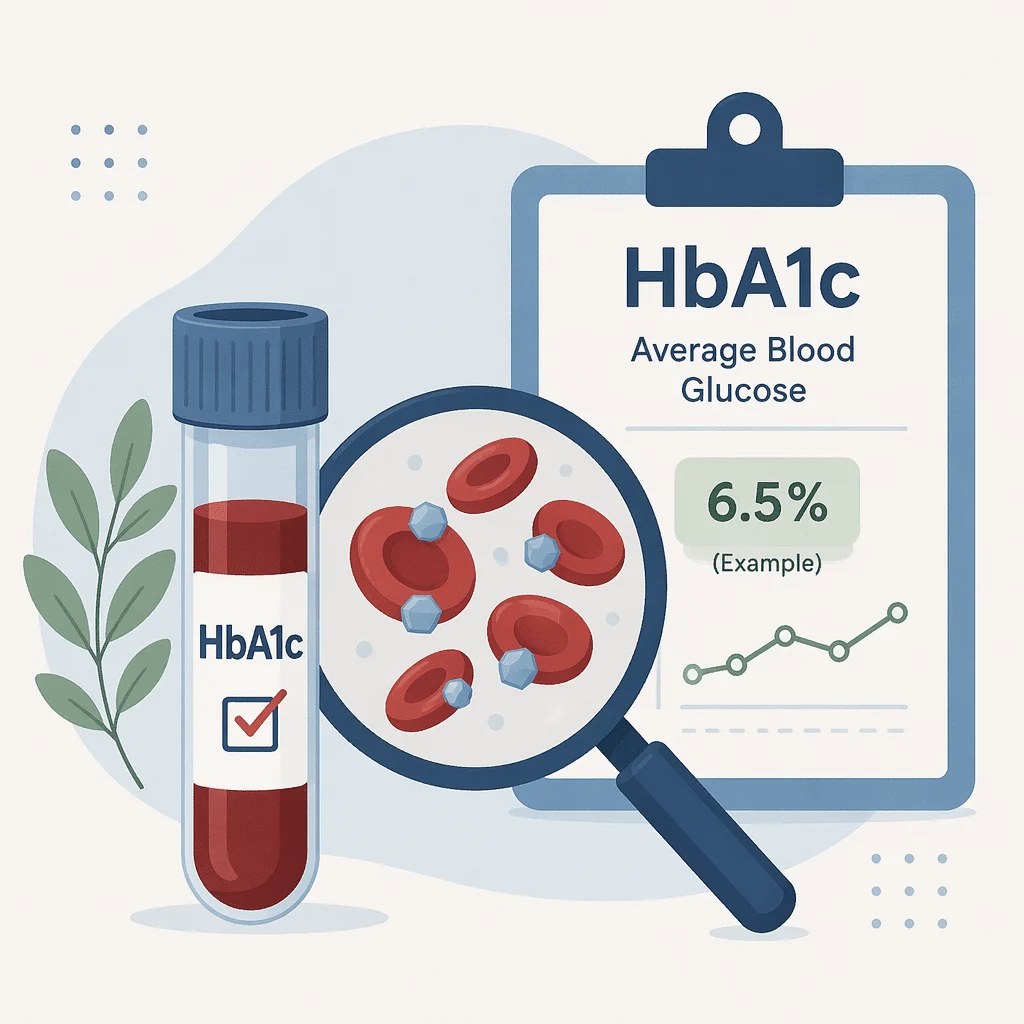
An HbA1c test measures the percentage of your hemoglobin that has glucose attached to it, giving doctors a picture of your average blood sugar over roughly the past two to three months. Unlike a fasting glucose check, which captures a single moment, this test reflects a longer trend and is used both to diagnose diabetes and prediabetes and to track how well an existing diagnosis is being managed. This guide explains how the test works, what the numbers mean, and why results can sometimes be misleading for people with certain blood or kidney conditions. It also covers how target levels are shifting toward a more personalized approach, particularly for older or frail patients.
What the HbA1c test actually measures
Red blood cells carry hemoglobin, a protein that binds oxygen for transport around the body. When glucose circulates in the bloodstream, some of it attaches to hemoglobin in a process called glycation. This attachment is not something the body actively controls; it happens gradually and remains for the life of the red blood cell, which is about three months. Because of this, the share of glycated hemoglobin builds up in proportion to how much glucose has been present in the blood.
A lab reports the result as a percentage. A value of 6.0%, for example, means 6% of the hemoglobin sampled has glucose bound to it. Some countries and labs also report the value in millimoles per mole (mmol/mol), a format more common outside the United States. Because red blood cells turn over continuously, the number is a rolling average rather than a snapshot, weighted more heavily toward the most recent 30 days than toward three months ago.
Why doctors order this test
Clinicians use the HbA1c test for two distinct purposes. The first is diagnosis: screening people who have risk factors for diabetes, such as excess weight, a sedentary lifestyle, or a family history of the condition. The second is monitoring: tracking glucose control in people already diagnosed, typically every three to six months, to see whether current treatment is working.
The test has practical advantages over daily glucose checks. It does not require fasting, so a sample can be drawn at any time of day. It also smooths out the natural swings in blood sugar caused by meals, stress, or illness, offering a steadier signal than a single glucose reading. This is why it has become a standard part of routine blood work and a key component of a diabetes blood test panel.
How to read your HbA1c result
The table below shows the ranges most US labs and professional bodies use to interpret HbA1c results. These are general reference points; your own doctor may apply a different target depending on your health history.
| HbA1c result | Category | Estimated average glucose |
|---|---|---|
| Below 5.7% | Normal | Roughly 90–115 mg/dL |
| 5.7% to 6.4% | Prediabetes | Roughly 117–137 mg/dL |
| 6.5% or above | Diabetes | 140 mg/dL or higher |
| 7.0% (common treatment goal) | Managed diabetes | Around 154 mg/dL |
A single result rarely tells the whole story. Trends across multiple tests, alongside fasting blood glucose levels and symptoms, give a more complete picture than any one number in isolation. If you are learning to interpret a lab report generally, our guide to how to read blood test results walks through the basics of reference ranges and flagged values.
When HbA1c results can be misleading
The HbA1c test relies on an assumption: that red blood cells live for a predictable amount of time and that glucose binds to hemoglobin at a steady, unremarkable rate. Several common conditions break that assumption, which is a detail often missing from general explanations of the test.
Anemia and blood loss
When red blood cells are destroyed faster than normal or replaced more quickly, as happens in some forms of anemia, there is less time for glucose to accumulate on hemoglobin. This can push an HbA1c result artificially low, understating a person’s true average glucose. Iron deficiency, by contrast, has sometimes been linked to falsely elevated readings. Recent blood transfusions have a similar distorting effect, since transfused cells carry a different glycation history than the patient’s own.
Hemoglobinopathies
Genetic conditions that alter the structure of hemoglobin, including sickle cell disease and thalassemia, can interfere with some laboratory methods used to measure HbA1c. Depending on the specific variant and the assay a lab uses, results may run falsely high or low. People who carry a hemoglobin variant but do not have symptoms of disease, such as sickle cell trait, are sometimes still affected by the testing method, so it is worth mentioning any known hemoglobin variant to the ordering clinician.
Chronic kidney disease
Advanced kidney disease shortens the lifespan of red blood cells and is frequently accompanied by anemia, both of which reduce the reliability of HbA1c. As kidney function declines, the gap between what HbA1c shows and what a person’s actual average glucose has been tends to widen, which is why clinicians managing diabetes alongside significant kidney function panel abnormalities often lean on additional monitoring tools rather than HbA1c alone.
Pregnancy
Pregnancy speeds up red blood cell turnover and shifts normal glucose physiology, both of which can lower HbA1c relative to true glycemic exposure, particularly in the second and third trimesters. For this reason, gestational diabetes is usually screened for and monitored using direct glucose tests rather than HbA1c alone.
Alternatives when HbA1c is unreliable
When a patient’s history includes one of the conditions above, doctors have other tools available. Continuous glucose monitoring tracks glucose directly and continuously, sidestepping the red-blood-cell assumptions that HbA1c depends on. Fructosamine, which reflects glycation of blood proteins other than hemoglobin, offers a shorter two-to-three-week window and is unaffected by red blood cell lifespan; you can read more in our guide to fructosamine results. Glycated albumin, a related alternative, is increasingly used in kidney disease research for similar reasons. None of these fully replaces HbA1c for general use, but each can fill the gap when HbA1c is known to be inaccurate for a specific patient.
Individualized targets: one number does not fit everyone
Clinical guidance has moved away from a single universal HbA1c goal. A target of around 7% remains common for many adults with diabetes, but professional societies now explicitly recommend looser targets for people who are older, frail, living with dementia, or facing a shorter life expectancy, where the risks of tight control, particularly low blood sugar episodes, can outweigh the benefits.
This shift reflects a simple clinical reality: intensive glucose lowering takes years to show benefit in reducing complications, while the risk of a dangerous hypoglycemic episode is immediate. For a frail 85-year-old, a fall triggered by low blood sugar can cause more harm in a single afternoon than years of a slightly elevated HbA1c. Younger, healthier patients with a longer life expectancy generally still benefit from tighter control aimed at preventing long-term complications.
Conditions linked to abnormal HbA1c
A persistently elevated HbA1c most often points toward impaired glucose regulation, but the underlying cause varies.
- Type 2 diabetes, involving insulin resistance combined with declining insulin production over time.
- Type 1 diabetes, an autoimmune condition destroying the insulin-producing cells of the pancreas, often with a faster onset.
- Gestational diabetes, triggered by pregnancy-related hormonal changes affecting insulin sensitivity.
- Metabolic syndrome, a cluster of risk factors including abdominal weight gain, high blood pressure, and abnormal cholesterol that often precedes a formal diabetes diagnosis.
- Medication effects, since long-term corticosteroid use in particular can raise blood glucose and HbA1c independent of underlying diabetes.
An unusually low HbA1c, below roughly 4%, is less common and can point toward the accuracy issues described above rather than unusually good glucose control, especially when it appears alongside anemia or another explanation for faster red blood cell turnover.
When to see a doctor
Most HbA1c results are best discussed at a routine follow-up, but certain situations call for more prompt attention.
- Your HbA1c has risen or fallen by more than half a percentage point since your last test without an obvious explanation.
- Your result sits at or above 6.5% and you have not yet been evaluated for a formal diabetes diagnosis.
- You have a high HbA1c alongside symptoms such as unexplained weight loss, excessive thirst, or persistent fatigue.
- You are pregnant or planning pregnancy and have a personal or family history of diabetes.
- You know or suspect you have a hemoglobin variant, significant anemia, or advanced kidney disease and want to understand whether your HbA1c result can be trusted at face value.
Latest scientific advances
Research on HbA1c accuracy and target-setting continues to evolve, and several recent studies clarify exactly where the test’s limitations matter most in practice.
According to PubMed, a 2026 UK study following nearly 180,000 adults aged 65 and older with type 2 diabetes found that death risk was lowest when HbA1c sat between roughly 6.5% and 7.4%, and rose at both lower and higher levels, with the pattern holding across every level of frailty (DOI). Hospital admission risk was highest among people with an HbA1c below 6.5%, and this effect was strongest in those with severe frailty, who were over four times more likely to be admitted than similar patients with higher readings. What this means for you: if you or a family member is older and frail, a “low” HbA1c is not automatically a good sign, and pushing levels down aggressively can carry more risk than benefit; a personalized target set with your doctor matters more than chasing a single number.
According to PubMed, a 2025 study from Diabetic Medicine tested whether switching to fructosamine or glycated albumin would improve accuracy for people with conditions known to affect HbA1c, including sickle cell trait, anemia, and kidney impairment (DOI). The researchers found that anemia meaningfully distorted the relationship between HbA1c and actual average glucose, causing an underestimation, but that sickle cell trait on its own did not significantly change the test’s accuracy. What this means for you: not every hemoglobin variant carries the same accuracy risk, so a specific diagnosis matters more than a general label, and anemia deserves particular attention when interpreting your result.
According to PubMed, a 2026 study of people with stage 5 chronic kidney disease on hemodialysis found that HbA1c did not reliably predict cardiovascular death risk in this group, while glycated albumin, a newer alternative marker, showed a much stronger and more consistent association with poor outcomes (DOI). What this means for you: if you are managing diabetes alongside advanced kidney disease, especially if you are on dialysis, ask your care team whether an alternative marker alongside or instead of HbA1c would give a more accurate read on your glucose control.
According to PubMed, a 2024 review in World Journal of Diabetes examined why HbA1c becomes less dependable as chronic kidney disease progresses, pointing to anemia and altered red blood cell survival as the main drivers, and highlighted continuous glucose monitoring as a way to see real-time glucose patterns that HbA1c can miss entirely in this population (DOI). What this means for you: the accuracy problem with HbA1c in kidney disease is not a minor technicality, it is well-documented enough that clinicians are actively building alternative monitoring approaches around it.
According to PubMed, a 2024 study of community-dwelling older adults in Singapore found that tight glycemic control, defined using established frailty-based guideline cutoffs, was still common in frail and pre-frail participants, despite current recommendations favoring looser targets in this group (DOI). What this means for you: even where guidelines call for a more relaxed target in frail or older patients, treatment in practice does not always catch up right away, so it is worth explicitly asking your doctor whether your current HbA1c goal reflects your overall health status, not just your diabetes.
Practical steps to manage your HbA1c
Whichever category your result falls into, small, sustained changes tend to move HbA1c more reliably than short bursts of effort. Regular physical activity, aiming for roughly 150 minutes of moderate exercise weekly, improves how effectively the body uses insulin. Reducing refined sugar and highly processed carbohydrates, while favoring vegetables, lean protein, and whole grains, supports steadier glucose levels throughout the day. Consistent sleep and stress management also play a measurable role, since poor sleep and chronically elevated stress hormones both interfere with insulin sensitivity.
Follow-up frequency should match your result and risk profile. People with a normal HbA1c and no major risk factors often only need retesting every two to three years, while those with prediabetes typically benefit from checks every six to twelve months, and people with diagnosed diabetes usually test every three to six months depending on how stable their control has been.
Glossary
| Term | Definition |
|---|---|
| Glycation | The chemical process by which glucose attaches to a protein, such as hemoglobin, without the help of enzymes. |
| Hemoglobinopathy | A genetic condition, such as sickle cell disease or thalassemia, that changes the structure of hemoglobin. |
| Estimated average glucose (eAG) | A calculated value that converts an HbA1c percentage into an approximate average blood sugar reading in mg/dL. |
| Fructosamine | A blood marker reflecting glucose bound to blood proteins other than hemoglobin, covering a shorter two-to-three-week window. |
| Glycated albumin | A marker measuring glucose attached to albumin, a blood protein, used as an alternative to HbA1c in some kidney disease settings. |
| Continuous glucose monitoring (CGM) | A wearable sensor system that tracks glucose levels throughout the day and night in real time. |
| Frailty | A clinical state of reduced physiological reserve, often assessed in older adults, that affects how treatment risks and benefits are weighed. |
| Hypoglycemia | A drop in blood sugar low enough to cause symptoms such as shakiness, confusion, or fainting. |
| Prediabetes | A state of blood sugar that is higher than normal but not yet high enough to meet the threshold for a diabetes diagnosis. |
Frequently asked questions about the HbA1c test
Do I need to fast before an HbA1c test?
No. Unlike a fasting glucose test, HbA1c reflects an average over months rather than a single point in time, so eating or drinking beforehand does not meaningfully change the result. This makes it a convenient test that can be drawn at any routine blood draw appointment without special preparation.
What does an HbA1c of 5.8% mean?
A result of 5.8% falls within the prediabetes range, which spans 5.7% to 6.4%. It suggests blood sugar is higher than typical but has not reached the threshold used to diagnose diabetes. Many people at this level can lower their risk of progressing to diabetes through changes in diet and activity, and a doctor may recommend retesting within six to twelve months.
How is HbA1c calculated from average blood sugar?
Labs measure the actual percentage of glycated hemoglobin directly from a blood sample rather than calculating it from glucose readings. However, once the HbA1c percentage is known, it can be converted into an estimated average glucose value using a standard formula, which is how the mg/dL figures on some lab reports are generated.
Can HbA1c and fasting glucose give different results?
Yes, and this is common. Fasting glucose reflects blood sugar at a single moment, while HbA1c reflects a two-to-three-month average, so the two can disagree, particularly if glucose has been fluctuating or if a condition affecting red blood cells is skewing the HbA1c. When results conflict, doctors often repeat testing or add a second type of test before making a diagnosis.
Is HbA1c reliable during pregnancy?
It is less reliable than usual. Pregnancy alters red blood cell turnover and glucose metabolism in ways that can lower HbA1c relative to a person’s true glucose exposure, particularly later in pregnancy. For this reason, gestational diabetes is typically screened for using direct glucose tolerance testing rather than HbA1c alone.
What should I do if my HbA1c and my doctor’s target do not match current general guidelines?
General guidelines are a starting point, not a fixed rule for everyone. Your doctor may set a different target based on your age, other health conditions, risk of low blood sugar, or life expectancy. If your target seems unusually loose or strict compared with what you have read, it is reasonable to ask your doctor to explain the reasoning specific to your situation.
Understanding what a single blood marker means is only the first step; seeing how it fits alongside your other results often makes the bigger picture clearer. AI DiagMe was built to help you make sense of a full lab report, not just one number in isolation, translating technical values into plain language you can discuss confidently with your doctor.
Understand your lab results with AI DiagMe
Get your results interpreted in minutes
Further reading
- Normal blood test ranges
- Complete blood count
- Comprehensive metabolic panel
- Blood tests during pregnancy
- Medical glossary of key blood markers
Sources
- CDC — A1C Test for Diabetes and Prediabetes — Centers for Disease Control and Prevention, 2024 — https://www.cdc.gov/diabetes/diabetes-testing/prediabetes-a1c-test.html
- MedlinePlus (National Library of Medicine) — Hemoglobin A1C (HbA1c) Test — U.S. National Institutes of Health, 2024 — https://medlineplus.gov/lab-tests/hemoglobin-a1c-hba1c-test/
- Harvard Health Publishing — Hemoglobin A1c (HbA1c): What to know if you have diabetes or prediabetes or are at risk for these conditions — Harvard Medical School, 2024 — https://www.health.harvard.edu/diseases-and-conditions/hemoglobin-a1c-hba1c-what-to-know-if-you-have-diabetes-or-prediabetes-or-are-at-risk-for-these-conditions
- Crabtree TSJ, Aldafas R, Qureshi N, Gordon J, Vinogradova Y, Idris I — The use of the electronic frailty index to optimise HbA1c targets in older individuals with type 2 diabetes — Age and Ageing, 2026 — https://doi.org/10.1093/ageing/afag149
- Niwaha AJ, Balungi PA, McDonald TJ, Hattersley AT, Shields BM, Nyirenda MJ, Jones AG — Glycated albumin and fructosamine do not improve accuracy of glycaemic control assessment in patients with conditions reported to affect HbA1c reliability — Diabetic Medicine, 2025 — https://doi.org/10.1111/dme.70011
- Bulatovic A, Dimkovic N, Jelic S, Jankovic A, Damjanovic T, Todorov-Sakic V, Bjedov J, Stopic B, Djuric P, Naumovic R — Glycated Albumin and Cardiovascular Mortality in CKD Stage V Patients with Diabetes Mellitus: A Five-Year Follow-Up Study — International Journal of Molecular Sciences, 2026 — https://doi.org/10.3390/ijms27052215
- Veeranki V, Prasad N — Utilising continuous glucose monitoring for glycemic control in diabetic kidney disease — World Journal of Diabetes, 2024 — https://doi.org/10.4239/wjd.v15.i10.2006
- Tan LF, Merchant RA — Prevalence of tight glycemic control based on frailty status and associated factors in community-dwelling older adults — Postgraduate Medical Journal, 2024 — https://doi.org/10.1093/postmj/qgae077