





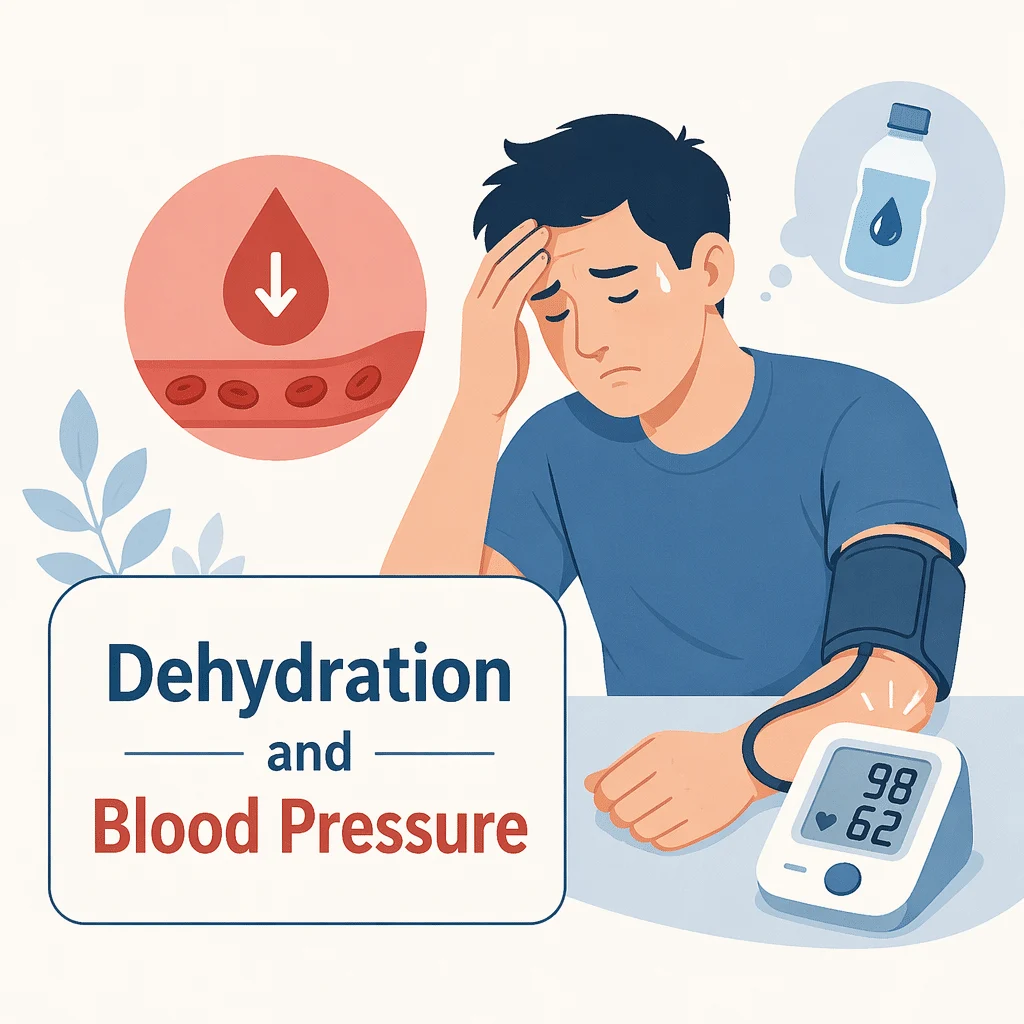
Most people believe that dehydration lowers blood pressure. That is half the story. Heavy fluid loss does push it down, but the link between dehydration and blood pressure runs in both directions: when losses are mild, the body defends its pressure so efficiently that a reading can come out normal, or even slightly higher than usual. A single number cannot tell you whether you are dry.
In this article you’ll learn what fluid loss does to your circulation, why heavy losses drop blood pressure while mild dehydration can nudge it upward, why dizziness on standing matters more than any single reading, who is genuinely at risk, what a sick-day plan is and why it belongs to your prescriber, how much fluid people really need, and when to seek help.
What dehydration does to your circulation
Dehydration means your body has lost more water and salts than it has taken in. What matters for blood pressure is what happens inside your blood vessels. Plasma, the liquid part of blood, shrinks first. Less liquid in the system means less blood returning to the heart between beats, so the heart has less to eject with each contraction.
Blood pressure is essentially how much blood the heart pumps out multiplied by how tightly the arteries are squeezed. Reduce the volume pumped and, all else being equal, pressure falls. But all else is rarely equal. Sensors in the neck arteries and the heart notice within seconds and trigger corrections: the heart speeds up, the sympathetic nervous system tightens small arteries, and the kidneys hold on to sodium and water with help from hormones including aldosterone. The pituitary releases vasopressin, or antidiuretic hormone, which concentrates the urine and constricts blood vessels. So dehydration does not simply subtract from blood pressure: it subtracts from volume, and the body adds back whatever pressure it can. What you measure is the net result of that tug of war.
Why dehydration can lower blood pressure, and why mild dehydration can raise it
When fluid loss pushes pressure down
Significant fluid loss wins the tug of war. Once enough volume has gone, compensation cannot keep up and blood pressure falls in a way you feel. That happens with repeated vomiting, a day or more of diarrhea, prolonged heat, extensive burns or bleeding. Clinicians call the underlying state volume depletion.
The classic pattern is lightheadedness, weakness, and a pulse that is fast but feels thin rather than strong. Skin may be cool and clammy as blood is diverted toward the brain and heart. If losses continue this progresses to shock, in which organs stop receiving enough blood flow, which is why severe dehydration is never a wait-and-see problem.
Why mild dehydration can nudge pressure upward
Now the part that surprises people. When fluid loss is modest, the compensations do not merely hold the line, they can overshoot it. Vasopressin release and increased sympathetic tone both narrow blood vessels, raising the resistance the heart pumps against. In someone who has lost only a little fluid, that can more than offset the small drop in volume.
The practical consequence is that a modestly dehydrated person may record a blood pressure that is normal, or a few points above their own usual figure, rather than below it. This is a short-lived response to a temporary situation. It is not a cause of sustained high blood pressure, and it is not why anyone develops hypertension, but it is enough to make the popular rule of thumb unreliable.
Why you cannot read hydration from a blood pressure number
Put the two halves together and the conclusion is uncomfortable but useful: a blood pressure reading is a poor hydration test, and hydration is a poor predictor of blood pressure. A normal reading does not rule out dehydration, because compensation may be masking it. A raised reading does not prove it. And a low reading has causes unrelated to fluid, including medicines, rhythm problems and recovery from an operation, as our article on low blood pressure after surgery describes. The table below is a map, not a diagnostic tool.
| Situation | What usually happens to blood pressure | What to do |
|---|---|---|
| Mild fluid loss in an otherwise healthy adult | Often unchanged, sometimes a little higher than usual, because hormones and nerves tighten the blood vessels | Drink in response to thirst and carry on; do not treat the reading as a hydration measurement |
| Vomiting or diarrhea lasting a day | Can fall, usually alongside a faster pulse; the fall is often clearest when standing up | Sip fluids steadily, watch the red flags below, and contact a clinician if fluids will not stay down |
| Dizziness on standing in an older adult | A measurable drop between lying and standing, known as orthostatic hypotension | Report it to a doctor, particularly after a fall; it needs proper assessment rather than self-diagnosis |
| Dehydration while taking a diuretic, ACE inhibitor, ARB or SGLT2 inhibitor | Can fall sharply, and kidney blood tests may worsen at the same time | Follow the sick-day plan your prescriber has given you; if you have never been given one, ask your prescriber or pharmacist |
| Very high fluid intake during endurance exercise | Pressure often changes little, but blood sodium can fall to dangerous levels | Drink in response to thirst rather than to a fixed schedule; treat confusion, headache or vomiting during a long event as urgent |
Orthostatic hypotension: where this actually shows up
If dehydration announces itself through blood pressure at all, it usually does so on standing. Orthostatic hypotension is a drop in pressure when you move from lying or sitting to standing. Gravity pulls blood into the legs the moment you stand, and the circulation has a fraction of a second to compensate. With less fluid in the system, that is harder.
The symptoms are recognizable: lightheadedness in the seconds after standing, graying or blurring of vision, unsteadiness, sometimes fainting. Symptoms that appear only when upright and settle on sitting or lying down are the characteristic pattern. Persistent spinning unrelated to posture points elsewhere, and our guide to vertigo covers those causes.
Clinicians measure it by taking blood pressure after several minutes lying or sitting quietly, then again after standing, usually at about one minute and at three. Comparing the two reveals the drop; a single seated reading hides it. This is a clinical assessment rather than a home test, because technique matters and someone should be present if the person feels faint.
The reason it matters is falls. In older adults, orthostatic hypotension is a recognized contributor to falls and the fractures that follow, and it is often the first practical clue that someone has become dry. A fall after standing up is a reason to see a doctor, not just a reason to take the stairs more carefully.
Who is most at risk
Older adults
Aging changes hydration in two ways that compound each other. Thirst becomes blunted, so the internal alarm rings later and more quietly. Meanwhile the kidneys concentrate urine less well, so more water is lost even while the body tries to conserve it. Total body water is lower to begin with, so any loss takes a larger share of the reserve.
Dehydration in older people therefore develops quietly, without dramatic thirst, and is a common reason for hospital admission. Confusion or drowsiness can be the presenting feature rather than a dry mouth, and relatives often notice first. The National Institute on Aging notes that diuretics and some heart and blood pressure medicines also make it harder to cool down in heat.
People taking medicines that affect fluid balance
Several widely prescribed drug groups raise the risk of volume depletion, or of a sharp fall in blood pressure and kidney function during an acute illness. Diuretics, often called water pills, increase urine output by design. ACE inhibitors and angiotensin receptor blockers, or ARBs, alter the hormone system the kidney uses to defend its own blood flow. SGLT2 inhibitors, used in diabetes and in heart and kidney disease, work partly by increasing water loss in urine. Anti-inflammatory painkillers such as ibuprofen and naproxen add to the risk. None of this makes these medicines dangerous; in normal circumstances they protect the heart and kidneys, which is why they are prescribed. The problem is combining them with an acute illness that dries a person out.
People with diabetes, kidney disease, dialysis or heart failure
For some people fluid balance is a careful clinical calculation, and general advice to drink more can be exactly wrong. In heart failure the difficulty is often too much fluid rather than too little, and many patients are given a deliberate limit. People on dialysis have fluid gains between sessions monitored closely, and in advanced kidney disease intake is individualized. Poorly controlled diabetes works the other way, since high glucose pulls water into the urine. If you are in any of these groups, your target is the one your own team has set.
Medicines, illness and sick-day plans
This part is genuinely useful and almost never explained to patients. Guidelines in several countries recommend that people on certain higher-risk medicines be given a sick-day plan: an agreement, made in advance with their prescriber, about what to do during a spell of vomiting, diarrhea or fever.
The logic is straightforward. When you are dry, blood flow through the kidneys falls. Healthy kidneys usually protect themselves, but some medicines interfere with the mechanisms they use. Continuing those drugs while the body is depleted can tip the kidneys into acute kidney injury. Some prescribers therefore arrange for particular medicines to be paused temporarily and restarted once eating and drinking return to normal.
That decision belongs to your prescriber. It depends on which drugs you take, your kidney function and the illness itself, and no web page can make it for you. Nothing in this article is an instruction to stop, pause or change any medicine, and you should not alter a prescription on your own.
What is worth doing is having the conversation before you are ill. The National Institute of Diabetes and Digestive and Kidney Diseases suggests asking your provider or pharmacist, in advance, questions along these lines: if I get sick, are there medicines I should not take while I am sick? If I need to pause something, when should I restart it? What can I take for pain or fever? If I have diarrhea or am vomiting, does that change how I take my blood pressure medicine? If nobody has ever given you a plan, that is a good reason to raise it at your next appointment or at the pharmacy counter.
If you are already unwell and unsure what to do, do not guess. Contact your prescriber, your pharmacist or your usual medical service and ask them directly.
How much fluid people actually need, and why more is not always better
The familiar eight-a-day rule has no good evidence behind it. No universal fixed intake suits everyone, and the figure seems to have entered folklore by repetition rather than research. Needs vary with body size, activity, climate, diet, pregnancy, fever and health conditions, and much of our water arrives in food rather than drinks.
For most healthy people two everyday guides are reasonable: thirst, a functioning signal in adults even if it becomes less reliable with age, and pale urine. The CDC suggests light yellow or clear urine usually means you are drinking enough. Neither is precise, and other things change urine color, but together they suffice.
The mirror-image myth deserves as much attention. Drinking far more than the body can excrete, especially quickly, dilutes the sodium in the blood. That is hyponatremia, and it can cause nausea, headache, confusion, seizures and, in severe cases, death. It is best known in endurance athletes, where heavy drinking during a long event combines with exercise-driven vasopressin release to trap water, but it also occurs in shorter events and team sports. More is not automatically safer.
Two cautions. Oral rehydration solutions are widely used after vomiting and diarrhea, but their proportions are calibrated and a homemade approximation with the wrong ratios can do harm, so use a prepared product or ask a pharmacist. And salt tablets are not a home remedy, as MedlinePlus notes, because they can cause serious complications.
What a doctor checks
Assessing hydration is a composite judgement, not a single test. A clinician starts at the bedside: blood pressure lying or sitting and then standing, pulse rate and character, skin elasticity, moisture of the mouth, capillary refill, and in a child the fontanelle and the presence of tears. Expect questions too about vomiting, diarrhea, fever, heat exposure, appetite and every medicine you take.
Blood tests fill in the picture. Sodium shows whether the loss was of water, of salt or of both, and identifies the dilution problem above. Potassium often shifts with vomiting, diarrhea and diuretic use. Urea and creatinine show how the kidneys are coping; in volume depletion urea rises out of proportion to creatinine, which is why the BUN to creatinine ratio is informative and why raised BUN and creatinine together prompt a closer look. Concentrated urine with a high specific gravity suggests the kidneys are conserving water hard, and blood glucose is usually checked too.
When to seek help
Most mild fluid loss settles with steady sipping and time. The signs below are different and need medical attention, not more fluid at home.
Red flags: get medical help
- Fainting, or feeling that you are about to faint
- Confusion, unusual drowsiness, or difficulty waking someone
- Passing no urine for many hours
- A rapid, weak pulse with cold, clammy skin
- Being unable to keep any fluid down
- Chest pain or breathlessness
- Dizziness on standing in an older adult, especially if there has been a fall
- In infants and young children: sunken eyes, no tears when crying, far fewer wet diapers than usual, or unusual floppiness
Call emergency services for loss of consciousness, seizures, or signs of shock: cold clammy skin with a fast weak pulse and rapid breathing.
Latest scientific advances in hydration and blood pressure research
A 2026 review of orthostatic hypotension in JAMA Internal Medicine described it as common but under-recognized, more frequent with age and associated with falls, poorer quality of life and higher mortality. The authors argue for testing higher-risk groups even without symptoms, including frail adults over seventy and anyone with unexplained falls, and note that treatment targets symptom relief and fall prevention rather than a particular number. What this means for you: if standing makes you dizzy, that is worth reporting even when your usual readings look fine.
A 2024 systematic review and meta-analysis in the Journals of Gerontology pooled a large body of research on heart and circulation problems and falls in people aged fifty and over. Several conditions were consistently linked with falling, orthostatic hypotension among them, and the work informed the World Guidelines for falls in older adults. What this means for you: clinicians treat dizziness on standing as a genuine fall risk factor.
A 2026 report in the International Journal of Clinical Pharmacy described a Dutch primary-care program built around sick-day guidance: temporarily adjusting higher-risk medicines during periods of raised dehydration risk such as diarrhea, fever or vomiting, to prevent acute kidney injury. Awareness among patients and professionals alike was low, and written and spoken information did not reliably lead patients to report sick days. What this means for you: many who should have such a plan do not, so raising it with your prescriber or pharmacist is reasonable.
A 2026 review of exercise-associated hyponatremia in the Journal of Endocrinological Investigation set out the mechanism: it arises mainly from taking in more fluid than the body can excrete, combined with vasopressin release driven by the exertion itself, rather than from sodium lost in sweat. Once thought confined to ultramarathons, it is now recognized in team sports and shorter events. The authors conclude that advice to drink ahead of thirst should be replaced by drinking when thirsty.
A 2025 narrative review in Nutrients compared programmed fluid intake, where volumes are prescribed from an estimated sweat rate, with thirst-driven drinking in ultra-endurance running. Neither was universally superior. Thirst-driven drinking proved safe and effective for many experienced athletes in the field, though it may fall short for those with very high sweat rates or blunted thirst. What this means for you: even where intake is studied most intensively, there is no single correct number.
Glossary
| Term | Definition |
|---|---|
| Vasopressin (antidiuretic hormone) | A pituitary hormone that makes the kidneys conserve water and narrows blood vessels, helping defend blood pressure when fluid is short |
| Volume depletion | Loss of fluid from inside the blood vessels, the state that underlies most blood pressure effects of dehydration |
| Orthostatic hypotension | A drop in blood pressure on moving from lying or sitting to standing, often causing dizziness, blurred vision or fainting |
| Sympathetic tone | The background level of fight-or-flight nerve activity that sets how tightly small arteries are squeezed |
| Hyponatremia | A blood sodium concentration below the normal range, which can follow drinking far more fluid than the body can excrete |
| Acute kidney injury | A sudden fall in the kidneys’ ability to filter blood, sometimes triggered by dehydration combined with certain medicines |
| Diuretic | A medicine, often called a water pill, that increases the amount of urine the kidneys produce |
| Sick-day plan | An agreement made in advance with a prescriber about how to manage specific medicines during an illness that causes fluid loss |
| Oral rehydration solution | A prepared drink with a calibrated balance of salts and sugar, used to replace fluid lost through vomiting or diarrhea |
| Specific gravity | A urine measurement reflecting how concentrated it is, used as one clue to how hard the kidneys are conserving water |
Frequently asked questions
Can dehydration cause high blood pressure?
Mild dehydration can raise blood pressure slightly, yes. As fluid drops, the body releases vasopressin and increases sympathetic nerve activity, and both narrow the blood vessels. In someone who has lost only a little fluid, that extra squeeze can outweigh the small loss of volume, so the reading comes out normal or marginally above their usual figure. It is a temporary, protective response to a temporary situation. It does not cause sustained hypertension, and it is not a reason to worry about a single elevated reading taken on a hot day.
Does drinking water lower blood pressure?
Not as a treatment for high blood pressure, no. If someone is genuinely depleted, restoring fluid restores normal circulation, and any compensatory rise in pressure settles as it does so. But in a person who is already adequately hydrated, drinking more water is not a way to reduce blood pressure and should never be used as a substitute for treatment that has been prescribed. Established approaches to hypertension involve diet, physical activity, weight, alcohol, sodium intake and, where indicated, medicines agreed with a doctor.
How much water should I drink a day?
There is no single correct figure, and the widely repeated eight-a-day rule is not supported by evidence. Needs vary with body size, how active you are, the climate, what you eat, pregnancy, illness and a number of medical conditions, and a substantial part of daily water intake comes from food. For most healthy adults, drinking in response to thirst and aiming for pale urine are reasonable everyday guides. If you have heart failure, kidney disease or are on dialysis, follow the specific target your clinical team has set instead.
Can dehydration raise my heart rate as well as change my blood pressure?
Yes, and the pulse is often the more sensitive early sign. When circulating volume falls, one of the body’s first corrections is to beat faster to maintain the amount of blood moving per minute. A rising pulse combined with a blood pressure that has not yet fallen is a common pattern in early fluid loss. A pulse that is fast and feels weak or thready, particularly alongside cold, clammy skin, is more concerning and needs prompt medical assessment.
Do coffee, tea and alcohol count toward my fluid intake?
Coffee and tea contribute fluid. Caffeine has a mild diuretic effect, but in habitual drinkers the net contribution of a caffeinated drink is still positive, so a cup of tea is not working against you. Alcohol is different: it suppresses vasopressin, so it increases urine output and can leave you with less fluid than you started with. In hot weather or during physical activity, health agencies including the CDC and the National Institute on Aging suggest limiting alcohol for that reason.
Can a blood test show that I am dehydrated?
Blood tests support the assessment rather than settle it. Sodium, urea and creatinine and the balance between them, together with urine concentration, give a clinician useful information about fluid state and how the kidneys are responding. But results are interpreted alongside the examination, your symptoms, your medicines and your usual baseline. No single value confirms or excludes dehydration on its own, and a full urinalysis is often part of the same workup.
Sources
- National Heart, Lung, and Blood Institute. Low Blood Pressure.
- National Institute of Diabetes and Digestive and Kidney Diseases. Keeping Kidneys Safe: Smart Choices about Medicines.
- National Institute on Aging. Hot Weather Safety for Older Adults.
- Centers for Disease Control and Prevention. About Heat and Your Health.
- MedlinePlus, U.S. National Library of Medicine. Dehydration.
- Moloney D, Youssef A, Okamoto LE. Management of Orthostatic Hypotension: A Review. JAMA Internal Medicine. 2026. https://doi.org/10.1001/jamainternmed.2026.0284
- Bourke R, Doody P, Perez S, Moloney D, Lipsitz LA, Kenny RA. Cardiovascular Disorders and Falls Among Older Adults: A Systematic Review and Meta-Analysis. The Journals of Gerontology Series A. 2024;79(2). https://doi.org/10.1093/gerona/glad221
- Coppes T, Koster ES, Philbert D, van Gelder T, Bouvy ML. ESCP best practice: development, implementation and evaluation of sick day guidance in primary care in the Netherlands. International Journal of Clinical Pharmacy. 2026;48(2):667-676. https://doi.org/10.1007/s11096-026-02097-0
- Altieri B, Aini I, Cannavale G, Magnelli C, Mancini C, Zamponi V, Isidori AM, Colao A, Faggiano A, Peri A. Pathophysiology and treatment of exercise-associated hyponatremia. Journal of Endocrinological Investigation. 2026;49(1):1-10. https://doi.org/10.1007/s40618-025-02673-7
- Wierick SC, Perez RI, Zhao X, McDermott BP. Hydration Strategies in Ultra-Endurance Running: A Narrative Review of Programmed Versus Thirst-Driven Approaches. Nutrients. 2025;17(22):3526. https://doi.org/10.3390/nu17223526
Further reading
- Urine electrolytes: interpreting your test results
- The electrolyte panel explained
- Kidney stones: causes, symptoms and treatments
- Magnesium deficiency: symptoms, causes and treatments
- Normal urine pH levels: causes and meaning
Understand your lab results with AI DiagMe
When fluid balance is in question, the numbers your doctor looks at are usually sodium, potassium, urea and creatinine, and the wording on the report is rarely written for patients. AI DiagMe translates those results into plain language so you can follow what has been measured and why. It helps you understand a report; it does not diagnose, it does not assess your hydration or your blood pressure, and it does not replace your doctor.
Get your results interpreted in minutes