







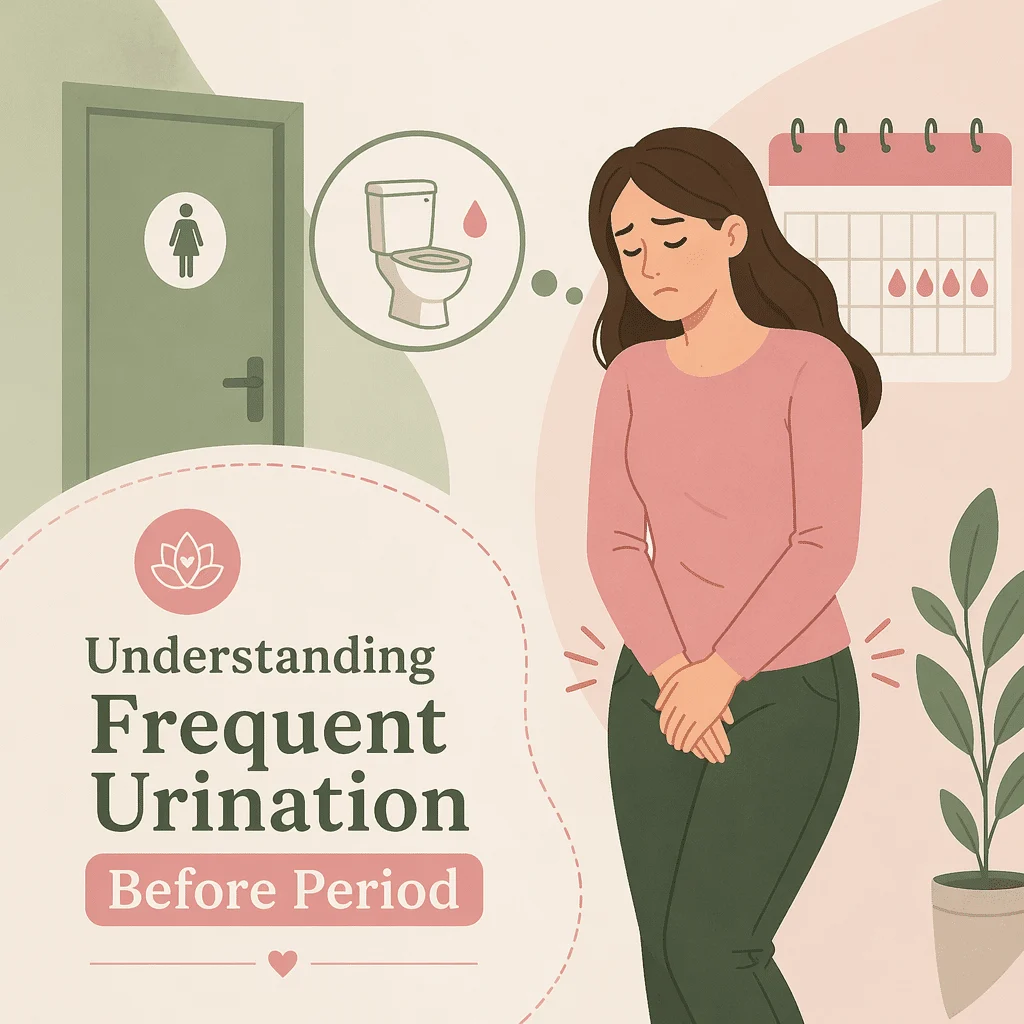
Frequent urination before your period is one of the most familiar premenstrual changes, and also one of the most unsettling, because it can look like the opening sign of a bladder infection. In the days before bleeding starts, hormone levels shift, the body lets go of fluid it had been holding, prostaglandins ramp up, and a slightly fuller uterus rests against the bladder. The usual result is more trips to the bathroom, with no pain. In this article you will learn what makes premenstrual frequency clearly cyclical, which signs point instead to a urinary tract infection, high blood sugar or a bladder condition, which lab tests answer the question, and when the pattern deserves a medical opinion.
Why frequent urination before a period happens
The days between ovulation and bleeding are called the luteal phase. Across that stretch, the hormone environment changes twice: first a rise, then a sharp withdrawal. The bladder sits in the middle of all of it, directly in front of the uterus and downstream of the kidneys, so it registers both the hormonal change and the mechanical one.
Progesterone rises, then falls away
After ovulation the ovary produces progesterone, and the body tends to hold on to a little more salt and water than usual. That is the phase many people experience as puffiness, tight rings and a heavier feeling in the lower abdomen. When progesterone falls in the last days before bleeding, the retained fluid is released. The kidneys then pass a larger volume of urine over a day or two, and the bladder simply fills faster than it did in the first half of the cycle. Nothing is wrong with the bladder itself; it is handling a temporary surplus.
Prostaglandins act on more than the uterus
As the lining of the uterus prepares to shed, it releases prostaglandins, hormone-like messengers that make smooth muscle contract. Smooth muscle is not confined to the uterus: the bowel and the bladder wall are built from it too. That is why urgency, cramping and looser stools often turn up on the same day rather than separately. Our library also covers the causes of period diarrhea, which follows the same mechanism at the other end of the digestive tract.
A fuller uterus resting on the bladder
Premenstrually the uterus is a little larger and more congested with blood. It sits immediately behind and above the bladder, so even a small increase in size reduces how much urine the bladder can hold before the urge signal fires. The bladder is not weaker; it is being asked to work in a smaller space. This is also why the sensation often eases once bleeding is well established and the uterus begins to empty.
Everyday habits that amplify the effect
Premenstrual cravings frequently run toward salt, chocolate and caffeine, and all three change the picture. Salt increases how much water the body holds before the drop, so there is more to release afterward. Caffeine and alcohol both irritate the bladder lining and increase urine production. A single cycle can therefore feel much more intense than the last one purely because of what changed around it.
Is frequent urination before a period normal?
For most people, yes. What matters is the pattern rather than the number of bathroom trips, and a cyclical pattern is usually easy to recognize once you know what to look for.
What a cyclical pattern looks like
- It appears in the few days before bleeding and settles within a day or two of the period starting.
- It repeats, cycle after cycle, at roughly the same point.
- Passing urine feels completely normal: no burning, no stinging, no straining.
- The volume is generous rather than a small painful trickle.
- Urine looks pale and clear, sometimes almost like water.
- It travels with other familiar premenstrual signs such as bloating, breast tenderness or a slight weight change. In a dedicated guide, our team explains the causes of premenstrual weight gain.
What it should not include
Cyclical frequency does not come with burning, blood in the urine, fever, pain in the side or lower back, cloudy or foul-smelling urine, intense thirst, or unexplained weight loss. Any of those points away from the cycle and toward something that needs testing rather than tracking.
Cyclical frequency, urinary infection, or high blood sugar
Frequent urination before a period, a urinary tract infection and high blood sugar all produce the same headline symptom, and they are separated by the details around it. The table below compares them on the five features that discriminate best.
| Feature | Cyclical premenstrual frequency | Urinary tract infection | High blood sugar |
|---|---|---|---|
| Timing | Starts a few days before bleeding, eases once the period is underway, repeats each cycle | Can begin at any point in the cycle and does not follow it | Builds gradually over weeks or months, unrelated to the cycle |
| Burning or stinging | Absent, passing urine feels normal | Common, often with pressure low in the pelvis | Absent unless an infection is present at the same time |
| Urine appearance | Pale and clear, sometimes very dilute | Often cloudy or strong-smelling, occasionally pink or bloody | Usually pale, because the volume passed is large |
| Thirst | Normal | Normal | Marked and persistent, including at night |
| Fever and general feeling | No fever, energy tracks the usual premenstrual dip | Fever, chills or flank pain suggest the kidney is involved | No fever, but fatigue, blurred vision and weight loss are common |
Read the table as a whole rather than row by row. One isolated cloudy sample after a day of poor hydration means little; cloudy urine plus burning plus a timing that ignores your cycle is a different story. Our library covers the symptoms of a urinary tract infection. The combination that should always prompt a same-week appointment is frequent urination with intense thirst and unintended weight loss, because that trio is a recognized presentation of undiagnosed diabetes.
Other explanations worth knowing about
Overactive bladder
Overactive bladder describes a bladder that signals urgency before it is full. It is not tied to the cycle, although a premenstrual fluid shift can make an existing overactive bladder much more noticeable for a few days. The giveaway is that the urgency never fully disappears in the first half of the cycle.
Interstitial cystitis
Interstitial cystitis, also called bladder pain syndrome, produces frequency and urgency together with genuine bladder discomfort that eases briefly after passing urine. Urine tests come back clear of infection. Many people with the condition report that symptoms flare premenstrually, which is exactly why the timing alone cannot rule it out.
Thyroid changes
An overactive thyroid speeds up metabolism and can increase urine production, and it often disturbs the menstrual cycle at the same time, which makes the two easy to confuse. Weight loss without trying, a racing heart, heat intolerance and shaky hands alongside the urinary change point toward the thyroid. The first blood test used is TSH, or thyroid-stimulating hormone. To check this, our library details the normal thyroid hormone ranges.
Early pregnancy
Needing to urinate more often is one of the earliest pregnancy signs, and it arrives at almost exactly the moment a period is expected. If the period then does not come, testing is the fastest way to separate the two. Another article explains how a home pregnancy test works.
Lab tests that settle the question
When the pattern is not obviously cyclical, a small number of ordinary tests usually resolves it quickly. A doctor chooses among them based on the other symptoms.
- Urinalysis, a dipstick and microscope check of a urine sample, looks for infection markers, blood, protein and sugar in one pass. Our team explains how to read a urinalysis report.
- White blood cells in the sample suggest inflammation or infection. We also cover the meaning of leukocytes in a urine test.
- Nitrites are produced by several bacteria that infect the urinary tract, so a positive result raises the likelihood of infection considerably. Another guide explains the meaning of nitrites in urine.
- A urine culture grows any bacteria present and identifies which antibiotic will work, which is why it is often added when infections keep coming back.
- Sugar in the urine is not normal and usually reflects blood glucose above the level the kidney can reabsorb. A separate article describes the causes of glucose in the urine.
- Fasting glucose and A1C assess blood sugar, the second reflecting the average of the past two to three months. Our team explains what an A1C result means.
- A metabolic panel checks kidney function, sodium, potassium and calcium, all of which influence how much urine the body produces. Our team also breaks down a comprehensive metabolic panel report.
When to see a doctor
Frequent urination before a period rarely needs investigating on its own. Book an appointment if any of the following apply:
- Burning, stinging or pain when passing urine, at any point in the cycle.
- Blood in the urine, or urine that is persistently cloudy and strong-smelling.
- Fever, chills, nausea or pain in the side or lower back.
- Frequent urination together with intense thirst, unexplained weight loss or new fatigue.
- Urinary frequency that no longer follows your cycle, or that keeps you awake most nights.
- Frequency severe enough to interfere with work, sleep or daily activities.
- A missed period alongside the urinary change.
What helps day to day
None of these measures treat a medical cause, but they do reduce the intensity of a cyclical pattern. Keep drinking normally; cutting fluids concentrates urine, irritates the bladder and tends to make urgency worse rather than better. Shift most of your intake toward the earlier part of the day if night waking is the main problem. Ease off caffeine, fizzy drinks and alcohol in the week before bleeding, since all three act on the bladder directly. Reducing salt across the luteal phase limits how much fluid is stored and later released. Pelvic floor exercises improve the ability to hold on when the urge arrives. Finally, tracking symptoms across two or three cycles is the single most useful thing you can bring to an appointment, because it shows at a glance whether the pattern really is cyclical.
Latest scientific advances
Research into frequent urination before a period, and into urinary symptoms across the cycle more broadly, is still young. Here is what the last three years have added, in plain language.
Urinary urgency is common enough that researchers now measure it
A 2025 survey of more than 450 amateur Gaelic football and Camogie players found that urinary urgency, the sudden need to reach a bathroom quickly, was the pelvic floor symptom they reported most often, and that nearly all of those not using hormonal contraception noticed cycle-related symptoms. What this means for you: the experience is widely shared and is now being documented rather than dismissed. The nuance is that this was a self-reported survey in young athletes, so it does not tell us how common the symptom is in the general population.
Fluid shifts are among the most reported premenstrual changes
A 2025 study published in a leading obstetrics journal collected premenstrual symptom reports from more than 45,000 women. Swelling and fluid retention ranked among the physical symptoms reported most frequently, across every age group examined. What this means for you: the water-handling side of the premenstrual phase is one of its defining physical features, so the bathroom pattern that accompanies it is entirely in keeping with the rest.
The bladder genuinely responds to sex hormones
A 2025 pooled analysis of seventeen studies covering roughly two thousand postmenopausal women found that local estrogen treatment improved urgency, daytime frequency, nighttime urination (nocturia) and recurrent infections. A 2025 joint American urology and urogynecology guideline reached a similar conclusion and stressed that these symptoms overlap heavily with overactive bladder, so they should be tested rather than assumed. What this means for you: hormone levels really do change bladder behavior, which supports the premenstrual explanation, but this evidence comes from menopause and does not transfer directly to the luteal phase.
Hormonal contraception may soften the fluid-related symptoms
A 2025 analysis of nearly 1,900 participants taking a combined pill containing estetrol and drospirenone found that people starting hormonal contraception for the first time reported less premenstrual water retention, while those switching from another method saw little change. What this means for you: if you are not already using hormonal contraception, it is a reasonable topic to raise with your doctor, though it was studied for premenstrual symptoms in general and not as a treatment for urinary frequency.
Night waking may cluster premenstrually
A 2026 study of elite team-sport athletes recorded significantly more waking episodes during the premenstrual phase than at other points in the cycle. What this means for you: if you notice you are getting up at night mainly in the days before bleeding, that observation fits the emerging picture. This one is preliminary: only twelve athletes were tracked, so it needs confirmation in larger groups before anyone draws firm conclusions.
Glossary
| Term | Definition |
|---|---|
| Luteal phase | The part of the menstrual cycle that runs from ovulation to the start of bleeding, typically about two weeks. |
| Progesterone | A hormone produced after ovulation. Its rise and later withdrawal drive many premenstrual changes, including how the body handles salt and water. |
| Prostaglandins | Hormone-like substances released as the uterine lining prepares to shed. They make smooth muscle contract in the uterus, bowel and bladder. |
| Urinalysis | A basic urine test combining a dipstick reading with a microscope examination. It screens for infection, blood, protein and sugar. |
| Urine culture | A laboratory test that grows any bacteria present in a urine sample and identifies which antibiotic is likely to work. |
| Nocturia | Waking during the night specifically to pass urine, as opposed to waking for another reason and going on the way. |
| A1C | Short for hemoglobin A1c. A blood test that reflects average blood sugar over the previous two to three months. |
| Overactive bladder | A pattern in which the bladder signals an urgent need to empty before it is actually full, unrelated to infection. |
| Interstitial cystitis | Also called bladder pain syndrome. Long-standing bladder pain with urgency and frequency, in the absence of infection. |
| TSH | Thyroid-stimulating hormone. The first blood test used to check whether the thyroid is underactive or overactive. |
Frequently asked questions
How many days before a period does frequent urination start?
Most people notice it in the last three to five days of the cycle, and some only in the final day or two. It tends to peak right at the transition into bleeding, then fade over the following day or so as the uterus empties and the fluid balance settles. The exact window varies between individuals but stays fairly stable for the same person from one cycle to the next, which is why tracking it is so informative. A pattern that suddenly shifts by a week or more is worth mentioning to a doctor.
Is needing to urinate often a sign that a period is coming?
It can be, especially when it arrives alongside bloating, breast tenderness or a mood shift you recognize from previous cycles. It is not a reliable predictor on its own, though, because hydration, caffeine, a warm environment and stress all move urinary frequency around independently. Treat it as one signal among several rather than a countdown. If your cycles are irregular, a symptom diary kept over two or three months will tell you far more than any single sign.
Could it be early pregnancy instead?
Early pregnancy is a genuine possibility, because increased urinary frequency starts very early and coincides with the expected period. The two are indistinguishable on symptoms alone during that window. A home test taken from the first day of a missed period gives a clear answer for most people, and repeating it a few days later resolves an early negative when the period still has not arrived. If pregnancy is possible and the period is late, test rather than wait.
How can I reduce frequent urination before my period?
Keep your total fluid intake steady but move more of it into the morning and early afternoon, cut back on caffeine and alcohol during the premenstrual week, and reduce salt across the second half of the cycle so less fluid is stored and then released. Regular pelvic floor exercises improve bladder control over a few weeks. What does not help is drinking less overall: concentrated urine irritates the bladder lining and usually makes urgency worse.
Why do bloating and frequent urination happen together?
They are two stages of the same process. During the luteal phase the body holds extra salt and water, which is felt as bloating and puffiness. When hormone levels drop just before bleeding, that stored fluid is released and passes through the kidneys, so the bloating eases at the same time as the bathroom trips increase. Seeing one give way to the other over a day or two is a reassuring sign that the pattern is cyclical rather than a bladder problem.
Does birth control change this symptom?
It can. Combined hormonal contraception flattens the natural rise and fall of progesterone, which is what drives the premenstrual fluid shift, so some people notice fewer swings. Recent research suggests the benefit is clearest for people starting hormonal contraception for the first time, and much less apparent for those switching between methods. It is not prescribed to treat urinary frequency, so discuss it with your doctor in the context of your wider contraceptive needs.
Sources
- MedlinePlus, U.S. National Library of Medicine — Frequent or urgent urination
- Centers for Disease Control and Prevention — Symptoms of diabetes
- Cleveland Clinic — Premenstrual syndrome (PMS): symptoms and treatment
- Nolan D, Maguire PJ, Bell L — Menstrual cycle, hormonal contraceptives, and pelvic floor dysfunction in ladies Gaelic football and Camogie — Science and Medicine in Football, 2025
- Pedro AO, Verdade RC, et al. — Premenstrual dysphoric disorder prevalence and symptoms across age groups — BJOG, 2025
- Porcari I, Uccella S, et al. — Vulvovaginal estrogen therapy for urinary symptoms in postmenopausal women: a review and meta-analysis — Climacteric, 2025
- Kaufman MR, Ackerman AL, et al. — The AUA/SUFU/AUGS guideline on genitourinary syndrome of menopause — Journal of Urology, 2025
- Bouchard C, Bitzer J, et al. — Effects of estetrol/drospirenone on self-reported physical and emotional premenstrual and menstrual symptoms — Contraception, 2025
- McGeever A, Mallon N, et al. — Sleep characteristics and menstrual cycle phase-based differences in sleep in naturally menstruating elite female team sport athletes — European Journal of Sport Science, 2026
Further reading
- Distended bladder: symptoms, causes and treatments
- Urine specific gravity levels and what they mean
- Urine color: understanding causes and changes
- Ovulation nausea: symptoms and causes explained
- Perimenopause nausea: causes and treatments
Understand your lab results with AI DiagMe
When urinary frequency stops following your cycle, the answer is usually sitting in a handful of ordinary results: a urinalysis, a urine culture, a fasting blood sugar or A1C, a thyroid test and a metabolic panel. AI DiagMe reads those reports back to you in plain language, so you know which values fall outside the expected range and which questions are worth raising. It helps you understand your results; it does not diagnose and does not replace your doctor.
Get your results interpreted in minutes