





































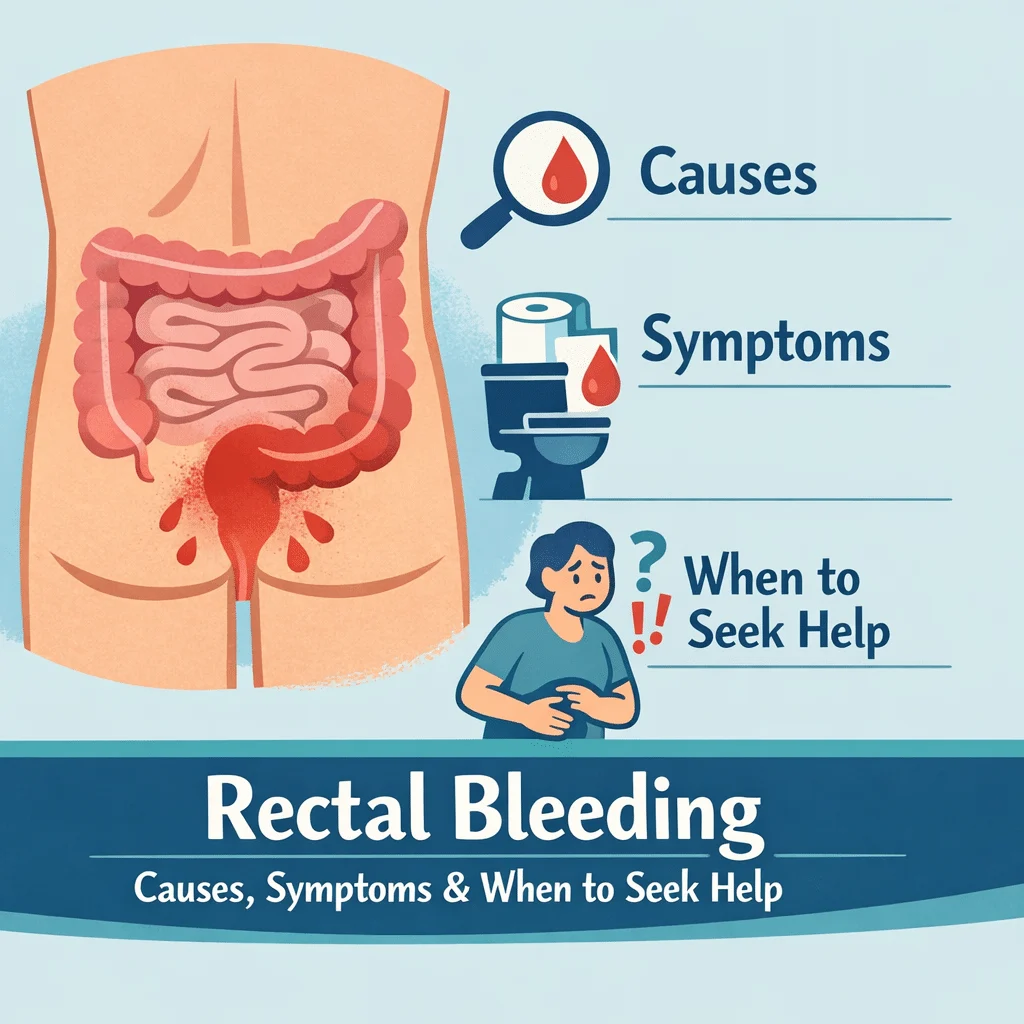
Rectal bleeding — blood that shows up on the toilet paper, in the bowl, or mixed into stool — is a common reason people look for answers, and in most cases the explanation turns out to be benign. That does not make it safe to ignore. The color of the blood, how much of it there is, and the symptoms that come with it point toward different parts of the digestive tract and different levels of urgency. In this article you’ll learn what bright red, dark red, and black tarry stool each suggest, which conditions cause bleeding most often, which situations need emergency care the same day and which can wait for a scheduled appointment, and how clinicians look for the source using stool tests, blood tests, and endoscopy.
What the color of the blood says about where it comes from
Blood changes color as it travels through the digestive tract. Digestive enzymes and gut bacteria break down hemoglobin, the iron-carrying protein inside red blood cells, and the longer that process runs, the darker the result. Color is therefore a rough map of distance: the brighter the blood, the closer the source is to the anus.
This is a starting point for a conversation with a clinician, not a diagnosis. A fast bleed high in the gut can still arrive looking red because it moves through quickly, and several foods imitate blood convincingly. Beets, red gelatin, and tomato sauces can tint stool red, while iron tablets, bismuth-containing stomach remedies, black licorice, and blueberries can darken it.
| What you see | What it usually suggests |
|---|---|
| Bright red on the paper or dripping into the bowl, stool otherwise normal | The anus or the lower rectum. Hemorrhoids and anal fissures are the usual explanations. |
| Bright red blood mixed through the stool | The rectum, sigmoid colon, or left colon. Polyps, diverticula, inflammation, or a tumor become more plausible. |
| Dark red or maroon blood, sometimes with clots | Higher in the colon or the small intestine. A rapid bleed from further up can also look like this. |
| Black, sticky, tar-like stool with a strong odor (melena) | The stomach, duodenum, or upper small intestine. The blood has been digested along the way. |
| Nothing visible, but a stool test detects blood (occult blood) | Slow, ongoing loss anywhere in the gut. This is often the first clue to a polyp or an early cancer. |
Blood is only one of the things that can change how stool looks, and a companion article explains what normal and abnormal stool consistency looks like. Tiny dark flecks are a separate question, and another guide covers the possible meanings of black specks in stool.
The conditions behind most rectal bleeding
Hemorrhoids and anal fissures
These two account for the large majority of visible bleeding in people under 50. Hemorrhoids are swollen vascular cushions inside or just outside the anal canal; internal ones typically bleed painlessly, coating the stool or dripping bright red into the bowl after a bowel movement. An anal fissure is a small tear in the lining of the anal canal, usually caused by a hard stool, and it announces itself with sharp, tearing pain during and after defecation plus a streak of blood on the paper. A dedicated guide details the causes, treatments, and prevention of hemorrhoids. A sudden, painful blue-purple lump at the anal opening is more likely a clotted vein, and one article describes the symptoms and treatment of a perianal hematoma.
Diverticular bleeding and angiodysplasia
Diverticula are small pouches that bulge outward through weak points in the colon wall. They become very common after age 60 and are usually silent, but a vessel stretched over the neck of a pouch can rupture. The result is characteristic: sudden, painless, sometimes heavy loss of dark red or maroon blood. Angiodysplasia — fragile, abnormally widened small vessels in the wall of the colon or small intestine — is the other classic cause in older adults, and it more often produces slow, repeated loss than a dramatic episode.
Polyps and colorectal cancer
Polyps are growths on the lining of the colon or rectum. Most are harmless, but some types slowly accumulate changes that can turn into cancer over years. Both polyps and tumors bleed intermittently, often in amounts far too small to see, which is exactly why invisible bleeding matters as much as the obvious kind. A separate article reviews the risk factors and treatment of colorectal cancer.
Inflammatory bowel disease and proctitis
Ulcerative colitis and Crohn’s disease inflame and ulcerate the bowel lining, and bleeding usually arrives alongside diarrhea, urgency, mucus, cramping abdominal pain, and sometimes weight loss or fever. Proctitis — inflammation limited to the rectum — can follow radiation therapy to the pelvis or certain infections, including sexually transmitted ones, or it can be the first sign of ulcerative colitis. Our library also covers the diagnosis and daily management of Crohn’s disease. Clinicians frequently pair that suspicion with a stool inflammation marker, and a companion article explains the interpretation of fecal calprotectin results. When recent travel or diarrhea lasting more than two weeks is part of the story, an infectious cause deserves consideration, and another guide details the ova and parasites stool test.
Less common sources
Bleeding can also come from an anal fistula or abscess, solitary rectal ulcer syndrome, ischemic colitis (a temporary loss of blood supply to part of the colon, typically causing cramping pain then bloody diarrhea in older adults), rectal prolapse, or trauma. Pale, greasy, floating stool is a different problem altogether, and one guide covers the causes and treatment of fatty stool.
How blood thinners and pain relievers change the picture
Medication history changes both the likelihood of bleeding and how seriously an episode should be taken.
- Anticoagulants — warfarin, apixaban, rivaroxaban, edoxaban, dabigatran, heparins — do not create a lesion, but they allow an existing one to bleed longer and more heavily.
- Antiplatelet drugs such as aspirin and clopidogrel act through a different mechanism with a similar effect, and the risk rises when two are combined.
- Nonsteroidal anti-inflammatory drugs (NSAIDs) — ibuprofen, naproxen, diclofenac — can damage the lining of the stomach, small intestine, and colon directly, and they are a recognized cause of bleeding in both the upper and the lower gut.
Never stop a prescribed blood thinner on your own because of bleeding. Stopping abruptly carries its own risk of clots, strokes, and heart attacks. Call the clinician who prescribed it, describe exactly what you are seeing, and let them make that decision.
Rectal bleeding: when to seek emergency care and when an appointment is enough
This is the question most people actually want answered, so here it is as plainly as possible. Any visible bleeding deserves medical assessment, even when a benign cause such as hemorrhoids is very likely. The two are not mutually exclusive, and having hemorrhoids does not protect anyone from also having a polyp. What changes from one situation to the next is the timing.
| Level of urgency | What it looks like | What to do |
|---|---|---|
| Emergency care today | Heavy bleeding that does not stop, large clots, black tarry stool, vomiting blood or material that looks like coffee grounds, lightheadedness, fainting, a racing heart, cold clammy skin, confusion, or severe abdominal pain with the bleeding | Go to an emergency department or call 911. Do not drive yourself. These signs point to fast or large blood loss that needs same-day assessment. |
| An appointment within days | Blood mixed through the stool rather than only on the paper; bleeding that keeps returning over more than a week or two; bleeding with a lasting change in bowel habit, unexplained weight loss, ongoing abdominal pain, fatigue, or breathlessness; any bleeding from age 45 onward; bleeding while taking an anticoagulant, an antiplatelet drug, or regular NSAIDs; a personal or family history of colorectal cancer, polyps, or inflammatory bowel disease | Contact your doctor and ask to be seen promptly. Expect an examination and, in most cases, a stool test, blood tests, or a referral for endoscopy. |
| Routine follow-up | A single small streak on the paper in a young adult with known hemorrhoids or a typical anal fissure, no other symptoms, and bleeding that settles within a few days | Still mention it at your next visit. If it returns, becomes heavier, or new symptoms appear, move up to the row above. |
Two situations deserve a separate mention. Bleeding during pregnancy is usually hemorrhoidal but should always be reported. And in a child, blood in the stool is never something to watch and wait on at home: it warrants a same-day call to a pediatrician.
How rectal bleeding is investigated
Examination and stool testing
A visit usually starts with the history — color, amount, timing, pain, bowel habit, medications, family history — followed by an examination of the anal area and a digital rectal examination. Anoscopy, a short rigid tube that opens the anal canal to view, can confirm internal hemorrhoids or a fissure within seconds in the office.
When the source is not obvious, a stool test for blood comes next. The fecal immunochemical test (FIT) uses antibodies that recognize human hemoglobin specifically, so food and most medications no longer interfere and no dietary preparation is required. The older guaiac-based fecal occult blood test (gFOBT) relies on a chemical reaction instead, which is why it demanded dietary restrictions and why only the high-sensitivity version is still recommended. Both pick up blood the eye cannot see.
Looking inside the bowel
Colonoscopy examines the full length of the colon and the last part of the small intestine with a flexible camera, and it is the only test that can find a lesion and remove it in the same session. Flexible sigmoidoscopy reaches only the left side of the colon; it is quicker, needs less preparation, and can be enough when the suspected source sits low. CT colonography produces detailed images without a camera but cannot take a biopsy. When bleeding is brisk and the source stays hidden, CT angiography or a nuclear medicine red-cell scan can localize it, and upper endoscopy is added whenever melena or an upper source is suspected.
Blood tests that measure the consequences
Bleeding that has run quietly for months shows up in the blood before it shows up in the toilet. A complete blood count can reveal a low hemoglobin with small, pale red cells, the signature of iron deficiency. Ferritin, the protein that stores iron, falls earliest and is the most sensitive marker of depleted stores. In a man of any age or a woman past menopause, iron deficiency anemia without another explanation is treated as blood loss from the gut until proven otherwise. Our library explains the symptoms, causes, and tests for anemia, and another article details the causes and treatment of low ferritin levels.
Colorectal cancer screening now starts at 45
Screening is what happens before symptoms appear, and it is the reason many polyps are removed before they ever bleed. The US Preventive Services Task Force recommends screening for every adult aged 45 to 75, having lowered the starting age from 50 to 45 because colorectal cancer is being diagnosed more often in younger adults. Between 76 and 85, screening becomes an individual decision that weighs overall health and previous screening history.
Several approaches are considered acceptable: FIT every year, high-sensitivity gFOBT every year, a stool DNA-FIT test every one to three years, colonoscopy every ten years, CT colonography every five years, or flexible sigmoidoscopy every five years, or every ten years when combined with annual FIT. One point matters more than the choice itself: a positive result on any test other than colonoscopy must be followed by a colonoscopy, otherwise the screening is left unfinished. Recent coverage looks at a blood test for colon cancer screening.
Screening applies to people without symptoms. Visible rectal bleeding is a symptom, and it calls for a diagnostic evaluation rather than a screening test.
Latest scientific advances
Research over the past three years has focused less on new treatments than on a practical question: who needs a colonoscopy, and how fast? Here is what recent work suggests.
A stool test helps decide who needs the camera first
A 2025 Scottish study followed people referred to hospital with rectal bleeding and tested whether the fecal immunochemical test could rank them by risk. One sample sorted the group well and two samples sorted it better: people with no detectable hemoglobin in stool were very unlikely to have cancer, while the cases concentrated among those with higher readings. An earlier analysis from the same team, published in 2023, reached a similar conclusion about using two samples rather than one. What this means for you: if your doctor asks for a stool sample even though you can see the blood, it is not a delaying tactic, it helps decide how urgently a camera test is needed. These results come from referral clinics within one health system, so local practice varies, and a stool test that finds nothing never cancels out symptoms that continue.
Bleeding is among the symptoms that most often lead to a diagnosis
A 2024 analysis by the British Society of Gastroenterology used a national endoscopy database — a registry that records what was found during each procedure — to examine which referral symptoms actually led to a cancer diagnosis at colonoscopy. Rectal bleeding and anemia stood out, especially in combination and in older patients, while several other referral reasons produced very little. What this means for you: gastroenterologists take bleeding seriously for a measured reason, and it is worth describing precisely rather than downplaying.
Colorectal cancer in younger adults: a real signal, and an ongoing debate
A 2025 analysis by researchers at the National Cancer Institute confirmed that colorectal cancer is being diagnosed more often in adults under 50 in the United States, which is the trend behind the lowered screening age. A 2025 commentary in a general medical journal argued that part of the apparent rise across early-onset cancers as a whole reflects more intensive testing rather than more disease, and urged caution in reading the numbers. What this means for you: the shift toward younger patients is real enough that guidelines changed, yet it does not mean a young adult with a small streak of blood should assume the worst. It does mean that being under 50 is no longer a reason to skip an evaluation.
The starting age is still being weighed elsewhere
A 2026 review asked whether other countries should follow the United States and begin stool-based screening at 45 rather than 50, weighing the cancers caught earlier against the extra colonoscopies, the strain on endoscopy services, and the risk of overdiagnosis, meaning growths found and treated that would never have caused harm. What this means for you: recommendations differ between countries because the trade-off is genuinely close. Ask your clinician which schedule applies where you live, and what your own history changes about it.
Glossary
| Term | Definition |
|---|---|
| Angiodysplasia | Fragile, abnormally widened small blood vessels in the wall of the intestine. They are a common cause of slow, repeated bleeding in older adults. |
| Anoscopy | A brief office examination using a short rigid tube to view the anal canal and lower rectum. It can confirm hemorrhoids or an anal fissure in seconds. |
| Diverticula | Small pouches that push outward through weak spots in the colon wall. Common with age and usually silent, but a vessel stretched over a pouch can bleed suddenly. |
| Fecal immunochemical test (FIT) | A stool test that uses antibodies to detect human hemoglobin. It needs no dietary preparation and is used both for screening and for sorting out symptoms. |
| Ferritin | The protein that stores iron in the body. Its level in blood falls early when iron stores are being drained, which makes it a sensitive marker of chronic blood loss. |
| Hemoglobin | The iron-containing protein in red blood cells that carries oxygen. Its breakdown as blood travels through the gut is what turns stool black. |
| Melena | Black, sticky, tar-like stool with a strong distinctive smell, caused by digested blood. It usually points to bleeding in the stomach or upper small intestine. |
| Occult blood | Blood present in stool in amounts too small to see, detectable only by a laboratory test. |
| Polyp | A growth on the inner lining of the colon or rectum. Most are harmless, but some types can slowly develop into cancer, which is why they are removed when found. |
| Proctitis | Inflammation of the lining of the rectum. Causes include radiation therapy to the pelvis, certain infections, and inflammatory bowel disease. |
Frequently asked questions
Why am I bleeding from the rectum with no pain?
Painless bleeding is the more common pattern, not the exception. Internal hemorrhoids sit above the point where the anal canal carries pain-sensing nerves, so they often bleed brightly without hurting at all. Diverticular bleeding and angiodysplasia are usually painless too, and so are most polyps and many early tumors. Pain is therefore neither reassuring nor alarming on its own; it mainly helps narrow the list. An anal fissure hurts sharply, hemorrhoids usually do not, and cramping pain with bloody diarrhea points toward inflammation or a reduced blood supply to the colon. Because painless bleeding covers both the most harmless and some of the most serious causes, it still deserves an assessment.
When should I worry about bright red blood in my stool?
A single streak on the paper, in a young adult with hard stools and no other symptoms, is usually anal in origin and can be raised at a routine visit. Act faster if the blood is mixed through the stool rather than sitting on its surface, if it keeps coming back over more than a week or two, if you are 45 or older, if you take a blood thinner or regular anti-inflammatory painkillers, or if it arrives with a lasting change in bowel habit, unexplained weight loss, tiredness, or abdominal pain. Go to an emergency department the same day for heavy bleeding, large clots, dizziness, or fainting.
What does it mean if there is blood when I wipe but not in the stool?
Blood only on the paper, with clean stool in the bowl, usually means the source sits right at the exit: most often an anal fissure or an internal hemorrhoid that bleeds as stool passes. It is the least worrying pattern, particularly when it follows a hard or straining bowel movement and stops within a few days. It is still worth mentioning to a clinician, especially past 45, because a lesion low in the rectum can produce exactly the same picture. If the pattern changes, or blood starts appearing in the stool itself, have it looked at.
How can I stop rectal bleeding at home?
Home measures target the common anal causes rather than the bleeding itself. Softening the stool is the main lever: more fiber from food or a supplement, more fluids, and no delaying when the urge arrives. Short sitz baths, meaning sitting in a few inches of warm water for 10 to 15 minutes, relax the anal sphincter and ease fissure pain. Avoid straining and long sessions on the toilet. Over-the-counter creams and suppositories may relieve symptoms but do not treat a cause. None of this replaces finding out where the blood comes from, and bleeding that continues beyond a few days needs an appointment rather than another remedy.
Can hemorrhoids cause a large amount of blood in the toilet?
Yes. Hemorrhoidal bleeding can look alarming because a small volume of blood spreads dramatically through toilet water, and internal hemorrhoids occasionally bleed enough to drip steadily. Even so, a large amount of blood should never be assumed to be hemorrhoidal without an examination. Diverticular bleeding produces exactly that kind of sudden, painless, heavy episode and comes from much higher in the colon. Bleeding that soaks through pads, contains large clots, or arrives with dizziness, weakness, or a fast heartbeat is an emergency whatever diagnosis you were given before.
Does blood in the stool always mean cancer?
No. Most bleeding comes from hemorrhoids, anal fissures, diverticula, or inflammation, and cancer accounts for a small minority of cases, especially under 50. Clinicians investigate anyway because the bleeding pattern alone cannot reliably separate a benign cause from an early tumor, and colorectal cancer found early is highly treatable. Being sent for tests is not a signal that your doctor suspects cancer: it is how that possibility gets set aside so the real cause can be treated.
Sources
- US Preventive Services Task Force — Colorectal Cancer: Screening, final recommendation statement, 2021 — uspreventiveservicestaskforce.org
- National Institute of Diabetes and Digestive and Kidney Diseases (NIH) — Symptoms and Causes of Gastrointestinal (GI) Bleeding — niddk.nih.gov
- Cleveland Clinic — Blood in Stool (Rectal Bleeding) — my.clevelandclinic.org
- Shah F, Gunn F, Dunlop MG, Din FVN, Gerrard AD — Single and double faecal immunochemical test strategies are effective in risk stratification for patients with symptoms of per rectal bleeding suggestive of colorectal cancer — BJS Open, 2025 — consensus.app
- Gerrard AD, Maeda Y, Miller J, Gunn F, Theodoratou E, Noble C, Porteous L, Glancy S, MacKay P, Dunlop MG, Wang X, Din FVN — Double faecal immunochemical testing in patients with symptoms suspicious of colorectal cancer, 2023 — consensus.app
- Beaton D et al. — Diagnostic yield from symptomatic lower gastrointestinal endoscopy in the UK: a British Society of Gastroenterology analysis using data from the National Endoscopy Database — Alimentary Pharmacology and Therapeutics, 2024 — doi.org/10.1111/apt.18003
- Shiels MS et al. — Trends in Cancer Incidence and Mortality Rates in Early-Onset and Older-Onset Age Groups in the United States, 2010-2019 — Cancer Discovery, 2025 — doi.org/10.1158/2159-8290.CD-24-1678
- Patel VR, Adamson AS, Welch HG — The Rise in Early-Onset Cancer in the US Population, More Apparent Than Real — JAMA Internal Medicine, 2025 — doi.org/10.1001/jamainternmed.2025.4917
- Rabeneck L et al. — Should we screen for colorectal cancer with biennial FIT beginning at age 45 in Canada? — Journal of the Canadian Association of Gastroenterology, 2026 — consensus.app
Further reading
- The tests included in an iron studies panel
- What a stool culture test looks for
- The diagnosis and management of irritable bowel syndrome
- C-reactive protein as a marker of inflammation
- The meaning and limits of tumor markers
Understand your lab results with AI DiagMe
When bleeding is investigated, the answers often arrive as numbers: a complete blood count, a ferritin level, a stool test for hidden blood, or an inflammation marker. AI DiagMe turns those results into clear language so you can see what changed, what sits outside the usual range, and which questions are worth raising at your next appointment. It helps you understand your results; it does not diagnose anything and does not replace your doctor.
Get your results interpreted in minutes