





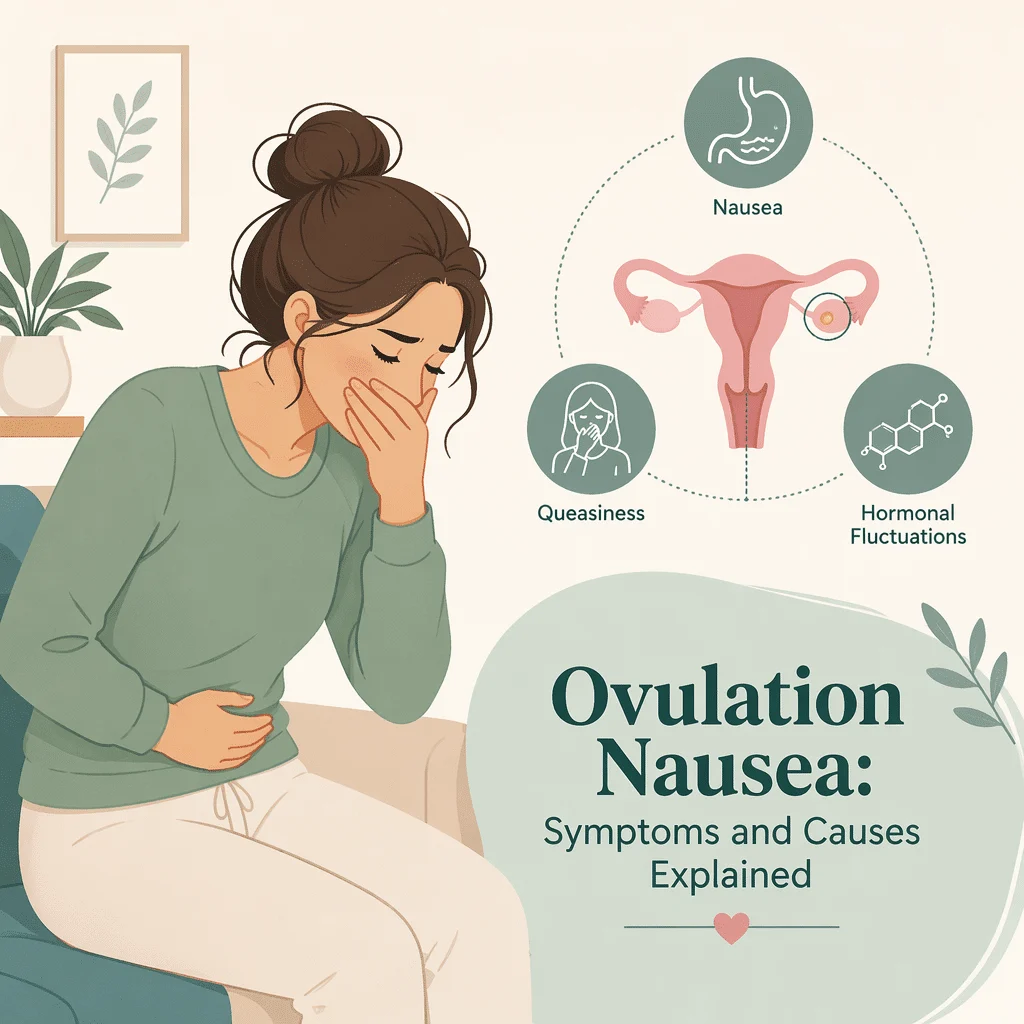
Ovulation nausea is queasiness that shows up around the middle of your menstrual cycle, at the point when an ovary releases an egg. For most people who notice it, the timing is the whole story: it arrives roughly two weeks before the next period, lasts hours rather than days, and often travels with a one-sided twinge low in the abdomen. In this article you’ll learn how to place mid-cycle nausea on your own calendar, how it differs from early pregnancy sickness and from the pain of an ovarian cyst, which symptoms deserve urgent care, and which lab tests can show what your hormones were actually doing that week. The goal is to help you read your own pattern with less guesswork, and to know the small number of situations where guessing is not good enough.
What ovulation nausea is, and where it sits in your cycle
Ovulation is the moment an ovary releases an egg. It is set up by two hormonal moves. Estrogen climbs steadily through the first half of the cycle, then luteinizing hormone spikes sharply and triggers the release roughly a day later. Home ovulation kits are built to catch that spike. Our library explains a positive ovulation test result.
When the follicle opens, it releases a small amount of fluid and sometimes a trace of blood into the pelvis. The follicle is the little fluid-filled sac that held the maturing egg. That fluid can irritate the peritoneum, the thin membrane lining the abdominal cavity, which carries a dense supply of nerves. The same event releases prostaglandins, hormone-like messengers that make smooth muscle contract and that the digestive tract responds to readily. Prostaglandins are the reason many people notice bowel changes at predictable points in the cycle, and our team also covers period diarrhea and its causes.
Between peritoneal irritation, prostaglandin release and the abrupt swing in estrogen after the surge, there are several plausible routes from ovulation to an unsettled stomach. These are the same processes behind mittelschmerz, the German word clinicians use for mid-cycle ovulation pain, which frequently keeps ovulation nausea company.
The mid-cycle window: count backward, not forward
The most useful way to place a symptom is to count backward from your next period rather than forward from your last one. The first half of the cycle stretches and shrinks between months; the luteal phase, the stretch between ovulation and the next bleed, is the steadier half and usually runs about 12 to 16 days. So mid-cycle symptoms landing roughly 12 to 16 days before your next period fit the ovulation window well, while the same symptoms landing three days before bleeding do not.
Cycle length varies more than the textbook 28-day diagram suggests. The Eunice Kennedy Shriver National Institute of Child Health and Human Development notes that ovulation can occur anywhere from 10 to 21 days after the first day of a cycle. That is why a single calendar estimate is a weak anchor on its own, and why two or three cycles of notes beat one month of assumption.
The symptom pattern that points to your cycle
Ovulation nausea rarely arrives alone. The cluster around it is what makes the pattern recognizable, and most of it is mild and short-lived:
- A one-sided ache or twinge low in the abdomen, which can swap sides from month to month because ovaries do not take strict turns.
- A change in cervical mucus, which becomes clearer, thinner and more slippery in the days before release.
- Mild breast tenderness.
- Light spotting in some cycles. This guide describes the causes of ovulation spotting.
- Bloating or a heavy, full feeling in the pelvis.
Duration is one of the most reliable clues. Mayo Clinic describes mid-cycle pain as often lasting a few minutes to a few hours, and sometimes as long as a day or two. Nausea tied to the same event tends to follow that arc: it fades on its own within a day or so, rather than settling in.
Where the evidence stops, and why that matters
It is worth being straightforward here, because a lot of online content is not. Major clinical references describe mid-cycle events mainly in terms of pain, not nausea. Queasiness at ovulation is widely reported by people who track their cycles closely, but it has not been precisely quantified in the medical literature, and you should be skeptical of any article that gives you a confident percentage.
More importantly, the direction of the advice runs the other way. Mayo Clinic’s guidance is to contact a healthcare provider when mid-cycle pain becomes severe, when it comes with nausea or fever, or when it does not go away. So mild, brief queasiness that resolves the same day is a reasonable thing to note and track, while marked nausea alongside significant mid-cycle pain is a reason to check in rather than a reason to assume ovulation. That distinction is the practical heart of this topic.
Ovulation nausea versus the other causes of mid-cycle queasiness
Mid-cycle nausea has several possible explanations, and they separate cleanly on four axes: when it lands in the cycle, how long it lasts, what the pain does, and how urgently it needs attention.
| Possible cause | Timing in the cycle | How long it lasts | Pain pattern | Urgency |
|---|---|---|---|---|
| Ovulation nausea | Mid-cycle, about 12 to 16 days before the next period | Hours, occasionally up to a day or two | Mild one-sided lower abdominal twinge; may change sides between cycles | Routine; track it and raise it at a scheduled visit if it repeats |
| Early pregnancy | Starts later than ovulation, typically around or after a missed period | Daily and persistent across weeks, rather than clearing in a day | Usually no one-sided ovulation-type pain; mild cramping possible | Routine; take a pregnancy test and arrange prenatal care |
| Ovarian cyst rupture or ovarian torsion | Any point; follicular cysts relate to the ovulation window | Does not settle and often escalates over minutes to hours | Sudden, severe, one-sided pelvic pain, commonly with vomiting | Emergency; seek immediate medical care |
| Gastrointestinal cause | No consistent relationship to the cycle once you track several months | Varies with the underlying illness | Central or generalized cramping, often with diarrhea; no cyclical rhythm | Routine unless there is dehydration, high fever or blood in stool |
Could this be early pregnancy?
This is the question behind most searches on the subject, and timing answers it. Nausea at the moment of ovulation cannot be caused by a pregnancy that has not started yet. Fertilization happens within about a day of release, and the fertilized egg then takes several days to travel and implant in the uterine lining. Only after implantation does the body begin producing human chorionic gonadotropin, the hormone pregnancy tests detect, and pregnancy-related nausea typically builds in the weeks after that.
So the practical split is this: queasiness on the day of ovulation that clears by the next morning is not an early pregnancy sign, while nausea that begins around the time your period is due and then keeps returning day after day is worth a test. This guide explains pregnancy test accuracy and interpretation.
Conditions that can flare around ovulation
Several conditions can make mid-cycle days heavier than usual, and each one changes what to do next:
- Ovarian cysts. Follicular cysts form when a follicle does not open and keeps growing. Most cause nothing at all, but larger ones bring pressure and bloating. Our library details ovarian cyst size and its risks.
- Endometriosis, in which tissue similar to the uterine lining grows outside the uterus and can inflame the pelvis at several points in the cycle. We also cover endometriosis diagnosis and treatment.
- Pelvic inflammatory disease, an infection of the reproductive organs that usually adds fever, unusual discharge or pain during sex, and which needs prompt treatment rather than tracking.
- Migraine with a hormonal trigger. Nausea is a core migraine symptom, not just an add-on, so a mid-cycle attack can present mostly as queasiness with light sensitivity. Our team explains migraine causes, symptoms and treatments.
- A gastrointestinal bug or a food-related upset that simply coincided with mid-cycle. Tracking across two or three cycles is what separates coincidence from pattern.
Two neighboring patterns are worth naming so you do not misfile your own. If your cycles have become irregular and unpredictable in your forties or fifties, the hormonal picture is a transition rather than a clean mid-cycle event, and our library covers perimenopause nausea and its treatments. If your symptoms cluster in the week before bleeding rather than at mid-cycle, that is the luteal phase, and a separate article explains frequent urination before a period.
Red flags that need urgent care
Ordinary mid-cycle discomfort is mild, brief and self-limiting. A small number of presentations are not, and they are worth knowing precisely so that you can act quickly without worrying about the everyday version.
Ovarian torsion happens when an ovary twists on its supporting ligaments and its blood supply is cut off. Clinical references describe it as a true surgical emergency, because an ovary deprived of blood flow can be lost. It typically presents as sudden, severe, one-sided pelvic pain with nausea and vomiting, and an ovarian mass or cyst is the main risk factor. A ruptured cyst can also cause severe pain and bleeding inside the pelvis.
Seek emergency care for any of the following:
- Sudden, severe abdominal or pelvic pain, particularly one-sided pain that keeps escalating.
- Severe pain with vomiting, or pain with fever.
- Fainting, lightheadedness, cold clammy skin or rapid breathing, which can signal internal bleeding.
- Severe pain with heavy vaginal bleeding.
Arrange a non-urgent appointment if mid-cycle nausea is getting worse cycle after cycle, if it lasts more than two days, if it comes with pain that interferes with work or sleep, or if it appears alongside unusual discharge, pain during sex or a change in bowel habits that persists.
Lab tests that help explain mid-cycle nausea
No blood test diagnoses ovulation nausea directly. What testing does is confirm or rule out the explanations around it, and that is often what turns an anxious guess into a settled answer. Which tests make sense depends on the question you are asking.
- Luteinizing hormone and estradiol, measured around the expected surge, show whether the hormonal machinery of ovulation is behaving as expected. This page explains luteinizing hormone blood results, and our library covers a female hormone panel.
- Progesterone drawn in the mid-luteal phase, roughly a week after the suspected release, is the practical way to confirm that ovulation actually happened rather than assuming it from a calendar. We describe a fertility blood test panel.
- Human chorionic gonadotropin, the pregnancy hormone, when the timing is ambiguous or a period is late.
- Thyroid stimulating hormone, because thyroid problems cause both nausea and cycle irregularity, and are easy to miss when everything gets attributed to hormones.
- A complete blood count and C-reactive protein, an inflammation marker, if infection is a possibility alongside fever or unusual discharge.
Timing matters more than usual with these tests. A progesterone level drawn at the wrong point in the cycle is close to uninterpretable, so it is worth noting the first day of your last period before any blood draw and telling the lab or clinician.
What helps when ovulation nausea hits
Because the episode is short, the aim is comfort rather than cure. Small, plain meals tend to sit better than large or rich ones; steady fluids help, especially if the nausea comes with a headache; and lying down with a warm compress on the lower abdomen eases the accompanying ache for many people. Gentle movement suits some people better than rest.
Over-the-counter pain relievers that reduce prostaglandins are commonly used for mid-cycle pain, but they are not right for everyone, and anything taken repeatedly every cycle is worth discussing with a clinician rather than settling into on your own. The same applies to hormonal contraception: methods that suppress ovulation remove the trigger entirely, which is a real option for people with disruptive symptoms, but it is a decision to make with a clinician rather than a self-prescribed fix.
The single most useful habit is unglamorous. Note the date, the duration, the side and the severity for two or three cycles. A short log converts a vague worry into a pattern a clinician can act on in a few minutes, and it is also what tells you whether the nausea genuinely tracks your cycle at all.
Latest scientific advances
Research has not focused on mid-cycle nausea as its own subject. What has moved, and what matters directly to this question, is how reliably ovulation can be pinned down, because everything here depends on knowing whether a symptom really landed at ovulation.
A 2023 study in Scientific Reports tested how well hormone measurements predict the day of release, using daily blood tests and ultrasound scans. The finding that matters for everyday use is a corrective one: luteinizing hormone levels on their own, or their rise and fall, did not reliably predict ovulation. A drop in estrogen was a far more consistent marker, and combining several hormone readings with ultrasound gave the most accurate picture. What this means for you is that a single positive ovulation stick is a helpful pointer rather than proof, and that a mid-luteal progesterone test, which confirms release after the fact, answers a different and often more useful question.
A 2024 systematic review in the Journal of Medical Internet Research, which pooled the existing studies on wearable devices, looked at whether rings, wristbands and similar trackers can identify cycle phases from body signals such as skin temperature and heart rate. Most devices reviewed could distinguish the fertile window, the luteal phase and menstruation with reasonable accuracy. The authors were clear that this is promising rather than settled, and that more validation is needed. For someone trying to work out whether their nausea is cycle-linked, a wearable can add a second line of evidence to a written log, without replacing it.
A 2025 feasibility study from Harvard and Massachusetts General Hospital, also in the Journal of Medical Internet Research, made a point worth carrying to the drugstore shelf: standard over-the-counter ovulation kits were designed and optimized for people with regular cycles and a predictable mid-cycle surge. The team was testing an early smartphone-based approach for people with irregular cycles, including polycystic ovary syndrome. This is early-stage work rather than an available tool. The practical takeaway is simply that if your cycles are irregular, a negative or confusing ovulation test says less about you than the packaging implies.
Finally, a 2025 review in the journal Drugs examined treating migraine attacks early, including at predictable points in the cycle such as menstruation. It is a useful reminder that nausea is a defining feature of migraine rather than a side note, and that attacks tied to recognizable cycle timing can be anticipated. If your mid-cycle episodes involve queasiness with headache, light sensitivity or visual changes, migraine is a differential worth raising, not an afterthought.
Glossary of key terms
| Term | Definition |
|---|---|
| Ovulation | The release of a mature egg from an ovary, roughly midway through the menstrual cycle. |
| Mittelschmerz | The medical term for one-sided lower abdominal pain that occurs at ovulation. The word is German for middle pain. |
| Follicle | The small fluid-filled sac in the ovary that holds a maturing egg and opens to release it. |
| Luteinizing hormone (LH) | The hormone that spikes sharply just before ovulation and triggers the egg’s release. It is what home ovulation kits measure. |
| Estradiol | The main form of estrogen in people of reproductive age. It rises through the first half of the cycle and falls after ovulation. |
| Progesterone | The hormone produced after ovulation. Measured about a week later, it is used to confirm that an egg was actually released. |
| Luteal phase | The part of the cycle between ovulation and the next period, usually about 12 to 16 days long. |
| Prostaglandins | Hormone-like substances released during ovulation and menstruation that make smooth muscle contract and can unsettle the gut. |
| Peritoneum | The thin, nerve-rich membrane lining the abdominal cavity. Fluid released at ovulation can irritate it. |
| Ovarian torsion | A twisting of the ovary that cuts off its blood supply. It is a surgical emergency and causes sudden severe pain with vomiting. |
| Human chorionic gonadotropin (hCG) | The hormone produced after a fertilized egg implants in the uterus. It is what pregnancy tests detect. |
Frequently asked questions
How long does ovulation nausea last?
Usually hours rather than days. Mayo Clinic describes the associated mid-cycle pain as lasting from a few minutes to a few hours, and sometimes as long as a day or two, and nausea linked to the same event tends to follow a similar course. If queasiness at mid-cycle stretches beyond two days, keeps returning daily, or gets more intense rather than fading, the timing no longer fits ovulation well and it is worth having it looked at.
Is feeling sick during ovulation a sign that I am pregnant?
Not at the moment of ovulation itself. Pregnancy hormones only start to rise after a fertilized egg implants in the uterus, which is several days after release, and nausea related to pregnancy usually builds in the weeks after that. Nausea on the day of ovulation that clears within a day is not an early pregnancy sign. Nausea that begins around the time a period is due and then continues day after day is a different pattern, and a pregnancy test is the sensible next step.
Is nausea during ovulation a good sign?
It is neither good nor bad in itself. Mid-cycle symptoms can suggest that ovulation is occurring, which some people find reassuring, but they are not proof and their absence is not a problem. Plenty of people ovulate normally with no symptoms at all. If you want confirmation rather than inference, a progesterone blood test drawn in the mid-luteal phase, about a week after the suspected release, is the test that actually answers the question.
Can ovulation nausea cause vomiting?
Mild queasiness is the typical description, and repeated vomiting is not. That distinction matters. Sudden severe one-sided pelvic pain together with vomiting is the classic presentation of ovarian torsion, which is a surgical emergency, and it can also indicate a ruptured cyst. Vomiting alongside intense mid-cycle pain should be treated as a reason for immediate medical assessment rather than as an intense version of an ordinary symptom.
I have never had ovulation nausea before, so why now?
A first-time episode is common and usually unremarkable, since cycles are not identical to each other and factors such as illness, stress, travel, sleep loss and stopping hormonal contraception all shift how a cycle feels. Coming off a method that suppressed ovulation is a particularly frequent explanation, because ovulation resumes and with it the sensations it can produce. What deserves attention is not the novelty but the pattern: if it repeats across several cycles, worsens, or arrives with severe pain or fever, have it assessed.
Can endometriosis make ovulation nausea worse?
It can. Endometriosis involves tissue similar to the uterine lining growing outside the uterus, where it can inflame the pelvis and provoke pain at several points in the cycle, including around ovulation. Nausea often accompanies significant pelvic pain regardless of its cause. Clues that point beyond ordinary mid-cycle discomfort include pain that is severe or lasts several days, pain during sex, heavy or very painful periods, bowel or bladder pain during menstruation, and difficulty conceiving. Those warrant a proper gynecological assessment.
Sources
- Mayo Clinic — Mittelschmerz: symptoms and causes, 2026 — mayoclinic.org
- MedlinePlus Medical Encyclopedia, National Library of Medicine — Mittelschmerz, 2025 — medlineplus.gov
- Eunice Kennedy Shriver National Institute of Child Health and Human Development — Menstruation: condition information — nichd.nih.gov
- Huang J, Nguyen J — Ovarian Torsion — StatPearls, National Library of Medicine — ncbi.nlm.nih.gov
- Mayo Clinic — Ovarian cysts: symptoms and causes, 2025 — mayoclinic.org
- Maman E, Adashi EY, Baum M, Hourvitz A — Prediction of ovulation: new insight into an old challenge — Scientific Reports, 2023 — doi.org/10.1038/s41598-023-47241-2
- Lyzwinski L, Elgendi M, Menon C — Innovative approaches to menstruation and fertility tracking using wearable reproductive health technology: systematic review — Journal of Medical Internet Research, 2024 — doi.org/10.2196/45139
- Peebles E, Finlay W, Nguyen TM, et al. — Digitally enabled AI-interpreted salivary ferning-based ovulation prediction: feasibility study — Journal of Medical Internet Research, 2025 — doi.org/10.2196/73028
- Shah T, Ailani J — Situational prevention of migraine attacks: can early treatment change the conversation? — Drugs, 2025 — doi.org/10.1007/s40265-025-02219-4
Further reading
- Our library decodes estradiol as a hormonal marker.
- This guide explains a complete blood count.
- Our team covers normal thyroid levels and their ranges.
- We also explain a period five days late.
- This article details PCOS symptoms, causes and tests.
Understand your lab results with AI DiagMe
Mid-cycle symptoms make more sense once you can see what your hormones were doing that week. AI DiagMe reads your lab report and explains it in plain language, whether that is a luteinizing hormone or estradiol result around the surge, a progesterone level drawn to confirm that ovulation happened, a pregnancy test result, or a thyroid check when cycles and nausea both feel off. It helps you understand your own numbers and arrive at an appointment with better questions. It does not diagnose, and it does not replace your doctor.
Get your results interpreted in minutes