








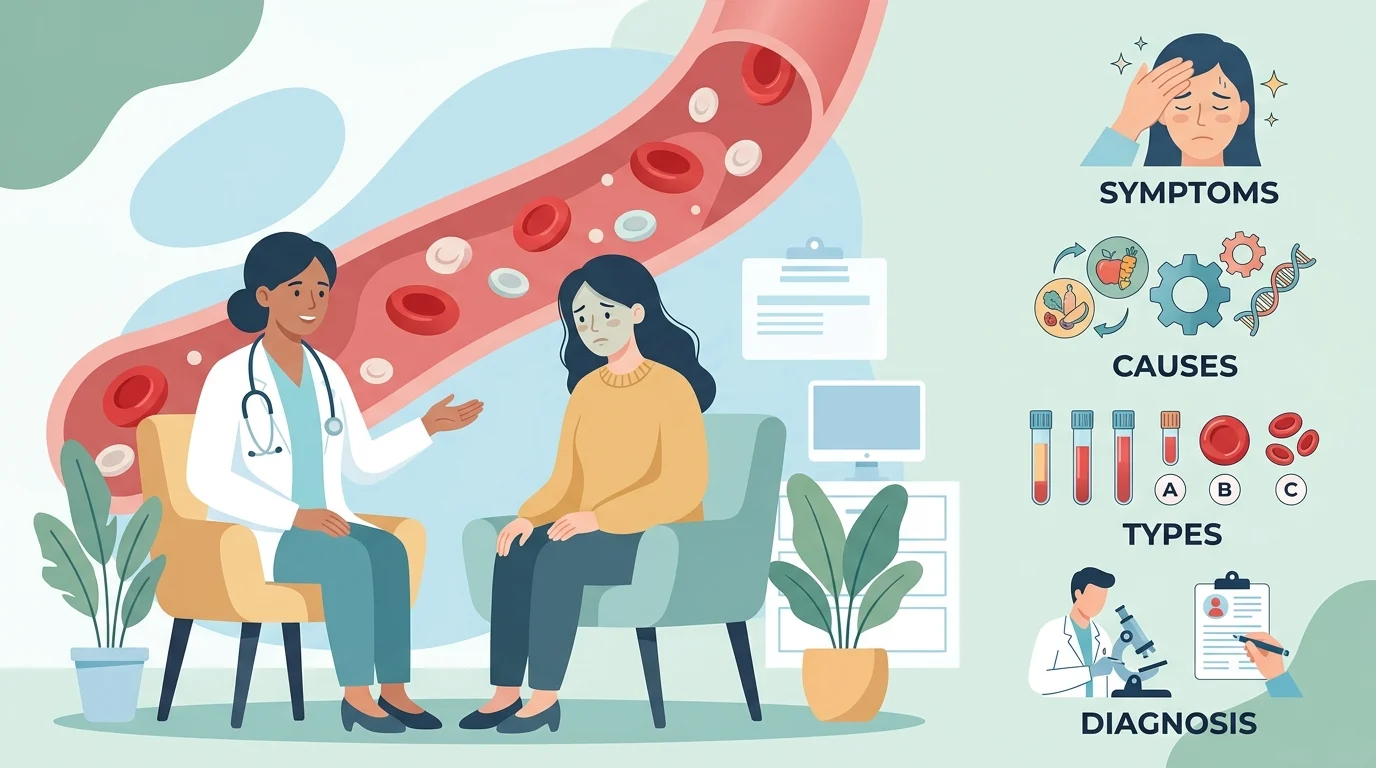
Anaemia is one of the most common blood conditions in the world, yet it is widely misunderstood. It happens when your body does not have enough healthy red blood cells, or enough haemoglobin (the protein inside them that carries oxygen), to supply your tissues with the oxygen they need. The result is often tiredness, paleness, and shortness of breath that build up so slowly you may not notice them at first. This article explains what anaemia is, the symptoms to watch for, the main types, what causes it, the blood tests used to diagnose it, how it is treated, and the latest research changing care for specific forms of the condition.
What anaemia actually is
Red blood cells are made in your bone marrow and live for about four months before being replaced. Each one is packed with haemoglobin, an iron-containing protein that picks up oxygen in the lungs and releases it throughout the body. When the number of red blood cells or the amount of haemoglobin drops below the normal range, less oxygen reaches your muscles, brain, and organs. That oxygen shortfall is what produces the classic feeling of being run down.
Doctors usually confirm anaemia by measuring haemoglobin on a full blood count (FBC). In general terms, anaemia is defined as a haemoglobin level below roughly 13 g/dL in men and below about 12 g/dL in non-pregnant women, though laboratories set their own reference values and pregnancy lowers the threshold.
Why low red blood cells make you feel tired
Oxygen is the fuel your cells burn to make energy. When delivery falls, the heart compensates by beating faster and harder, which is why a racing or pounding heartbeat can accompany anaemia. The brain and muscles are especially sensitive to low oxygen, so concentration, stamina, and exercise tolerance often slip before anything else feels wrong.
“Lack of blood” is a common misconception
Many people search for anaemia as a “lack of blood,” but that phrase is misleading. Anaemia is rarely about the total volume of blood in your body. It is about the quality and quantity of the oxygen-carrying cells within it. You can have a perfectly normal amount of blood and still be anaemic if those cells are too few, too small, or carrying too little haemoglobin.
Common symptoms of anaemia
Mild anaemia may cause no symptoms at all and only show up on a routine blood test. As it becomes more pronounced, the signs tend to include:
- Persistent fatigue and weakness that rest does not fix
- Pale or sallow skin, gums, or inner eyelids
- Shortness of breath, especially during activity
- Dizziness, lightheadedness, or headaches
- Cold hands and feet
- A fast, pounding, or irregular heartbeat
- Brittle nails and increased hair shedding
- Difficulty concentrating or low mood
Because the body adapts as red blood cells decline gradually, symptoms often creep in over weeks or months. A sudden, severe drop, for example from heavy bleeding, can instead cause rapid breathlessness, fainting, or chest pain and needs urgent care.
Symptoms in specific groups
Women with heavy menstrual periods are among the most affected, since regular blood loss steadily drains iron stores. During pregnancy, blood volume expands faster than red blood cell production, so mild anaemia is common and is checked through routine blood tests during pregnancy. Older adults may mistake anaemia for normal ageing, and children with iron deficiency can show irritability, poor appetite, or trouble paying attention rather than obvious tiredness.
The main types of anaemia (and how a blood test tells them apart)
Anaemia is not a single disease but a sign with many possible causes. One of the most useful clues is the average size of your red blood cells, a CBC value called the mean corpuscular volume (MCV). Small cells, normal-size cells, and large cells point towards different underlying problems, which helps a clinician narrow the search quickly.
| Type of anaemia | What goes wrong | Cell-size clue (MCV) | Common causes |
|---|---|---|---|
| Iron-deficiency anaemia | Too little iron to build haemoglobin | Small cells (low MCV) | Heavy periods, gut bleeding, low dietary iron, pregnancy |
| Vitamin B12 or folate deficiency | Missing vitamins needed to make red blood cells | Large cells (high MCV) | Poor absorption, low intake, pernicious anaemia (autoimmune B12 loss) |
| Anaemia of chronic disease | Long-term inflammation blocks iron use | Normal or small cells | Kidney disease, infections, autoimmune conditions, cancer |
| Haemolytic anaemia | Red blood cells destroyed faster than they are made | Often normal cells | Autoimmune disease, inherited cell defects, certain drugs |
| Aplastic anaemia | Bone marrow makes too few cells of all types | Usually normal cells | Autoimmune damage, toxins, some medications |
| Inherited anaemias | Genetic changes in haemoglobin or cell shape | Often small cells | Sickle cell disease, thalassaemia |
If your MCV is low, the cause is most often iron related; you can read more about what that means in our guide to low MCV. If your MCV is high, vitamin deficiency or other factors may be involved, as explained in our overview of high MCV levels.
What causes anaemia
Three basic mechanisms
Every cause of anaemia falls into one of three categories. First, the body may not make enough red blood cells, usually because it lacks a building block such as iron, vitamin B12, or folate, or because the bone marrow is impaired. Second, you may lose red blood cells through bleeding, whether obvious or hidden. Third, red blood cells may be destroyed too quickly, a process called haemolysis. When haemolysis is suspected, doctors often check markers such as haptoglobin and LDH, which change when cells break down.
The most common everyday causes
Iron deficiency is by far the leading cause worldwide. It develops when intake or absorption cannot keep up with the body’s needs or losses. Frequent triggers include heavy menstrual bleeding, slow bleeding in the stomach or intestines, diets low in iron, and pregnancy. Low vitamin B12 or folate, which the body needs to produce healthy cells, is another major source; you can explore these in our articles on low vitamin B12 and folate deficiency. Chronic illnesses such as kidney disease, inflammatory conditions, and cancer can suppress red blood cell production, while inherited disorders like sickle cell disease and thalassaemia are present from birth.
How anaemia is diagnosed
Diagnosis almost always starts with a CBC, which measures haemoglobin, haematocrit (the percentage of blood made up of red cells), red blood cell count, MCV, MCH (the average amount of haemoglobin per cell), and RDW (how much cell size varies). Together these numbers confirm whether you are anaemic and hint at the cause. Our guide on how to read blood test results explains how these values fit together.
If iron deficiency is suspected, the next step is usually an iron studies panel. This includes ferritin, which reflects your stored iron, along with serum iron, transferrin (the protein that carries iron), and transferrin saturation. A 2025 JAMA review notes that iron deficiency is typically diagnosed by a low ferritin, usually under 30 ng/mL in people without inflammation, or a transferrin saturation below 20%. A very low ferritin is a strong signal that iron stores are depleted.
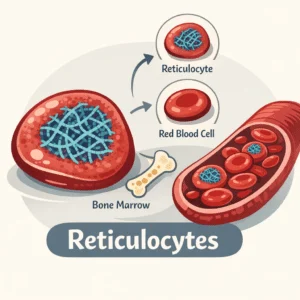
Depending on the cell size and your history, your doctor may add vitamin B12 and folate levels, a reticulocyte count (a measure of how many new red cells the marrow is releasing), kidney function tests, or a haemoglobin analysis to look for inherited conditions. Finding the cause matters as much as confirming the anaemia itself, because treatment differs completely from one type to another.
How anaemia is treated
The single most important principle is that you treat the cause, not just the number. Taking iron when the real problem is bleeding or a vitamin deficiency will not fix the anaemia and can be harmful.
Iron deficiency
Most people start with oral iron, often ferrous sulphate. Research summarised in the 2025 JAMA review suggests that taking iron once a day or even on alternate days can improve absorption and reduce side effects compared with multiple daily doses, because frequent dosing raises a hormone called hepcidin that blocks further uptake. Pairing iron with a source of vitamin C and avoiding tea or coffee at the same time can also help. Iron-rich foods support recovery and prevention; our guide to an iron-rich breakfast offers practical examples. When tablets are not tolerated, absorption is poor, blood loss is ongoing, or iron is needed quickly, intravenous (IV) iron is an effective alternative.
Vitamin B12 and folate
These deficiencies are corrected with supplements or, when the body cannot absorb B12 from food, with injections. Pernicious anaemia, an autoimmune cause of B12 deficiency, usually requires lifelong replacement.
Other types
Anaemia of chronic disease improves when the underlying condition is controlled. Severe anaemia may need a blood transfusion, and inherited or bone marrow disorders are managed by specialists, sometimes with newer targeted therapies. Whether anaemia can be “cured” depends entirely on its cause: nutritional anaemias usually resolve fully once stores are replaced, while inherited forms are managed long term.
Latest scientific advances
Based on recent studies indexed in PubMed, treatment for several specific types of anaemia is moving quickly, even though everyday iron-deficiency anaemia is still managed with the well-established steps above. The developments below are promising, but most apply to particular or rarer conditions and should be interpreted with care: a new option in a clinical trial is not the same as a treatment proven and recommended for everyone.
A landmark example is gene-editing therapy for sickle cell disease. In a phase 3 trial published in 2024, a one-time CRISPR-based treatment called exagamglogene autotemcel (exa-cel, marketed as Casgevy) eliminated severe pain crises for at least a year in the large majority of treated patients (Frangoul H, et al., New England Journal of Medicine, 2024, DOI). It is a major scientific milestone, but it requires intensive hospital conditioning and is among the most expensive medicines ever launched, which researchers warn limits real-world access (Kliegman M, et al., Nature, 2024, DOI).
For inherited anaemias, an oral drug called mitapivat (a pyruvate kinase activator) raised haemoglobin in adults with non-transfusion-dependent thalassaemia in a 2025 phase 3 trial, offering a possible pill-based option where few existed before (Taher AT, et al., The Lancet, 2025, DOI).
In anaemia linked to chronic kidney disease, a newer class of oral medicines known as HIF prolyl hydroxylase inhibitors offers an alternative to injected erythropoiesis-stimulating agents. A 2024 systematic review and meta-analysis of 25 trials and more than 26,000 participants found their long-term cardiovascular safety was broadly comparable to the standard injections (Ha JT, et al., NEJM Evidence, 2024, DOI). For anaemia caused by a bone marrow disorder called lower-risk myelodysplastic syndromes, an injectable drug called luspatercept outperformed standard treatment in a 2024 phase 3 trial and is now considered a new first-line option for eligible patients (Della Porta MG, et al., The Lancet Haematology, 2024, DOI).
Even for ordinary iron deficiency, the evidence base is being refined rather than overturned: the 2025 JAMA review consolidates guidance on alternate-day oral dosing and on when IV iron is the better choice (Auerbach M, et al., JAMA, 2025, DOI). The takeaway is that anaemia care is becoming more tailored to its specific cause, but a doctor remains the right person to decide whether any of these advances fits an individual situation.
When to see a doctor
Mild anaemia is common and often easily treated, but some situations need prompt medical attention. Contact a clinician or seek urgent care if you have:
- Chest pain, severe shortness of breath, or fainting
- A very fast or irregular heartbeat at rest
- Black, tarry, or bloody stools, or vomiting that looks like coffee grounds, which can signal internal bleeding
- Menstrual bleeding so heavy it soaks through protection in an hour or two
- Symptoms of anaemia during pregnancy
- Tiredness, paleness, or breathlessness that is new, worsening, or unexplained
Avoid self-treating with high-dose iron supplements without testing, because too much iron is harmful and can mask the real cause. A simple blood test is the safest way to know what is going on.
Glossary
| Term | Definition |
|---|---|
| Anaemia | A condition in which the blood has too few healthy red blood cells or too little haemoglobin to carry enough oxygen. |
| CBC (complete blood count) | A common blood test that counts red cells, white cells, and platelets and measures haemoglobin and cell size. |
| Ferritin | A protein that stores iron; a low level usually means iron stores are depleted. |
| Haematocrit | The percentage of your blood made up of red blood cells. |
| Haemoglobin | The iron-rich protein inside red blood cells that carries oxygen from the lungs to the body. |
| Haemolysis | The breakdown of red blood cells faster than the body can replace them. |
| MCV (mean corpuscular volume) | The average size of your red blood cells, used to help identify the type of anaemia. |
| Meta-analysis | A study that combines results from many trials to reach a more reliable overall conclusion. |
| Pernicious anaemia | An autoimmune condition that prevents the body from absorbing vitamin B12. |
| Reticulocytes | Young red blood cells; their number shows how actively the bone marrow is producing cells. |
Frequently asked questions
Is anaemia dangerous?
Mild anaemia is usually not dangerous and often easy to treat, but it should not be ignored because it can point to an important underlying problem, such as slow internal bleeding. Severe or rapidly developing anaemia strains the heart and reduces oxygen to vital organs, which can be serious. The risk depends on how low the haemoglobin is, how fast it dropped, and your overall health, so it is best assessed with a blood test and a doctor’s review.
Can anaemia be cured?
It depends on the cause. Anaemia from iron, vitamin B12, or folate deficiency can usually be corrected completely once the missing nutrient is replaced and any source of loss is addressed, though it may take a few months. Anaemia tied to a chronic illness tends to improve when that condition is managed. Inherited anaemias such as sickle cell disease or thalassaemia are generally managed over the long term rather than cured, although new therapies are expanding the options.
Can anaemia cause headaches, hair loss, or make you feel cold?
Yes, all three are recognised effects. Reduced oxygen delivery to the brain can trigger headaches and difficulty concentrating, whilst poor circulation often leaves the hands and feet feeling cold. Iron deficiency in particular is associated with increased hair shedding, which usually improves once iron levels are restored. These symptoms are not specific to anaemia, so testing is needed to confirm the cause.
Is anaemia genetic?
Some forms are. Sickle cell disease, thalassaemia, and certain rarer red blood cell disorders are inherited and can be passed from parents to children. However, the most common causes of anaemia, such as iron deficiency and vitamin deficiency, are not genetic and are linked to diet, bleeding, or other health conditions. If anaemia or an inherited blood disorder runs in your family, mention it to your doctor.
What causes anaemia during pregnancy?
During pregnancy the volume of blood increases faster than the production of red blood cells, which naturally dilutes haemoglobin and causes mild anaemia in many women. The growing baby also increases demand for iron and folate, so deficiency is common if intake is low. This is why iron and folate are routinely checked and often supplemented in pregnancy. Significant or symptomatic anaemia should always be reviewed by a healthcare provider.
How long does it take to recover from anaemia?
For iron-deficiency anaemia, haemoglobin often begins to rise within a few weeks of starting treatment, but it usually takes two to three months to normalise and several more months to fully refill iron stores, so completing the full course matters. Recovery time varies with the cause, the severity, and how well the underlying problem is controlled. Follow-up blood tests confirm that levels are improving as expected.
Sources
- Anaemia – What Is Anaemia? (NHLBI, National Institutes of Health)
- Anaemia: Symptoms, Causes & Treatment (Cleveland Clinic)
- Anaemia (American Society of Hematology)
- Frangoul H, et al. Exagamglogene autotemcel for severe sickle cell disease. New England Journal of Medicine, 2024. DOI
- Auerbach M, DeLoughery TG, Tirnauer JS. Iron deficiency in adults: a review. JAMA, 2025. DOI
- Ha JT, et al. Hypoxia-inducible factor prolyl hydroxylase inhibitors in kidney disease (systematic review and meta-analysis). NEJM Evidence, 2024. DOI
- Taher AT, et al. Mitapivat in adults with non-transfusion-dependent thalassaemia (ENERGIZE). The Lancet, 2025. DOI
- Della Porta MG, et al. Luspatercept versus epoetin alfa in lower-risk myelodysplastic syndromes (COMMANDS). The Lancet Haematology, 2024. DOI
Further reading
- Complete blood count: how to read your results
- Iron studies panel: ferritin, TIBC and more explained
- Low ferritin: causes, symptoms, and treatment
- Low vitamin B12: symptoms, causes, treatments
- Blood tests during pregnancy: what’s checked
Understand your lab results with AI DiagMe
Anaemia is found and followed almost entirely through blood work, but a page of numbers like haemoglobin, MCV, ferritin, serum iron, and vitamin B12 can be hard to make sense of on your own. AI DiagMe helps you understand what your results mean in plain language, putting each value in context so you can have a more informed conversation with your doctor. It is designed to help you understand your results, not to diagnose or replace medical advice. If you have a recent blood test, you can see what it is telling you in just a few minutes.
➡️ Get your results interpreted in minutes