










A reticulocyte count measures how many young, immature red blood cells your bone marrow is releasing into your bloodstream. Because those new cells appear within a day or two of being made, the number works as a real-time snapshot of how hard your marrow is working to replace red blood cells. Doctors order it most often to find the cause of anaemia, to check whether a treatment is working, and to see how well the marrow is recovering after chemotherapy. In this article you will learn what the test measures, how to read a percentage, an absolute count, and the corrected indices, what high and low results can mean, and which related blood tests help complete the picture. The goal is to make your result less intimidating, not to replace your doctor’s interpretation.
What is a reticulocyte count?
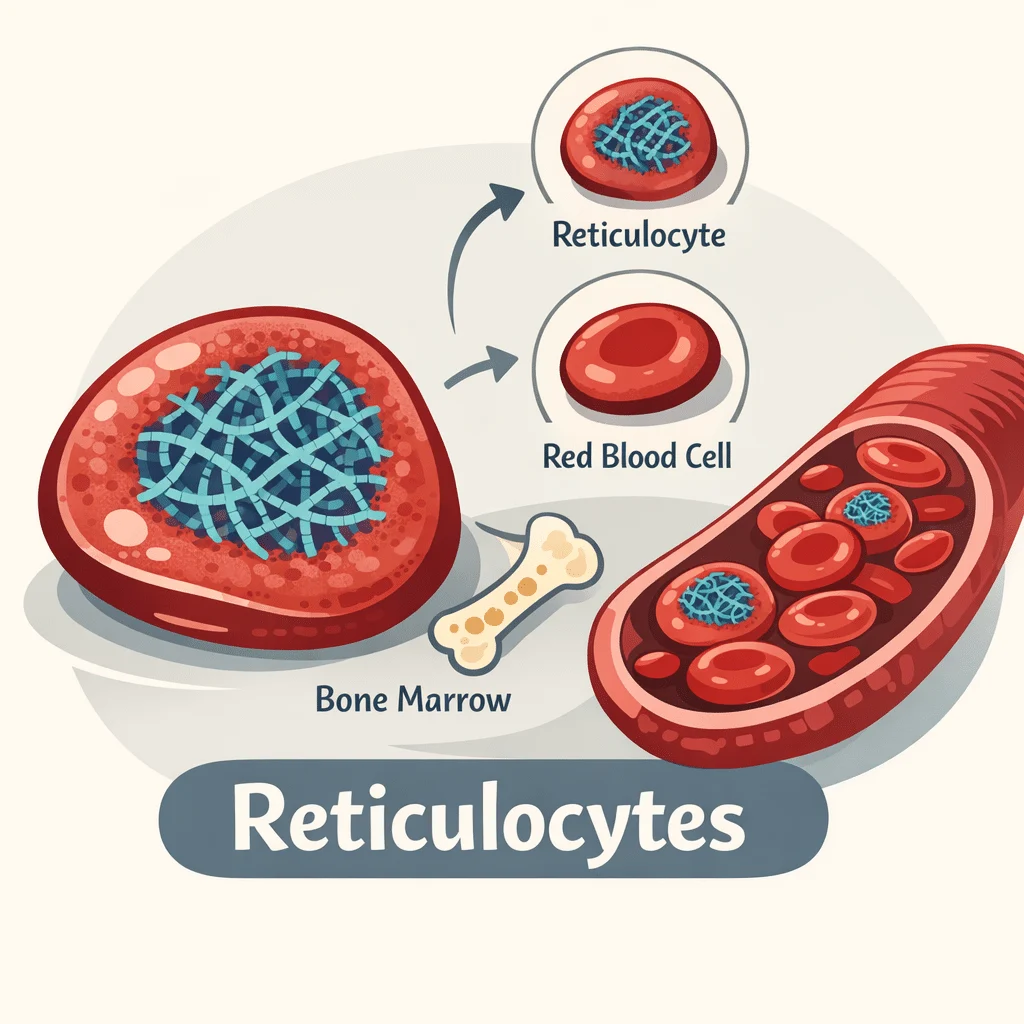
Reticulocytes are red blood cells that have just left the production line in your bone marrow. They have already pushed out their nucleus, but they still carry leftover genetic material called RNA, which is exactly what laboratory stains and automated analysers detect. These young cells usually circulate for only one to two days before maturing into fully formed red blood cells, so counting them shows your doctor how actively the marrow is producing replacements at this moment.
The whole process is driven by a hormone called erythropoietin (EPO), which your kidneys release when your tissues need more oxygen, for example during anaemia, after blood loss, or at high altitude. EPO levels typically rise three to four days before the reticulocyte count climbs, so the test reflects a recent, deliberate response by the body. Because the marrow is the factory and reticulocytes are its freshest output, the count acts as a production gauge: it helps separate anaemia caused by a marrow that cannot keep up from anaemia caused by red blood cells being lost or destroyed too quickly.
The reticulocyte count is frequently run alongside, or triggered by, a full blood count when red blood cell values look abnormal. To see how the wider panel fits together, you can review our full blood count guide. The reticulocyte result adds the piece a standard count cannot show on its own: the speed of new cell production.
How a reticulocyte count is measured and reported
Modern haematology analysers measure reticulocytes automatically and can report them in several complementary ways. Each format answers a slightly different question, and your report may show one or all of them. The table below summarises the measures you are most likely to encounter.
| Measure | What it tells you | Typical reference point | Why it matters |
|---|---|---|---|
| Reticulocyte percentage | Share of red blood cells that are reticulocytes | About 0.5% to 2.5% in adults | Quick screen, but can mislead when red cell numbers are low |
| Absolute reticulocyte count | Actual number of reticulocytes in a set volume of blood | Often around 25,000 to 85,000 cells/µL (labs vary) | Less distorted by anaemia than the percentage |
| Corrected reticulocyte count | The percentage adjusted for the degree of anaemia | Scaled against a normal haematocrit | Prevents a falsely reassuring percentage in anaemia |
| Reticulocyte production index (RPI) | Whether marrow output matches the severity of anaemia | Above roughly 2 suggests an adequate response | Separates a responding marrow from a sluggish one |
| Immature reticulocyte fraction (IRF) | Proportion made up of the very youngest reticulocytes | A higher value means a brisk, early response | Early signal of marrow recovery or relapse |
| Reticulocyte haemoglobin (Ret-He / CHr) | How much iron has been built into new red cells | Below about 28 to 30 pg suggests iron-deficient cells | Flags iron deficiency earlier than some other tests |
Reticulocyte percentage and absolute count
The percentage is the most familiar figure, but it has a built-in trap. It describes reticulocytes as a fraction of all red blood cells, so when the total red cell count falls in anaemia, the percentage can look high even when the marrow is barely producing. The absolute reticulocyte count sidesteps that problem by reporting the actual number of young cells, which is why many clinicians look at it first when anaemia is present.
Corrected reticulocyte count and the reticulocyte production index (RPI)
To fix the percentage trap, laboratories calculate a corrected reticulocyte count, which scales the percentage to your haematocrit, the share of blood made up of red cells. The reticulocyte production index goes one step further by accounting for the fact that young cells released under stress survive a little longer in circulation. As a commonly used guide, an index above roughly 2 to 3 suggests the marrow is responding appropriately to anaemia, while a value below 2 points to a marrow that is under-producing. Your laboratory or doctor calculates these corrections for you, so you do not need to do the maths yourself.
Immature reticulocyte fraction (IRF) and reticulocyte haemoglobin (Ret-He)
Two newer indices add useful detail. The immature reticulocyte fraction (IRF) measures what share of reticulocytes are the youngest of all, and a rising IRF is one of the earliest signs that a marrow is springing back to life, which makes it valuable after chemotherapy or a bone marrow transplant. Reticulocyte haemoglobin, written as Ret-He or CHr, estimates how much iron has actually been packed into brand-new cells, giving an early window onto iron-deficient production. Values below about 28 to 30 picograms typically point to iron-starved red cells. To see how iron status is assessed more fully, you can explore our iron studies panel guide.
Normal reticulocyte count ranges
Reference ranges differ from one laboratory to another because they depend on the equipment used and the population each lab studies, so the numbers printed on your own report are the ones that matter. As a general guide, healthy adults usually fall between about 0.5% and 2.5%, a range used by the Cleveland Clinic and by the clinical reference material in StatPearls. Newborns are naturally higher, often 2% to 6%, because they produce red cells rapidly after birth, and the level settles towards the adult range within the first months of life. When an absolute count is reported, many labs use a range of roughly 25,000 to 85,000 cells per microlitre, though this too varies by method.
A practical habit is to read the reticulocyte count next to your haemoglobin rather than on its own. If haemoglobin is low but the reticulocyte count is high, the marrow is responding to the shortfall as it should. If haemoglobin is low and the reticulocyte count is also low, the marrow itself may be the problem. To understand the oxygen-carrying value it is paired with, you can read our haemoglobin guide.
What a high reticulocyte count means
A higher-than-normal result, known as reticulocytosis, usually means the marrow is working overtime to replace red blood cells the body is losing or destroying. A healthy marrow is doing its job here, so a high count is often a sign of an appropriate response rather than a disease in itself. The pattern still needs context, because the underlying reason matters.
Haemolytic anaemia and blood loss
In haemolytic anaemia, red blood cells are broken down faster than their normal lifespan of about four months, and the marrow ramps up reticulocyte production to compensate. After bleeding, whether sudden or slow and hidden, the marrow responds the same way. When destruction of red cells is suspected, doctors often check markers that change as cells break apart; see our haptoglobin guide and read our LDH blood test guide, since haptoglobin tends to fall and LDH tends to rise during haemolysis.
Recovery after starting treatment
A rising reticulocyte count is also good news when it follows treatment. When someone with iron, vitamin B12, or folate deficiency begins the right supplement, the count usually climbs within about three to five days as the marrow restarts production. Clinicians call this the reticulocyte response, and it is one of the simplest ways to confirm that a treatment is working. Although some people search whether a high reticulocyte count means cancer, the far more common reasons are bleeding, haemolysis, or a marrow that is recovering well, and a blood cancer is never diagnosed from this single number.
What a low reticulocyte count means
A low result means the marrow is not replacing red blood cells quickly enough to meet the body’s needs. When this happens alongside anaemia, it points toward a production problem rather than a loss or destruction problem, and the next step is usually to find out which building block or process is missing.
Iron deficiency is the most common cause worldwide. Without enough iron, the marrow cannot build haemoglobin, so the reticulocyte count stays low or inappropriately normal even though the body needs more red cells. You can read our low ferritin guide to see how depleted iron stores are detected. Shortfalls of vitamin B12 or folate disrupt red cell production in a different way; see our low vitamin B12 guide and read our folate deficiency guide.
Other causes sit further upstream. In aplastic anaemia the marrow fails to make enough cells of any kind, while chronic kidney disease lowers EPO, the very hormone that tells the marrow to produce red cells; you can explore our kidney function panel guide to see how kidney health is checked. Chemotherapy and some other medicines temporarily suppress production as well. Because small red cells often accompany iron problems, doctors may also weigh the average cell size, and you can see our low MCV guide for that part of the picture.
Reading a reticulocyte count alongside other markers
Because the reticulocyte count is a production gauge, it is most powerful when paired with haemoglobin and a few iron markers. The quick guide below shows patterns clinicians see often. It is a starting point for understanding, not a diagnosis, and only your doctor can confirm what your particular combination means.
| Haemoglobin | Reticulocyte count | What it often suggests | Tests a doctor may add |
|---|---|---|---|
| Low | High | Blood loss or haemolysis, with the marrow responding | Haptoglobin, LDH, bilirubin |
| Low | Low or normal | A production problem: iron, B12, folate, marrow, or kidney | Ferritin, iron studies, B12, folate, kidney function |
| Normal | High | Recent bleeding or an anaemia that is recovering | Repeat FBC, iron studies |
| Normal | Normal | Usually reassuring for red cell production | Routine follow-up if symptoms continue |
One more nuance is worth knowing: a reticulocyte count can be technically normal yet still be too low for the situation. When anaemia is severe but the count has not risen to match it, clinicians describe an inappropriate response, which is exactly why the corrected count and production index exist.
Latest scientific advances
Based on recent studies indexed in PubMed, one of the most active areas around the reticulocyte count is reticulocyte haemoglobin (Ret-He), the index that estimates how much iron sits inside the newest red cells. The findings below are promising, but they should be read with care: a marker that performs well in one group can be weaker in another, and none of this replaces a doctor’s assessment.
In a multicentre study of 2,760 major surgical patients, a low Ret-He (below 33.5 picograms) helped identify iron-deficiency anaemia with good accuracy and stayed useful even when ferritin was falsely high because of inflammation, a situation where standard iron tests can mislead (Choorapoikayil S, et al., BMC Anesthesiology, 2025, DOI). A large paediatric study at a US children’s hospital reached a similar conclusion, finding that Ret-He at or below about 30 picograms helped confirm iron deficiency in children (Poventud-Fuentes I, et al., International Journal of Laboratory Hematology, 2024, DOI).
The limits matter just as much as the promise. In a US cohort of pregnant patients, Ret-He showed only low accuracy for detecting mild iron deficiency, and the authors concluded that ferritin remained the preferable test in pregnancy (Haizler-Cohen L, et al., American Journal of Perinatology, 2024, DOI). Taken together, the appeal of Ret-He is that it rides on the same blood sample as a routine full blood count and is not thrown off by inflammation, but the current evidence suggests it complements ferritin and iron studies rather than replacing them. As always, which test fits a given person is a decision for a clinician.
When to see a doctor
A reticulocyte count is a clue, not a verdict, and a single out-of-range value is rarely an emergency on its own. Still, some situations deserve prompt medical attention. Contact a healthcare professional, or seek urgent care, if you notice:
- A reticulocyte count that is very high or very low, especially with other abnormal blood values
- Severe fatigue, breathlessness, dizziness, or a fast or pounding heartbeat
- Signs of bleeding, such as black or tarry stools, or menstrual bleeding that soaks through protection in an hour or two
- A rapid change in your values between two tests
- Symptoms that are new, worsening, or unexplained
If the change is mild, isolated, and you feel well, your doctor may simply recommend a repeat test later. It is wise to avoid taking high-dose iron or other supplements without testing first, because too much iron is harmful and can hide the real cause. A simple blood test, read in context, is the safest way to know what is happening.
Glossary
| Term | Definition |
|---|---|
| Reticulocyte | A young red blood cell, recently released from the bone marrow, that still contains traces of RNA and matures within a day or two. |
| Reticulocyte count | A blood test that measures how many reticulocytes are present, showing how actively the marrow is making red blood cells. |
| Erythropoietin (EPO) | A hormone made mainly by the kidneys that signals the bone marrow to produce more red blood cells. |
| Absolute reticulocyte count | The actual number of reticulocytes in a set volume of blood, less affected by anaemia than the percentage. |
| Corrected reticulocyte count | The reticulocyte percentage adjusted for the degree of anaemia, giving a fairer picture of marrow output. |
| Reticulocyte production index (RPI) | A calculation that shows whether the marrow’s response is adequate for the severity of anaemia. |
| Immature reticulocyte fraction (IRF) | The share of reticulocytes that are the youngest, used as an early sign of marrow recovery. |
| Reticulocyte haemoglobin (Ret-He / CHr) | An index of how much iron has been built into new red cells, used to spot iron-deficient production early. |
| Reticulocytosis | A higher-than-normal reticulocyte count, often a response to bleeding or red blood cell destruction. |
| Haemolytic anaemia | Anaemia caused by red blood cells being destroyed faster than the marrow can replace them. |
Frequently asked questions
Is a reticulocyte count part of a FBC?
It is closely related but usually a separate measurement. A standard full blood count reports red cell numbers, haemoglobin, and cell size, while the reticulocyte count specifically measures new cell production. Many modern analysers can produce it from the same blood sample, and labs often run it automatically when red cell results look abnormal or when a doctor requests it. So although it travels with the FBC, it is typically reported as its own value rather than being included in every routine count.
Do reticulocytes have a nucleus?
No. By the time a reticulocyte is released into the blood, it has already expelled its nucleus, which is what separates it from even younger cells called nucleated red blood cells. What it still carries is leftover RNA, the material that stains and analysers detect to identify and count these cells. This is why reticulocytes are described as immature red blood cells rather than as a completely different cell type: they are one short step away from being fully mature.
What does a high reticulocyte count mean?
A high count usually means the bone marrow is producing red blood cells faster than usual, most often to replace cells lost through bleeding or destroyed in haemolysis, or as a healthy response to treatment for anaemia. In that sense it often reflects a marrow that is working well. The result still needs to be read alongside your haemoglobin and your symptoms, because the reason behind the rise is what guides any next steps. Your doctor is best placed to interpret it.
What does a low reticulocyte count mean?
A low count suggests the marrow is not making enough new red blood cells. Common reasons include iron, vitamin B12, or folate deficiency, chronic kidney disease, the effects of chemotherapy, or a marrow disorder such as aplastic anaemia. When a low count appears together with anaemia, it usually points to a production problem rather than blood loss. Identifying which cause is responsible, often with iron studies or vitamin levels, matters because the treatments are very different.
Can you have a normal reticulocyte count with anaemia?
Yes, and it is an important pattern. A count that looks normal can actually be too low for the situation when anaemia is significant, because a healthy marrow should be producing extra cells to compensate. Clinicians call this an inappropriate reticulocyte response. To reveal it, they often calculate the corrected reticulocyte count or the reticulocyte production index, which adjust the raw number for the degree of anaemia and show whether the marrow is truly keeping up.
Are reticulocytes increased in iron-deficiency anaemia?
Usually not. Because iron is a building block the marrow needs to make red cells, iron deficiency tends to keep the reticulocyte count low or only normal rather than high, even though the body needs more cells. This is the opposite of what happens in haemolytic anaemia or after bleeding, where the count rises. The contrast is one reason the reticulocyte count is so useful: it helps separate anaemias caused by a supply shortage from those caused by loss or destruction.
Sources
- Reticulocyte Count (MedlinePlus, National Library of Medicine, NIH)
- Reticulocyte Count: Testing, Purpose & Results (Cleveland Clinic)
- Histology, Reticulocytes (StatPearls, NCBI Bookshelf, NIH)
- Choorapoikayil S, et al. Reticulocyte hemoglobin content: a new frontier in iron deficiency diagnostics for major surgical patients. BMC Anesthesiology, 2025. DOI
- Poventud-Fuentes I, et al. Reticulocyte hemoglobin equivalent as a marker to assess iron deficiency: a large pediatric tertiary care hospital study. International Journal of Laboratory Hematology, 2024. DOI
- Haizler-Cohen L, et al. Utility of Reticulocyte Hemoglobin Equivalent in Screening for Iron Deficiency in Pregnancy. American Journal of Perinatology, 2024. DOI
Further reading
- Anaemia: symptoms, causes, and the blood tests used to diagnose it
- Complete blood count: how to read your results
- Low ferritin: causes, symptoms, and treatment
- Haemoglobin: understanding this key blood marker
- How to read your blood test results
Understand your lab results with AI DiagMe
A reticulocyte count rarely travels alone. It makes the most sense next to values like haemoglobin, ferritin, and the rest of your full blood count, and reading all of them together is where confusion usually starts. AI DiagMe helps you understand what each of these results means in plain language, putting your reticulocyte count in context so you can ask your doctor sharper questions. It is designed to help you understand your results, not to diagnose a condition or replace medical advice. If you have a recent blood test, you can see what it is telling you in just a few minutes.
➡ Get your results interpreted in minutes