








A transferrin blood test measures the protein that carries iron through your bloodstream. It is almost never read on its own: your doctor reads it as one line of an iron panel, next to serum iron, ferritin and transferrin saturation. The result that surprises most people is the direction of travel. When iron runs low, transferrin usually goes up rather than down, because the body builds more carriers to scavenge whatever iron is left. A high transferrin is therefore far more often a sign of iron deficiency than of iron excess. In this article you’ll learn what transferrin does, why transferrin saturation is the more useful number, how TIBC and UIBC fit in, why illness can hide a genuine iron problem, and when a result deserves a conversation with your doctor.
What transferrin does in the body
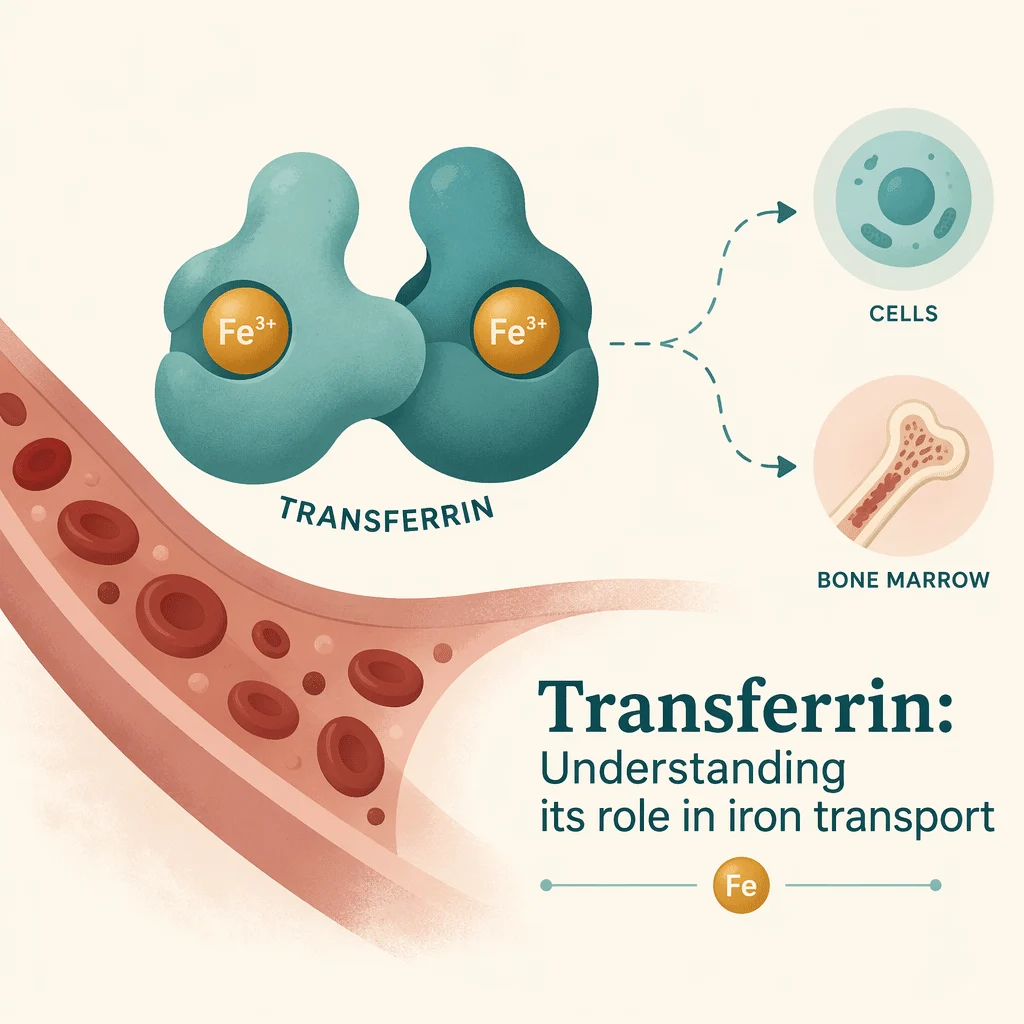
Iron is essential, but loose iron in the bloodstream is chemically aggressive and damages tissue, so the body never lets it travel alone. Transferrin is the escort: a protein made mainly in the liver that binds iron atoms, keeps them soluble and harmless, and delivers them to the cells that need them.
Each transferrin molecule carries up to two iron atoms. Most of that cargo goes to the bone marrow, where developing red blood cells use iron to build haemoglobin, the molecule that carries oxygen. Delivery works like a shuttle: cells display transferrin receptors, loaded transferrin docks on, the cell pulls the package inside and releases the iron, and the empty transferrin returns to the circulation to collect another load.
Because the liver makes transferrin, and adjusts how much it makes according to how much iron is around, the level is a window onto two things at once: liver function, and iron handling.
Why a transferrin blood test is never read alone
A transferrin value on its own is close to meaningless. The same number can point in opposite directions depending on what sits beside it. This is why laboratories group the measurements together, and why your doctor will usually order a full iron studies panel rather than a single marker.
The panel typically contains four pieces of information. Serum iron is a snapshot of the iron circulating right now, and it swings widely through the day and after meals. Ferritin reflects how much iron is stored in the tissues. Transferrin, or its near-twin TIBC, shows how much carrying capacity the body has built. Transferrin saturation is the ratio between the iron present and the capacity available.
None of these is a verdict by itself. Read together, though, they form a recognisable pattern, and the pattern is what your doctor is actually reading.
Why high transferrin usually means low iron
This is the single point that confuses readers most, so it is worth stating plainly: high transferrin generally means too little iron, not too much.
The logic becomes obvious once you picture transferrin as a fleet of delivery vans. When iron is scarce, the body puts more vans on the road, hoping to capture every last atom that passes through. Carrying capacity climbs. But because there is little iron to carry, most of those vans travel empty, so transferrin saturation falls even as transferrin rises. In iron overload the mirror image happens: the body has no reason to build extra carriers, so capacity falls whilst the few vans on the road travel packed full, and saturation climbs.
That gives a rule of thumb worth remembering. High transferrin with low saturation points towards iron deficiency, which over time may develop into iron deficiency anaemia. Low transferrin with high saturation points towards iron overload. It is the combination, not the transferrin figure, that carries the meaning. A reader who sees “transferrin: high” flagged on a report and concludes they have too much iron has reached exactly the wrong conclusion, and acting on that assumption can cause real harm.
Transferrin saturation: the number that matters most
If you only look at one line of the iron panel, make it transferrin saturation. Often abbreviated TSAT and reported as a percentage, it answers a direct question: of all the seats available on your transferrin, how many are actually occupied by iron? Many laboratories report the same idea as iron saturation or the saturation coefficient. It is more informative than transferrin alone because it already combines two measurements, and because it moves in the intuitive direction: more iron, higher number.
What a high transferrin saturation can signal
A persistently raised transferrin saturation, roughly above 45%, is the classic screening signal for iron overload, and it is the most clinically actionable finding on the whole panel. The commonest underlying cause is hereditary haemochromatosis, a genetic condition in which the body absorbs more iron from food than it needs and gradually deposits the surplus in the liver, heart, pancreas and joints.
Two facts deserve equal billing here, because together they justify calm rather than alarm. First, this genuinely matters: unaddressed iron overload can damage organs, and the damage is largely preventable if picked up early. According to the National Institute of Diabetes and Digestive and Kidney Diseases, doctors diagnose haemochromatosis mainly on blood tests, using the ratio of iron to transferrin and the ferritin level, followed by genetic testing. Second, a single raised saturation is not a diagnosis. Levels rise after an iron-rich meal, after supplements and in other situations, which is why the test is usually repeated, often fasting, before anyone draws conclusions.
Haemochromatosis is also both common and treatable. The Centers for Disease Control and Prevention notes that it occurs most often in people with Northern European ancestry, that many people carrying the genetic changes never develop symptoms or complications, and that where treatment is needed, regularly scheduled blood removal is the most effective way to reduce the body’s iron. Our guide to haemochromatosis treatment options explains what that involves. The decision belongs with your doctor.
What a low transferrin saturation can signal
A saturation below roughly 20% suggests that not enough iron is reaching the cells that need it. In the straightforward case this reflects genuinely depleted stores, and the panel will usually show low ferritin levels alongside high transferrin. Red cells made under these conditions tend to be small and pale, often appearing on the blood count as a low MCV.
There is a second, trickier version: iron may be present but locked away in storage where developing red cells cannot reach it. Clinicians call this functional iron deficiency, and it is common in chronic inflammatory and cardiovascular conditions. Here ferritin looks normal or even high whilst saturation stays low, which is precisely why the two are read together.
TIBC and UIBC explained
Many reports never print the word transferrin at all. Instead they show TIBC, and sometimes UIBC. If that describes your report, you have not been given a different test, only the same information measured a different way.
Total iron-binding capacity, or TIBC, measures how much iron the blood could carry if every binding site were filled. Since transferrin does almost all of that carrying, TIBC is essentially transferrin counted by the seats it provides instead of by the protein itself, and the two rise and fall together. Unsaturated iron-binding capacity, or UIBC, measures the seats currently empty, so serum iron plus UIBC gives you TIBC.
Everything said above about transferrin therefore applies unchanged to TIBC. A high TIBC usually means low iron. Transferrin saturation is calculated as serum iron divided by TIBC, expressed as a percentage. If your report shows a high TIBC and a low saturation, that is the iron deficiency pattern in different vocabulary.
Reading your iron panel as a pattern, not a list of numbers
This table shows the combinations that come up most often in practice. It is a guide to how the panel is reasoned about, not a way to diagnose yourself: real reports are messier, and your history, symptoms and other results all change the reading.
| Serum iron | Ferritin | Transferrin / TIBC | Saturation | Likely picture | Usual next step |
|---|---|---|---|---|---|
| Low | Low | High | Low | Iron deficiency, the classic pattern | Your doctor looks for the cause of the loss and decides what, if anything, to do about it |
| Normal | Low | High | Low to normal | Early iron depletion, before anaemia appears | Discuss with your doctor; the cause still matters |
| Low | Normal or high | Low to normal | Low | Inflammation in the picture; iron may be present but unavailable, or a real deficiency may be masked | Check CRP; repeat the panel once the illness has settled |
| High | High | Low to low-normal | High, above about 45% | Possible iron overload, including hereditary haemochromatosis | Repeat fasting; your doctor may arrange genetic testing and further assessment |
| Low to normal | Normal | Low | Normal | Transferrin low for a non-iron reason: liver disease, protein loss or undernutrition | Liver tests, albumin and urine protein are usually reviewed |
| Normal | Normal | Normal | Normal | Iron handling looks unremarkable | No further iron testing usually needed |
How inflammation distorts iron studies
Here is the trap that catches even experienced readers. Transferrin is what biochemists call a negative acute-phase protein: when the body mounts an inflammatory response, whether from an infection, an autoimmune flare, recent surgery or a chronic illness, the liver reduces transferrin production. At the same time ferritin, a positive acute-phase protein, climbs for reasons that have nothing to do with how much iron is stored.
The two markers move in opposite directions, and both move away from the truth. Someone genuinely short of iron who is also unwell can produce a panel that looks reassuring: transferrin pulled down towards normal, ferritin pushed up into the normal range. The deficiency is real and the numbers hide it.
This is why iron studies taken during an acute illness are unreliable, and why your doctor may check C-reactive protein (CRP) alongside them. A raised CRP tells the reader to distrust the ferritin. It is also why saturation earns its keep: it holds up better than ferritin when inflammation is present, though it is not immune either. Where the picture stays murky, repeating the panel once you are well is often the most informative next step.
Other reasons transferrin runs low
Iron status is not the only thing that moves transferrin, and it is worth knowing the alternatives so a low result does not automatically read as iron overload.
The liver makes transferrin, so anything impairing the liver’s manufacturing can reduce it. In cirrhosis and other chronic liver conditions, transferrin often falls simply because production has dropped, which is why doctors read the result alongside liver function tests.
Transferrin is built from protein, so a genuine shortage of dietary protein, or severe malabsorption, limits how much the liver can make. Doctors typically also find low albumin levels here, since albumin faces the same constraint. Protein can also be lost rather than under-produced: in nephrotic syndrome, damaged kidney filters leak proteins including transferrin into the urine, so the level falls despite normal liver function, and the laboratory looks for protein in the urine.
Movement in the other direction is not always a problem. Pregnancy raises transferrin substantially, and this is expected physiology rather than disease, as our guide to blood tests during pregnancy describes. Oestrogen has the same effect, so combined oral contraceptives and oestrogen therapy commonly nudge it upwards. Mentioning what you take matters when your results are interpreted.
Carbohydrate-deficient transferrin is a different test
One clarification prevents a common misunderstanding. Carbohydrate-deficient transferrin, usually abbreviated CDT, sounds like a refinement of the transferrin blood test. It is not: it is a separate test for a separate purpose, and it says nothing about your iron.
Transferrin normally carries sugar chains attached to its structure. Sustained heavy alcohol consumption alters that attachment, producing molecules missing some of those chains. CDT measures the proportion of these altered forms, which makes it a marker of alcohol intake over recent weeks, used in specialist and occasionally legal settings. It is sometimes considered alongside an alcohol urine test, which covers a much shorter window.
So if your report says transferrin or TIBC, you have had the iron test. Only an explicit mention of CDT means the alcohol marker.
When to see a doctor
Most abnormal transferrin results turn out to be manageable, and many are explained by something as ordinary as heavy periods, pregnancy or a recent infection. Some findings, though, warrant a conversation rather than a wait.
Arrange to speak with your doctor if any of the following applies to you:
- Your transferrin saturation is above about 45%, particularly if it stays high on a repeat sample.
- Your ferritin is high and your saturation is high at the same time.
- You have a parent, sibling or child diagnosed with haemochromatosis, whatever your own results show.
- You have persistent fatigue, joint pain (often in the knuckles), abdominal pain, loss of libido, or a bronze or grey tint to your skin.
- Your saturation or ferritin is low, and you have not had a cause identified.
- You are short of breath on exertion, unusually pale, dizzy, or notice a racing heartbeat.
- You are already taking any iron-containing product and your results have changed.
One rule applies in every case: do not start, stop or adjust iron supplements on the strength of a transferrin result. Iron taken on a wrong assumption is genuinely harmful in iron overload, and unnecessary iron irritates the gut for no benefit. That decision needs your doctor and the full picture.
Latest scientific advances in transferrin testing
Recent work has sharpened, rather than overturned, how these markers are used.
Transferrin saturation has been reaffirmed as the defining signal for iron overload. A 2024 review in the American Society of Hematology’s education programme, by Girelli and colleagues, describes raised transferrin saturation as the diagnostic hallmark of haemochromatosis, the marker separating it from the far more numerous other causes of a high ferritin. It also puts the condition in proportion: the common HFE form is present in roughly 1 in 200 people of Northern European descent, but penetrance is low, meaning most carriers never become ill, particularly women. The condition is now usually caught before organ damage and has an excellent outlook when treated. What this means for you: a high saturation is a reason for proper assessment, not for alarm, and a high ferritin alone is much more often something other than haemochromatosis.
On the deficiency side, the case for reading saturation alongside ferritin keeps strengthening. A 2026 study by Kawamata and colleagues examined women with adenomyosis, which causes both heavy bleeding and inflammation. Ferritin alone identified iron deficiency in around 31% of them; adding transferrin saturation raised that to about 66%, so roughly half the affected women would have been missed. This was a retrospective single-centre study in one patient group, so the exact numbers will not transfer everywhere. What this means for you: if you have an inflammatory condition and your ferritin looks acceptable, saturation may still reveal a deficiency the ferritin conceals.
Why ferritin behaves this way remains only partly understood. A 2023 review by Fonseca and colleagues describes the inflammatory rise in ferritin as one of the genuine open questions of iron biology: where the circulating protein comes from, how it is released and what it does are all unresolved. What this means for you: caution about interpreting ferritin during illness is not excessive conservatism, it reflects a real gap in the science, and it is one reason clinicians lean on the wider panel.
That thinking is now embedded in guidance. A 2026 position paper from the Inter-American Society of Cardiology, led by García-Zamora and colleagues, on anaemia and iron deficiency before cardiac surgery, defines functional iron deficiency explicitly as a normal or raised ferritin combined with a transferrin saturation below 20%, and states that haemoglobin, ferritin and saturation must be interpreted together. What this means for you: reading the panel as a pattern rather than a list of numbers is not an editorial simplification, it is how specialist bodies now instruct clinicians to work.
Glossary
| Term | Definition |
|---|---|
| Transferrin | The protein, made mainly in the liver, that binds iron and carries it safely through the blood to the cells that need it. |
| Transferrin saturation (TSAT) | The percentage of transferrin’s iron-binding sites that are actually occupied. Calculated as serum iron divided by TIBC. |
| TIBC | Total iron-binding capacity: how much iron the blood could carry if every binding site were filled. Rises and falls with transferrin. |
| UIBC | Unsaturated iron-binding capacity: the binding sites currently empty. Serum iron plus UIBC equals TIBC. |
| Ferritin | The protein that stores iron in tissues. Usually reflects iron stores, but rises during inflammation regardless of them. |
| Serum iron | The amount of iron circulating in the blood at the moment of the draw. Varies throughout the day and after meals. |
| Acute-phase protein | A protein whose blood level shifts during inflammation. Ferritin rises (positive); transferrin and albumin fall (negative). |
| Functional iron deficiency | Iron is present in the body but locked in storage and unavailable to cells. Ferritin looks normal or high whilst saturation stays low. |
| Hereditary haemochromatosis | An inherited condition in which the body absorbs excess iron from food and deposits it in organs. Most often linked to the HFE gene. |
| Carbohydrate-deficient transferrin (CDT) | A separate test measuring alcohol-altered forms of transferrin. Used as a marker of alcohol intake, not of iron status. |
Frequently asked questions
Does high transferrin mean too much iron?
Usually the opposite. High transferrin most often means your body is short of iron and has built extra carrier proteins to capture whatever is available. The confirming clue sits next to it: in iron deficiency, transferrin is high whilst transferrin saturation is low, because most of that extra carrying capacity is travelling empty. Iron overload tends to produce the reverse pattern, a low or low-normal transferrin with a saturation above roughly 45%. So check the saturation before drawing any conclusion, and let your doctor interpret the combination rather than the single flagged value.
Is transferrin the same thing as ferritin?
No, and the names are unhelpfully similar. Transferrin transports iron around the body; ferritin stores it inside tissues. Think of transferrin as the delivery vans and ferritin as the warehouse. They also move in opposite directions in iron deficiency: transferrin rises whilst ferritin falls. During inflammation they diverge again, with ferritin climbing and transferrin dropping, which is exactly why doctors read both rather than choosing one.
What is a normal transferrin level?
Adult transferrin is commonly reported somewhere around 2.0 to 3.6 g/L, and TIBC in the region of 240 to 450 µg/dL, but these figures vary between laboratories depending on the method used. Always compare your value to the reference range printed on your own report rather than to a range you found online. A result slightly outside the range is common and frequently unimportant, particularly if the rest of the panel and your saturation are unremarkable.
Do I need to fast before a transferrin blood test?
Often yes, though it depends on what is being measured and why. Serum iron and therefore transferrin saturation swing with recent meals, iron-containing supplements and the time of day, typically running higher in the morning. Because of this, laboratories frequently ask for a morning fasting sample, and a raised saturation is often rechecked fasting before it is acted upon. Follow the instructions your clinic gives you, and tell them about any supplements you take.
Can the contraceptive pill change my transferrin?
Yes. Oestrogen increases transferrin production, so combined oral contraceptives and oestrogen therapy commonly raise the level, as does pregnancy. This is an expected effect rather than a sign of illness, but it can make a transferrin result look abnormal when your iron status is fine. It is a good reason to tell whoever interprets your results about every medication and supplement you take, including ones you consider routine.
Does a vegetarian or vegan diet raise transferrin?
It can. Iron from plant foods is absorbed less efficiently than iron from meat, so the body may respond by producing more transferrin to improve its capture. That is an adaptation, not automatically a deficiency, and many people eating plant-based diets have entirely normal iron status. If your ferritin and saturation are also low, however, that combination suggests genuine depletion and deserves a discussion with your doctor rather than a self-prescribed supplement.
Sources
- National Institute of Diabetes and Digestive and Kidney Diseases — Diagnosis of Haemochromatosis
- MedlinePlus, National Library of Medicine — Iron Tests
- Centers for Disease Control and Prevention — About Hereditary Haemochromatosis
- Girelli D, Marchi G, Busti F. Diagnosis and management of hereditary haemochromatosis: lifestyle modification, phlebotomy, and blood donation. Hematology Am Soc Hematol Educ Program. 2024. https://doi.org/10.1182/hematology.2024000568
- Kawamata M, Ito F, Tahara N, et al. Characteristics of transferrin saturation and anaemia-related biomarkers in patients with uterine adenomyosis. PLoS One. 2026. https://doi.org/10.1371/journal.pone.0344781
- Fonseca Ó, Ramos AS, Gomes LTS, Gomes MS, Moreira AC. New perspectives on circulating ferritin: its role in health and disease. Molecules. 2023. https://doi.org/10.3390/molecules28237707
- García-Zamora S, Aisenberg G, Chacón-Díaz M, et al. Position paper on the clinical impact of anaemia and iron deficiency prior to cardiac surgery. Part 1: diagnosis. Arch Cardiol Mex. 2026. https://doi.org/10.24875/ACM.25000290
Further reading
- Iron studies panel: how the full set of iron markers is read
- Haemochromatosis treatments: a practical guide
- Anaemia: symptoms, causes and the tests used
- Complete blood count: what each line measures
- How to read your blood test results
Understand your lab results with AI DiagMe
Transferrin, ferritin, serum iron and transferrin saturation only make sense as a group, and that is exactly what makes an iron panel hard to read on your own. AI DiagMe turns the numbers on your report into plain language, so you can see which markers belong together and what your pattern is showing. It is a tool for understanding, not for diagnosis, and it does not replace your doctor. Bring what you learn to your next appointment and use it to ask better questions.
Get your results interpreted in minutes