








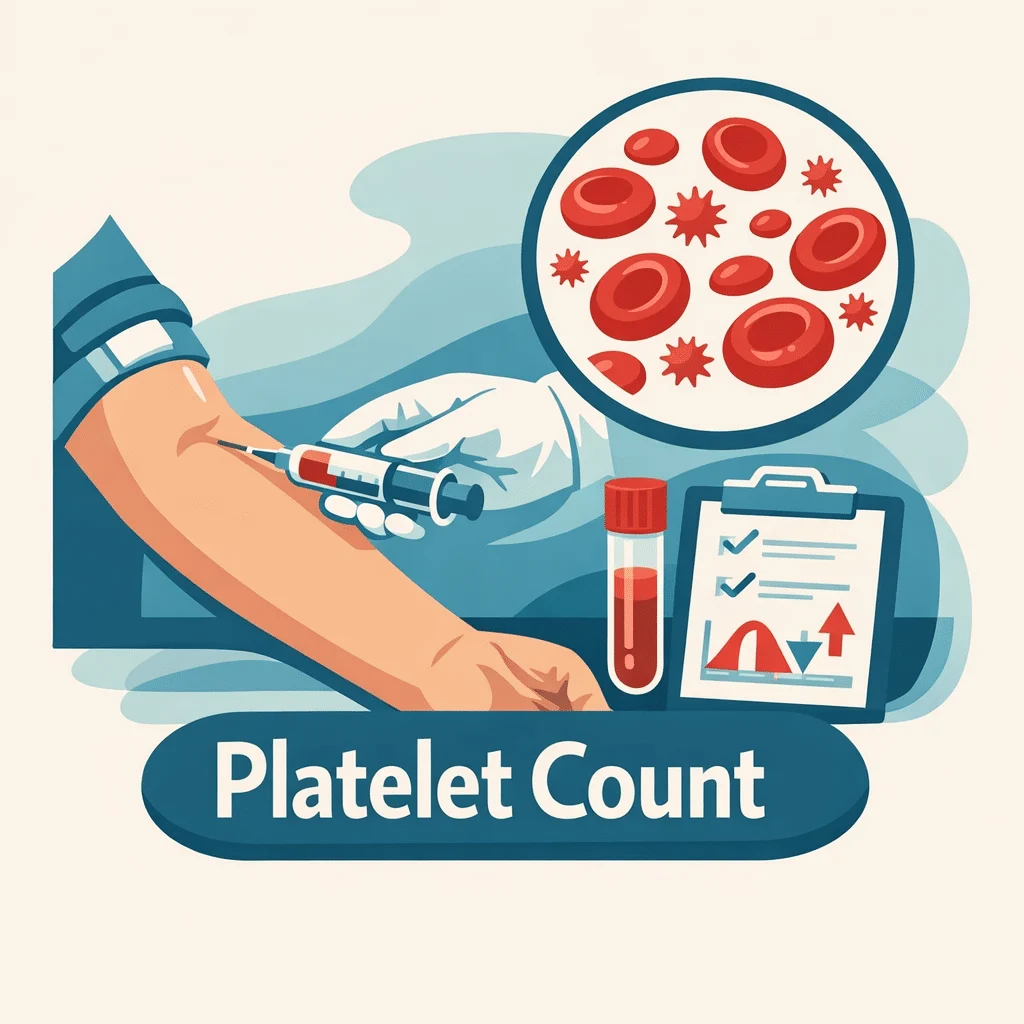
Platelet count is the number of platelets, or thrombocytes, measured in a sample of your blood. This small cell fragment plays an outsized role in stopping bleeding, and doctors check it constantly because both too few and too many platelets can signal an underlying health issue. In this article you’ll learn what a normal platelet count looks like, what a low or high result may mean, how doctors sort out the likely causes, and when a result is worth an urgent conversation with your doctor.
Platelet size varies as well as number — see what a high or low PDW result means.
What is a platelet count?
A platelet count measures how many platelets circulate in your bloodstream. Platelets are not full cells; they are tiny, disc-shaped fragments that split off from giant bone marrow cells called megakaryocytes. Your bone marrow makes roughly 100 billion new platelets every day to keep the supply steady, since each platelet only lives about 7 to 10 days.
The test itself is simple. A phlebotomist draws blood from a vein in your arm, and a lab machine counts the platelets in about a minute. No special preparation is usually needed, and results are often available the same day.
Why platelets matter for your health
The main job of platelets is primary haemostasis, the first step your body takes to stop bleeding. When a blood vessel is injured, platelets rush to the site, change shape to become sticky, and clump together to form a temporary plug. This “platelet plug” seals the leak while your body builds a more durable clot behind it.
Platelets do more than clot blood, though. They release growth factors stored in internal granules that help repair tissue, and they take part in inflammation and immune defence. Because platelets touch so many body systems, an abnormal platelet count is often one of the earliest clues that something else, from an infection to a liver problem, needs a closer look.
Platelet count normal range and how to read your result
On a lab report, your platelet count normally appears inside the full blood count section, often labelled “PLT,” “Platelets,” or “Thrombocytes.” Understanding how this fits into your full blood count results makes the number much easier to interpret in context, alongside your red and white blood cell values.
For most healthy adults, the standard platelet count normal range runs from about 150,000 to 400,000 platelets per microlitre of blood, sometimes written as 150 to 400 x 109/L. Both notations describe the same quantity; labs simply use different unit conventions. Reference ranges can shift slightly between laboratories because of differences in equipment and the population used to set the range, which is why the values printed on your own report are the ones that matter most.
Labs often flag out-of-range values with colour, an arrow, or an asterisk. A single mildly abnormal result in someone with no symptoms rarely needs urgent action, but a marked or persistent change should always be discussed with your doctor. If you are unsure how to read a flagged marker anywhere on your panel, our broader guide on how to interpret your blood test results walks through reference ranges and flags step by step.
Low platelet count vs high platelet count: a quick comparison
Platelet count abnormalities fall into two opposite categories. A low platelet count is called thrombocytopenia, and a high platelet count is called thrombocytosis. The table below summarises how they differ.
| Feature | Low platelet count (thrombocytopenia) | High platelet count (thrombocytosis) |
|---|---|---|
| Typical threshold | Below 150,000/µL | Above 400,000 to 450,000/µL |
| Main risk | Excess bleeding or bruising | Unwanted blood clots |
| Common causes | Autoimmune destruction, viral infections, medications, liver disease, low B12 or folate | Infection, inflammation, iron deficiency, recent surgery, some bone marrow disorders |
| Most frequent pattern | Often an isolated finding tied to one clear cause | Usually reactive and temporary, resolving once the trigger clears |
| Typical symptoms | Easy bruising, petechiae, nosebleeds, prolonged bleeding from cuts | Usually none; occasionally headache, dizziness, or limb pain |
What causes a low platelet count
Thrombocytopenia develops for one of three general reasons: the bone marrow is not producing enough platelets, the body is destroying or using them up faster than it can replace them, or an enlarged spleen is trapping too many of them. Several specific conditions sit within these categories.
Immune thrombocytopenia
Immune thrombocytopenia (an autoimmune condition often abbreviated ITP) develops when the immune system mistakenly produces antibodies against platelets, leading to their early destruction, mainly in the spleen. People with ITP often notice tiny red spots on the skin called petechiae along with easy bruising.
Medications and infections
Certain drugs lower platelet count through an immune mechanism, heparin being a well-known example, whilst others, such as chemotherapy, act directly on the bone marrow. Viral infections including dengue, HIV, and hepatitis C are also common culprits, along with severe bacterial infections such as sepsis.
Liver disease and nutritional gaps
Cirrhosis and the portal hypertension that comes with it can enlarge the spleen, trapping platelets in a process called hypersplenism. Separately, deficiencies in vitamin B12 or folate can impair platelet production in the bone marrow, and these patients often show a form of anaemia alongside the low platelet count.
What causes a high platelet count
Thrombocytosis is grouped into two very different categories that carry very different levels of concern.
Reactive thrombocytosis
This is by far the most common cause of an elevated platelet count. It occurs as a response to something else happening in the body, such as chronic inflammation, an infection, recent surgery, or iron deficiency. The rise is usually moderate and resolves once the underlying trigger clears.
Myeloproliferative neoplasms
Less commonly, a persistently high platelet count stems from a bone marrow disorder called a myeloproliferative neoplasm, such as essential thrombocythaemia. These conditions arise from genetic changes in blood-forming stem cells and cause the marrow to keep making platelets without the usual controls, raising the risk of blood clots. Diagnosis typically requires bone marrow analysis and genetic testing for mutations such as JAK2, CALR, or MPL.
Reactive thrombocytosis or essential thrombocythaemia: telling them apart
Because reactive thrombocytosis is common and benign whilst essential thrombocythaemia is rare and needs specialist management, doctors use a set of clinical clues to sort persistent thrombocytosis into the right category before ordering expensive genetic testing.
| Clue | Points towards reactive thrombocytosis | Points towards essential thrombocythaemia |
|---|---|---|
| Known trigger | Active infection, surgery, chronic inflammatory disease, or iron deficiency present | No clear trigger identified |
| History of blood clots | Less typical | More frequently reported, particularly arterial clots |
| Other blood counts | White blood cells and body weight measures often also elevated | Haemoglobin, red cell size, and platelet size often higher |
| Course over time | Improves as the underlying trigger resolves | Persists over months without an explanation |
What to do based on your platelet count result
The general guidance below is a starting point only; your own plan should always come from your doctor, since it depends on your symptoms, other lab values, and medical history.
Low platelet count action plan
A slightly low count, roughly 100,000 to 150,000/µL, often just needs a follow-up test in about three months if you have no symptoms. A moderately low count, around 50,000 to 100,000/µL, generally calls for a recheck within a month and a medical consultation to investigate the cause. A severely low count, under 50,000/µL, needs urgent medical attention within 24 to 48 hours, and you should alert any doctor or dentist before a procedure.
High platelet count action plan
A slightly high count, roughly 400,000 to 600,000/µL, is usually reasonable to recheck in about three months whilst your doctor looks for an inflammatory cause or iron deficiency. A count above 600,000/µL warrants a consultation with a haematologist and an assessment of your clotting risk.
When to see a doctor about your platelet count
Most mildly abnormal platelet counts are not emergencies, but some situations call for prompt medical attention. Consider reaching out to your doctor or seeking urgent care if you notice any of the following.
- Your platelet count is below 50,000/µL or above 1,000,000/µL.
- You have unexplained bruising, tiny red or purple spots on the skin, or bleeding gums.
- Bleeding from a minor cut will not stop after normal first aid.
- You develop sudden swelling, pain, or warmth in one limb, or unexplained chest pain or shortness of breath, which can signal a blood clot.
- The abnormal result comes with other abnormal blood counts or a family history of platelet disorders.
A haematologist referral is generally appropriate for very low or very high counts, or when other lab values are also abnormal. Simple, isolated, and stable mild changes can usually be followed by your GP.
Platelet count and mean platelet volume (MPV)
Doctors rarely look at platelet count in isolation. Many full blood count reports also include the mean platelet volume (MPV) test results, which measures the average size of your platelets rather than how many you have. The two values are read together because the combination carries more information than either alone. For example, a low platelet count paired with a high MPV can suggest the bone marrow is releasing young, larger platelets quickly to compensate for loss elsewhere in the body, while a low platelet count with a low MPV points more toward reduced production. If your report flags MPV specifically, our guides to what causes a high MPV result and what a low MPV result can mean go into more depth, but this article focuses specifically on the platelet count itself, not platelet size.
Lifestyle habits that support a healthy platelet count
Everyday habits will not reverse a serious underlying disorder, but they can support healthy blood cell production and reduce related risks.
If your platelet count is low
Include foods rich in folate, such as lentils and leafy greens, and vitamin B12, found mainly in animal products, since both support platelet production. Limit alcohol, which can suppress bone marrow function. Avoid contact sports and other high fall-risk activities, use a soft-bristle toothbrush, and check with your doctor before taking aspirin or other NSAIDs.
If your platelet count is high
Stay well hydrated, particularly in hot weather, and avoid long periods of inactivity, since both immobility and dehydration can raise clotting risk. Regular moderate exercise, not smoking, and maintaining a healthy weight all help reduce chronic inflammation, a common driver of reactive thrombocytosis. Learn the warning signs of a blood clot, such as one-sided limb swelling or sudden chest pain, so you know when to seek care quickly.
Platelet count before surgery
Because platelets are central to normal clotting, surgeons routinely check this value before any procedure. The threshold needed depends on the type of surgery: major surgery, especially neurosurgery, typically requires a platelet count of at least 100,000/µL, minor surgery is often considered safe above 50,000/µL, and spinal or epidural anaesthesia usually calls for at least 80,000/µL. If your coagulation panel results are also being checked before a procedure, your care team is looking at both how many platelets you have and how well your broader clotting system is working.
Latest scientific advances
Because the line between a harmless reactive platelet rise and a bone marrow disorder can be hard to draw from symptoms alone, haematology researchers have recently focused on sharper ways to tell the two apart and on refining how myeloproliferative disorders are treated once identified.
A 2024 review of essential thrombocythaemia found that a small set of practical markers, including a documented history of blood clots, age, and specific gene mutations (JAK2, CALR, or MPL), can be used to sort patients into four risk categories with very different long-term outlooks. What this means for you: if your doctor orders genetic testing after a persistently high platelet count, it is not just to confirm a diagnosis, but to place you into a risk category that shapes how closely you are monitored and whether preventive treatment, such as low-dose aspirin, makes sense. This evidence comes from a comprehensive literature review rather than a single new trial, so it should be seen as a synthesis of current best practice rather than a brand-new discovery, and your own haematologist will weigh how it applies to your individual case.
Separately, a 2024 study comparing patients with confirmed essential thrombocythaemia against those with reactive thrombocytosis found that certain everyday clues, such as an active malignancy, a chronic inflammatory condition, a history of spleen removal, or iron deficiency anaemia, were significantly more common in the reactive group, while a history of arterial blood clots was more common in the essential thrombocythaemia group. What this means for you: your doctor may be able to reassure you about a high platelet count using your medical history and standard blood counts alone, without immediately ordering costly genetic panels, reserving that step for cases where no clear trigger explains the finding. This finding comes from a single-centre study, so it is a preliminary, practical framework still being validated in other patient populations rather than a universally confirmed rule, and doctors weigh it alongside the full clinical picture.
Glossary
| Term | Definition |
|---|---|
| Platelet (thrombocyte) | A small cell fragment in the blood that helps form clots to stop bleeding. |
| Thrombocytopenia | A platelet count below the normal reference range, which can raise bleeding risk. |
| Thrombocytosis | A platelet count above the normal reference range, which can raise clotting risk. |
| Megakaryocyte | A large bone marrow cell that breaks apart to release platelets into the blood. |
| Immune thrombocytopenia (ITP) | An autoimmune condition in which the body attacks and destroys its own platelets. |
| Essential thrombocythaemia | A rare bone marrow disorder that causes excessive, uncontrolled platelet production. |
| Reactive thrombocytosis | A temporary rise in platelet count caused by another condition, such as infection or inflammation. |
| Mean platelet volume (MPV) | A related test that measures the average size, rather than the number, of platelets. |
| Petechiae | Tiny red or purple spots on the skin caused by minor bleeding under the surface. |
| Hypersplenism | A condition in which an enlarged spleen traps and removes too many blood cells, including platelets. |
Frequently asked questions about platelet count
What does a high platelet count mean?
A high platelet count, or thrombocytosis, most often means your body is reacting to something else, such as an infection, recent surgery, chronic inflammation, or iron deficiency. This reactive pattern is by far the most common explanation and usually resolves once the underlying cause is treated. Less often, a persistently high count with no clear trigger points towards a bone marrow condition that needs specialist evaluation. Your doctor will look at your full history and other blood values before deciding whether further testing is needed.
Is a platelet count of 70 considered low?
Yes, a platelet count of 70,000/µL sits below the standard normal range of roughly 150,000 to 400,000/µL, so it would be classified as thrombocytopenia. A count in this range is generally considered moderately low rather than severely low, and it usually calls for a repeat test within a month along with a medical consultation to look for the cause. Whether it is concerning also depends on whether you have any bleeding symptoms and what your previous counts have shown.
How can I increase a low platelet count?
The right approach depends entirely on the cause, so the first step is always a medical evaluation rather than self-treatment. When a nutritional gap such as low vitamin B12 or folate is contributing, addressing that deficiency can help. When a medication is responsible, your doctor may adjust or stop it. In some cases, such as immune thrombocytopenia, specific treatments are used to reduce platelet destruction or boost production. General habits like limiting alcohol and eating a balanced diet support healthy blood cell production but will not resolve a significant underlying disorder on their own.
What level of platelet count is considered dangerous?
Very low counts, generally below 50,000/µL, raise your risk of significant bleeding, and counts below 20,000/µL carry a risk of spontaneous internal bleeding, so both are treated as urgent. On the high end, counts above roughly 1,000,000/µL are typically flagged for prompt haematology evaluation because of clotting risk. Between these extremes, how “dangerous” a result is depends heavily on your symptoms, the trend over time, and what is causing the change, which is why the same number can mean different things for different people.
Does platelet count vary with age?
Yes. Infants and young children can have platelet counts that run higher than the typical adult range, whilst adults over about 65 often see a modest decrease. This is a normal part of ageing blood cell production and does not by itself indicate a problem. Because of this pattern, some laboratories adjust their reference ranges based on age, which is one more reason to compare your result to the range printed on your own report rather than a generic chart.
Can medications or supplements affect my platelet count?
Yes, a wide range of substances can change your platelet count or how well your platelets function. Some antibiotics, antiepileptic drugs, chemotherapy agents, and heparin can lower platelet count, while corticosteroids can raise it. Certain supplements, including ginkgo biloba, high-dose fish oil, and ginseng, can interfere with platelet function even when the count itself looks normal. Always tell your doctor about every medication and supplement you take, especially if you have a known platelet disorder or notice a new abnormal result.
Sources
- Platelet Count (PLT): Normal Range, Test Results and Meaning — Cleveland Clinic — https://my.clevelandclinic.org/health/diagnostics/21782-platelet-count
- Platelet Tests — MedlinePlus, U.S. National Library of Medicine (NIH) — https://medlineplus.gov/lab-tests/platelet-tests/
- Thrombocytopenia — National Heart, Lung, and Blood Institute (NIH) — https://www.nhlbi.nih.gov/health/thrombocytopenia
- Tefferi A, Vannucchi AM, Barbui T — Essential thrombocythaemia: 2024 update on diagnosis, risk stratification, and management — American Journal of Hematology, 2024 — https://doi.org/10.1002/ajh.27216
- Almanaseer A, et al. — An Approach to the Investigation of Thrombocytosis: Differentiating between Essential Thrombocythaemia and Secondary Thrombocytosis — Advances in Hematology, 2024 — https://consensus.app/papers/details/06cd99c526e450acb2c148055a3d6b0a/?utm_source=claude_code
Further reading
- Full blood count (FBC): how to read your results
- How to read your blood test results
- Mean platelet volume (MPV): understanding this blood test marker
- Coagulation panel explained: PT, PTT, INR, and D-dimer
- Normal blood test ranges: a reference chart
A platelet count is just one piece of a larger picture that usually includes your full blood count, and sometimes a coagulation panel or iron studies such as ferritin, depending on why the test was ordered. Reading these values together, alongside your symptoms and history, is what turns a set of numbers into something useful for your health. AI DiagMe helps you understand what your lab results show; it does not diagnose you and never replaces your doctor’s evaluation.
Understand your lab results with AI DiagMe
Get your results interpreted in minutes