





































A haptoglobin blood test measures a protein your liver makes to capture and clear the haemoglobin that leaks out of red blood cells. Doctors most often order it when they suspect that red cells are breaking down faster than usual, a process called haemolysis. If this line has appeared on your report, it is natural to wonder what a low or a high value means for you. In this article you will learn what haptoglobin does, why the test is requested, how to read your result against the reference range, what pushes the number down or up, and which other tests are read alongside it. You will also find the latest research explained in plain language, a short glossary, and clear pointers on when a result is worth a conversation with your doctor.
What is haptoglobin, and what does the test measure?
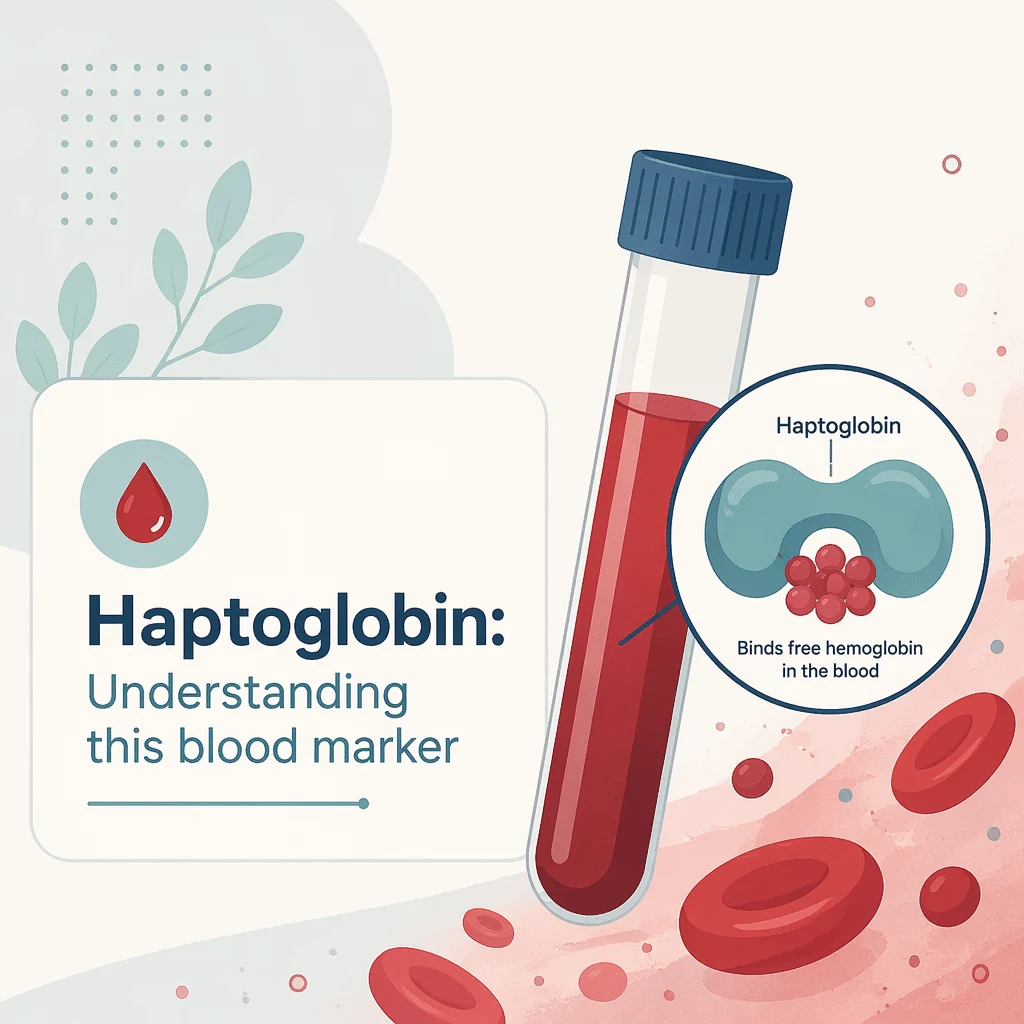
Haptoglobin is a protein produced mainly by the liver that circulates continuously in your blood. Its main job is to find and bind free haemoglobin, the oxygen-carrying molecule that normally stays locked inside red blood cells. A haptoglobin blood test simply measures how much of this protein is present in a sample of blood, which tells your doctor how hard it is currently working.
Your body replaces millions of red blood cells every day. As old cells are broken down, a small amount of haemoglobin is released into the circulation. Free haemoglobin can be harmful, particularly to the kidneys, so haptoglobin acts like a molecular clean-up crew: it grabs the loose haemoglobin, forms a haptoglobin-haemoglobin complex, and the liver and spleen then remove that complex from the blood. This also allows the iron inside haemoglobin to be recycled rather than lost.
Why the level falls when red cells break down
Because there is only so much haptoglobin in circulation at any moment, a sudden or heavy round of red cell destruction uses it up quickly. When many cells break apart at once, free haemoglobin floods the blood, haptoglobin binds it all, and the bound complexes are cleared faster than the liver can make new protein. The measurable result is a drop in your haptoglobin level, which is why a low value is such a useful signal of haemolysis.
Why haptoglobin can also rise
Haptoglobin has a second identity: it is an acute-phase reactant, meaning its production increases when the body is dealing with inflammation, infection, or tissue injury. In that sense it behaves like other inflammation proteins such as C-reactive protein. This dual role is important to bear in mind, because inflammation can push the level up at the same time that mild haemolysis is trying to pull it down, sometimes leaving a value that looks deceptively normal.
Why doctors order a haptoglobin blood test
The most common reason for a haptoglobin blood test is to check for haemolysis, especially when someone is anaemic and the cause is not yet clear. A low result points a doctor towards a haemolytic cause rather than, say, iron deficiency or blood loss. If you want the bigger picture on low red cell counts, our overview of anaemia symptoms, causes and tests explains how the different types are told apart.
Doctors also use the test in several other situations:
- To investigate symptoms that can accompany red cell breakdown, such as fatigue, breathlessness, dark-coloured urine, or yellowing of the skin and eyes (jaundice).
- To help evaluate a possible reaction after a blood transfusion, often paired with an antibody test.
- To monitor known conditions that affect red blood cells, including inherited disorders and autoimmune disease.
- To add context to an abnormal complete blood count, where the cell counts hint that something is destroying red cells.
On its own, the test rarely gives a diagnosis. It is one clue that becomes powerful when combined with your symptoms, your history, and a handful of partner tests described further below.
How to read your haptoglobin blood test results
On a laboratory report, haptoglobin is usually listed in grams per litre (g/L) or milligrams per decilitre (mg/dL). Reference ranges differ slightly between laboratories and methods, but a typical adult range runs from about 0.3 to 2.0 g/L, which is the same as roughly 30 to 200 mg/dL. The range printed on your own report, next to your value, is always the one that counts.
Those reference ranges are built to cover most healthy adults, so a value sitting a little outside them is not automatically a sign of disease. One quirk worth knowing: a naturally low haptoglobin is normal in babies under about six months old, because their liver is still ramping up production. To see how ranges and flags work across a report in general, our guide on how to read blood test results walks through the layout line by line.
The table below gives a quick, general sense of what a result may point toward. It is a guide, not a diagnosis, and only a clinician can interpret your number in context.
| Haptoglobin result | What it may suggest |
|---|---|
| Low or undetectable | Red blood cells breaking down faster than normal (haemolysis); can also be seen in liver disease or after a transfusion reaction |
| Within the usual range | Significant haemolysis and major inflammation are unlikely, although a normal value does not fully rule out mild haemolysis |
| High | An inflammatory or acute-phase response, such as infection, injury, or a flare of a chronic condition |
What a low haptoglobin level means
A clearly low haptoglobin almost always points to haemolysis, but the underlying reason can vary widely. Sorting out the cause is where the rest of the medical work-up comes in.
Autoimmune haemolytic anaemia
Here the immune system mistakenly makes antibodies that attack red blood cells. The resulting burst of destruction consumes haptoglobin rapidly, sending the level down. This is one form of an autoimmune disease, and it is often confirmed with a specific antibody test called the direct antiglobulin (Coombs) test.
Inherited red blood cell disorders
Conditions present from birth can make red cells fragile or short-lived, keeping haptoglobin persistently low. Common examples include sickle cell disease, thalassaemia, hereditary spherocytosis, and G6PD deficiency, an enzyme problem in which certain infections or medicines can trigger red cell breakdown.
Living with the condition brings its own questions: see what complications young adults with sickle cell face.
Mechanical and other causes
Red cells can also be damaged by physical stress. A mechanical heart valve can shear cells as blood passes through, and very intense, repetitive impact, such as long-distance running, can cause a temporary drop sometimes described as march or runner’s haemolysis. A mismatched blood transfusion is another cause of a sudden fall.
Liver disease: an important exception
Because the liver makes haptoglobin, severe liver disease can lower the level simply by reducing production, without any haemolysis at all. This is one reason a low result is never read in isolation. When the liver is the cause, other liver-made proteins tend to be low too, which helps a doctor tell the two situations apart.
What a high haptoglobin level means
Because haptoglobin is an acute-phase protein, a high level usually reflects inflammation rather than anything to do with red cells. The liver steps up production in response to a range of triggers.
- Infections and inflammatory conditions, including bacterial infections and flares of diseases such as rheumatoid arthritis or inflammatory bowel disease.
- Tissue damage from trauma, surgery, or a heart attack, where the body mounts an inflammatory response.
- Some chronic illnesses and certain cancers, which can keep production elevated over time.
Haptoglobin is not usually the test doctors rely on to diagnose or track these conditions; more specific inflammation markers do that job. When it comes to interpreting fatigue or a raised value in the context of iron, it can also help to understand the parallel role of another storage-and-inflammation protein, discussed in our guide to iron studies panel testing.
The tests doctors read alongside haptoglobin
Haptoglobin becomes far more informative when it is grouped with a few partner tests. Together they build a pattern that either supports or argues against active haemolysis. The Cleveland Clinic lists exactly this combination of tests when evaluating haemolytic anaemia, and the table below summarises what each one typically shows when red cells are breaking down.
| Test read with haptoglobin | What it typically shows during haemolysis |
|---|---|
| Haptoglobin | Falls, as it is used up binding free haemoglobin |
| Lactate dehydrogenase (LDH) | Rises, because red blood cells are rich in this enzyme and release it when they burst |
| Unconjugated (indirect) bilirubin | Rises, as freed haemoglobin is broken down into bilirubin, which can cause jaundice |
| Reticulocyte count | Rises, as the bone marrow releases young red cells to replace those lost |
| Direct antiglobulin (Coombs) test | Positive when the cause is autoimmune |
A classic haemolysis pattern is a low haptoglobin with a high LDH and a raised bilirubin, backed up by more young red cells. If you want to go deeper on the enzyme in that list, our dedicated guide explains how doctors interpret lactate dehydrogenase results. Reading the panel as a whole is what turns a single number into a meaningful answer.
How the haptoglobin blood test is done and how to prepare
The test itself is a simple, routine blood draw. A healthcare professional takes a small sample from a vein in your arm using a fine needle, and the whole process usually takes only a few minutes. You may feel a brief sting as the needle goes in or out, and mild soreness or a small bruise afterwards is the most you are likely to notice.
In most cases you do not need to do anything special to prepare, and fasting is not usually required for haptoglobin on its own. If the test is bundled with others, such as a glucose or cholesterol panel, you may be asked to fast, so follow the specific instructions your doctor or laboratory gives you. It is worth mentioning any medicines or supplements you take, along with any recent strenuous exercise, since these can influence the result. Findings are often available within a day or two, after which your doctor will read them in the context of your symptoms and your other blood tests rather than as a stand-alone number.
Latest scientific advances
Recent research continues to confirm haptoglobin as one of the most useful everyday signals of red cell breakdown, whilst also exploring roles that reach beyond haemolysis. The findings below are promising, but they refine current practice rather than overturn it, and a doctor remains the right person to apply them to any individual.
Two recent studies underline how the marker is best used as part of a set. A 2025 French review described haptoglobin as the single most sensitive routine marker of haemolysis, read together with LDH and bilirubin, with a rise in young red cells completing the picture (Ruivard and colleagues). A 2026 hospital study reached the same practical conclusion: in people with haemolytic anaemia, haptoglobin tended to fall whilst LDH and bilirubin rose, and the markers tracked how severe the breakdown was, making them a reliable, low-cost way to gauge haemolysis where more complex tests are hard to access (Madan and colleagues). What this means for you is simple: a haptoglobin value is rarely judged alone, and its strength comes from the pattern it forms with these other results.
A 2025 case report in the journal Blood is a useful reminder that the picture is not always straightforward. A young man developed haemolysis after a marathon, with an undetectable haptoglobin and a high LDH, yet his first antibody test came back negative before a repeat finally confirmed an autoimmune cause (Srinivasa and colleagues). What this means for you is that a very low haptoglobin can flag that red cells are breaking down well before the reason becomes clear, which is exactly why doctors repeat tests and weigh the whole clinical picture rather than one value. This is a single case, so it illustrates a point rather than proving a rule.
Researchers are also studying haptoglobin beyond haemolysis. People inherit different versions of the haptoglobin gene, and one version, called Hp2-2, appears to clear free haemoglobin less efficiently. A 2023 study in people with prediabetes found that those carrying the Hp2-2 type had clearly higher odds of coronary artery disease than those with other types (Mewborn and colleagues). What this means for you is that this is early, hypothesis-generating research about genetic risk, not a routine test your doctor will order, and it does not change how a standard haptoglobin blood test is used today. It is an area to watch rather than a cause for concern.
When to see a doctor
Your haptoglobin result is a tool for a conversation, not a verdict. Most of the time it is interpreted at a routine appointment, but some situations deserve more prompt attention. Contact a healthcare professional if you notice any of the following:
- A very low or very high haptoglobin that persists on repeat testing.
- Yellowing of the skin or eyes (jaundice) or dark, tea-coloured urine.
- Marked fatigue, breathlessness, dizziness, or a fast or pounding heartbeat.
- A low result alongside other signs of red cell breakdown, such as a raised LDH or bilirubin.
- Any new, severe, or unexplained symptom occurring with an abnormal value.
Seek urgent care if you feel acutely unwell, particularly with severe breathlessness, chest pain, or fainting. When in doubt, a brief question to your clinician is always more reliable than trying to interpret the number alone.
Glossary
| Term | Definition |
|---|---|
| Haptoglobin | A liver-made protein that binds free haemoglobin in the blood so it can be safely cleared. |
| Haemoglobin | The iron-rich protein inside red blood cells that carries oxygen around the body. |
| Haemolysis | The breakdown of red blood cells faster than the body can replace them. |
| Haemolytic anaemia | Anaemia caused by red blood cells being destroyed faster than they are made. |
| Acute-phase reactant | A protein whose blood level rises during inflammation, infection, or injury. |
| Reticulocytes | Young red blood cells; their number shows how actively the marrow is producing cells. |
| Bilirubin | A yellow substance made when haemoglobin is broken down; high levels can cause jaundice. |
| Lactate dehydrogenase (LDH) | An enzyme released from red blood cells when they break apart, often raised in haemolysis. |
| Direct antiglobulin (Coombs) test | A blood test that detects antibodies on red cells, used to find autoimmune haemolysis. |
Frequently asked questions
What is a normal haptoglobin level?
For most adults, a normal haptoglobin level falls somewhere in the region of 0.3 to 2.0 g/L, equivalent to about 30 to 200 mg/dL, though each laboratory sets its own reference range using its own methods. Always compare your result against the range printed on your own report rather than a figure found elsewhere. A value close to the edge of the range usually matters far less than one that is well outside it. Newborns and young infants normally have lower levels, which is expected and not a cause for concern.
Can you have no haptoglobin at all?
Yes. A small proportion of people, roughly one in a hundred, are born with a genetic absence of haptoglobin, a harmless condition called anhaptoglobinaemia. It causes no symptoms and needs no treatment, but it can be confusing on a report because the level reads as very low or undetectable without any haemolysis. This is one more reason a single low haptoglobin is always interpreted alongside other tests and your medical history rather than on its own.
Can intense exercise lower haptoglobin?
It can. Very hard, repetitive effort such as running a marathon can cause a temporary drop sometimes called march or runner’s haemolysis, in which the physical impact damages a small number of red blood cells. The level usually returns to normal within a few days of rest. If you have a blood test soon after strenuous exercise, it is worth mentioning to your doctor, as it can affect not only haptoglobin but several other markers too.
Do medications affect haptoglobin levels?
Some can. Certain drugs can trigger mild red cell breakdown and lower the level, whilst others, such as corticosteroids and oestrogen-containing medicines, can nudge it upward as part of a broader effect on the liver and inflammation. This is why it helps to give your doctor a full list of everything you take, including over-the-counter products and supplements, so an unexpected value can be interpreted correctly.
How do doctors tell a low haptoglobin from liver disease apart from haemolysis?
They look at the surrounding tests. In haemolysis, other signs of red cell destruction are usually present, such as a raised LDH and bilirubin and a higher reticulocyte count. When the liver is the cause, those breakdown markers tend to be normal, but other liver-made proteins are often low as well, and liver enzyme tests may be abnormal. The overall pattern, not the haptoglobin value alone, is what separates the two situations.
Is a haptoglobin blood test the same as a haemoglobin test?
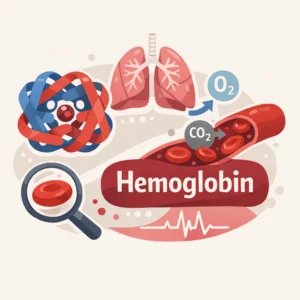
No, although the names sound alike. Haemoglobin is the oxygen-carrying protein inside red blood cells, and a haemoglobin test measures how much of it you have, which is a core check for anaemia. Haptoglobin is a separate protein that mops up haemoglobin once it escapes from red cells, so a haptoglobin blood test is measuring the clean-up protein rather than the oxygen carrier. The two are related and are often read together, but they answer different questions.
Sources
- MedlinePlus, National Library of Medicine (NIH) — Haptoglobin (HP) Test. https://medlineplus.gov/lab-tests/haptoglobin-hp-test/
- Cleveland Clinic — Haemolytic Anaemia: Symptoms, Treatment & Causes. https://my.clevelandclinic.org/health/diseases/22479-hemolytic-anemia
- National Heart, Lung, and Blood Institute (NIH) — Haemolytic Anaemia. https://www.nhlbi.nih.gov/health/anemia/hemolytic-anemia
- Ruivard M, et al. — Diagnosis of non-autoimmune hemolysis in the adult. La Revue de Médecine Interne, 2025. https://consensus.app/papers/details/4afc21deb3cf53c8b7e8a1987838990d/
- Madan Y, et al. — Correlation of serum lactate dehydrogenase, indirect bilirubin, and haptoglobin with hematological parameters in hemolytic anemia. International Journal of Current Pharmaceutical Review and Research, 2026. https://consensus.app/papers/details/ab464380bc1b5b32a905db22c323911e/
- Srinivasa S, et al. — Autoimmune hemolytic anemia with an initially negative direct antiglobulin test: a diagnostic challenge. Blood, 2025. https://consensus.app/papers/details/e8b27276a6cc52c69af36213fb6e18e0/
- Mewborn EK, et al. — Haptoglobin genotype is a risk factor for coronary artery disease in prediabetes: a case-control study. American Journal of Preventive Cardiology, 2023. https://consensus.app/papers/details/adae2ea83257566d8ebfccc93c7f5b40/
Further reading
- Erythrocyte sedimentation rate (ESR): understanding this marker
- Transferrin: understanding its role in iron transport
- High ferritin levels: causes, symptoms and risks
- Complete blood work guide: what a full blood panel includes
- Abnormal blood test results: what they mean
Understanding a haptoglobin result is easier when it sits next to the tests it is usually read with, such as your full blood count, LDH, bilirubin, and reticulocyte count. AI DiagMe puts these numbers into plain language so you can see the pattern rather than a single confusing value. It is built to help you understand your results and prepare better questions, not to diagnose you or replace your doctor.
Understand your lab results with AI DiagMe
Get your results interpreted in minutes