
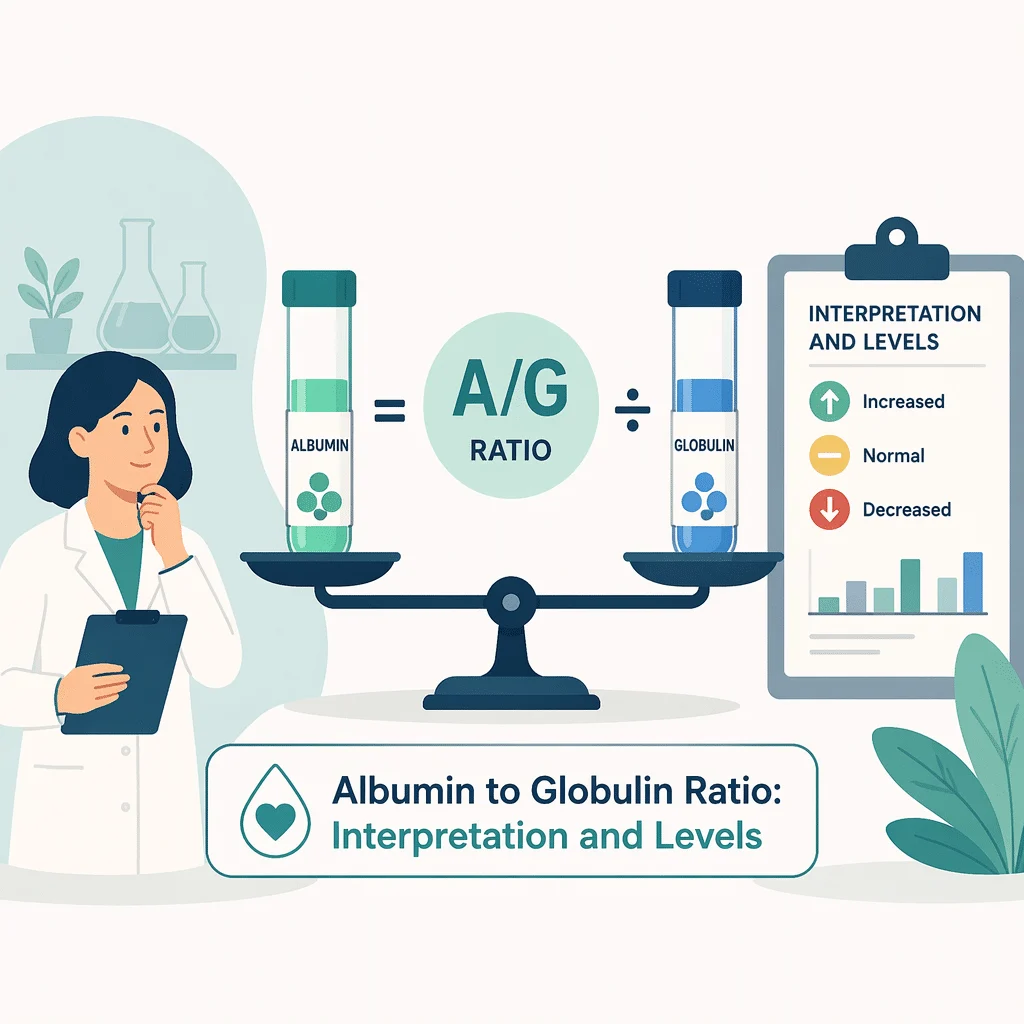
The albumin to globulin ratio compares the single most abundant protein in your blood with everything else your body keeps dissolved alongside it. Laboratories rarely measure it directly. They calculate it from two numbers already sitting on your comprehensive metabolic panel, which is why it often appears on a report you never specifically asked for. On its own the ratio diagnoses nothing, but it does something useful: it flags whether the balance between your two main protein groups has shifted, and in which direction. In this article you will learn how the ratio is calculated, what a low result and a high result each point to, which globulin fractions sit behind the number, and why serum protein electrophoresis is usually the test that follows an unexplained value.
What the albumin to globulin ratio actually measures
Your blood carries roughly 6 to 8 grams of protein per deciliter. That total splits into two camps. Albumin is one specific molecule made by the liver. Globulins are a mixed collection of hundreds of different proteins, including every antibody you have ever produced. The albumin to globulin ratio expresses the relationship between those two camps as a single number.
Because the two groups are produced by different tissues for different reasons, the ratio behaves as a crude balance indicator. When one side of the scale moves and the other does not, the ratio moves with it. That is the whole logic of the test, and it explains both its usefulness and its limits.
Albumin, the workhorse protein
The liver manufactures albumin continuously, producing somewhere between 10 and 18 grams a day in a healthy adult. Albumin holds fluid inside your blood vessels through osmotic pressure, and it ferries hormones, calcium, bilirubin, fatty acids, and many medications around the body. Anything that damages liver production, drains albumin through the kidneys or gut, or diverts the liver toward emergency proteins will pull the albumin number down.
Globulins, four fractions rather than one substance
Globulin is a category, not a molecule. Laboratory scientists separate it into four fractions named for how far they travel across an electrophoresis gel: alpha-1, alpha-2, beta, and gamma. The alpha and beta fractions hold transport and clotting proteins plus several inflammatory response proteins. The gamma fraction is almost entirely immunoglobulins, the antibodies your immune system makes. Our library explains the role of immunoglobulin G in your blood test, the most abundant antibody class and the one that moves the gamma fraction most.
This matters for interpretation. A globulin result that rises because of a chronic infection means something quite different from one that rises because a single clone of plasma cells has started overproducing one antibody. The ratio cannot tell those apart. Electrophoresis can.
How the albumin to globulin ratio is calculated
Your laboratory measures two things and derives the rest. It measures total protein using a chemical reaction, and it measures albumin separately using a dye that binds specifically to albumin. Globulin is never measured directly on a routine panel. It is obtained by subtraction:
- Globulin = total protein minus albumin
- Albumin to globulin ratio = albumin divided by globulin
Both proteins appear on the same panel that reports your glucose, electrolytes, kidney values, and liver enzymes. Our guide walks through every measurement on a comprehensive metabolic panel, including where total protein and albumin sit on the printout.
A worked example from a standard panel
Suppose your report shows a total protein of 7.2 g/dL and an albumin of 4.2 g/dL. Subtract albumin from total protein and you get a globulin of 3.0 g/dL. Divide 4.2 by 3.0 and the albumin to globulin ratio comes out at 1.4. That value sits comfortably inside the usual reporting range.
Now change one number. Keep total protein at 7.2 g/dL but drop albumin to 3.2 g/dL. Globulin becomes 4.0 g/dL and the ratio falls to 0.8. The total protein has not moved at all, yet the balance between the two camps has shifted substantially. A clinician reading only the total protein would see nothing unusual. This is precisely the situation the ratio was designed to expose.
Why the ratio moves when neither number looks alarming
Because the ratio is a quotient, small changes in both directions compound. Albumin drifting down while globulin drifts up produces a disproportionate fall in the ratio, even when each individual value stays within its own reference interval. That sensitivity is a genuine strength for screening. It is also why a mildly abnormal ratio, on its own and in someone who feels well, is rarely a reason for alarm.
What counts as a normal albumin to globulin ratio
Most United States laboratories report a normal albumin to globulin ratio somewhere between roughly 1.0 and 2.5, with many using a narrower window such as 1.1 to 2.2. There is no single universal cutoff, because the number inherits the reference intervals of the two assays behind it, and those differ by instrument and by laboratory. Always read your result against the range printed on your own report rather than against a range you found elsewhere.
One consequence of the subtraction method deserves attention. Since globulin is calculated rather than measured, any imprecision in the albumin assay feeds straight into the ratio. Different laboratories use different albumin methods, and results are not always interchangeable between them. Our team details the normal albumin levels reported on a standard blood panel, along with what shifts them, so you can check the albumin half of your calculation against its own reference interval.
What a low albumin to globulin ratio means
A low ratio is the more common abnormality and the more clinically meaningful one. It arises through two independent routes, and distinguishing between them is the first task after an abnormal result.
When globulins climb
Rising globulins push the ratio down while total protein often rises. The usual explanations are a sustained immune response or a plasma cell disorder:
- Chronic infections such as tuberculosis, HIV, or long-standing hepatitis, which keep antibody production elevated for months
- Autoimmune conditions including lupus and rheumatoid arthritis, in which the immune system produces antibodies against the body’s own tissues
- Chronic liver disease, where scarred liver tissue makes less albumin while immune stimulation raises gamma globulins at the same time, pushing the ratio down from both ends
- Monoclonal gammopathies, in which one clone of plasma cells overproduces a single identical antibody. Our guide covers the diagnosis and staging of multiple myeloma, the best known condition in this group
A useful pattern to recognize is a total protein that has risen while albumin has stayed flat or fallen. That combination points toward extra globulin rather than concentrated blood, and it is a classic trigger for further protein testing. Our article explains the causes of a high globulin level in more detail.
When albumin falls
Falling albumin lowers the ratio while total protein usually falls too. The mechanisms divide neatly into reduced production, active loss, and redistribution:
- Reduced production in cirrhosis and advanced liver disease. Our guide explains how to read a liver function panel, the natural companion test here
- Urinary loss in nephrotic syndrome, where damaged kidney filters let albumin escape into the urine. Our team covers the markers on a kidney function panel that help confirm this route
- Gastrointestinal loss in protein-losing enteropathy, severe inflammatory bowel disease, or extensive burns
- Systemic inflammation, in which the liver deliberately switches production away from albumin and toward acute phase proteins. Our article explains how to interpret C-reactive protein as an inflammation marker, the test most often paired with albumin in this setting
- Prolonged malnutrition or malabsorption, though this is a less frequent cause than many people assume
Our library sets out the mechanisms and risks behind hypoalbuminemia for readers whose albumin is the value driving their ratio down.
What a high albumin to globulin ratio means
A high ratio is less common and, in the great majority of cases, less concerning. It almost always reflects low globulins rather than genuinely high albumin, because the body has no mechanism for overproducing albumin.
- Immune deficiency, either inherited or acquired, in which antibody production is reduced. This is the possibility clinicians most want to exclude, particularly in someone with recurrent infections
- An inherited shortage of one specific globulin fraction, such as alpha-1 antitrypsin deficiency
- Dehydration, which concentrates the blood and raises albumin. This produces a genuinely high albumin with a high total protein, and it resolves with rehydration
- Certain blood cancers, including some leukemias, in which normal antibody production is crowded out
Our article explains the causes and symptoms of low globulin levels, which is the value doing the work in most high ratios.
Reading the pattern: likely mechanism and the usual next test
The ratio becomes informative only when read alongside the two numbers that produced it. The table below maps the common patterns to their usual mechanism and to the test a clinician typically orders next. It is a guide to what to expect from a consultation, not a substitute for one.
| Pattern on your report | Likely mechanism | Test usually ordered next |
|---|---|---|
| Low ratio, globulin high, total protein high | Extra antibody production from chronic infection, autoimmune disease, or a plasma cell disorder | Serum protein electrophoresis, with immunofixation added if a narrow spike appears |
| Low ratio, albumin low, total protein low | Reduced albumin production or ongoing albumin loss | Liver enzymes (ALT, AST, ALP) and a repeat albumin measurement |
| Low ratio, albumin low, protein detected in urine | Albumin escaping through damaged kidney filters | Urine protein or the urine albumin-to-creatinine ratio, plus a kidney panel |
| Low ratio during or just after an acute illness | An inflammatory response temporarily suppressing albumin production | C-reactive protein, then a repeat panel once the illness has settled |
| High ratio, globulin low | Reduced antibody production or an inherited shortage of one globulin fraction | Immunoglobulin levels (IgG, IgA, IgM) |
| High ratio, albumin high, total protein high | Concentrated blood from dehydration | Rehydration and a repeat sample, often with no further testing needed |
Serum protein electrophoresis, the test that explains the ratio
When a low albumin to globulin ratio has no obvious explanation, serum protein electrophoresis is the standard next step. The laboratory applies an electrical field to your serum and the proteins separate according to size and charge, producing a curve with distinct peaks for albumin and for each globulin fraction. Instead of one lumped globulin figure, the clinician sees which fraction is responsible.
A broad hump versus a narrow spike
The shape of the gamma region carries most of the diagnostic weight. A broad, rounded rise across the whole gamma region is a polyclonal pattern: many different plasma cells producing many different antibodies, which is what chronic infection and autoimmune disease look like. A narrow, sharp peak is a monoclonal pattern, meaning one clone producing one identical antibody. That narrow spike is what prompts investigation for myeloma and related conditions. Our guide explains how to read a protein electrophoresis report, including the distinction between these two curve shapes.
When immunofixation is added
Immunofixation is the confirmatory step. If electrophoresis shows a suspicious spike, immunofixation identifies exactly which antibody class and which light chain type it belongs to. Electrophoresis says a spike exists; immunofixation names it. The two are often run together when a plasma cell disorder is genuinely suspected.
When to see a doctor
An isolated, mildly abnormal ratio in someone who feels well usually warrants nothing more than a repeat test. Arrange a medical review when an abnormal albumin to globulin ratio comes with any of the following:
- Swelling in the ankles, legs, or around the eyes, or a noticeably distended abdomen
- Persistent bone pain, particularly in the back or ribs, or unexplained fractures
- Repeated infections that are unusually severe or slow to clear
- Unintended weight loss, drenching night sweats, or persistent fever
- Yellowing of the skin or eyes, or dark urine
- Foamy urine, which can indicate protein leaking through the kidneys
- A ratio that keeps falling across successive tests, even if each individual value is only slightly outside range
Seek urgent care rather than a routine appointment if severe swelling appears suddenly, if you become breathless, or if bone pain is intense and new.
Latest scientific advances
Research over the past three years has been steadily reframing what this old, inexpensive calculation is good for. The direction of travel is consistent: the ratio is being studied less as a standalone diagnostic and more as a cheap signal of how much inflammation a body is carrying. The findings below are research results, not clinical rules, and none of them changes how your own result should be interpreted today.
The strongest recent evidence comes from cancer surgery. A 2026 systematic review pooling six studies and just over 2,100 patients undergoing liver cancer surgery found that people whose ratio was lower before the operation tended to have poorer survival afterward. A systematic review pools many studies to see whether a finding holds up across all of them, which makes it more reliable than any single study. The authors were careful to note that every included study came from Asia and that the finding still needs testing in planned, forward-looking research. Similar patterns emerged in 2025 and 2026 in lung cancer and in early-stage colorectal cancer, where combining the ratio with a separate inflammation index sorted patients into risk groups more accurately than either measure alone. What this means for you: if your ratio is low and you are under cancer care, your team may read it as one more piece of background information about inflammation and nutrition, not as a statement about your individual outcome.
The signal is not limited to cancer. A 2026 study of 109 patients with necrotizing fasciitis, a rare and severe soft tissue infection, found that of all the routine laboratory values measured within a day of admission, the albumin to globulin ratio was the single most useful for identifying who was likely to do badly. This was a small, single-hospital study looking backward at existing records, so it is an early result rather than an established rule.
Perhaps the most relevant finding for everyday readers concerns albumin itself. A 2025 analysis of nearly 3,000 patients across 34 hospitals tracked what happened to albumin during hospital stays and concluded that a falling albumin reflects inflammation and illness severity far more than it reflects diet. The authors argued directly that treating albumin as a pure nutritional marker needs revising. What this means for you: a low albumin, and therefore a low ratio, is usually a sign that something inflammatory is happening rather than a sign that you need to eat more protein. Eating more protein does not reliably raise a low albumin when inflammation is the cause.
Finally, two 2025 and 2026 reports looked at catching plasma cell disorders earlier. A multi-center study developed a computer model using ten routine laboratory values, the albumin to globulin ratio among them, and found it flagged patients who turned out to have an abnormal monoclonal antibody more sensitively than conventional electrophoresis did in the same group. A separate case report described a rare blood cancer discovered because an unusual protein pattern, including an abnormal ratio, prompted a reflex electrophoresis test. Both point toward using ordinary numbers you already have to decide who needs specialized testing. Neither is in routine practice, and the computer model has not yet been tested in real time on new patients.
Glossary
| Term | Definition |
|---|---|
| Albumin | The single most abundant protein in blood, made by the liver. It holds fluid inside blood vessels and transports hormones, calcium, and many medications. |
| Globulins | A large mixed group of blood proteins that includes antibodies, transport proteins, and clotting factors. It is a category rather than a single molecule. |
| Total protein | The combined concentration of albumin and all globulins in your serum, usually reported in grams per deciliter. |
| A/G ratio | The standard abbreviation for the albumin to globulin ratio, calculated by dividing albumin by globulin. |
| Globulin fractions | The four groups that globulins separate into during electrophoresis: alpha-1, alpha-2, beta, and gamma. The gamma fraction holds the antibodies. |
| Serum protein electrophoresis (SPEP) | A laboratory test that separates blood proteins by size and electrical charge, showing which specific fraction is raised or lowered. |
| Immunofixation | A follow-up test that identifies exactly which antibody type an abnormal spike is made of, confirming what electrophoresis suggested. |
| Monoclonal gammopathy | A condition in which one clone of plasma cells overproduces a single identical antibody, producing a narrow spike on electrophoresis. |
| Polyclonal rise | A broad increase in many different antibodies at once, typical of chronic infection or autoimmune disease rather than cancer. |
| Hypoalbuminemia | The medical term for a lower than expected albumin level in the blood. |
| Nephrotic syndrome | A kidney disorder in which damaged filters allow large amounts of protein, mainly albumin, to leak into the urine, causing swelling. |
| Reflex test | An additional test a laboratory runs automatically when a first result meets certain criteria, without waiting for a new request. |
Frequently asked questions
What does a low albumin to globulin ratio mean?
It means the balance has tipped away from albumin, either because albumin has fallen or because globulins have risen. Falling albumin points toward liver disease, kidney protein loss, gut protein loss, or active inflammation. Rising globulins point toward a sustained immune response such as chronic infection or autoimmune disease, or less commonly toward a plasma cell disorder. The ratio alone cannot distinguish between these routes, which is why your clinician will look at the albumin and total protein values behind it and often order serum protein electrophoresis.
Is an albumin to globulin ratio of 1 normal?
A ratio of 1.0 means albumin and globulin are present in equal amounts. That sits at or just below the lower edge of most laboratory reference ranges, so it is usually reported as borderline rather than clearly abnormal. Whether it matters depends entirely on context: the same value means very different things in a healthy person after a recent infection than in someone with unexplained bone pain or ankle swelling. Compare it against the range printed on your own report and against your previous results if you have any.
How do I calculate the albumin to globulin ratio from my own report?
Find total protein and albumin on your panel, subtract albumin from total protein to get globulin, then divide albumin by that globulin figure. If your report shows total protein 6.8 g/dL and albumin 4.1 g/dL, globulin is 2.7 g/dL and the ratio is approximately 1.5. Use the same units for both values, which on United States reports is almost always grams per deciliter. Many laboratories print the ratio for you, so check the report before calculating it yourself.
Can dehydration change the albumin to globulin ratio?
Yes, and it is one of the most common reasons for a spuriously high result. Dehydration reduces the water content of your blood, concentrating everything dissolved in it. Albumin tends to rise more visibly than globulins in this situation, nudging the ratio upward alongside a raised total protein. A sample taken after vomiting, heavy sweating, or a long period without fluids can therefore produce a misleading result. Rehydrating and repeating the test usually settles the question without any further investigation.
Does an abnormal albumin to globulin ratio need treatment?
The ratio itself is never treated, because it is a calculation rather than a condition. Treatment is directed at whatever is behind it. If inflammation is driving albumin down, controlling the inflammation is what brings the value back. If a kidney problem is leaking albumin into the urine, treating the kidney condition is the answer. Dietary protein alone rarely corrects a low albumin when inflammation or organ disease is the cause, which is why supplements marketed for raising albumin are generally not the solution.
How often should the test be repeated?
That depends on why it was abnormal. A borderline result with no symptoms is often simply rechecked at your next routine panel, or after a few weeks if a recent illness or dehydration may have influenced it. A result that triggered electrophoresis will be followed on whatever schedule the underlying finding requires. When the ratio is being used to monitor a known chronic condition, testing usually follows the rhythm of that condition’s regular reviews rather than a fixed interval.
Sources
- National Library of Medicine — Total Protein and Albumin/Globulin (A/G) Ratio — MedlinePlus Medical Test, 2024 — medlineplus.gov
- Busher JT — Serum Albumin and Globulin — Clinical Methods: The History, Physical, and Laboratory Examinations, NCBI Bookshelf — ncbi.nlm.nih.gov
- Mayo Clinic — Multiple myeloma: symptoms and causes — Mayo Foundation for Medical Education and Research — mayoclinic.org
- National Institute of Diabetes and Digestive and Kidney Diseases — Nephrotic Syndrome in Adults — NIDDK — niddk.nih.gov
- Utsumi M, Inagaki M, Omoto K, et al. — Preoperative albumin-to-globulin ratio as a prognostic factor in patients undergoing curative hepatectomy for hepatocellular carcinoma: a systematic review and meta-analysis — Medicine (Baltimore), 2026 — doi.org/10.1097/MD.0000000000049830
- Xu Q, Deng Y, Cai Y, et al. — The predictive value of systemic inflammation response index and albumin-to-globulin ratio for prognosis in non-small cell lung cancer — Scientific Reports, 2026 — doi.org/10.1038/s41598-026-55879-x
- Li K, Zhang R, Zhang J, et al. — The prognostic role of inflammation-based hematologic markers in stage I-III colorectal cancer: a retrospective analysis — BMC Cancer, 2025 — doi.org/10.1186/s12885-025-15165-x
- Fan Y, Chai Z, Li X, et al. — Albumin-to-globulin ratio and neutrophil percentage as predictive markers for necrotizing fasciitis prognosis — Burns, 2026 — doi.org/10.1016/j.burns.2026.107876
- Li Y, Chen L, Yang X, et al. — Dynamic association of serum albumin changes with inflammation, nutritional status and clinical outcomes: a secondary analysis of a large prospective observational cohort study — European Journal of Medical Research, 2025 — doi.org/10.1186/s40001-025-02925-5
- Hu Y, Hao X, Li X, et al. — Multi-center validation of a machine learning model for early detection of monoclonal immunoglobulin-related disorders using routine laboratory data — Frontiers in Immunology, 2026 — doi.org/10.3389/fimmu.2026.1856505
- Wang D, Li P, Su W, et al. — From interference to insight: pseudo-lipidemia led to the diagnosis of Waldenström macroglobulinemia — BMC Cardiovascular Disorders, 2025 — doi.org/10.1186/s12872-025-04588-w
Further reading
- Our team explains how to read your blood test results from start to finish
- Our guide covers the meaning of the AST to ALT ratio
- Our library explains the interpretation of urinalysis results
- Our article describes the antibody tests that make up an autoimmune panel
- Our guide details the erythrocyte sedimentation rate as an inflammation test
Understand your lab results with AI DiagMe
An albumin to globulin ratio only makes sense next to the numbers that produced it and the rest of your panel. AI DiagMe reads your report as a whole, connecting your total protein, albumin, liver enzymes, kidney values, and inflammation markers such as C-reactive protein into a plain-language explanation of what the pattern suggests and which questions are worth raising. It helps you understand your results and prepare for your appointment. It does not diagnose, and it does not replace your doctor.
Get your results interpreted in minutes