



Hypoalbuminemia is the medical term for a low level of albumin in the blood, the main protein made by the liver. It is one of the most common findings in hospitalized and critically ill people, and it usually reflects an underlying disease of the liver, kidneys, gut, or a state of significant inflammation rather than a problem with albumin itself. This article takes a clinical view: how low albumin is graded, the mechanisms that cause it, why it predicts worse outcomes, how doctors track down the cause, and how it is managed. If you simply want to understand a low reading on your own report, start with our patient guide to a low albumin result.
What is hypoalbuminemia?
Albumin is the most abundant protein in blood plasma, making up about half of it, and the liver is its only source. Its central job is to hold fluid inside blood vessels by generating oncotic pressure, and it also carries hormones, calcium, drugs, and fatty acids. A normal serum albumin is roughly 3.5 to 5.5 g/dL. When it falls below the reference range, the diagnosis is hypoalbuminemia. Crucially, albumin is a negative acute phase reactant: during inflammation, signals such as interleukin-6 and tumor necrosis factor slow its production, so a low value often marks the severity of an illness. To read albumin alongside the other blood proteins, clinicians often look at the albumin-to-globulin ratio.
How low is low? Grading hypoalbuminemia
There is no single universal grading system, but clinicians commonly describe the drop in bands, because the cause and consequences differ across them. Use the table as a general guide, always read against the laboratory’s own range.
| Serum albumin | Grade | Typical context |
|---|---|---|
| 3.5 to 5.5 g/dL | Normal | Reference range, varies by lab |
| 3.0 to 3.4 g/dL | Mild | Often acute illness or inflammation |
| 2.5 to 2.9 g/dL | Moderate | Suggests significant underlying disease |
| Below 2.5 g/dL | Severe | Linked to edema and higher clinical risk |
The mechanisms behind hypoalbuminemia
Low albumin arises through four broad routes, and many patients have more than one at once.
Reduced production
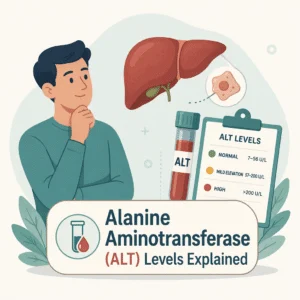
Because the liver has spare capacity, synthesis falls noticeably only in advanced disease. Hypoalbuminemia is a feature of advanced cirrhosis, and severe protein-energy malnutrition (kwashiorkor) lowers it by starving the liver of amino acids. Even here, reduced synthesis usually combines with the increased breakdown that accompanies serious illness. High liver enzymes on the same panel can point toward liver injury, so it helps to read albumin next to the ALT liver enzyme.
Urinary loss
Healthy kidneys leak almost no albumin. When the glomerular filter is damaged, albumin escapes into the urine. The classic example is nephrotic syndrome, defined by heavy proteinuria (3.5 grams or more of protein per day) together with low albumin, edema, and high cholesterol. Advanced chronic kidney disease can lower albumin through a mix of urinary loss and reduced synthesis.
Gastrointestinal loss
In protein-losing enteropathy, albumin leaks through the gut wall faster than the liver can replace it. Causes include conditions with high lymphatic pressure, inflammatory bowel disease with mucosal ulceration, and celiac disease.
Redistribution, dilution, and increased breakdown
Sepsis, major burns, and critical illness make capillaries leaky, so albumin shifts out of the bloodstream into the tissues; the same states also slow production and speed breakdown, driven by inflammatory cytokines. Large intravenous fluid volumes can dilute the remaining albumin, and heart failure lowers it through several of these routes at once. This is why a low albumin in a very sick patient is best read as a marker of how ill they are.
Why hypoalbuminemia predicts worse outcomes
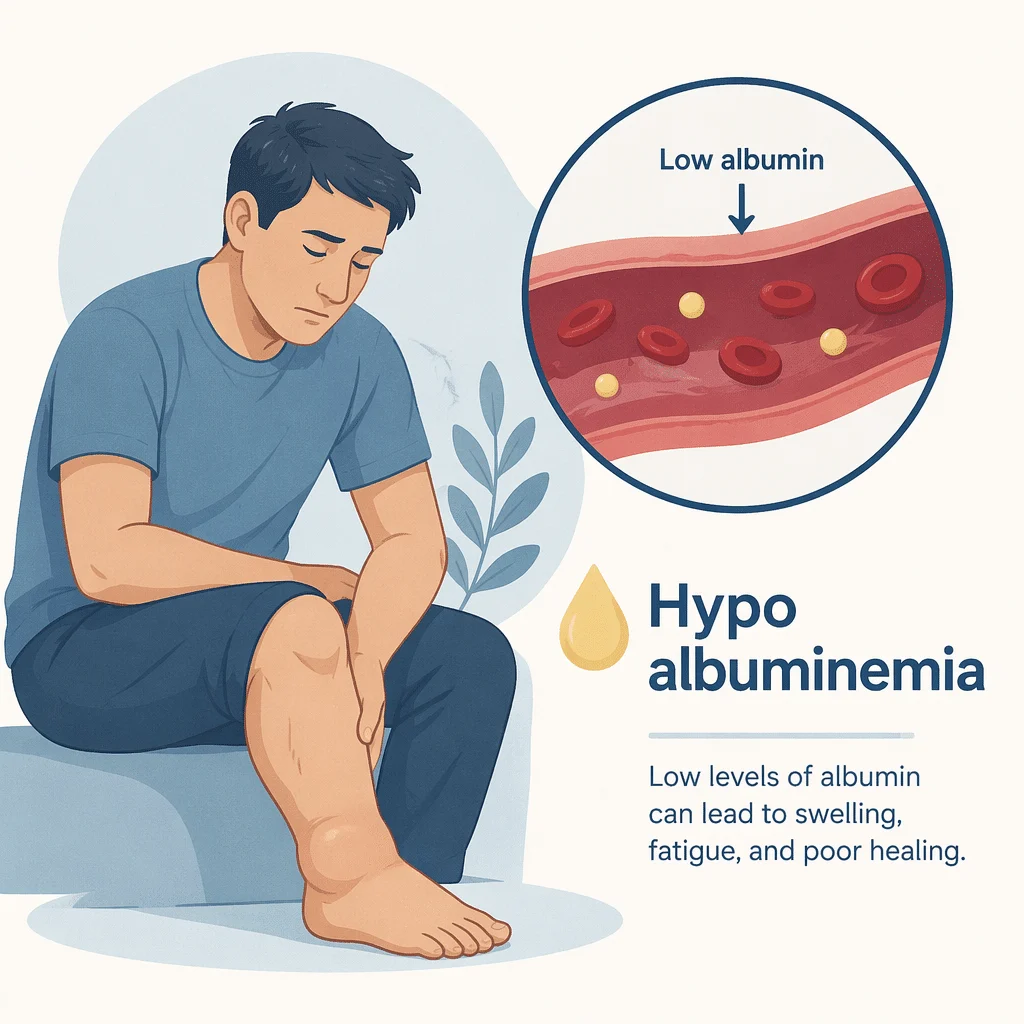
Across hospital and intensive-care settings, a low albumin consistently signals a higher risk of complications and death. That is largely because it reflects the severity of the underlying illness and the intensity of inflammation, not because low albumin alone is the direct culprit. It also has practical effects: falling oncotic pressure allows fluid to pool as leg swelling (edema), abdominal fluid (ascites), or generalized swelling (anasarca), and because albumin carries many drugs, a low level can raise the free, active fraction of a medication and change its effect. Low albumin is also tied to poorer wound healing and a greater vulnerability to infection.
How clinicians work out the cause
Diagnosis starts with a serum albumin measurement, usually within a comprehensive metabolic panel. From there the workup is aimed at the mechanism: urine tests (protein and the urine albumin-to-creatinine ratio) look for kidney loss; liver enzymes and a full panel of liver function tests assess the liver; and specialized tests, such as alpha-1-antitrypsin clearance in stool, can confirm gut loss. Serum protein electrophoresis is especially useful, because the pattern points to the cause: acute inflammation shows low albumin with raised alpha-1 and alpha-2 globulins, chronic liver disease shows low albumin with raised gamma globulins and beta-gamma bridging, and nephrotic syndrome shows low albumin with raised alpha-2 and low gamma globulins.
How hypoalbuminemia is managed
The guiding principle is to treat the disease behind the low albumin, not the number itself. Depending on the cause, that may mean controlling blood pressure and proteinuria in kidney disease, managing heart failure, treating infection, addressing inflammatory bowel disease, or providing nutritional support with a dietitian. Intravenous albumin has a defined role in specific situations, such as certain complications of cirrhosis and large-volume drainage of ascites, and in burns, but it is not a general fix for a low reading and can carry risks, so it is reserved for evidence-based indications. Because albumin has a long half-life of about three weeks, levels recover slowly once the cause is controlled.
Physical signs, including Muehrcke’s lines
Many people with mild hypoalbuminemia have no outward signs. As it deepens, fluid-related signs appear: pitting swelling of the legs, ascites, or breathlessness if fluid gathers around the lungs. A classic nail sign is Muehrcke’s lines, pairs of pale horizontal bands across the nails that fade when the nail bed is pressed and that reflect low albumin. These signs support the laboratory picture but do not replace it.
Latest scientific advances
Recent research has clarified when raising albumin actually helps, and why low albumin matters so much in infection. Here is the practical picture.
A large 2021 trial in the New England Journal of Medicine tested giving concentrated albumin to hospitalized patients with advanced cirrhosis, aiming to push their level back up. Topping up albumin this way did not reduce infections, kidney problems, or deaths compared with standard care, and it caused more serious side effects. In plain terms, correcting the number is not the same as correcting the disease, which is why treatment focuses on the cause. A 2024 review reached a similar nuanced conclusion for cirrhosis: albumin infusion clearly helps in specific complications, but it is not a blanket treatment, and altered forms of albumin may even serve as prognostic clues. A 2021 review explained the other side of the story, that low albumin both signals and may worsen the risk of infection, because albumin supports immune defense and helps carry antimicrobial drugs. What this means for patients and clinicians is that a low albumin deserves a careful search for its cause and close monitoring, rather than a reflex to simply infuse more albumin. These conclusions continue to be refined as trials report.
Glossary
- Hypoalbuminemia: a serum albumin below the laboratory reference range.
- Albumin: the main plasma protein, made by the liver, that holds fluid in vessels and carries many substances.
- Oncotic pressure: the pull albumin exerts to keep fluid inside blood vessels.
- Negative acute phase reactant: a protein whose level falls during inflammation, as albumin does.
- Nephrotic syndrome: a kidney disorder with heavy protein loss in urine, low albumin, and edema.
- Protein-losing enteropathy: excessive loss of protein, including albumin, through the gut.
- Anasarca: severe, generalized swelling from fluid retention.
- Muehrcke’s lines: paired pale horizontal nail bands linked to low albumin.
Frequently asked questions
Is hypoalbuminemia dangerous? It can be, mainly as a marker of serious underlying illness. Severe or falling albumin is associated with more complications and higher mortality in hospitalized patients, which is why the cause is investigated promptly.
Can low albumin cause death on its own? Very low albumin rarely causes death directly, but it reflects and can worsen dangerous conditions such as sepsis, advanced cirrhosis, or nephrotic syndrome, so it is treated seriously.
What causes hypoalbuminemia most often? In hospital settings, inflammation and critical illness are the most common drivers; longer term, liver disease, nephrotic syndrome, gut protein loss, and malnutrition are frequent causes.
How is hypoalbuminemia treated? By treating the underlying disease. Intravenous albumin is used only for specific indications, such as some cirrhosis complications and burns, not as a routine correction.
Can I raise albumin with diet or supplements? Diet supports the liver’s production when poor intake is the cause, but you cannot replace blood albumin with oral supplements. Medical nutrition support and treating the cause are the effective routes.
How quickly does albumin recover? Slowly. Because albumin lasts about three weeks in the body, levels typically improve over weeks to months once the underlying problem is controlled.
Further reading
- Low albumin: what your result means
- High albumin: causes and interpretation
- Albumin-to-globulin ratio explained
- Liver function tests overview
- High ALT: causes and warning signs
Sources
- Gounden V, Vashisht R, Jialal I. Hypoalbuminemia. StatPearls, NIH National Library of Medicine, 2023. https://www.ncbi.nlm.nih.gov/books/NBK526080/
- Cleveland Clinic. Hypoalbuminemia. https://my.clevelandclinic.org/health/diseases/22529-hypoalbuminemia
- MedlinePlus, NIH National Library of Medicine. Albumin Blood Test. https://medlineplus.gov/lab-tests/albumin-blood-test/
- China L, et al. A Randomized Trial of Albumin Infusions in Hospitalized Patients with Cirrhosis (ATTIRE). N Engl J Med, 2021. https://consensus.app/papers/details/1530a60c9bda5a6685d37c11a833e52f/
- Wiedermann CJ. Hypoalbuminemia as Surrogate and Culprit of Infections. Int J Mol Sci, 2021. https://consensus.app/papers/details/4e811775454a5af3acedd18152671028/
- Heybe MA, et al. Role of albumin infusion in cirrhosis-associated complications. Clin Exp Med, 2024. https://consensus.app/papers/details/e2c1db27cc6a5bd188aa17e5f9340c88/
Understand your lab results with AI DiagMe
A low albumin is a clue that makes most sense next to your liver enzymes, kidney markers, and total protein. AI DiagMe reads your uploaded lab report and explains what your albumin and related results may mean, in clear language, so you can have a more focused conversation with your doctor. It helps you understand your results; it does not diagnose disease or replace medical care.
Get your results interpreted in minutes