
































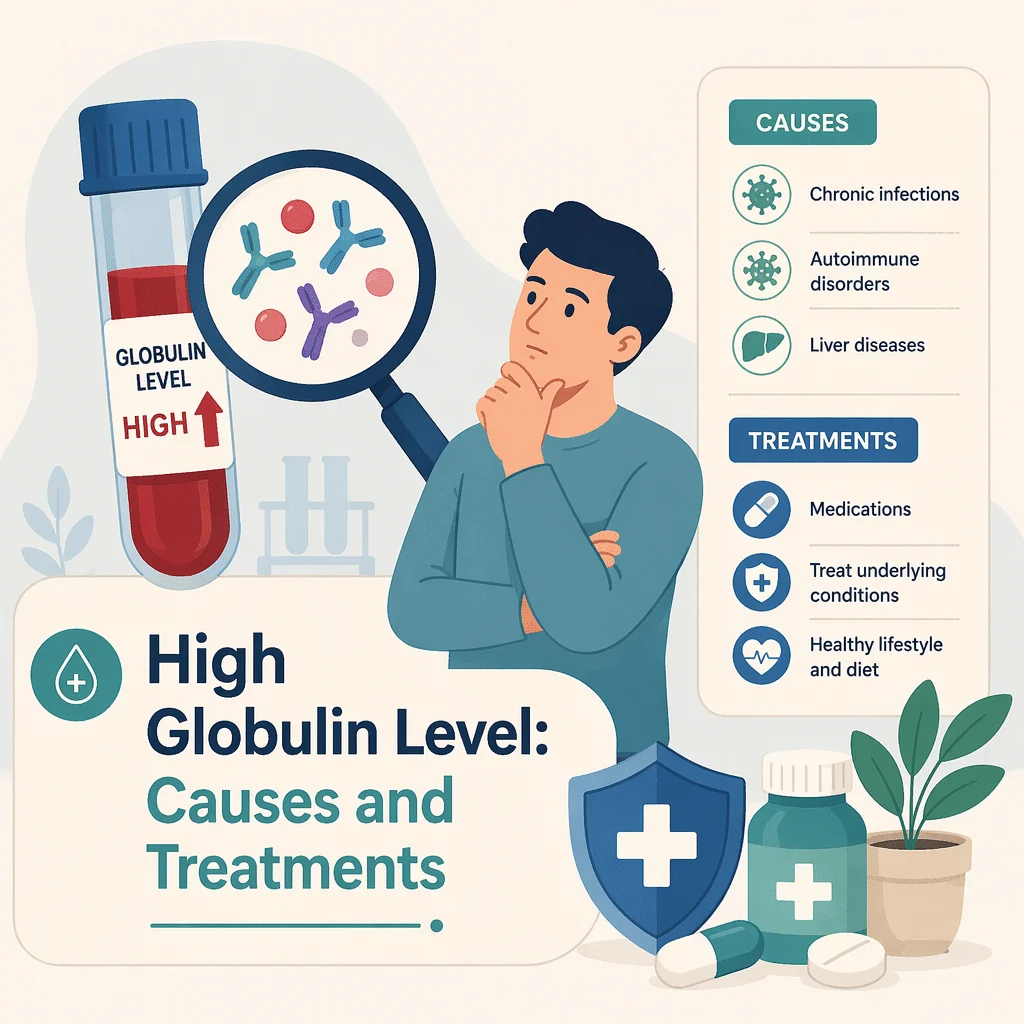
Seeing a high globulin level flagged on a routine blood panel is unsettling, and the first thought for many people is cancer. It almost never is. A raised total globulin most often reflects something ordinary: not drinking enough before the blood draw, an infection your body is still clearing, long-running inflammation, or a liver that is under strain.
The number itself is also stranger than it looks. On most metabolic panels, globulin is not measured at all. It is worked out by subtraction, which changes how much weight a single result deserves.
In this article you’ll learn what globulins actually are, why your globulin figure is usually calculated rather than measured, what the albumin/globulin (A/G) ratio adds, which everyday conditions push globulin up, and what a doctor does next when the value stays high.
What globulins are as a group
Your blood plasma carries a large amount of protein. Doctors split that protein into two buckets. The first is albumin, a single well-defined protein made by the liver that holds fluid inside your blood vessels and ferries hormones, calcium and medicines around the body.
The second bucket is everything else. That is what “globulin” means. It is not one substance. It is a catch-all category for hundreds of different proteins that happen not to be albumin.
Inside that category sit three very different kinds of protein. There are the antibodies, also called immunoglobulins, which your immune system makes to recognize viruses and bacteria. There are carrier proteins such as transferrin, which moves iron, and ceruloplasmin, which moves copper. And there are clotting proteins and complement proteins that help wounds seal and help the immune system destroy germs.
So a single globulin figure lumps together your antibody supply, your iron transport system and part of your clotting machinery. That is why the number, on its own, cannot say what is happening. It can only say that the non-albumin protein pool has grown.
Why total globulin is calculated, not measured
This is the point almost no lab report explains, and it matters.
A comprehensive metabolic panel measures two protein values directly: total protein and albumin. The analyzer never puts a probe on “globulin”. Instead the lab subtracts one from the other:
total protein minus albumin equals globulin.
Clinicians sometimes call this the calculated globulin, or the globulin gap. It is a derived figure, not a direct measurement.
What that means for trusting a borderline result
Because globulin is a difference between two measured numbers, it inherits the measurement error of both. If the total protein assay runs slightly high on a given day and the albumin assay runs slightly low, the calculated globulin absorbs both errors at once and lands further from the truth than either parent value.
Albumin adds a second wrinkle. Different laboratories measure albumin with different dye-binding chemistries, and those methods do not always agree with each other. Two labs can analyze the same tube of blood and report globulin figures that differ enough to move a result from “normal” to “flagged”.
None of this makes the number useless. It does mean a result sitting a whisker outside the reference range carries much less weight than a result that is clearly high, and far less weight than the same result appearing twice on separate occasions. This is exactly why the standard response to a single mildly raised globulin is to repeat the panel rather than to launch an investigation.
The A/G ratio and its two very different explanations
Many panels also report an albumin/globulin ratio, usually written A/G. It is simply albumin divided by globulin. In most healthy adults albumin outweighs globulin, so the ratio sits comfortably above one.
A low A/G ratio gets attention. But here is the trap: the ratio is a fraction, and a fraction can fall for two entirely unrelated reasons.
The globulin at the bottom can rise. That is the situation this article is about, and it points towards infection, inflammation, liver disease or an antibody-producing disorder.
Or the albumin at the top can fall, with globulin doing nothing at all. Low albumin has its own list of causes: liver disease, kidney disease that leaks protein into urine, poor nutrition, gut conditions that stop protein being absorbed, extensive burns, and any serious acute illness, because inflammation itself suppresses albumin production.
Those two scenarios call for completely different investigations. A low A/G ratio is therefore not a finding in itself. It is a prompt to look at which of the two numbers actually moved.
| Pattern on your report | What it usually points to | Usual next step |
|---|---|---|
| Globulin slightly high, albumin normal, total protein normal | Often nothing more than day-to-day variation in a calculated figure | Repeat the panel, well hydrated, after a few weeks |
| Globulin high and albumin high together, total protein high | Hemoconcentration, most often dehydration at the time of the draw | Rehydrate and retest; the pattern usually settles |
| Low A/G ratio driven by low albumin, globulin normal | An albumin problem, not a globulin problem: liver, kidney, gut or nutrition | Liver and kidney tests, urine protein check |
| Globulin high with raised inflammatory markers | Chronic infection, chronic inflammation or autoimmune disease | Investigation aimed at the underlying condition |
| Globulin clearly and persistently high on repeat testing | Undetermined until the fractions are separated | Serum protein electrophoresis to see which globulins are raised |
Dehydration, the commonest harmless cause
The single most frequent innocent reason for a high globulin is that there was less water in your blood than usual when the sample was taken.
Globulin is reported as a concentration, a quantity of protein per volume of blood. Remove some of the water and every protein in that volume looks more concentrated, even though the actual amount of protein in your body has not changed at all. Laboratory medicine calls this hemoconcentration.
It happens easily. A long overnight fast before a fasting panel, a hot day, a hard workout, a bout of vomiting or diarrhea, a diuretic tablet, or simply a habit of drinking very little all shift blood water enough to nudge protein concentrations up.
The giveaway is that dehydration lifts everything together. Total protein rises, albumin rises, globulin rises. If albumin is at or above the top of its range alongside a high globulin, hydration is a very likely explanation. It is also completely reversible, which is why a repeat test taken on a normal day so often comes back clean.
Infection, inflammation and autoimmune disease
When the immune system is working hard for a long time, it makes more antibodies. Antibodies are globulins, so the total goes up.
Long-running infections do this. Chronic viral hepatitis, tuberculosis, HIV, infective endocarditis, persistent parasitic infection and chronic abscesses all keep antibody production elevated for months or years. A short cold does not usually shift the number in a lasting way.
Chronic inflammatory and autoimmune conditions do the same thing from a different direction. In rheumatoid arthritis, lupus, Sjögren syndrome, sarcoidosis and inflammatory bowel disease, the immune system is persistently activated and antibody output stays high. Inflammation also drives the liver to produce more of the carrier and complement proteins that live in the globulin bucket.
This is why doctors rarely look at globulin alone. They read it alongside inflammatory markers such as C-reactive protein and the erythrocyte sedimentation rate, and alongside your symptoms. A high globulin in someone with months of joint pain and morning stiffness reads very differently from the same number in someone who feels perfectly well.
If antibody classes need separating, individual immunoglobulin tests such as IgG, IgA and IgM can be measured directly rather than inferred from a calculated total.
Chronic liver disease
The liver has an unusual double role in this test, which is why liver disease produces such a recognizable pattern.
The liver makes almost all of your albumin. When it is scarred, as in cirrhosis, or persistently inflamed, as in chronic hepatitis or autoimmune hepatitis, albumin production falls.
At the same time, a damaged liver filters blood arriving from the intestine less effectively. Bacterial products that would normally be cleared slip through into the general circulation, and the immune system responds by making more antibodies. Globulin rises.
Albumin down and globulin up is the classic picture, and it drives the A/G ratio below one. Because the two changes reinforce each other, the ratio can be a more sensitive signal of chronic liver disease than either value alone. This is one of the few situations where a low A/G ratio genuinely means something on its own, and it is why doctors typically pair a raised globulin with liver function tests.
When the trail leads to electrophoresis
If a high globulin persists on repeat testing and hydration, infection, inflammation and liver disease do not explain it, the next investigation is serum protein electrophoresis.
The idea is simple. Rather than one lumped number, electrophoresis separates the globulins into bands according to how they travel through a gel or capillary under an electric current. The lab then reports each band separately: alpha-1, alpha-2, beta and gamma.
That is the whole point of the referral. Your calculated globulin says the non-albumin pool has grown. Only electrophoresis can say which part of it grew, and different parts mean different things.
If the rise sits mainly in the gamma band, our article on gamma globulins covers that fraction in detail, including how doctors tell a broad immune response apart from a single abnormal protein. If the beta bands are the ones raised, see beta-2 globulins. And where an abnormal antibody protein is suspected, the follow-up test measures antibody fragments in the blood, which is covered in our guide to the kappa/lambda free light chain ratio.
Reaching electrophoresis is the natural end point of a high total globulin. It is not a bad sign. It is simply the test that turns one uninformative number into an answer.
What a high globulin does not mean
A high globulin is not a cancer diagnosis, and it is not a cancer screening result.
Most raised globulins have a benign or manageable explanation. Dehydration, chronic infection, chronic inflammation, autoimmune disease and liver disease together account for the large majority. Blood disorders that produce an abnormal antibody protein are a real but much less common cause, and they are far more likely in older adults and in people whose result is markedly high rather than borderline.
It also does not work as a self-scoring exercise. You cannot tell from one number whether your globulins are up because you were thirsty, because your immune system is busy, or because a single group of cells is overproducing one protein. Nobody can, including your doctor. That inability is not a gap in your knowledge; it is the reason electrophoresis exists.
The honest position sits between two errors. Panicking over a mildly high globulin is unwarranted. Ignoring one that stays high across repeat tests is also unwise, because electrophoresis is precisely how an abnormal protein gets found early, when there is most benefit in knowing.
A related point: a low globulin is a different question entirely, with its own separate list of causes.
When to see a doctor
Any out-of-range result on a blood panel deserves a conversation with the clinician who ordered it. For most people that conversation is brief and ends with a plan to repeat the test.
Bring the whole report rather than the single flagged line. Your doctor needs total protein and albumin alongside globulin to interpret it at all, and previous results are valuable because a stable pattern over years is reassuring in a way a single snapshot never is.
| When to see a doctor about a high globulin |
|---|
| Book a routine appointment if a raised globulin appears on a routine panel, so the result can be put in context and repeated if needed |
| Ask for review sooner if the globulin stays high on a repeat test taken when you were well and properly hydrated |
| Mention it promptly alongside persistent fever, drenching night sweats, unexplained weight loss, swollen glands lasting weeks, or bone pain |
| Mention it promptly alongside yellowing of the skin or eyes, abdominal swelling, or swelling of the ankles and legs |
| Mention it promptly if you get infections unusually often or they are unusually hard to shake off |
| Seek urgent care for severe breathlessness, sudden confusion, or heavy unexplained bleeding, whatever your blood results show |
Latest scientific advances in interpreting globulin levels
Research since 2023 has focused less on what raises globulin and more on how much a calculated number can honestly be asked to do.
A Brazilian and Welsh team led by Cristina Frias Sartorelli de Toledo Piza tested whether calculated globulin, meaning total protein minus albumin, tracks the body’s actual antibody supply. Analyzing 886 adult samples, they compared calculated globulin against directly measured IgG and found the two moved together well enough that a low calculated globulin flagged antibody deficiency with useful sensitivity and specificity. What this means for you is that the subtraction, crude as it looks, does carry genuine biological information. That is why clinicians act on it rather than dismissing it, and equally why they treat it as a screening prompt rather than an answer.
A systematic review by Will Roberts and colleagues gathered a decade of studies on the albumin-to-globulin ratio across 18 different solid tumor types and found a lower ratio was consistently linked to worse outcomes. The framing matters enormously here. Every one of those studies measured the ratio in people who had already been diagnosed with cancer, using it to gauge nutrition and inflammation and to estimate prognosis. None of them used it to find cancer in healthy people. What this means for you is that a low A/G ratio on your routine panel is not a cancer screening result, and should not be read as one.
That the ratio is a general health signal rather than a cancer signal is reinforced by work outside oncology. A 2025 study by Linlin Wang and colleagues followed 1,408 people having stents placed for acute coronary syndrome and found that a lower albumin-to-globulin ratio independently predicted worse cardiac outcomes. Separately, Ruifeng Duan and colleagues showed the ratio shifts in rheumatoid arthritis patients who develop lung complications. What this means for you is that when your A/G ratio drifts, the most likely story is inflammation and nutrition, the two things it has always reflected.
Finally, a multicenter survey by Sibtain Ahmed and colleagues asked laboratories how they report serum protein electrophoresis and found substantial variation in terminology, technique and quantification between institutions. What this means for you is practical: an electrophoresis report is written for a clinician to interpret in context, and comparing your printout with someone else’s, or with a figure found online, can mislead. Ask the doctor who ordered it what your specific report says.
Glossary of key terms
| Term | Definition |
|---|---|
| Globulin | A catch-all name for every protein in blood serum that is not albumin, including antibodies, carrier proteins and clotting proteins |
| Albumin | The single most abundant blood protein, made by the liver, which holds fluid inside blood vessels and transports many substances |
| Total protein | The measured combined amount of albumin and globulin in a sample of blood serum |
| Calculated globulin | The globulin figure on a routine panel, obtained by subtracting albumin from total protein rather than by direct measurement |
| A/G ratio | Albumin divided by globulin; a low value can mean high globulin, low albumin, or both |
| Hemoconcentration | A rise in the measured concentration of blood components caused by reduced blood water rather than by more protein being present |
| Immunoglobulin | An antibody; a protein made by the immune system to recognize a specific germ or foreign substance |
| Serum protein electrophoresis | A laboratory test that separates serum proteins into bands so each group of globulins can be reported individually |
| Reference range | The span of results seen in most healthy people at a given laboratory, which varies between laboratories and methods |
| Comprehensive metabolic panel | A routine group of blood tests that includes total protein and albumin, and therefore reports a calculated globulin |
Frequently asked questions
Does a high globulin mean cancer?
No. A high globulin is not a cancer diagnosis and is not used as a cancer screening test. The great majority of raised globulins come from dehydration, chronic infection, chronic inflammation, autoimmune disease or liver disease. Blood disorders in which one group of cells overproduces a single antibody protein are a genuine but much less common cause, and they are more likely when the value is clearly high, stays high on repeat testing, and occurs in an older adult. That possibility is not ignored, which is why persistent elevations are sent for electrophoresis. But finding a raised globulin on a routine panel is not, by itself, a reason to expect cancer.
Can dehydration raise globulin?
Yes, and it is the most common harmless explanation. Globulin is measured as a concentration, so when there is less water in your blood every protein looks more concentrated even though nothing has actually been produced in excess. A long fast before the test, hot weather, hard exercise, vomiting, diarrhea or diuretic medication can all do it. The clue is that dehydration raises total protein, albumin and globulin together, rather than globulin alone. It is fully reversible, and a repeat test taken on an ordinary day with normal fluid intake usually returns to normal.
What is a low A/G ratio?
The A/G ratio is your albumin divided by your globulin, and it normally sits above one because albumin is the larger fraction. A low ratio simply means the two have moved closer together. It can happen because globulin went up, or because albumin came down, and those are unrelated problems needing different investigations. Low albumin can reflect liver disease, kidney disease losing protein in urine, poor nutrition, gut absorption problems or serious illness. So a low ratio is a signal to look at which of the two numbers actually changed, not a diagnosis in itself.
Should I retest, and how soon?
Repeat testing is the usual first step for a mildly raised globulin, and your doctor will set the timing. A few weeks is common, which allows any short-lived illness to settle. Because globulin is calculated from two other measurements, it inherits the variability of both, so a single borderline result carries much less weight than the same result appearing twice. Turning up well hydrated and not immediately after a hard workout removes the most common source of a false alarm. Where possible, use the same laboratory, since methods and reference ranges differ between them.
Can medications change my globulin level?
They can. Diuretics reduce blood water and can raise all protein concentrations, including globulin. Corticosteroids and drugs that suppress the immune system tend to lower antibody production and therefore lower globulin. Some medications can trigger immune reactions that raise it. Recent vaccination can cause a small temporary rise in antibodies. Tell the doctor interpreting your results about everything you take, including over-the-counter products, but do not stop or change any prescribed medicine because of a blood test result without discussing it first.
Will I have symptoms if my globulin is high?
Usually not from the globulin itself. A high globulin is a laboratory finding rather than a condition, and most people who have one feel entirely well; it is typically discovered on a panel ordered for another reason. Any symptoms that are present belong to the underlying cause rather than to the protein level. That might be fatigue and joint pain with an autoimmune condition, or fatigue and abdominal swelling with liver disease. The absence of symptoms is reassuring but does not remove the value of repeating a persistently abnormal result.
Understand your lab results with AI DiagMe
Total protein, albumin, globulin and the A/G ratio only make sense when they are read together, and a lab report rarely explains how they connect. AI DiagMe turns those numbers into plain language so you can see what your own report actually shows. It helps you understand your results and prepare better questions; it does not diagnose anything and does not replace your doctor.
Get your results interpreted in minutes
Sources
- Total Protein and Albumin/Globulin (A/G) Ratio, MedlinePlus, National Library of Medicine
- Total protein, MedlinePlus Medical Encyclopedia, National Library of Medicine
- Dehydration, MedlinePlus, National Library of Medicine
- Cirrhosis, National Institute of Diabetes and Digestive and Kidney Diseases
- Gounden V, Vashisht R, Jialal I. Hypoalbuminemia. StatPearls, NCBI Bookshelf, National Library of Medicine
- de Toledo Piza CFS, Aranda CS, Sole D, Jolles S, Condino-Neto A. Screening for antibody deficiencies in adults by serum electrophoresis and calculated globulin. Journal of Clinical Immunology, 2023 (via PubMed)
- Roberts WS, Delladio W, Price S, Murawski A, Nguyen H. The efficacy of albumin-globulin ratio to predict prognosis in cancer patients. International Journal of Clinical Oncology, 2023 (via PubMed)
- Wang L, Xie S, Mei A, Fu Y, Wang X, Song G, Sun L, Zhang Y. Albumin-to-globulin ratio as an independent risk factor for predicting prognostic risk in patients with acute coronary syndrome undergoing percutaneous coronary intervention. BMC Cardiovascular Disorders, 2025 (via PubMed)
- Duan R, Lin L, Zou Y, Lin X. Neutrophil-to-lymphocyte ratio combined with albumin to globulin ratio for predicting rheumatoid arthritis-associated pneumonia. American Journal of Translational Research, 2024 (via PubMed)
- Ahmed S, Afzal N, Jafri L, Khan MD, Khan MQA, Iqbal S, Abbas G, Imran K, Ali U, Siddiqui I. Reporting practices of serum protein electrophoresis in Pakistan, a multicenter survey. Clinical Laboratory, 2024 (via PubMed)
Further reading
- Total proteins blood test: understanding and interpreting results
- Albumin to globulin ratio: interpretation and levels
- Protein electrophoresis results explained
- Gamma globulins: interpreting high or low levels
- Low globulin levels: causes and what they mean