








An autoimmune panel is a group of blood tests that look for antibodies your immune system has mistakenly made against your own body. Doctors often order one when symptoms such as joint pain, unexplained fatigue, rashes, or long-lasting inflammation suggest an autoimmune condition. This guide explains, in plain language, what an autoimmune panel tests for, with a close look at the three results people ask about most: antinuclear antibodies (ANA), rheumatoid factor (RF), and anti-CCP antibodies. You will learn what a positive or negative result means, why a single test rarely settles a diagnosis, what reflex testing is, and when your results are worth discussing with a doctor.

What is an autoimmune panel?
An autoimmune panel is not one fixed test. It is a set of blood tests chosen to detect autoantibodies — antibodies aimed at your own tissues instead of at germs. The exact tests vary between laboratories and depend on which condition your doctor suspects.
To understand the panel, it helps to know what it is searching for. Your immune system normally makes antibodies to attack viruses and bacteria. In autoimmune disease, that system misfires and produces antibodies against healthy parts of your body, such as the lining of your joints or the nucleus of your cells. An autoimmune panel tries to detect those misdirected antibodies.
These tests are most useful when you already have symptoms. They support a diagnosis rather than make one on their own, and a result always has to be read alongside your symptoms, physical exam, and sometimes imaging.
You may see a panel offered under a fixed name, or built test by test for your situation. A laboratory might package a set of antibodies as a single “autoimmune” or “connective tissue” panel, while a specialist may instead pick individual tests that match your symptoms. Either way, the principle is the same: the panel looks for specific autoantibodies, and the choice of tests should follow the clinical question being asked rather than a fixed, one-size-fits-all list.
Common reasons to order a panel include persistent joint pain or swelling, ongoing fatigue, recurring rashes, dry eyes or mouth, or inflammation markers that stay high without a clear cause. For a wider picture of how these conditions show up, see our overview of autoimmune disease symptoms. To make sense of any lab report, our guide to reading blood test results walks through the basics.
The three core tests: ANA, rheumatoid factor, and anti-CCP
Most autoimmune panels are built around three antibody tests. Each points toward a different group of conditions, and each has its own strengths and blind spots.
Antinuclear antibodies (ANA)
Antinuclear antibodies (ANA) are antibodies that target parts of the cell nucleus. The ANA test is the main screening test for connective tissue diseases such as lupus, Sjögren’s syndrome, and scleroderma.
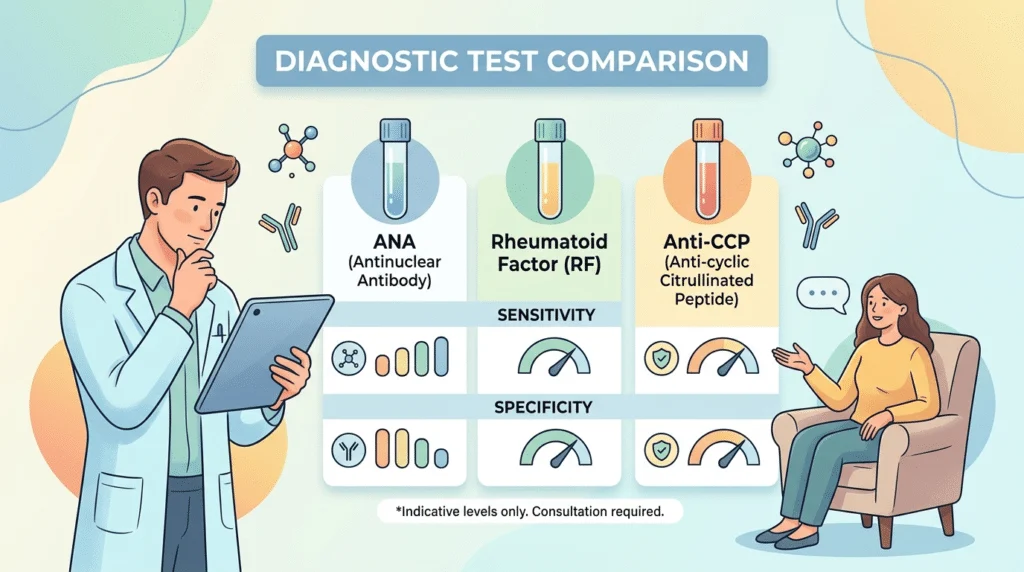
ANA is very sensitive but not very specific. In plain terms, almost everyone with lupus tests positive, but a positive result by itself does not mean you have a disease. ANA can be positive in at least 1 in 10 healthy people, and it becomes more common with age and is more frequent in women.
Results are reported in two parts: a titer and a pattern. The titer shows how far the blood can be diluted and still show antibodies, written as a ratio such as 1:80 or 1:320; higher numbers are generally more meaningful. The pattern describes how the antibodies look under the microscope (for example, speckled or homogeneous) and can hint at which condition is involved, which is why it helps guide the next, more specific tests. A handful of medications can also trigger a temporary positive ANA, so your doctor will review what you take before drawing conclusions. Learn more in our detailed guide to the ANA blood test.
Rheumatoid factor (RF)
Rheumatoid factor is an antibody directed against other antibodies in your blood. It is mainly linked to rheumatoid arthritis, a disease that inflames and slowly damages joints.
Rheumatoid factor is found in roughly 70% of people with rheumatoid arthritis, so it is a useful clue. But it is not specific: it also appears in other autoimmune conditions such as Sjögren’s syndrome, in some long-term infections such as hepatitis C, and in a small share of healthy people, more often as they get older. Its level does not closely track how active the disease is, so it is not a reliable way to follow treatment over time. A positive result, on its own, does not confirm arthritis, which is why it is interpreted with symptoms and other tests.
Anti-CCP antibodies
Anti-CCP antibodies (short for anti-cyclic citrullinated peptide) are the most specific of the three for rheumatoid arthritis. Around 95% of people who test positive truly have the disease, which makes a positive result a strong signal.
Two features make anti-CCP especially valuable. It can appear years before joint symptoms begin, giving an early warning, and higher levels are linked to more aggressive joint damage over time. Because of this, both rheumatoid factor and anti-CCP are part of the international criteria used to classify rheumatoid arthritis. Our dedicated article on anti-CCP antibodies explains the result in more depth.
ANA vs rheumatoid factor vs anti-CCP: a quick comparison
Seeing the three tests side by side makes their roles clearer. The values below are approximate and only describe how the tests behave — they are not a diagnosis.
| Test | Mainly points to | Roughly how sensitive | Roughly how specific | Also raised in |
|---|---|---|---|---|
| ANA | Lupus, Sjögren’s, scleroderma | High (most patients positive) | Low | Healthy people, ageing, some infections, thyroid disease |
| Rheumatoid factor (RF) | Rheumatoid arthritis | Moderate (about 70%) | Moderate | Sjögren’s, hepatitis C, some healthy people |
| Anti-CCP | Rheumatoid arthritis | Moderate (about 70%) | High (around 95%) | Rarely raised outside rheumatoid arthritis |
A simple way to remember it: ANA is good at catching connective tissue disease but flags many healthy people too, while anti-CCP rarely fires unless rheumatoid arthritis is truly present. This is also why doctors frequently order rheumatoid factor and anti-CCP together — when both are positive, the case for rheumatoid arthritis is much stronger than either test alone.
What a full autoimmune panel may include
Beyond the three core tests, a fuller autoimmune panel often adds markers that measure inflammation or refine the picture. Your doctor selects these based on your symptoms, so no two panels look exactly alike.
- Extractable nuclear antigen (ENA) tests — a group of more specific antibodies (such as anti-dsDNA, anti-Ro/SSA, anti-La/SSB, and anti-Sm) used to pin down which connective tissue disease is present. They are often run after a positive ANA.
- Complement proteins — low complement C3 and complement C4 levels can suggest active lupus, because these proteins get used up when the immune system is busy.
- Inflammation markers — the erythrocyte sedimentation rate (ESR) and C-reactive protein (CRP) show how much inflammation is present, though neither is specific to any one disease.
- Thyroid antibodies — anti-TPO antibodies point to autoimmune thyroid conditions, which often overlap with other autoimmune diseases.
- Immunoglobulin levels — measuring total IgG, IgA, and IgM (the main classes of antibodies) can show whether the immune system is over- or under-active, which sometimes accompanies autoimmune conditions.
These extra tests do not replace the core three. They add context, helping a doctor tell similar conditions apart and judge how active a disease is.
How to read your autoimmune panel results
Most results come back as “positive” or “negative,” sometimes with a number or titer beside them. Reference ranges differ from one laboratory to another, so always compare your result to the range printed on your own report rather than to a figure from the internet. Our guide to reading blood test results explains how these ranges work.
A few principles apply across the whole panel.
How likely a condition was before testing also changes what a result means. The same positive antibody carries more weight in someone with classic symptoms than in someone tested by chance. This is why a result is never read in isolation: doctors combine the antibody findings, inflammation markers, your symptoms, and the physical exam into a single picture. One test rarely confirms or excludes a disease, but several pointing the same way are far more convincing.
Why a positive result is not a diagnosis
A positive antibody test means antibodies were detected — not that you definitely have a disease. Healthy people, older adults, and people with infections or unrelated conditions can all test positive. This is exactly why doctors weigh results against symptoms and exam findings. A low ANA titer in someone with no symptoms, for example, is often left alone and simply monitored.
Why a normal panel does not always rule disease out
The reverse is also true. Some people with rheumatoid arthritis test negative for both rheumatoid factor and anti-CCP; this is called seronegative disease. Early in an illness, antibodies may not have risen enough to detect. A normal panel is reassuring, but if symptoms persist, your doctor may repeat the testing later or investigate further with imaging.
Reflex testing: what happens after a positive ANA
You may see the phrase “reflex testing” on your order form or report. It simply means the laboratory automatically runs follow-up tests when a first result is positive, so you usually do not need a second blood draw.
A typical reflex sequence works like this:
- The lab runs the ANA test first.
- If the ANA is negative and there is no strong suspicion of disease, testing usually stops there.
- If the ANA is positive, the lab reports the titer and the pattern.
- A positive ANA then triggers more specific tests — often an ENA panel and anti-dsDNA — to identify the exact condition.
This stepwise approach avoids running expensive, highly specific tests on everyone, while still following up the results that actually matter. If your report mentions a reflex test you did not expect, it is part of this normal process rather than a sign that something is wrong.
When to see a doctor
An autoimmune panel is only meaningful when read by a clinician, but certain symptoms are worth raising promptly. Consider booking an appointment if you have:
- Joint pain, swelling, or stiffness that lasts more than six weeks, especially in the small joints of the hands and feet.
- Morning stiffness that lasts longer than 45 minutes to an hour.
- A new, unexplained rash, particularly one spread across the cheeks and nose.
- Persistent dry eyes and a dry mouth.
- Unexplained fatigue, a low-grade fever, or weight loss alongside any of the above.
Seek urgent care for severe chest pain, breathing difficulty, or sudden weakness, which can occasionally accompany active autoimmune disease. A fuller description of warning signs is available in our guide to autoimmune disease symptoms. Whatever your results show, the final interpretation belongs with a doctor who knows your complete history.
Getting an autoimmune panel: who it’s for and how it’s done
An autoimmune panel is usually ordered when symptoms already suggest an autoimmune process — not as a routine screen for people who feel well. Testing without symptoms tends to produce confusing false positives that cause needless worry.
The test itself is straightforward. It uses a standard blood draw from a vein in your arm, often at the same time as other routine tests such as a complete blood count. Most autoimmune antibody tests do not require fasting, but you should follow any specific instructions from your laboratory and mention any medicines or supplements you take.
Because the panel is one part of a wider workup, your doctor may combine it with a physical exam, imaging, and a review of your symptoms before reaching any conclusion. The antibodies are clues, not verdicts — and reading them well is what turns a confusing report into a clear next step.
Glossary
- Anti-CCP (anti-cyclic citrullinated peptide antibodies): Antibodies that strongly point to rheumatoid arthritis. They are very specific and can appear before joint symptoms begin.
- Antinuclear antibodies (ANA): Antibodies that target the nucleus of cells. The ANA test screens for connective tissue diseases such as lupus.
- Autoantibody: An antibody that mistakenly attacks the body’s own tissues instead of germs. Autoimmune panels are designed to look for these.
- Connective tissue disease: A group of autoimmune conditions, including lupus and Sjögren’s syndrome, that affect the tissues supporting the body, such as joints and skin.
- ENA panel (extractable nuclear antigens): A set of more specific antibody tests, often run after a positive ANA, used to identify the exact condition.
- Reflex testing: A laboratory process where a positive first result automatically triggers follow-up tests, without needing a new blood sample.
- Rheumatoid factor (RF): An antibody linked mainly to rheumatoid arthritis. It can also appear in other conditions and in some healthy people.
- Specificity: How well a test avoids false positives. A highly specific test, such as anti-CCP, rarely flags people who do not have the disease.
- Titer: A measure of how concentrated antibodies are, shown as a ratio such as 1:160. Higher titers are generally more meaningful.
Frequently asked questions
How long does it take to get autoimmune panel results?
Most basic markers, such as ESR and CRP, can come back the same day or within 24 hours. The antibody tests in an autoimmune panel — ANA, rheumatoid factor, anti-CCP, and ENA tests — usually take longer, often two to seven days, because they may be sent to a specialised laboratory. If your panel includes reflex testing, follow-up tests are added automatically and can extend the wait by a few more days. Timing also depends on the lab and how your clinic shares results. For a fuller breakdown by test type, see our guide on how long blood test results take.
Do I need to fast before an autoimmune panel?
For most autoimmune antibody tests, no. ANA, rheumatoid factor, and anti-CCP do not require fasting, and you can usually eat and drink normally beforehand. The exception is when your doctor bundles the panel with tests that do need fasting, such as glucose or a lipid (cholesterol) panel. In that case, the fasting instruction comes from those other tests, not from the autoimmune markers. Always follow the specific guidance printed on your lab slip or given by your clinic, and mention any medicines or supplements you take, since some can influence results.
Can you have a positive ANA without having an autoimmune disease?
Yes, and it is common. A positive antinuclear antibody (ANA) test only shows that these antibodies are present, not that they are causing harm. At least 1 in 10 healthy people test positive, and the chance rises with age and is higher in women. Infections, some medications, and thyroid disease can also produce a positive ANA. This is why doctors do not screen people who feel well, and why a positive result is always interpreted together with symptoms. A low titer with no symptoms is usually not a cause for concern.
Is rheumatoid factor or anti-CCP more reliable for rheumatoid arthritis?
They measure different things and work best together. Rheumatoid factor is found in about 70% of people with rheumatoid arthritis but also appears in other conditions and in some healthy people, so it is less specific. Anti-CCP is found in a similar share of patients but is far more specific — around 95% — so a positive anti-CCP is a stronger pointer to rheumatoid arthritis. When both are positive, the likelihood of the disease is high. Anti-CCP also tends to appear earlier and is linked to more aggressive joint damage, which adds useful prognostic information.
Does a normal autoimmune panel rule out autoimmune disease?
Not completely. A normal panel makes autoimmune disease less likely and is reassuring, but it does not fully exclude it. Some people have what is called seronegative disease — for example, rheumatoid arthritis without detectable rheumatoid factor or anti-CCP. Early in an illness, antibody levels may be too low to register. If your symptoms continue despite normal results, your doctor may repeat the tests later, order different ones, or use imaging. Persistent or worsening symptoms always deserve follow-up, whatever the first panel showed.
What should I do if my autoimmune panel results are abnormal?
First, avoid drawing conclusions on your own. A single abnormal antibody result rarely means a confirmed diagnosis. Bring the full report to the doctor who ordered it, and share any symptoms you have noticed, when they started, and how they have changed. Your doctor will interpret the result alongside your exam and history, and may arrange follow-up tests, a referral to a rheumatologist, or simply monitoring over time. If you have no symptoms and only a borderline result, the next step is often watchful waiting rather than treatment.
Sources
- ANA (Antinuclear Antibody) Test — MedlinePlus, NIH
- Rheumatoid Arthritis: Diagnosis, Treatment, and Steps to Take — NIAMS, NIH
- Understanding Rheumatoid Arthritis Blood Test Results — Hospital for Special Surgery
Further reading
- How to read blood test results: a simple guide
- Autoimmune disease symptoms, causes, and treatments
- Complete blood count: how to read your results
- CRP (C-reactive protein): understanding this inflammation marker
- How long do blood test results take?
Understand your lab results with AI DiagMe
Antibody results like antinuclear antibodies (ANA), rheumatoid factor, and anti-CCP — along with inflammation markers such as C-reactive protein (CRP) — can be hard to make sense of on your own. AI DiagMe reads your blood, urine, and stool results and explains what each value means in clear, plain language, with analysis reviewed by a medical committee. It is built to help you understand your report and prepare for your appointment, not to diagnose or replace your doctor. Upload your results to see what they are telling you.
➡️ Get your results interpreted in minutes