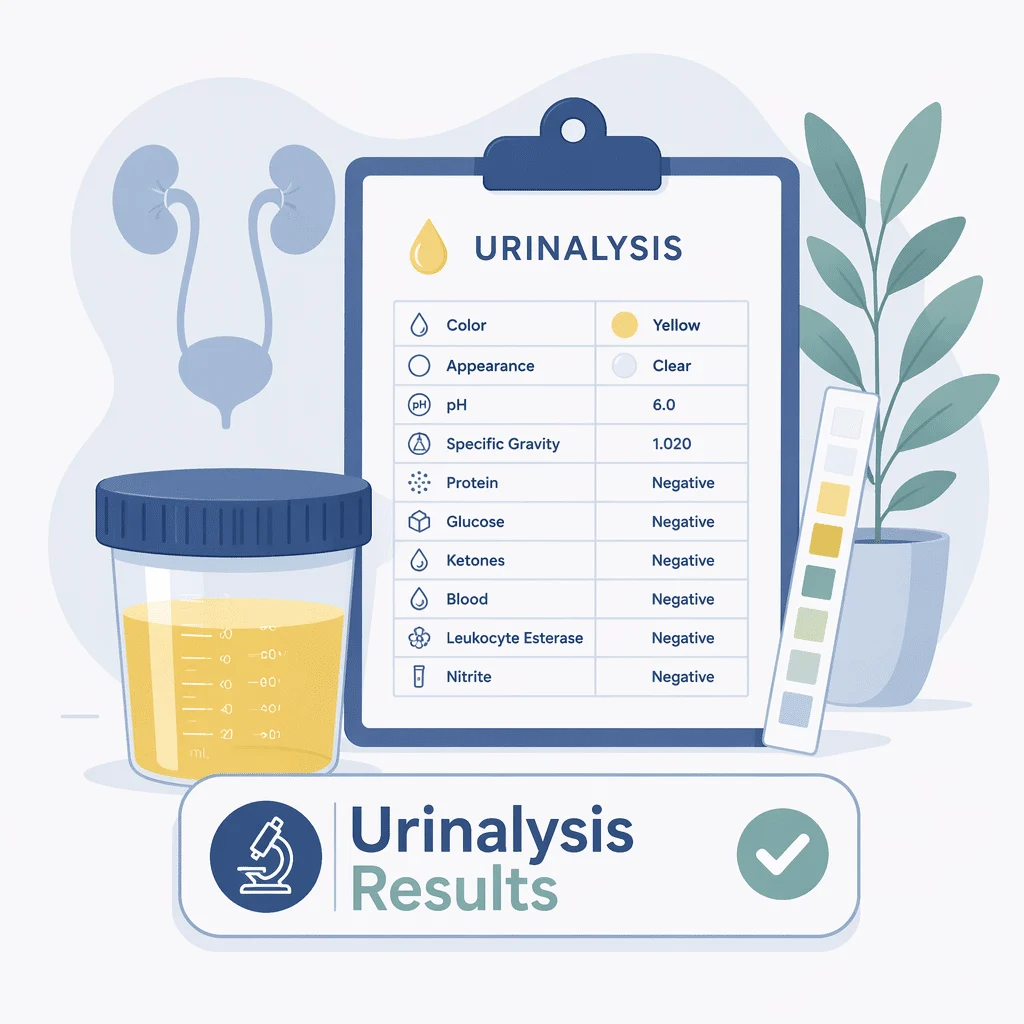
Urinalysis results can look like a wall of abbreviations: SG, pH, LE, NIT, then a row of pluses and minuses. In practice a urine test is three separate examinations reported on one sheet, and most of the lines only mean something once they are read alongside how you actually feel. In this article you’ll learn what the three parts of a urinalysis are, what each dipstick pad is measuring, what can make a strip give the wrong answer, and which patterns are worth acting on. You will also learn the most under-communicated point in urine testing: bacteria found in someone with no urinary symptoms is usually not an infection, and usually should not be treated with antibiotics.
What a urinalysis actually includes
A urinalysis is not one test but up to three examinations of the same sample, printed together, each answering a different question. Knowing which part produced a given line is the fastest way to make sense of your report.
1. The visual check
Someone records colour and clarity. This is the crudest part of the test, and the easiest to misread at home, because food, supplements and medicines all shift the shade. Cloudiness alone is not a diagnosis: it can come from crystals, mucus, cells or simply a concentrated sample.
2. The dipstick, or chemical test
A plastic strip carrying up to ten chemical pads is dipped in the urine. Each pad changes colour in the presence of one substance, and the reader records it as negative, trace, or one to four pluses. A dipstick is a screening tool: fast, cheap and approximate, designed to point at things worth checking rather than to confirm them.
3. The microscope, or sediment exam
Urine is spun in a centrifuge and the sediment examined for red cells, white cells, bacteria, casts and urine crystals, which have their own causes and significance. Many laboratories perform this step only when the dipstick is abnormal, which is why plenty of reports carry a dipstick column and nothing else. If yours mentions blood or protein but shows no microscopy, that is worth asking about.
The dipstick, pad by pad
Here is what each pad is for, in one or two lines. Each one has its own full guide where the detail lives.
- Specific gravity: how concentrated the urine is, compared with water. A high value usually means you were dehydrated when you gave the sample, a low value that you had been drinking heavily, and it shifts every other pad with it.
- pH: how acidic or alkaline the urine is, which moves with diet, medicines and how long the sample sat around. See normal urine pH levels and what changes them.
- Protein: mostly detects albumin, and a single trace is common and often meaningless. Persistent findings are covered in protein in urine.
- Glucose: sugar in the urine, which normally means the blood level has risen above what the kidney can reabsorb, unless a medicine is causing it. See glucose levels.
- Ketones: appear when the body is burning fat rather than sugar, which happens in fasting, low-carbohydrate diets and illness. See ketones in urine.
- Blood: reacts to haemoglobin and myoglobin, not to whole red cells, which is why it flags positive far more often than the microscope confirms. See hematuria.
- Leukocyte esterase: an enzyme released by white blood cells, so it suggests inflammation somewhere in the urinary tract rather than infection specifically. See leukocyte esterase.
- Nitrite: turns positive when certain bacteria have had several hours in the bladder to convert dietary nitrate, so it misses many infections and can be positive without one. See nitrites in urine.
- Bilirubin: a pigment from broken-down red cells that should not reach the urine, and when it does the question is usually about the liver or bile ducts.
- Urobilinogen: a related pigment whose reading is notoriously unreliable and rarely acted on alone; the detail sits in urobilinogen in urine.
Patterns worth recognising
| Finding | What it usually means | What to do |
|---|---|---|
| Trace blood, no symptoms | Very common and often temporary; exercise, menstruation and minor irritation all produce it | Ask whether microscopy confirmed it, and whether a repeat sample away from those triggers is worth doing |
| Protein once, no symptoms | Often follows exercise, a fever, or a long day upright | Ask about a repeat first-morning sample, and about a ratio test if it keeps appearing |
| Glucose present | Usually reflects a raised blood glucose, but is expected and harmless on SGLT2 inhibitor medicines | Bring your medicine list; ask whether a blood glucose or HbA1c test is indicated |
| Positive nitrite or leukocyte esterase, no urinary symptoms | Bacteria or white cells present without infection, known as asymptomatic bacteriuria | Outside pregnancy and certain urological procedures, no antibiotic is needed; ask why the urine was tested |
| Positive nitrite with burning and fever | Consistent with a urinary tract infection that needs assessment | Contact a clinician promptly rather than waiting to see whether it settles |
| Ketones with a high glucose in someone with diabetes | Can signal diabetic ketoacidosis, which develops quickly | Seek emergency care the same day |
What a positive result for bacteria does and does not mean
This is the most important section on the page. Bacteria living in the bladder without causing illness is called asymptomatic bacteriuria, and it is common: in older adults, in people with diabetes, in anyone with a urinary catheter, and in a fair number of healthy women. It produces exactly the same dipstick picture as an infection, because the strip cannot tell whether the bacteria are doing any harm.
A positive nitrite or leukocyte esterase pad in someone with no urinary symptoms is therefore not a urinary tract infection. Outside two well-defined exceptions, treating it with antibiotics does not help and does cause harm: resistant bacteria, side effects, allergic reactions such as a penicillin allergy, and Clostridioides difficile infection, a serious antibiotic-related bowel infection. The exceptions are pregnancy, and the period before certain urological procedures that break the lining of the urinary tract. That is what the guidelines from the Infectious Diseases Society of America say, and what the US Preventive Services Task Force says about screening.
Urine should not be dipped when there are no symptoms
The cleanest way to avoid an unhelpful result is not to generate it. In most situations, outside pregnancy, pre-procedure checks and specific monitoring your clinician has explained, there is no reason to test urine in someone with no urinary symptoms. Once a positive result exists on a chart it is hard to ignore, and it tends to attract an antibiotic prescription it does not need. Asking “what will we do differently depending on the result?” is a fair question before the pot is handed over.
Symptoms are what make a urine result meaningful: burning or stinging when passing urine, needing to go far more often or more urgently than usual, pain low in the abdomen, or pain in the back or side with a fever. If you have those, this is not a reason to stay away. Get assessed.
Why this matters most in older adults
Bacteria in the urine become steadily more common with age, and in nursing homes they are close to background. When an older person becomes confused, drowsy or unsteady, urine is often the first thing sent, a positive strip comes back, and the confusion gets blamed on a urinary tract infection. Without urinary symptoms or fever, that link is usually wrong, and treating it delays the search for the real cause: a new medicine, dehydration, pain, constipation, poor sleep or an infection elsewhere. None of this means an unwell older person should be left alone. It means the urine result should not end the conversation.
Cranberry is worth stating plainly on the same theme: the evidence concerns prevention in people who get repeated infections, and it is modest even there. It is not a treatment, and not a substitute for being assessed.
What makes a dipstick give the wrong answer
Dipsticks are chemistry, and chemistry can be interfered with. These are the interferences worth knowing, because most are things you can mention before the sample is taken.
- Vitamin C. Ascorbic acid blocks the reactions on the blood and glucose pads, so a high-dose supplement, or a fizzy drink or sachet containing vitamin C, can turn a genuinely positive result negative. This is a false negative: it hides findings rather than inventing them. Mention supplements before you give the sample.
- Menstruation, vigorous exercise and recent sex. All three can push blood or protein onto the strip in someone with nothing wrong. Timing the sample away from them, where possible, avoids a whole round of follow-up.
- Concentration. Very concentrated urine exaggerates everything on the strip; very dilute urine can wash a real finding below the threshold. Hydration and timing change what your report says.
- A sample left standing. The pH drifts upward, red and white cells break apart, and any bacteria present multiply. A sample that sits for hours before reaching the laboratory describes the pot, not the bladder.
- Colour from medicines and food. Rifampin and phenazopyridine turn urine orange or red, nitrofurantoin can darken it to brown, and beetroot can produce a pink that looks alarming and is not blood. These can make pads hard to read, but they are not bleeding.
Blood on the dipstick: when it matters
The blood pad is the most frequently positive pad on the strip and the one most often over-read. It reacts to haemoglobin rather than to intact red cells, so it turns positive for things that are not bleeding at all, and a large share of positives are not confirmed when someone actually looks under the microscope.
The distinction that matters has three steps. A one-off positive dipstick, with no symptoms and nothing on microscopy, is usually transient and does not need a work-up. Microscopic hematuria, meaning red cells that a microscope confirms and that persist on a repeat sample, does need evaluation, and how thorough that evaluation is depends on age, smoking history and other risk factors. Visible blood in the urine, which turns it pink, red or cola-coloured, always needs assessment, at any age and even if it happens once and stops.
Explanations range from the benign to the serious: a urinary infection, vigorous exercise, kidney stones, an enlarged prostate, inflammation inside the kidney, and less commonly a tumour. That range is why the confirming step exists, and why neither panic nor dismissal fits a single plus sign.
Protein, glucose and ketones in context
Protein on a dipstick is common and mostly innocent on a single reading. Exercise, fever, cold exposure and simply standing upright for a long stretch all push a little protein through, and it clears. What matters is persistence. When protein keeps appearing, the next step is usually to measure it properly on a spot sample as a ratio against creatinine, which corrects for how dilute the urine was; urine creatinine explains how that correction works. Persistent protein alongside swelling of the ankles is a different picture from a single trace after a run.
Glucose in urine usually means the blood glucose has risen past the level the kidney can reabsorb, which is why it prompts questions about diabetes. There is now an important exception. SGLT2 inhibitors, a widely used class of medicines for type 2 diabetes, heart failure and chronic kidney disease, work precisely by making the kidney dump glucose into the urine. If you take one, glucose on your dipstick is the medicine doing its job, not a warning sign, and it should not trigger a diabetes work-up on its own. Tell whoever reads the report that you take one.
Ketones show that the body is running on fat rather than sugar. Fasting, a low-carbohydrate diet, pregnancy sickness, vomiting or any illness that stops you eating will produce them, and in that context they are expected. The exception is critical: in a person with diabetes, ketones together with a high blood glucose can mean diabetic ketoacidosis, which can develop within hours and is a medical emergency rather than something to monitor at home.
How to give a sample that is worth reading
Half of the interference problems above are collection problems. A clean-catch midstream sample means washing your hands, cleaning the genital area, passing the first part of the stream into the toilet, and only then collecting into the sterile pot. The first part of the stream carries skin and genital cells and bacteria with it, and skipping that step is the commonest reason a sample has to be repeated.
Get the pot to the laboratory quickly, or ask whether it should be refrigerated if there will be a delay. A first-morning sample is preferred for some tests, including protein, because it has been in the bladder overnight and is concentrated enough for small amounts to register. Finally, say what you take: supplements, especially vitamin C, and medicines that colour urine are worth mentioning before the strip goes in rather than after.
When to seek care
Most findings on a urinalysis are handled at the next routine appointment. A small number are not, and these should not wait for a follow-up call.
Seek medical care urgently if you have any of the following:
- Visible blood in the urine, at any age, even if it happens once and stops
- Fever together with pain in the back or the side
- Being unable to pass urine at all
- Burning when passing urine together with fever, vomiting or feeling very unwell
- Ketones with a high glucose reading in someone with diabetes, which is an emergency
- Pregnancy with any urinary symptom
- Swelling of the legs, hands or face together with persistently frothy urine
Latest scientific advances in urine testing
Recent research has focused less on new pads and more on a harder question: when is a urine result worth generating and acting on? Five studies indexed in PubMed show where the field has landed.
A systematic review and meta-analysis in Clinical Microbiology and Infection pooled studies of leukocyte esterase and nitrite dipsticks in people aged sixty and over, against urine culture. What was found: the strip rarely misses bacteria, but flags large numbers of people who have no infection, so its ability to confirm one is poor. Because bacteria without infection is so common at that age, the authors concluded that a positive dipstick does not establish a urinary tract infection in older adults. What this means for you: a positive dip in an older relative without clear urinary symptoms is not a diagnosis.
A study in Urology reviewed records from more than a hundred United States health systems, covering adults whose dipstick was positive for blood. What was found: where a confirmatory microscopic urinalysis was performed, most of those positives were not confirmed. Some people went on to imaging or cystoscopy, a camera examination of the bladder, without that confirming step, while many with genuinely confirmed microscopic hematuria had no follow-up at all. What this means for you: a dipstick positive for blood is a prompt to confirm, in both directions.
A hospital study in Antimicrobial Stewardship and Healthcare Epidemiology tested a three-question tool for deciding whether a urine result justified antibiotics. What was found: a substantial share of antibiotic courses given for a urinary tract infection actually met the definition of asymptomatic bacteriuria, and the urinalysis could not separate the two, because white cells in the urine were almost as common in people with bacteria and no symptoms as in people with a real infection. What this means for you: the strip cannot make the diagnosis; your symptoms do.
A review in Infectious Disease Clinics of North America asked what actually reduces unnecessary treatment. What was found: the interventions that work best act before a result exists, by not sending urine when there are no symptoms, and by changing how laboratories report bacteria so the number does not read like an instruction. What this means for you: “why are we testing my urine?” is a legitimate question, not an awkward one.
Finally, a study in the American Journal of Obstetrics and Gynecology MFM looked at routine antenatal visits, where a dipstick is standard. What was found: a positive leukocyte esterase pad was often used on its own to justify treatment, and a structured algorithm increased confirmatory urine cultures while reducing unnecessary prescriptions. What this means for you: pregnancy is one of the few situations where bacteria without symptoms is treated, but the decision should rest on a culture rather than a colour change.
Frequently asked questions
Does a positive urine test mean I need antibiotics?
Usually not. A positive nitrite or leukocyte esterase pad tells you that bacteria or white cells are present, not that they are causing illness. If you have no urinary symptoms, that finding is most likely asymptomatic bacteriuria, and outside pregnancy and the period before certain urological procedures, antibiotics do not improve anything and carry real risks. If you do have symptoms such as burning, urgency or fever with back pain, the same result means something entirely different and you should be assessed. The decision belongs to a clinician who knows your symptoms, not to the strip.
What does trace blood in urine mean?
Trace blood is one of the most common dipstick findings and is frequently transient. Exercise, menstruation, recent sex and minor irritation all produce it, and the pad reacts to haemoglobin rather than to whole red cells, so it turns positive readily. The useful next step is confirmation: a microscopic examination, and often a repeat sample taken away from those triggers. Confirmed red cells that keep appearing do warrant evaluation, and visible blood always does. A single trace with no symptoms and no confirmation on microscopy is usually not the start of anything.
Can vitamin C affect a urine test?
Yes, and in the direction people least expect. Ascorbic acid interferes with the chemical reactions on the blood and glucose pads and can turn a genuinely positive result negative. That is a false negative: it hides real findings rather than creating false alarms. High-dose supplements are the usual culprit, but effervescent tablets and some drinks contain enough to matter. Mention any supplement you take before giving the sample, so that a negative result can be read with that in mind and repeated if necessary.
Why was my urine not examined under a microscope?
Many laboratories run microscopy only when the dipstick shows something. It is slower and more labour-intensive than dipping a strip, so it is reserved for samples where it will change something. If your report shows blood, protein or white cells on the dipstick and no microscopy column, it is worth asking whether the sediment was examined, particularly for blood, where the confirming step decides whether any follow-up is needed at all.
Do I need to use the first urine of the morning?
For some tests, yes. Urine that has been in the bladder overnight is more concentrated, so small amounts of protein or other substances are more likely to register rather than being diluted below the threshold. For other purposes any clean-catch sample will do. If nobody specified, ask when you are given the pot, because collecting the wrong sample is a common reason a test has to be repeated.
Can I test my own urine at home with a strip?
A home strip has the same limitations as a clinic strip, plus a few of its own: colour interpretation by eye is unreliable, strips degrade when the pot is left open, and there is no microscopy to confirm anything. It cannot tell you whether you have an infection, because it cannot distinguish bacteria that are causing illness from bacteria that are simply present. If you have urinary symptoms, contact a clinician rather than testing yourself. If you have none, a strip result is unlikely to help and may lead to treatment you do not need.
Glossary of key terms
| Term | Definition |
|---|---|
| Urinalysis | A group of up to three examinations of a urine sample: appearance, a chemical dipstick, and a microscopic look at the sediment |
| Dipstick (reagent strip) | A plastic strip with chemical pads that change colour in the presence of specific substances, read as negative, trace or a number of pluses |
| Specific gravity | A measure of how concentrated the urine is compared with water, which reflects hydration and shifts the other readings |
| Leukocyte esterase | An enzyme released by white blood cells, indicating inflammation in the urinary tract rather than infection specifically |
| Nitrite | A chemical produced when certain bacteria convert dietary nitrate in urine that has sat in the bladder for several hours |
| Asymptomatic bacteriuria | Bacteria present in the urine of someone with no urinary symptoms, which is common and is not an infection |
| Microscopic hematuria | Red blood cells in the urine that are only visible under a microscope, as opposed to blood you can see |
| Clean-catch midstream sample | A collection method in which the first part of the stream is discarded to reduce contamination from skin and genital cells |
| Protein-to-creatinine ratio | A calculation on a spot urine sample that corrects the protein amount for how dilute or concentrated the sample was |
| Sediment | The solid material left after urine is spun in a centrifuge, containing cells, casts, crystals and any bacteria |
Sources
- MedlinePlus, US National Library of Medicine. Urinalysis
- Centers for Disease Control and Prevention. Urinary Tract Infection Basics
- National Institute of Diabetes and Digestive and Kidney Diseases. Chronic Kidney Disease Tests and Diagnosis
- US Preventive Services Task Force. Asymptomatic Bacteriuria in Adults: Screening
- Nicolle LE, Gupta K, Bradley SF, et al. Clinical Practice Guideline for the Management of Asymptomatic Bacteriuria: 2019 Update by the Infectious Diseases Society of America. Clinical Infectious Diseases. 2019. Indexed in PubMed. https://doi.org/10.1093/cid/ciy1121
- Moragas A, Monfa R, Garcia-Sangenis A, Llor C. Accuracy of leukocyte esterase and nitrite tests for diagnosing bacteriuria in older adults: a systematic review and meta-analysis. Clinical Microbiology and Infection. 2026. Indexed in PubMed. https://doi.org/10.1016/j.cmi.2025.08.027
- Lan TL, Baer BR, Raman JD. Confirmatory Microscopic Urinalysis After Positive Dipstick Microhematuria: Adherence Patterns and Quality Improvement. Urology. 2025. Indexed in PubMed. https://doi.org/10.1016/j.urology.2025.09.007
- Gilboa M, Boatwright R, Salazar V, et al. Development and validation of an antimicrobial stewardship clinical decision-support tool to improve the management of urinary tract infections versus asymptomatic bacteriuria in hospitalized patients. Antimicrobial Stewardship and Healthcare Epidemiology. 2024. Indexed in PubMed. https://doi.org/10.1017/ash.2024.433
- Nicolle LE. Reducing Treatment of Asymptomatic Bacteriuria: What Works? Infectious Disease Clinics of North America. 2024. Indexed in PubMed. https://doi.org/10.1016/j.idc.2024.03.005
- Bergbower SB, Saad AF, Williams-Bouyer NM, Rajendran R. Implementation of an algorithm for testing, diagnosis, and antibiotic stewardship of asymptomatic bacteriuria in pregnancy. American Journal of Obstetrics and Gynecology MFM. 2024. Indexed in PubMed. https://doi.org/10.1016/j.ajogmf.2024.101516
Further reading
- Foamy urine explained: causes and risks
- Pregnancy test guide: accuracy and interpretation
- High BUN and creatinine levels explained
- High CRP levels: causes, symptoms and treatments
- Urine color: understanding causes and changes
A urinalysis report puts protein, blood, glucose and a handful of other markers on one page, often without the context that decides what any of them mean. AI DiagMe reads your report back to you in plain language, including how a protein or creatinine result fits with the rest. It helps you understand what you are looking at and what to ask; it does not diagnose infection or kidney disease and does not replace your doctor.
Understand your lab results with AI DiagMe
Get your results interpreted in minutes