
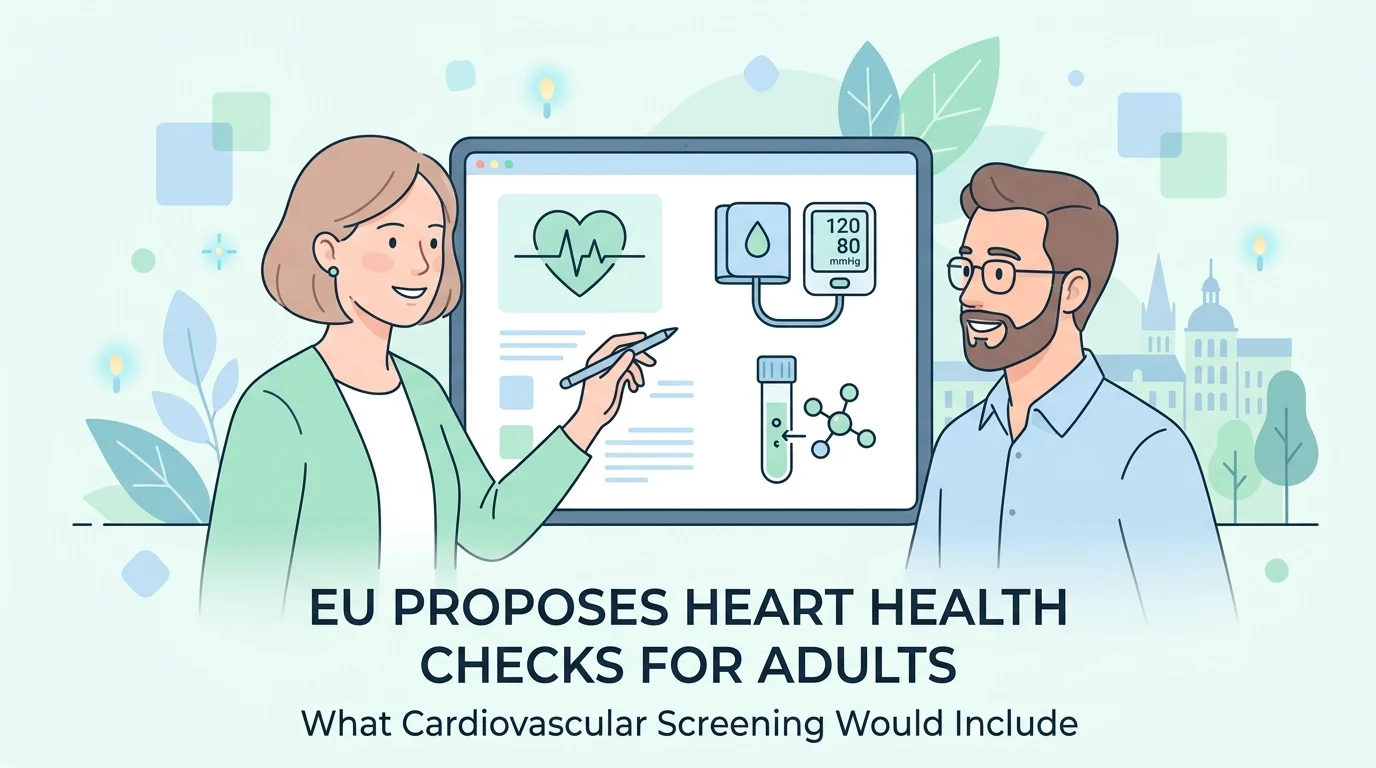
The European Commission has put forward a plan to make heart health checks a normal part of adult life across the EU. The proposal, presented on September 28, 2026 at the start of the first European Screening Week and timed with World Heart Day, is a draft Council recommendation on cardiovascular screening. Cardiovascular diseases cause about 1.7 million deaths a year in the EU, and the Commission says most of them are preventable. This article explains what was actually proposed, what a heart check usually involves, what recent research says about screening, and what it means for you, wherever you live.
What the EU proposed on cardiovascular screening
The text is a proposal for a Council recommendation, not a law. If member states endorse it, each country would still decide how to build its own programs. According to press coverage of the announcement, the proposal sets out a schedule that depends on age, summarized below.
| Faixa etária | Proposed frequency | What the check covers |
|---|---|---|
| Under 35 | At least one check | Blood pressure and a blood analysis, with more tests if heart disease runs in the family |
| 35 to 64 | At least every five years | Lifestyle, family history, body mass index, kidney function and other risk factors |
| 65 and over | Every three to five years | A broader exam, including an electrocardiogram |
Public health groups welcomed the direction but raised a caution. The European Public Health Alliance argues that Europe cannot screen its way out of heart disease, and that checks only help if prevention before the check and care after it are strong. Equity is the other concern: people who rarely see a doctor are the easiest to miss.
What a heart health check usually includes
Whatever the country, the core of a cardiovascular check is simple and the same numbers keep coming back. The CDC lists high blood pressure, high cholesterol and smoking among the main drivers of heart disease, and notes that high blood pressure often causes no symptoms at all.
Pressão arterial
A cuff reading takes a minute. Because a single reading can mislead, a high result is normally confirmed on another day or with home monitoring. If you want to see how doctors use lab values alongside it, read our guide to the blood tests behind blood pressure decisions.
Cholesterol and blood sugar
A lipid panel shows LDL, HDL and triglycerides, and a fasting glucose or HbA1c test checks for prediabetes and diabetes. To learn how each number is read, start with the complete lipid panel explained, depois veja the HbA1c ranges and what they mean.
Função renal
The kidneys and the heart share risk factors, which is why kidney markers appear in broader checks. You can learn what the numbers mean in our explanation of eGFR and kidney filtration, and why a urine test matters in the microalbuminuria guide.
Extra tests for selected people
Some people may be offered a lipoprotein(a) test or a coronary calcium scan, usually when family history or unusual results raise questions. These are not part of a routine first check. Read who really needs a coronary calcium score before asking for one.
Latest scientific advances on heart screening
Three recent studies, drawn from PubMed and Consensus, help put the proposal in context. All are observational, which means they show links, not proven cause and effect.
A large Korean study of adults in their thirties followed people whose blood pressure, blood sugar and LDL cholesterol were each only slightly above ideal. None of them had a diagnosed condition, and standard risk calculators would have labeled them low risk. Yet people with all three borderline readings together had more heart attacks and strokes over the following years than people with none. What it changes for you: a set of results that are each “almost normal” deserves a conversation, not a shrug.
A US study asked a different question: do people who say they were screened for high blood pressure, diabetes and cholesterol live longer? Over a few years of follow-up, it found no clear difference in deaths. That does not mean tests are useless. It suggests that a test only helps when an abnormal result leads to real changes, such as treatment, diet or exercise. What it changes for you: the check is the first step, and the follow-up is where the benefit comes from.
A third study, in adults aged 80 and over, found that signs of kidney leakage in the urine and of low-grade inflammation in the blood were stronger warning signals than blood pressure or diabetes alone. What it changes for you: in later life, urine and inflammation markers can add useful information to the usual numbers. These findings are preliminary and do not replace medical guidelines.
O que isto significa para si
For now, nothing changes automatically. The recommendation is a proposal, and national health systems will decide whether and when to act on it. Screening Week runs from September 28 to October 4, 2026, with free checks in some places, so it is worth asking your local health services what is on offer.
You do not need to wait for a program. In the United States, a routine visit usually includes a blood pressure reading, and a lipid panel and a glucose test are commonly ordered based on age and risk. If you already have recent results, you can understand your lab results with AI DiagMe before your appointment so you arrive with better questions.
Quando falar com o seu médico
Do not wait for a screening program if you have chest pain or pressure, shortness of breath, fainting, or sudden weakness on one side of the body. Call emergency services in those cases. Book a routine visit if you have a close relative who had heart disease at a young age, if you smoke, or if you have never had your blood pressure and cholesterol checked.
Glossário
- Council recommendation: a non-binding EU text that encourages member states to act in a common direction.
- Painel lipídico: a blood test measuring LDL, HDL and triglycerides.
- HbA1c: a blood test reflecting average blood sugar over about three months.
- TFGe: an estimate of how well the kidneys filter blood.
- Albuminúria: protein leaking into the urine, a possible sign of kidney or vascular damage.
- Estudo observacional: research that observes people without assigning treatments, so it cannot prove cause and effect.
FAQ
Is the EU heart check mandatory?
No. A Council recommendation is not binding. Each country decides whether to create or expand its own screening program.
At what age should I start cardiovascular screening?
The proposal suggests at least one check before age 35, then regular checks from 35. Your own doctor may advise starting earlier if you have risk factors.
How often should you get a heart health check?
The proposal points to at least every five years between 35 and 64, and every three to five years from 65. People at higher risk may need more frequent follow-up.
Which blood tests are part of a cardiovascular check?
Most checks include a lipid panel and a glucose or HbA1c test, and some add kidney markers. Extra tests are usually reserved for people with specific risk factors.
Does this apply to people in the United States?
No, it is an EU proposal. The core tests, however, are the same ones commonly used in US primary care, so the explanations here still apply.
Fontes
- Eunews: EU Cardiovascular Disease Prevention Week gets underway
- European Public Health Alliance: a common approach to cardiovascular screening
- European Commission Representation in France: launch of the European Screening Week (September 28, 2026)
- CDC: Heart disease risk factors
- Lee et al., European Journal of Preventive Cardiology, 2026: combined pre-hypertension, pre-diabetes and borderline LDL in young adults (PubMed, DOI)
- Zhang et al., Journal of Clinical Hypertension, 2025: screenings for hypertension, diabetes and high cholesterol and mortality (Consensus)
- Muntner et al., Circulation: Population Health and Outcomes, 2026: cardiovascular events in US adults aged 80 and over (PubMed, DOI)
Outros artigos
- High blood pressure: causes, risks and how to act
- Lipoprotein(a): the inherited cardiovascular risk marker
- Glicemia em jejum: o que significam os seus valores
Compreenda os seus próprios resultados de análises ao sangue com o AI DiagMe
Already have lab results from a heart check? Perceba os seus resultados de análises com o AI DiagMe and get a clear, doctor-reviewed explanation of each value.