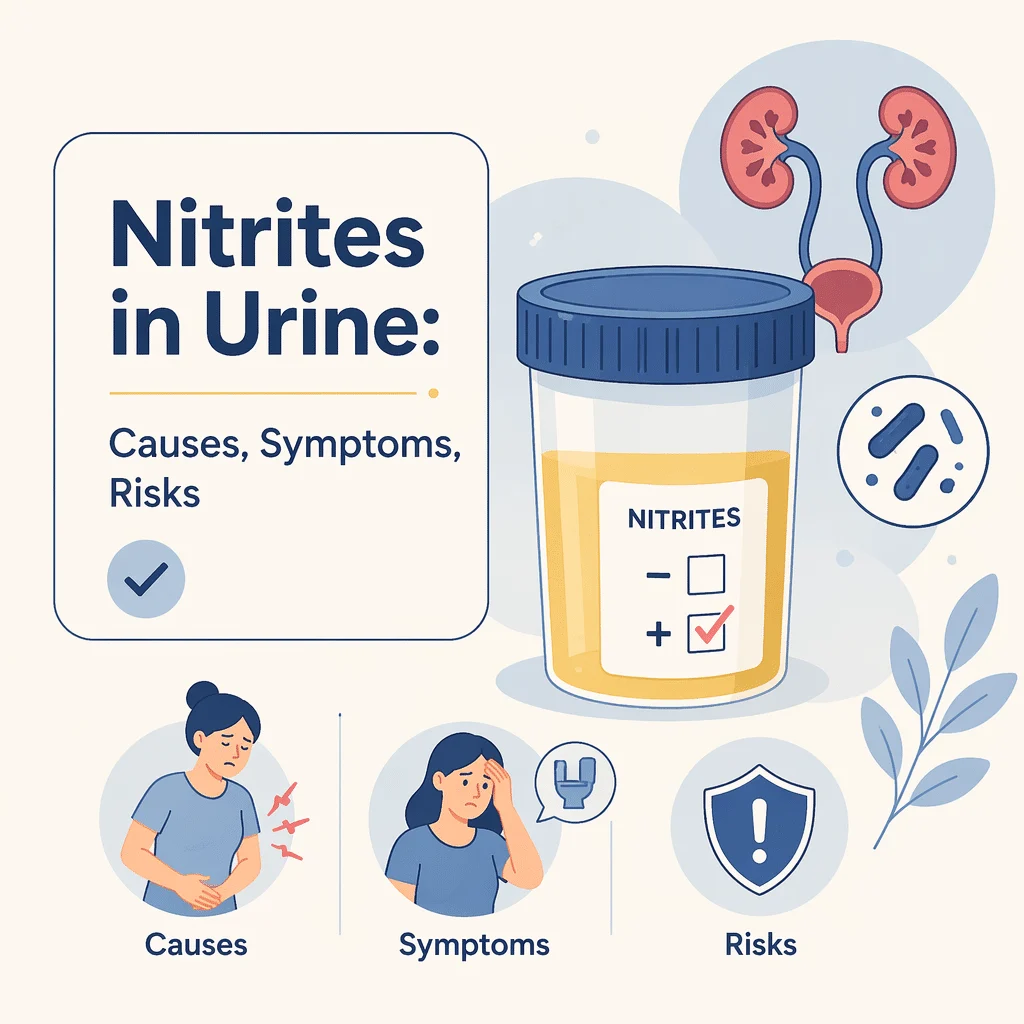
Encontrar nitritos na urina em um exame laboratorial geralmente aponta para uma coisa: bactérias estiveram ativas no seu trato urinário. O organismo normalmente não produz nitritos; eles aparecem quando certas bactérias convertem nitrato — um composto inofensivo que chega à urina por meio dos alimentos — em nitrito. Esse único processo é o que faz com que o campo de nitritos na fita reagente de urina seja uma das formas mais rápidas e acessíveis de rastrear uma infecção urinária.
Um campo, porém, raramente conta toda a história. Neste artigo, você vai entender como o teste de nitritos funciona, o que sugerem os resultados positivos e negativos, como o nitrito deve ser interpretado junto ao campo de esterase leucocitária, por que resultados falsos são mais comuns do que se imagina e quais exames costumam ser solicitados em seguida.
O que os nitritos na urina realmente significam
O nitrato é uma parte normal da urina. Ele vem de vegetais folhosos, beterraba, alimentos curados e água potável, e o próprio metabolismo do organismo também contribui. O nitrito é diferente. Em um trato urinário saudável, praticamente não existe nitrito, pois nada nesse ambiente converte um no outro.
A conversão que faz o teste funcionar
Muitas bactérias que infectam a bexiga possuem uma enzima chamada nitrato redutase. Ao se multiplicarem na urina, elas retiram um átomo de oxigênio do nitrato e deixam o nitrito como subproduto. Portanto, os nitritos na urina não são algo que o seu organismo produziu nem algo que você ingeriu: são um subproduto da atividade bacteriana, o que é o que torna o resultado significativo.
A Escherichia coli é o microrganismo mais frequentemente envolvido. Em um grande estudo de 2025 sobre lactentes febris, publicado na revista Pediatrics, a E. coli foi responsável por aproximadamente nove em cada dez infecções urinárias confirmadas. Espécies de Proteus, Klebsiella e Enterobacter também convertem nitrato com facilidade.
Por que o campo é uma triagem, não um diagnóstico
O campo de nitritos responde a uma pergunta específica: há bactérias conversoras de nitrato em quantidade suficiente para alterar a composição química desta amostra? Ele não indica qual microrganismo está presente, se a infecção está localizada na bexiga ou já atingiu um rim, nem se é necessário tratamento. Essas respostas vêm dos seus sintomas e de uma urocultura. Para uma visão mais completa de todos os campos da fita, você pode consultar nosso guia completo de interpretação do exame de urina.
Como o teste de nitrito é realizado e interpretado
Do recipiente à mudança de cor
O nitrito é quase sempre medido em uma fita reagente de urina, uma tira plástica com vários campos reagentes. Mergulhada na amostra, cada campo muda de cor em segundos, sendo lido a olho nu em comparação com uma tabela impressa ou por um leitor de bancada. As orientações dos Institutos Nacionais de Saúde destacam o método do jato médio: limpe a região genital, comece a urinar no vaso sanitário e, em seguida, colete a parte do meio do jato em um recipiente estéril sem tocar a parte interna do coletor.
O nitrito é registrado simplesmente como positivo ou negativo, e não como um valor numérico. Não existe um nível normal de nitrito, pois o resultado esperado em uma pessoa saudável é a ausência total.
Onde o resultado aparece no seu laudo
Na maioria dos laudos, o nitrito aparece na seção química, ao lado de esterase leucocitária, sangue, proteína, glicose, cetonas e pH. Cada campo acrescenta informações ao contexto. A mesma fita possui um campo para sangue, e nossa biblioteca aborda sangue na urina (hematúria). O campo de proteína tem seu próprio significado, e um artigo separado explica proteína na urina. A acidez influencia a própria reação do nitrito, e detalhamos os valores normais de pH da urina.
O que significa um resultado positivo para nitrito
Um resultado positivo para nitritos na urina significa que havia bactérias capazes de converter nitrato em quantidade suficiente. Em alguém com ardência ao urinar, urgência, aumento da frequência urinária ou desconforto na parte inferior do abdômen, esse achado apoia o diagnóstico de infecção bacteriana do trato urinário e costuma ser tratado rapidamente. Outro artigo descreve sintomas e tratamento de infecção urinária.
Um resultado positivo sem nenhum sintoma
Essa situação é comum e frequentemente mal compreendida. Bactérias podem estar presentes na urina sem causar infecção — um estado chamado bacteriúria assintomática. Ela se torna mais frequente com a idade, especialmente em mulheres mais velhas. As principais diretrizes são consistentes ao afirmar que, fora de circunstâncias específicas como gravidez ou cirurgia urológica programada, tratar essa condição não traz benefício e expõe as pessoas a efeitos colaterais evitáveis e ao risco de resistência bacteriana. Nossa biblioteca também aborda bacteriúria assintomática.
A consequência prática é que um campo de nitrito positivo em alguém que se sente completamente bem é uma informação, não uma indicação de tratamento. São os seus sintomas, analisados em conjunto com o resultado, que têm o maior peso.
O que um resultado positivo não significa
Um resultado positivo para nitrito não é um marcador de câncer e não mede dano renal nem a ingestão de nitrato pela alimentação. Também não indica a gravidade de uma infecção. Febre, dor no flanco, náusea e mal-estar geral são os sinais de que uma infecção pode ter se espalhado além da bexiga — não a intensidade da cor.
Interpretando o nitrito junto com a esterase leucocitária
Analisar o nitrito em conjunto com a esterase leucocitária é o que torna o exame de urina realmente informativo — e é exatamente onde a maioria das explicações para. O nitrito indica a presença de bactérias; a esterase leucocitária indica a presença de glóbulos brancos, ou seja, a resposta do seu sistema imunológico. Lidos juntos, os dois parâmetros geram quatro combinações possíveis, cada uma apontando para uma direção diferente. Um artigo separado explica os resultados da esterase leucocitária.
| Nitrito e esterase leucocitária | O que geralmente indica | Próximo passo típico |
|---|---|---|
| Nitrito positivo, esterase leucocitária positiva | O padrão mais consistente de infecção urinária bacteriana: bactérias redutoras de nitrato estão presentes e os glóbulos brancos já chegaram ao local. | Uma urocultura para identificar o microrganismo, interpretada junto com seus sintomas. As decisões sobre o tratamento são do seu médico. |
| Nitrito positivo, esterase leucocitária negativa | Bactérias capazes de produzir nitrito estão presentes, mas a resposta imunológica é fraca ou a amostra foi coletada cedo demais. Também pode ocorrer com amostras contaminadas ou antigas. | Uma nova amostra coletada com técnica adequada (jato médio), geralmente acompanhada de urocultura, para distinguir uma infecção inicial de um problema na coleta. |
| Nitrito negativo, esterase leucocitária positiva | Glóbulos brancos sem nitrito. Esse padrão aparece com microrganismos que não produzem nitrito, com irritação ou inflamação não infecciosa e com contaminação proveniente da região genital. | A urocultura é especialmente útil nesse caso, pois a fita reagente sozinha não consegue distinguir essas possibilidades. |
| Nitrito negativo, esterase leucocitária negativa | Infecção é menos provável; essa combinação é mais útil para tranquilizar do que para confirmar qualquer diagnóstico. | Se você não tiver sintomas, geralmente nenhuma investigação adicional é necessária. Se os sintomas persistirem, uma urocultura ainda é indicada, pois um resultado negativo na fita reagente não descarta infecção. |
Por que a combinação é mais confiável do que cada parâmetro isolado
Pesquisadores descrevem duas formas de combinar as fitas. Considerar o teste positivo quando qualquer uma das fitas for positiva detecta quase todas as infecções, mas gera muitos falsos alarmes. Exigir que as duas fitas sejam positivas torna um resultado positivo muito mais confiável, embora deixe passar uma parcela considerável de infecções reais. Um estudo de coorte de 2024 em gestantes ilustrou esse dilema: a regra de qualquer fita positiva detectou cerca de nove em cada dez infecções, mas a maioria das mulheres sinalizadas não tinha infecção; já a exigência de ambas as fitas inverteu o equilíbrio e deixou passar cerca de metade dos casos.
Não existe uma configuração única e correta. A regra que o médico prefere depende do custo de uma infecção não detectada na sua situação específica — e é por isso que duas pessoas com o mesmo resultado podem ser tratadas de forma diferente.
Por que um resultado de nitrito pode estar errado
Ambos os tipos de erro são comuns o suficiente para mudar a forma como o exame deve ser interpretado. Isso é o mais importante a entender sobre os nitritos na urina.
Falsos negativos: infecção presente, fita negativa
A fita de nitrito só fica positiva quando bactérias capazes de converter nitrato estão presentes em quantidade suficiente e tiveram tempo para agir. Algumas situações comuns interrompem essa cadeia. Certos microrganismos simplesmente não produzem nitrito — por isso o MedlinePlus afirma claramente que um resultado negativo não descarta uma infecção. Leveduras também não produzem nitrito, e nossa biblioteca aborda leveduras na urina. A urina muito diluída e o tempo curto de permanência na bexiga também influenciam o resultado.
Falsos positivos: fita positiva, sem infecção na bexiga
A contaminação durante a coleta é a explicação mais comum, especialmente quando a amostra não foi coletada pelo método do jato médio. Uma amostra deixada em temperatura ambiente também pode causar esse problema, pois as bactérias continuam se multiplicando no recipiente. Medicamentos com pigmentação, especialmente os prescritos para desconforto urinário, e fitas expostas ao ar completam a lista.
| Situação | Efeito na fita de nitrito | Por que isso é importante para você |
|---|---|---|
| Bactérias que não convertem nitrato | Falso negativo | Alguns microrganismos, incluindo certas bactérias gram-positivas e leveduras, nunca produzem nitrito, portanto a fita permanece negativa mesmo durante uma infecção real. |
| Vitamina C (ácido ascórbico) de suplementos ou alimentos | Falso negativo | O ácido ascórbico interfere na reação química da fita. Suplementos em doses elevadas valem a pena ser mencionados ao seu médico. |
| Urina retida na bexiga por menos de cerca de quatro horas | Falso negativo | As bactérias precisam de tempo para converter o nitrato. Uma amostra coletada pela manhã, logo ao acordar, é mais confiável do que uma coletada pouco tempo após a última micção. |
| Urina muito diluída ou muito concentrada | Falso negativo | Ambos os extremos podem fazer a reação cair abaixo do nível que o reagente detecta. |
| Muito pouco nitrato na alimentação | Falso negativo | O teste precisa de nitrato para funcionar, e dietas pobres em vegetais fornecem menos dessa substância. |
| Urina fortemente ácida | Falso negativo | Um pH urinário baixo enfraquece a reação de cor. |
| Contaminação durante a coleta | Falso positivo | Bactérias da pele ou da região genital podem entrar no recipiente e alterar o reagente sem que haja nenhuma infecção. |
| Amostra deixada em temperatura ambiente | Falso positivo | As bactérias se multiplicam no recipiente, e o reagente acaba refletindo o conteúdo do frasco, não o da sua bexiga. |
| Medicamentos que pigmentam a urina e fitas reagentes expostas ao ar | Falso positivo | Alguns medicamentos para dor na bexiga deixam a urina laranja ou vermelha, e fitas deixadas sem tampa se deterioram; ambas as situações podem ser interpretadas erroneamente como resultado positivo. |
O que geralmente acontece após um resultado de nitrito
A urocultura
A urocultura é o exame de referência. O laboratório cultiva as bactérias presentes, identifica o microrganismo e verifica a quais antibióticos ele responde. O resultado leva de um a três dias — e é exatamente por isso que a fita reagente existe: ela fornece uma resposta provisória enquanto a cultura é processada. A urocultura é especialmente útil quando os sintomas e a fita reagente divergem, quando os sintomas continuam voltando, durante a gravidez ou quando um tratamento anterior não funcionou.
Exames que complementam o diagnóstico
Quando há suspeita de envolvimento renal, exames de sangue costumam ser solicitados. A filtração renal é avaliada por meio da creatinina, e você pode ler nosso guia sobre o painel de função renal. Marcadores de inflamação indicam a intensidade da resposta do organismo, e explicamos o exame de PCR (proteína C-reativa) no sangue. Um hemograma mostra se os glóbulos brancos estão elevados de forma generalizada, e nossa biblioteca aborda o hemograma completo.
Situações que alteram a interpretação
- Gravidez: o exame de urina é feito com mais frequência, e uma urocultura positiva é tratada mesmo sem sintomas, devido aos riscos para a gestação.
- Idosos: a bacteriúria assintomática é tão comum após os 60 anos que uma fita reagente positiva isolada diz muito pouco, e as evidências apontam para não depender apenas dela.
- Bebês e crianças pequenas: os sintomas são vagos, por isso a fita reagente tem mais peso e os resultados são tratados com mais rapidez.
- Sondas vesicais: bactérias colonizam sondas com frequência, por isso um reagente positivo é esperado e interpretado quase que exclusivamente pelos sintomas.
- Cálculos recorrentes: os cálculos podem abrigar bactérias e fazer as infecções voltarem repetidamente, e um artigo separado aborda cálculos renais.
Quando procurar atendimento médico
Um resultado de nitrito é uma informação, não uma emergência em si. Os seus sintomas é que determinam a urgência.
- Entre em contato com um profissional de saúde em um ou dois dias se sentir ardência ao urinar, urgência, aumento da frequência urinária, urina turva ou com cheiro forte, ou desconforto na parte inferior do abdômen.
- Procure atendimento com rapidez se tiver febre, calafrios, dor no flanco ou nas costas, náusea ou vômito, pois esses sinais podem indicar que a infecção chegou aos rins.
- Procure atendimento médico imediatamente se você estiver grávida e tiver qualquer sintoma urinário, independentemente do resultado da fita reagente.
- Procure atendimento médico imediatamente em caso de sangue visível na urina, ou se os sintomas ocorrerem em um bebê, em um idoso fragilizado ou em qualquer pessoa com imunidade baixa, diabetes ou cateter.
- Volte ao seu médico se os sintomas persistirem ou voltarem após o tratamento, ou se uma fita reagente negativa tiver sido usada como garantia, mas você ainda não se sentir bem.
Últimos avanços científicos
Pesquisas publicadas desde 2023 aprimoraram o peso que os nitritos na urina devem ter. A tendência é consistente: a fita é boa para não deixar passar infecções e ruim para confirmá-las.
Um resultado positivo é uma evidência mais fraca do que se supunha
Uma revisão sistemática com meta-análise de 2025, publicada na Clinical Microbiology and Infection, reuniu 16 estudos com adultos com 60 anos ou mais. A leitura combinada das fitas de nitrito e esterase leucocitária identificou cerca de nove em cada dez casos de bactérias na urina, mas descartou corretamente apenas cerca de metade das pessoas que não tinham nenhuma. Os autores concluíram que uma fita reagente positiva nessa faixa etária não confirma uma infecção.
O que isso significa para você: acima dos 60 anos, uma fita positiva isolada não é motivo suficiente para esperar antibióticos. Seus sintomas são o que mais importa, e a urocultura costuma ser o próximo passo.
Elevar o limiar reduz os falsos alarmes
Um estudo de 2026 publicado no BMC Geriatrics testou todos os pontos de corte possíveis em idosos com suspeita de infecção. O limiar habitual identificou quase todas as infecções, mas sinalizou erroneamente cerca de quatro em cada dez pessoas que não tinham nenhuma. Exigir um sinal mais forte reduziu esses falsos alarmes pela metade, mantendo a detecção de cerca de oito em cada dez infecções. Como os próprios autores ressaltam, este estudo isolado precisa ser confirmado.
O que isso significa para você: uma leitura fraca e uma leitura forte não são equivalentes, portanto é razoável perguntar qual foi a intensidade do seu resultado.
Na gravidez, a precisão é menor do que os livros sugerem
Um estudo de coorte de 2024 publicado na revista Antibiotics comparou os resultados da fita reagente com as uroculturas em gestantes em dois hospitais e encontrou uma precisão abaixo dos relatos anteriores. Apenas cerca de uma em cada seis mulheres tratadas com base na fita reagente teve urocultura positiva.
O que isso significa para você: na gravidez, a urocultura é mais importante do que a fita reagente.
Onde a fita reagente tem bom desempenho
Um estudo de 2025 publicado na Pediatrics, com quase 9.400 bebês febris entre dois e seis meses de idade, constatou que a fita reagente à beira do leito era pelo menos tão precisa quanto a contagem laboratorial de glóbulos brancos — mais demorada —, identificando cerca de nove em cada dez infecções e descartando corretamente mais de nove em cada dez bebês sem infecção.
O que isso significa para você: o reagente é mais valioso para descartar uma infecção do que para confirmá-la.
Infecções com nitrito negativo são documentadas, não teóricas
Uma análise de 2023 publicada no Journal of Medical Microbiology buscou amostras que apresentavam crescimento de bactérias intestinais comuns, mas resultado negativo para nitrito, e as encontrou em aproximadamente três a cinco por cento dos casos suspeitos de infecção. A confirmação química concordou com a fita, portanto o reagente não havia falhado. As explicações mais prováveis foram baixa ingestão de nitrato na dieta, urina muito diluída e vitamina C.
O que isso significa para você: resultado negativo na fita junto com sintomas persistentes é uma combinação reconhecida. Informe ao seu médico e pergunte sobre a possibilidade de fazer uma urocultura.
O que vem a seguir
Como a maioria das uroculturas acaba não apresentando crescimento bacteriano, há grande interesse em identificar os casos negativos com mais rapidez. Um estudo de 2025 publicado na Clinical Chemistry treinou modelos de aprendizado de máquina em quase 23.000 pacientes, combinando os resultados da fita reagente com dados como idade e sexo. O melhor modelo descartou infecção com mais confiabilidade do que qualquer reagente isolado e forneceu a resposta em menos de uma hora — embora os autores considerem o trabalho ainda inicial e dependente de validação em outros contextos.
O que isso significa para você: a espera pelo resultado de uma urocultura deve diminuir nos próximos anos.
Glossário de termos-chave
| Prazo | Definição |
|---|---|
| Nitrato | Um composto de nitrogênio que chega à urina por meio da alimentação, especialmente de vegetais, e do metabolismo normal do organismo. Está presente na urina saudável e, por si só, não é sinal de doença. |
| Nitrito | O composto produzido quando certas bactérias convertem quimicamente o nitrato em nitrito. A urina saudável praticamente não contém nitrito, por isso sua presença aponta para a existência de bactérias. |
| Bactérias redutoras de nitrato | Bactérias que possuem a enzima necessária para transformar nitrato em nitrito. A Escherichia coli, a causa mais comum de infecção do trato urinário, é uma delas. |
| Fita reagente de urina | Uma fita plástica com vários reagentes químicos. Ao ser mergulhada na urina, cada reagente muda de cor para fornecer uma leitura rápida de nitrito, glóbulos brancos, sangue, proteína, glicose e acidez. |
| Esterase leucocitária | Uma enzima liberada pela maioria dos glóbulos brancos. O reagente correspondente na fita é um sinal indireto da presença de glóbulos brancos na urina. |
| Cultura de urina | Um exame laboratorial que cultiva bactérias a partir de uma amostra de urina para identificar o microrganismo e verificar a quais antibióticos ele responde. Geralmente leva de um a três dias. |
| Bacteriúria assintomática | Bactérias presentes na urina de uma pessoa sem sintomas urinários. É comum com o avanço da idade e, na maioria das pessoas, não é tratada como infecção. |
| Amostra de jato médio | Um método de coleta em que você limpa a região genital, começa a urinar no vaso sanitário e, em seguida, coleta a parte do meio do jato em um recipiente estéril, para reduzir a contaminação. |
| Sensibilidade | Com que frequência um exame detecta corretamente uma condição quando ela realmente está presente. Alta sensibilidade significa poucos casos não detectados. |
| Especificidade | Com que frequência um exame permanece corretamente negativo quando a condição está ausente. Baixa especificidade significa muitos falsos alarmes. |
Perguntas frequentes
Nitritos na urina são sinal de câncer?
Não. A fita reagente para nitritos detecta a presença química de bactérias, não de células tumorais, e não é um exame de rastreamento de câncer. A confusão surge porque o câncer de bexiga e a infecção urinária podem ter sintomas em comum, como sangue visível na urina e vontade frequente de urinar, e porque pessoas com tumores na bexiga também podem desenvolver infecções. Se o sangue na urina persistir após o tratamento de uma infecção, ou aparecer sem nenhuma infecção, esse achado é investigado por conta própria, geralmente com exames de imagem e uma avaliação interna da bexiga.
Qual é a diferença entre nitratos e nitritos na urina?
Uma letra, mas uma diferença importante. O nitrato está normalmente presente na urina e vem principalmente de vegetais, alimentos processados e água potável. O nitrito é o que resta após as bactérias transformarem quimicamente o nitrato, e a urina saudável praticamente não contém nitrito. Laudos laboratoriais e resultados de pesquisa frequentemente usam as duas palavras de forma intercambiável, o que gera confusão. A fita reagente mede o nitrito. Um resultado descrito como nitratos na urina em um laudo ou site quase sempre se refere à fita de nitrito.
Pedras nos rins podem causar nitritos na urina?
Não diretamente. Um cálculo é mineral e não converte nitrato. No entanto, os cálculos podem abrigar bactérias em sua superfície e bloquear o fluxo de urina, e ambas as situações aumentam a chance de uma infecção real que, então, torna a fita positiva. Alguns cálculos, chamados de cálculos de estruvita, se formam justamente como consequência de infecção por determinadas bactérias. Portanto, um resultado positivo para nitrito em alguém com cálculos conhecidos geralmente reflete uma infecção associada, e não o cálculo em si.
Alimentos, suplementos ou medicamentos podem alterar o resultado do nitrito?
Sim, em ambas as direções. Suplementos de vitamina C interferem na química da fita e podem gerar um resultado falsamente negativo, por isso vale mencionar suplementos em doses altas ao entregar a amostra. Uma dieta muito pobre em vegetais fornece pouco nitrato para as bactérias converterem, com o mesmo efeito. No sentido oposto, medicamentos que tingem a urina de laranja ou vermelho — incluindo os prescritos para desconforto na bexiga — podem fazer a fita parecer positiva mesmo sem infecção.
Um resultado positivo para nitrito sempre exige antibióticos?
Não, e essa é uma das mensagens mais claras nas pesquisas recentes. Bactérias na urina sem sintomas são comuns, especialmente com o avanço da idade, e tratá-las geralmente não traz benefício. A decisão de usar antibióticos depende dos seus sintomas, do seu histórico médico, de você estar grávida ou não, e muitas vezes do resultado da cultura — e cabe ao seu médico tomar essa decisão, não à fita reagente. Pergunte o que seus sintomas indicam e se uma cultura foi solicitada, em vez de presumir que uma fita positiva encerra a questão.
Devo repetir o exame se o resultado foi negativo, mas os sintomas continuam?
Converse com seu médico, pois uma fita negativa para nitrito não descarta uma infecção. Microrganismos que não produzem nitrito, urina muito diluída, uma amostra coletada logo após a última micção e a vitamina C podem gerar um resultado negativo mesmo durante uma infecção real. A coleta da primeira urina da manhã (jato médio) enviada para cultura é o caminho habitual a seguir. Sintomas persistentes com resultados repetidamente negativos também levam a investigar causas não infecciosas de irritação da bexiga.
Fontes
- MedlinePlus, National Library of Medicine — Nitrites in Urine: Medical Test, 2024 — medlineplus.gov
- National Institute of Diabetes and Digestive and Kidney Diseases (NIDDK) — Bladder Infection (Urinary Tract Infection) in Adults — niddk.nih.gov
- Queremel Milani DA, Jialal I — Urinalysis — StatPearls, NCBI Bookshelf, 2023 — ncbi.nlm.nih.gov
- Givler DN, Givler A, et al. — Asymptomatic Bacteriuria — StatPearls, NCBI Bookshelf, 2023 — ncbi.nlm.nih.gov
- Mayo Clinic — Urinalysis: About the test — mayoclinic.org
- Moragas A, Monfa R, Garcia-Sangenis A, Llor C, et al. — Accuracy of leukocyte esterase and nitrite tests for diagnosing bacteriuria in older adults: a systematic review and meta-analysis — Clinical Microbiology and Infection, 2025 — doi.org/10.1016/j.cmi.2025.08.027
- Baart AM, Oosterkamp CI, Mc Garrigle RS, Bilsen MP, et al. — An observational diagnostic accuracy study comparing the urine dipstick with a consensus-based reference standard for the diagnosis of urinary tract infections in older adults — BMC Geriatrics, 2026 — doi.org/10.1186/s12877-026-07741-y
- Werter DE, Schneeberger C, Geerlings SE, de Groot CJM, et al. — Diagnostic Accuracy of Urine Dipsticks for Urinary Tract Infection Diagnosis during Pregnancy: A Retrospective Cohort Study — Antibiotics, 2024 — doi.org/10.3390/antibiotics13060567
- Hunt KM, Green RS, Sartori LF, Aronson PL, et al. — Urine Dipstick for the Diagnosis of Urinary Tract Infection in Febrile Infants Aged 2 to 6 Months — Pediatrics, 2025 — doi.org/10.1542/peds.2024-068671
- Lopes Araujo-Filho CE, Santos Galvao V, et al. — Nitrite-negative results in urinary tract infection by Enterobacterales: does the nitrite dipstick test have low sensitivity? — Journal of Medical Microbiology, 2023 — doi.org/10.1099/jmm.0.001663
- Favresse J, Cabo J, Bosse M, Lardinois B, et al. — Machine Learning Algorithms for Predicting Urinary Tract Infections: Integration of Demographic Data and Dipstick Reflectance Results — Clinical Chemistry, 2025 — doi.org/10.1093/clinchem/hvaf088
Leitura complementar
- Leucócitos na urina: como entender seus resultados
- Entendendo a densidade urinária: valores e significado
- Células epiteliais na urina: interpretando os resultados do seu exame
- Cilindros urinários: como interpretar o exame de urina
- Cristais na urina: causas e riscos
Entenda os resultados dos seus exames com o AI DiagMe.
Um resultado de urina é exatamente o tipo de documento que gera mais dúvidas do que respostas, com o resultado de nitrito aparecendo em uma coluna cheia de abreviações e sinais de mais. O AI DiagMe lê seus exames e explica, em linguagem simples, o que cada linha significa no contexto — incluindo as fitas de nitrito e esterase leucocitária, uma urocultura e exames de sangue como creatinina ou hemograma completo. Ele ajuda você a entender seus resultados e a se preparar para a consulta. Não faz diagnóstico e não substitui seu médico.
Obtenha a interpretação dos seus resultados em minutos.