






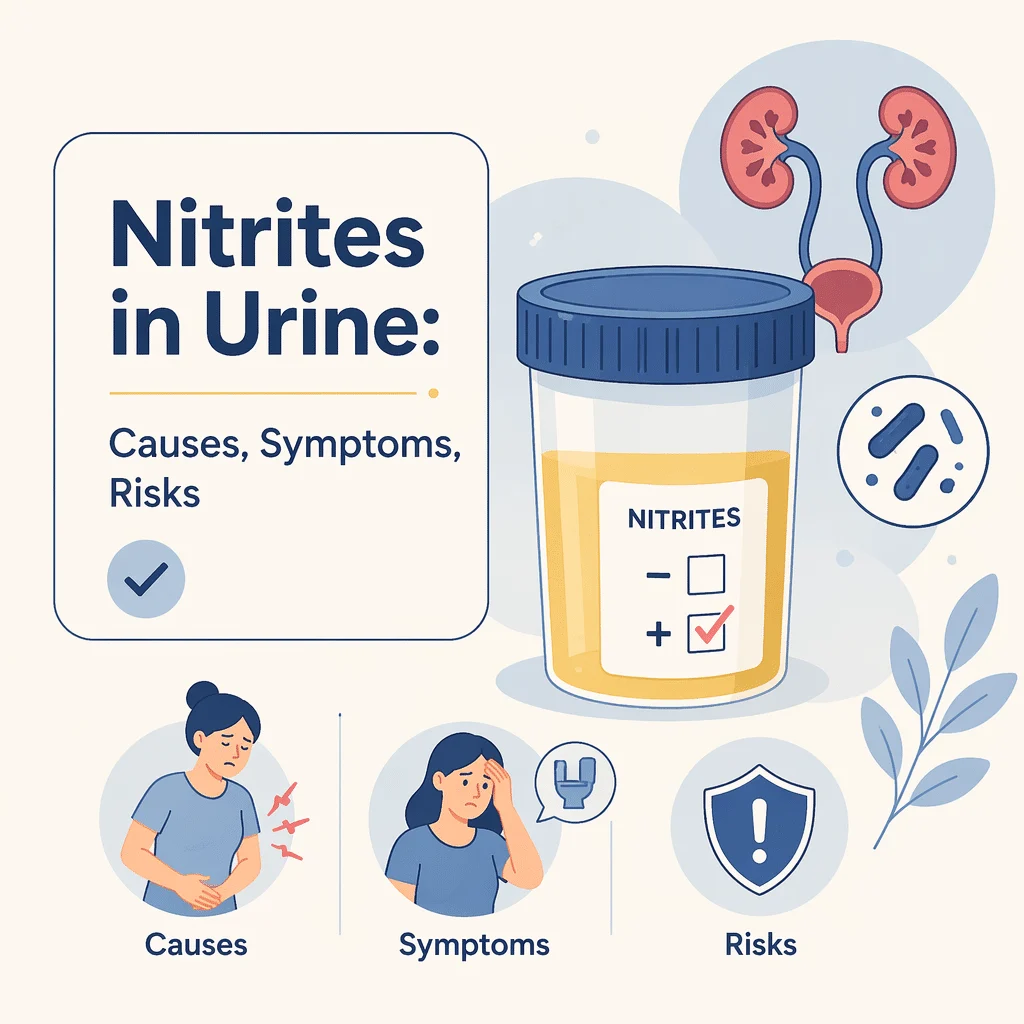
Finding nitrites in urine on a lab report usually points to one thing: bacteria have been active in your urinary tract. Your body does not normally make nitrites; they appear when certain bacteria convert nitrate, a harmless compound that reaches urine from food, into nitrite. That single step is why the nitrite pad on a urine dipstick is one of the fastest and cheapest screens for a urinary tract infection.
One pad, though, rarely tells the whole story. In this article you will learn how the nitrite test works, what positive and negative results suggest, how nitrite should be read alongside the leukocyte esterase pad, why false results are more common than expected, and which tests usually follow.
What nitrites in urine actually mean
Nitrate is a normal part of urine. It arrives from leafy vegetables, beetroot, cured foods, and drinking water, and your own metabolism adds more. Nitrite is different. In a healthy urinary tract, there is essentially none, because nothing there converts one into the other.
The conversion that makes the test work
Many bacteria that infect the bladder carry an enzyme called nitrate reductase. When they multiply in urine, they strip an oxygen atom from nitrate and leave nitrite behind. So nitrites in urine are not something your body produced or something you ate: they are a by-product of bacterial activity, which is what makes the result meaningful.
Escherichia coli is the organism behind this most often. In a large 2025 study of febrile infants published in Pediatrics, E. coli accounted for roughly nine in ten confirmed urinary infections. Proteus, Klebsiella, and Enterobacter species also convert nitrate readily.
Why the pad is a screen, not a diagnosis
The nitrite pad answers a narrow question: are nitrate-converting bacteria present in enough numbers to change the chemistry of this sample? It cannot say which organism is there, whether the infection sits in the bladder or has reached a kidney, or whether it needs treating. Those answers come from your symptoms and from a culture. For a wider view of every pad on the strip, you can review our complete urinalysis results interpretation guide.
How the nitrite test is performed and read
From cup to color change
Nitrite is almost always measured on a urine dipstick, a plastic strip carrying several reagent pads. Dipped in the sample, each pad changes color within seconds, read either by eye against a printed chart or by a bench-top reader. National Institutes of Health guidance emphasizes the clean-catch method: clean the genital area, begin urinating into the toilet, then collect the middle portion of the stream in a sterile container without touching the inside of the cup.
Nitrite is reported as a simple positive or negative rather than as a number. There is no such thing as a normal nitrite level, because the expected finding in health is none at all.
Where the result sits on your report
On most reports, nitrite appears in the chemical section next to leukocyte esterase, blood, protein, glucose, ketones, and pH. Each pad adds context. The same strip carries a blood pad, and our library covers blood in urine (hematuria). The protein pad has its own significance, and a separate article explains protein in urine. Acidity influences the nitrite reaction itself, and we detail normal urine pH levels.
What a positive nitrite result means
A positive result for nitrites in urine means nitrate-converting bacteria were present in sufficient numbers. In someone with burning on urination, urgency, frequency, or lower abdominal discomfort, that finding supports a bacterial urinary tract infection and is usually acted on quickly. Another article describes urinary tract infection symptoms and treatment.
A positive result without any symptoms
This situation is common and frequently misunderstood. Bacteria can live in urine without causing an infection, a state called asymptomatic bacteriuria. It becomes more frequent with age, particularly in older women. Major guidance is consistent that, outside specific circumstances such as pregnancy or planned urological surgery, treating it does not help and exposes people to avoidable side effects and resistance. Our library also covers asymptomatic bacteriuria.
The practical consequence is that a positive nitrite pad in someone who feels entirely well is information, not an instruction. It is your symptoms, examined together with the result, that carry the weight.
What a positive result does not mean
A positive nitrite pad is not a cancer marker, and it does not measure kidney damage or dietary nitrate intake. Nor does it indicate how severe an infection is. Fever, flank pain, nausea, and feeling generally unwell are the signals that an infection may have moved beyond the bladder, not the intensity of the color.
Reading nitrite together with leukocyte esterase
Reading nitrites in urine alongside leukocyte esterase is where a urinalysis becomes genuinely informative, and where most explanations stop short. Nitrite reports on bacteria; leukocyte esterase reports on white blood cells, meaning your immune response. Read together, the two pads give four combinations, and each points somewhere different. A separate article explains leukocyte esterase results.
| Nitrite and leukocyte esterase | What it usually suggests | Typical next step |
|---|---|---|
| Nitrite positive, leukocyte esterase positive | The most consistent pattern for a bacterial urinary tract infection: nitrate-reducing bacteria are present and white blood cells have arrived. | A urine culture to confirm the organism, interpreted alongside your symptoms. Treatment decisions belong to your clinician. |
| Nitrite positive, leukocyte esterase negative | Bacteria capable of making nitrite are present, but the immune response is faint or was sampled too early. It can also follow a contaminated or old sample. | A repeat clean-catch sample, often with a culture, to separate an early infection from a collection artifact. |
| Nitrite negative, leukocyte esterase positive | White blood cells without nitrite. This is the pattern seen with organisms that do not make nitrite, with non-infectious irritation or inflammation, and with contamination from the genital area. | A culture is especially useful here, because the dipstick alone cannot tell these possibilities apart. |
| Nitrite negative, leukocyte esterase negative | Infection is less likely; this combination is most useful for reassurance rather than ruling anything in. | If you have no symptoms, usually nothing further. If symptoms persist, a culture is still warranted, because a negative dipstick does not exclude infection. |
Why the combination outperforms either pad alone
Researchers describe two ways of combining the pads. Counting a test as positive when either pad is positive catches nearly every infection but produces many false alarms. Requiring both pads to be positive makes a positive result far more trustworthy while missing a substantial share of real infections. A 2024 cohort study in pregnancy illustrated the trade-off: the either-positive rule detected roughly nine in ten infections, but most women flagged did not have one, while requiring both pads reversed the balance and missed about half.
There is no single correct setting. Which rule a clinician leans on depends on how costly a missed infection would be in your situation, which is one reason two people with the same result can be managed differently.
Why a nitrite result can be wrong
Both directions of error are common enough that they change how the test should be interpreted. This is the single most useful thing to understand about nitrites in urine.
False negatives: infection present, pad negative
The nitrite pad only turns positive when nitrate-converting bacteria are present in sufficient numbers and have had time to work. Several ordinary circumstances break that chain. Some organisms simply cannot make nitrite, which is why MedlinePlus states plainly that a negative result does not rule out an infection. Yeasts do not produce nitrite either, and our library covers yeast in urine. Dilute urine and short bladder dwell time both matter as well.
False positives: pad positive, no bladder infection
Contamination during collection is the usual explanation, particularly when the sample was not a clean catch. A sample left at room temperature is another, because bacteria keep multiplying in the container. Pigmented medications, notably those prescribed for bladder discomfort, and strips left exposed to air round out the list.
| Situation | Effect on the nitrite pad | Why it matters to you |
|---|---|---|
| Bacteria that do not convert nitrate | False negative | Some organisms, including certain gram-positive bacteria and yeasts, never produce nitrite, so the pad stays negative during a real infection. |
| Vitamin C (ascorbic acid) from supplements or food | False negative | Ascorbic acid interferes with the pad chemistry. High-dose supplements are worth mentioning to your clinician. |
| Urine held in the bladder less than about four hours | False negative | Bacteria need time to convert nitrate. A first-morning sample reads more reliably than one passed shortly after the last void. |
| Very dilute or very concentrated urine | False negative | Both extremes can push the reaction below the level the pad detects. |
| Very little nitrate in the diet | False negative | The test needs nitrate to work with, and diets low in vegetables supply less of it. |
| Strongly acidic urine | False negative | A low urine pH weakens the color reaction. |
| Contamination during collection | False positive | Bacteria from the skin or genital area can enter the cup and change the pad without any infection. |
| A sample left standing at room temperature | False positive | Bacteria multiply in the container, so the pad reflects the cup rather than your bladder. |
| Pigmented medications and dipsticks exposed to air | False positive | Some bladder-pain medications dye urine orange or red, and strips left uncapped degrade; both can be misread as positive. |
What usually happens after a nitrite result
The urine culture
A culture is the reference test. The laboratory grows whatever bacteria are present, identifies the organism, and checks which antibiotics it responds to. It takes one to three days, which is precisely why the dipstick exists: it gives a provisional answer while the culture runs. A culture is particularly valuable when symptoms and dipstick disagree, when symptoms keep returning, during pregnancy, or when earlier treatment did not work.
Tests that add context
When a kidney may be involved, blood tests are often added. Kidney filtration is checked through creatinine, and you can read our kidney function panel guide. Inflammation markers gauge how strongly the body is responding, and we explain the CRP blood test. A blood count shows whether white cells are elevated system-wide, and our library covers the complete blood count.
Situations that change interpretation
- Pregnancy: urine is screened more often, and a positive culture is treated even without symptoms, because of the risks to the pregnancy.
- Older adults: asymptomatic bacteriuria is so common after 60 that a positive dipstick alone says very little, and evidence is moving away from relying on it.
- Infants and young children: symptoms are vague, so a dipstick carries more weight and results are acted on faster.
- Urinary catheters: bacteria colonize catheters routinely, so a positive pad is expected and interpreted almost entirely through symptoms.
- Recurrent stones: stones can harbor bacteria and keep infections coming back, and a separate article covers kidney stones.
When to seek medical care
A nitrite result is information, not an emergency in itself. Your symptoms decide the urgency.
- Contact a clinician within a day or two for burning on urination, urgency, frequency, cloudy or strong-smelling urine, or lower abdominal discomfort.
- Seek care promptly for fever, chills, pain in the flank or back, nausea, or vomiting, which can indicate that an infection has reached a kidney.
- Seek care promptly if you are pregnant and have any urinary symptoms, whatever the dipstick showed.
- Seek care promptly for visible blood in the urine, or for symptoms in an infant, a frail older adult, or anyone with a weakened immune system, diabetes, or a catheter.
- Go back to your clinician if symptoms persist or return after treatment, or if a negative dipstick was taken as reassurance but you still feel unwell.
Latest scientific advances
Research published since 2023 has sharpened how much weight nitrites in urine should carry. The direction is consistent: the pad is good at not missing infections and poor at confirming them.
A positive result is weaker evidence than long assumed
A 2025 systematic review and meta-analysis in Clinical Microbiology and Infection pooled 16 studies of adults aged 60 and over. Reading the nitrite and leukocyte esterase pads together caught around nine in ten cases of bacteria in the urine, but correctly cleared only about half of the people who had none. The authors concluded that a positive dipstick in this age group does not confirm an infection.
What this means for you: over 60, a positive strip alone is not a reason to expect antibiotics. Your symptoms matter most, and a culture is the usual next step.
Raising the threshold cuts false alarms
A 2026 study in BMC Geriatrics tested every possible cut-off in older adults with suspected infection. The usual threshold caught almost all infections but wrongly flagged around four in ten people who did not have one. Requiring a stronger signal roughly halved those false alarms while still catching about eight in ten infections. As its authors note, this single study needs confirming.
What this means for you: a faint reading and a strong one are not equivalent, so it is fair to ask how strong yours was.
In pregnancy, accuracy is lower than textbooks suggest
A 2024 cohort study in Antibiotics compared dipstick results with cultures in pregnant women at two hospitals and found accuracy below earlier reports. Only about one in six women treated on the strength of a dipstick had a positive culture.
What this means for you: in pregnancy the culture matters more than the strip.
Where the dipstick performs well
A 2025 Pediatrics study of nearly 9,400 feverish infants aged two to six months found the bedside dipstick at least as accurate as the slower laboratory white-cell count, catching about nine in ten infections while correctly clearing more than nine in ten of the babies without one.
What this means for you: the pad is most valuable for ruling infection out, and least valuable for ruling it in.
Nitrite-negative infections are documented, not theoretical
A 2023 analysis in the Journal of Medical Microbiology hunted for samples that grew common gut bacteria yet read nitrite-negative, and found them in roughly three to five percent of suspected infections. Confirmatory chemistry agreed with the strip, so the pad had not malfunctioned. Little dietary nitrate, dilute urine, and vitamin C were the likely explanations.
What this means for you: a negative strip alongside continuing symptoms is a recognized combination. Say so, and ask about a culture.
What is coming next
Because most urine cultures ultimately grow nothing, there is strong interest in spotting the negative ones faster. A 2025 study in Clinical Chemistry trained machine-learning models on almost 23,000 patients, combining dipstick readings with details such as age and sex. The best model ruled out infection more reliably than either pad alone and answered within an hour, though the authors call it early work needing validation elsewhere.
What this means for you: the wait for a culture result is likely to shorten in the coming years.
Glossary of key terms
| Term | Definition |
|---|---|
| Nitrate | A nitrogen compound that reaches your urine from food, especially vegetables, and from normal body chemistry. It is present in healthy urine and is not itself a sign of illness. |
| Nitrite | The compound produced when certain bacteria chemically convert nitrate. Healthy urine contains essentially none, which is why its presence points toward bacteria. |
| Nitrate-reducing bacteria | Bacteria that carry the enzyme needed to turn nitrate into nitrite. Escherichia coli, the most common cause of urinary tract infection, is one of them. |
| Urine dipstick | A plastic strip carrying several chemical pads. Dipped in urine, each pad changes color to give a rapid reading for nitrite, white blood cells, blood, protein, glucose, and acidity. |
| Leukocyte esterase | An enzyme released by most white blood cells. Its pad on the dipstick is an indirect signal that white blood cells are present in the urine. |
| Urine culture | A laboratory test that grows bacteria from a urine sample to identify the organism and check which antibiotics it responds to. It usually takes one to three days. |
| Asymptomatic bacteriuria | Bacteria growing in the urine of someone with no urinary symptoms. It is common with age and, in most people, is not treated as an infection. |
| Clean-catch sample | A collection method in which you clean the genital area, begin urinating into the toilet, then collect the middle part of the stream in a sterile cup, to limit contamination. |
| Sensitivity | How often a test correctly flags a condition when it truly is present. High sensitivity means few missed cases. |
| Specificity | How often a test correctly stays negative when the condition is absent. Low specificity means many false alarms. |
Frequently asked questions
Are nitrites in urine a sign of cancer?
No. The nitrite pad detects the chemical footprint of bacteria, not tumor cells, and it is not a cancer screening test. Confusion arises because bladder cancer and urinary infection can share symptoms such as visible blood in the urine and frequent urination, and because people with bladder tumors do get infections. If blood in the urine persists after an infection has been treated, or appears without any infection, that finding is followed up in its own right, usually with imaging and a look inside the bladder.
What is the difference between nitrates and nitrites in urine?
One letter, but a meaningful difference. Nitrate is normally present in urine and comes largely from vegetables, cured foods, and drinking water. Nitrite is what remains after bacteria chemically alter nitrate, and healthy urine contains essentially none. Lab reports and search results often use the two words interchangeably, which causes confusion. Your dipstick measures nitrite. A result described as nitrates in urine on a report or a website almost always refers to the nitrite pad.
Can kidney stones cause nitrites in urine?
Not directly. A stone is mineral, and it does not convert nitrate. Stones can, however, harbor bacteria in their surface and block urine flow, and both of those raise the chance of a genuine infection that then turns the pad positive. Some stones, called struvite stones, actually form as a consequence of infection with particular bacteria. So a positive nitrite result in someone with known stones usually reflects an accompanying infection rather than the stone itself.
Can food, supplements, or medications change a nitrite result?
Yes, in both directions. Vitamin C supplements interfere with the chemistry of the pad and can produce a falsely negative result, so it is worth mentioning high-dose supplements when you hand in a sample. A diet very low in vegetables supplies little nitrate for bacteria to convert, with the same effect. In the other direction, medications that dye urine orange or red, including those prescribed for bladder discomfort, can make the pad look positive when no infection is present.
Does a positive nitrite result always require antibiotics?
No, and this is one of the clearest messages in recent research. Bacteria in urine without symptoms is common, especially with age, and treating it generally does not help. Antibiotic decisions depend on your symptoms, your medical history, whether you are pregnant, and often the culture result, and they belong to your clinician rather than to the dipstick. Ask what your symptoms suggest and whether a culture was sent, rather than assuming a positive pad settles the question.
Should I repeat the test if the result was negative but symptoms continue?
Discuss it with your clinician, because a negative nitrite pad does not exclude an infection. Organisms that do not produce nitrite, dilute urine, a sample passed soon after the last void, and vitamin C can all give a negative reading during a real infection. A first-morning clean-catch sample sent for culture is the usual way forward. Persisting symptoms with repeatedly negative results also prompt a look at non-infectious causes of bladder irritation.
Sources
- MedlinePlus, National Library of Medicine — Nitrites in Urine: Medical Test, 2024 — medlineplus.gov
- National Institute of Diabetes and Digestive and Kidney Diseases (NIDDK) — Bladder Infection (Urinary Tract Infection) in Adults — niddk.nih.gov
- Queremel Milani DA, Jialal I — Urinalysis — StatPearls, NCBI Bookshelf, 2023 — ncbi.nlm.nih.gov
- Givler DN, Givler A, et al. — Asymptomatic Bacteriuria — StatPearls, NCBI Bookshelf, 2023 — ncbi.nlm.nih.gov
- Mayo Clinic — Urinalysis: About the test — mayoclinic.org
- Moragas A, Monfa R, Garcia-Sangenis A, Llor C, et al. — Accuracy of leukocyte esterase and nitrite tests for diagnosing bacteriuria in older adults: a systematic review and meta-analysis — Clinical Microbiology and Infection, 2025 — doi.org/10.1016/j.cmi.2025.08.027
- Baart AM, Oosterkamp CI, Mc Garrigle RS, Bilsen MP, et al. — An observational diagnostic accuracy study comparing the urine dipstick with a consensus-based reference standard for the diagnosis of urinary tract infections in older adults — BMC Geriatrics, 2026 — doi.org/10.1186/s12877-026-07741-y
- Werter DE, Schneeberger C, Geerlings SE, de Groot CJM, et al. — Diagnostic Accuracy of Urine Dipsticks for Urinary Tract Infection Diagnosis during Pregnancy: A Retrospective Cohort Study — Antibiotics, 2024 — doi.org/10.3390/antibiotics13060567
- Hunt KM, Green RS, Sartori LF, Aronson PL, et al. — Urine Dipstick for the Diagnosis of Urinary Tract Infection in Febrile Infants Aged 2 to 6 Months — Pediatrics, 2025 — doi.org/10.1542/peds.2024-068671
- Lopes Araujo-Filho CE, Santos Galvao V, et al. — Nitrite-negative results in urinary tract infection by Enterobacterales: does the nitrite dipstick test have low sensitivity? — Journal of Medical Microbiology, 2023 — doi.org/10.1099/jmm.0.001663
- Favresse J, Cabo J, Bosse M, Lardinois B, et al. — Machine Learning Algorithms for Predicting Urinary Tract Infections: Integration of Demographic Data and Dipstick Reflectance Results — Clinical Chemistry, 2025 — doi.org/10.1093/clinchem/hvaf088
Further reading
- Leukocytes in urine: how to read your results
- Understanding specific gravity: levels and meaning
- Epithelial cells in urine: interpreting your test results
- Urinary casts: interpreting urine test results
- Urine crystals: causes and risks
Understand your lab results with AI DiagMe
A urinalysis report is exactly the kind of document that raises more questions than it answers, with a nitrite result sitting in a column of abbreviations and plus signs. AI DiagMe reads your lab results and explains, in plain language, what each line means in context, including the nitrite and leukocyte esterase pads, a urine culture, and blood tests such as creatinine or a complete blood count. It helps you understand your results and prepare for your appointment. It does not diagnose, and it does not replace your doctor.
Get your results interpreted in minutes