
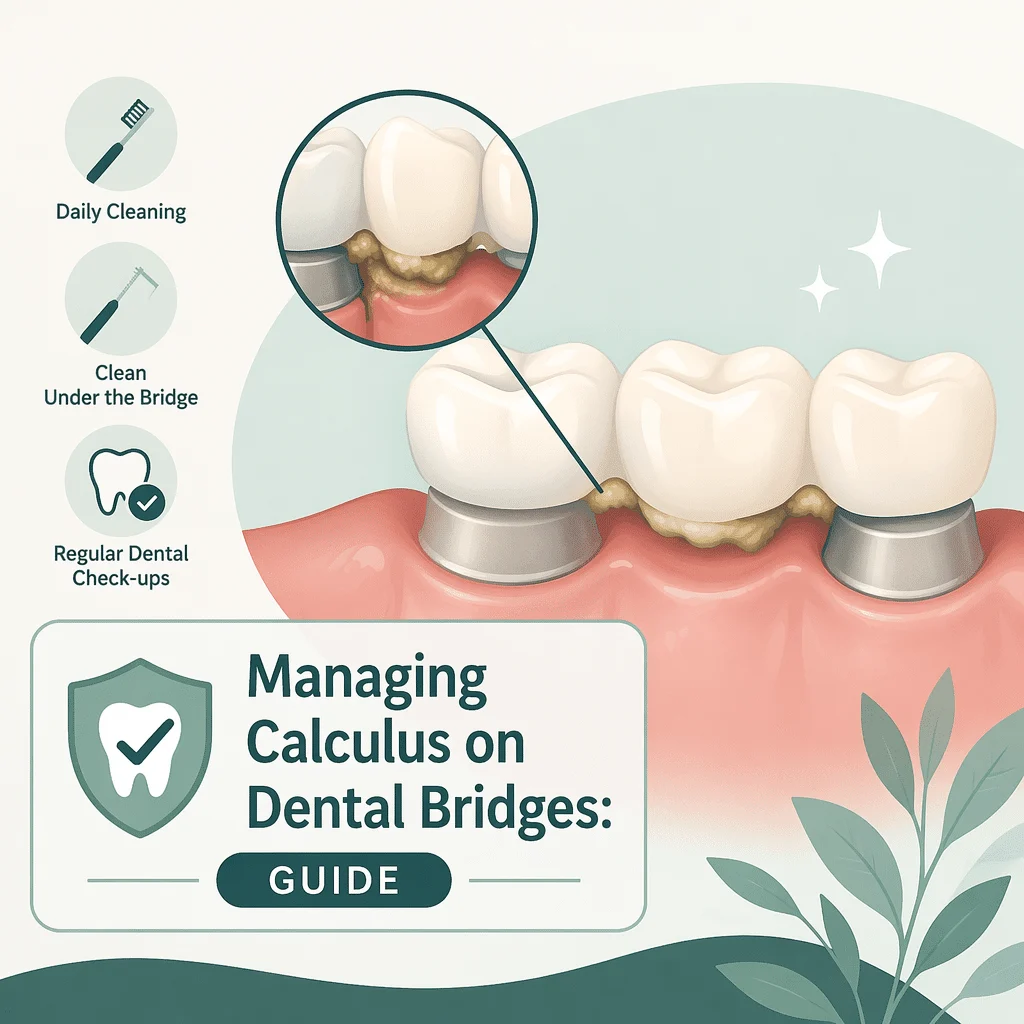
A calculus bridge is a thick band of hardened tartar that spans two or more teeth and locks them together under a continuous mineral crust. It is not a dental appliance, and it is not something you can chip away at home. It is the visible end point of months of dental plaque that was never fully removed, and it usually appears along the gum line of the lower front teeth. This article explains what a calculus bridge looks like, how it builds up, and what a dentist does to take it off. You will also find a comparison of the tools that clean between teeth and under fixed bridgework, plain-language summaries of recent research, and the health checks that often accompany dental treatment.
What a calculus bridge actually is
Dental calculus, commonly called tartar, is plaque that has absorbed minerals from saliva and turned solid. A calculus bridge is the advanced form of that process: instead of separate patches on individual teeth, the deposit grows across the gaps until it forms one continuous ledge. Run a tongue along it and the teeth feel fused under one rough shelf. The name describes the shape of the deposit, not a prosthetic bridge fitted by a dentist.
Plaque, tartar and the point of no return
Plaque is a soft, living film of bacteria that reforms on teeth within hours of brushing. While it is soft, a toothbrush and floss remove it. Once minerals from saliva crystallize inside it, the film hardens into calculus and bonds to the enamel and root. At that point household tools stop working. The hardened layer is porous, so fresh plaque clings to it more easily than to smooth enamel, and the deposit grows faster the longer it stays.
Where it appears first
Two sites collect calculus faster than anywhere else: the tongue side of the lower front teeth and the cheek side of the upper back molars. Both sit opposite the openings of major salivary glands, so they are constantly bathed in mineral-rich saliva. A calculus bridge usually starts there as a yellow or tan ridge at the gum margin, then spreads across neighboring teeth. Deposits below the gum line look darker, closer to brown or black, because they take up pigments from blood and food.
How a calculus bridge builds up
The sequence is predictable. Bacteria settle on a clean tooth within minutes and organize into a structured community called a biofilm. Over the following days that biofilm thickens. Calcium and phosphate ions in saliva then precipitate inside it, and the film stiffens from the base upward. Most people form measurable calculus within about two weeks of missed cleaning in a given spot, though the pace varies widely.
Why some people build tartar much faster
Saliva chemistry is the biggest single factor, and it is largely outside your control. People whose saliva carries more calcium and phosphate mineralize plaque faster, which is why two people with identical brushing habits end up with very different deposits. Saliva flow matters too: a dry mouth caused by medication, mouth breathing or dehydration leaves plaque undisturbed for longer. Crowded or rotated teeth create shelters a brush cannot enter. Smoking, which alters both saliva and the gum response, is the strongest modifiable risk factor for the gum disease that follows.
Signs you can check at home
A calculus bridge is one of the few dental problems you can see yourself, which makes it a prompt to book an appointment rather than a reason to panic.
What you can see
- A continuous yellow, tan or brown ridge crossing the gum line from one tooth to the next
- Gums that look puffy, shiny or darker red beside the deposit
- Blood on the toothbrush or in the sink, in the same area every time
- Teeth that look shorter or squarer because the deposit covers part of the crown
- Gums pulling back, leaving root surfaces exposed
What you can feel, taste and smell
The surface feels rough and gritty where enamel should feel smooth. Many people notice persistent bad breath or a sour taste that returns within hours of brushing, because the porous deposit shelters odor-producing bacteria. Gums may feel tender when eating crusty food. Teeth are usually not painful at this stage, which is why the problem is left alone until the supporting bone is affected.
When to see your dentist
- You can see or feel a hard deposit spanning more than one tooth
- Your gums bleed most times you brush, not just once in a while
- Bad breath persists despite thorough brushing and tongue cleaning
- Gums are receding, or a tooth feels loose or has shifted
- You have a crown, bridge or implant and the gum around it swells or bleeds
- You have diabetes, are pregnant, or take medication that dries the mouth
Calculus around crowns, bridges and implants
Fixed restorations change the geometry of the mouth, and calculus exploits it. Every crown has a margin where the restoration meets the tooth, and that junction is a favored landing site for plaque. A fixed dental bridge adds a second problem: the replacement tooth, called a pontic, sits on the gum but has no root, leaving a covered space underneath that ordinary floss cannot enter from above.
Why fixed bridgework needs a different routine
The supporting teeth at each end of a bridge, known as abutment teeth, carry the load of the missing tooth as well as their own. If calculus accumulates at their margins and gum disease follows, the foundation weakens and the whole restoration is at risk. A retrospective study of tooth-supported fixed bridges followed cases for up to fifteen years and found complications accumulating steadily over the working life of a restoration. That is a practical argument for keeping the supporting teeth under review rather than assuming the work is finished once the bridge is cemented.
Implants and peri-implant disease
Implants do not decay, but the gum and bone around them can become inflamed much as they do around a natural tooth. Early inflammation confined to the soft tissue is called peri-implant mucositis and is generally reversible; when it reaches the supporting bone it becomes peri-implantitis, which is not. Deposits at the implant collar are a recognized trigger, so cleaning around an implant-supported crown or bridge must reach the sides of the fixture, not only the visible surface.
Cleaning tools that reach where a toothbrush cannot
Most people brush reasonably well and still develop calculus, because a brush is built for broad surfaces and cannot enter the contact point between teeth or the space under a bridge. The table below sets each tool against what it reaches and where it stops.
| Tool | What it reaches | Where it stops |
|---|---|---|
| Manual or powered toothbrush | Outer, inner and biting surfaces, plus the accessible gum line | Bristles do not enter the contact point between two touching teeth |
| Standard dental floss | Flat surfaces between touching teeth and the shallow space under the gum edge | Cannot pass under a fixed bridge, and needs steady dexterity |
| Floss threader with ordinary floss | The underside of a bridge pontic and the inner side of each supporting tooth | Slow to use, and floss can shred on a rough crown margin |
| Superfloss with a stiff tip and spongy center | Under a pontic and around wide gaps in a single pass | The spongy section wears out fast and will not fit tight contacts |
| Interdental brush | Wider gaps, exposed root surfaces, and spaces beside bridge supports and implants | Must be correctly sized; an oversized brush bruises the gum |
| Water flosser or oral irrigator | Braces, bridge undersides and areas too tight or too tender for floss | Flushes loose debris away but does not scrape off attached calculus |
| Professional scaler, hand or ultrasonic | Hardened calculus above and below the gum line, including restoration margins | Available only in the dental chair |
The pattern is consistent: home tools govern whether plaque ever hardens, and only professional instruments remove it once it has. A more expensive device does not change that division of labor.
How a dentist removes a calculus bridge
Removal is a mechanical job. No mouthwash, tablet, oil or home remedy dissolves calculus, and the scrapers sold for home use often damage enamel or cut the gum. The National Institute of Dental and Craniofacial Research states plainly that only a professional cleaning removes tartar.
Scaling, and root planing when it is needed
The dentist first assesses how far the deposit extends below the gum. Scaling then removes calculus from the crown and the accessible root surface, usually with an ultrasonic instrument that vibrates it loose under a water spray, finished by hand along the margins. Where the deposit sits deep in a gum pocket, root planing smooths the root so the gum can reattach. Deep work is normally done under local anesthetic, often over more than one appointment.
What to expect afterward
Teeth often feel unfamiliar for a few days: longer, more sensitive to cold, and separated by gaps where the deposit used to sit. This is the shape of the teeth reappearing, not damage. Gums may bleed briefly, then bleed markedly less as inflammation settles. Sensitivity usually fades over one to two weeks and can be eased with a desensitizing toothpaste. Your dental team will set a recall interval based on how quickly you rebuild deposits, and that interval is part of the treatment.
Keeping a calculus bridge from coming back
Calculus always returns to some degree, because plaque returns within hours. The goal is to keep plaque soft long enough to remove it, and to have the residue cleared professionally before it hardens again.
A routine that holds up
- Brush twice daily for two minutes with fluoride toothpaste, angling the bristles into the gum line rather than scrubbing across the teeth
- Clean between the teeth daily with floss or a correctly sized interdental brush, and use a threader or superfloss under any bridge
- Give the two high-deposit zones extra attention: behind the lower front teeth and the outer surface of the upper back molars
- Add a water flosser if braces, bridgework or sore gums make flossing impractical, as an addition rather than a replacement
- Keep the recall interval your dental team recommends, even when nothing hurts
Habits, medicines and general health
Stopping smoking has a larger effect on gum outcomes than any consumer product. Frequent sugary snacking and sipping feeds the biofilm all day, so the timing of sugar matters as much as the amount. Many medicines, including some antidepressants, antihistamines and blood pressure drugs, reduce saliva flow; if your mouth is persistently dry, say so, because sipping water, chewing sugar-free gum or a saliva substitute all help.
Uncontrolled blood sugar makes gum disease harder to treat, which is why dentists ask about diabetes control, and our health library explains the causes and symptoms of diabetes. Severe, prolonged deficiency of vitamin C also causes bleeding gums; the same library covers the benefits and dietary sources of vitamin C and describes the vitamin C blood test.
Latest scientific advances
Research from the past three years has shifted the emphasis away from gadgets toward routine, maintenance and the link between gum inflammation and the rest of the body. Each finding below is summarized in plain language.
Knowing what to do is not the same as doing it
A 2026 Cochrane review examined whether adding behavior-change techniques, such as goal setting and structured follow-up, to standard advice helps adults with gum disease clean their teeth more consistently. The reviewers found some signal that it helps but rated their confidence in the evidence as limited. A Cochrane review pools every trial on a question and grades how sure we can be of the answer, so a cautious verdict carries weight. What this means for you: if your deposits keep returning, the gap is usually habit rather than knowledge, so ask for a written routine and a follow-up date rather than a general instruction to floss more.
Around implant-supported crowns and bridges, a brush alone is not enough
A 2025 systematic review combining several trials looked at cleaning around implant-supported restorations. Adding a device that cleans between the teeth, such as an interdental brush or a water flosser, improved gum health around those restorations compared with brushing alone. Interproximal simply means the space between two neighboring teeth. What this means for you: if you have an implant crown or bridge, treat between-the-teeth cleaning as a core part of the routine, and ask which size or device suits your restoration.
Water flossers help where floss is impractical, but they do not remove tartar
A 2024 review combining trials in people wearing braces found that water flossers reduced plaque and gum bleeding compared with usual cleaning alone. A separate 2024 scoping review, which maps the shape of the evidence rather than pooling it, noted that devices differ widely, that most studies are short, and that the benefit is clearest when irrigation is added to brushing rather than substituted for it. What this means for you: a water flosser is a reasonable purchase if hardware or sore gums make flossing difficult, but no irrigator removes hardened calculus or replaces a scaling appointment.
Scheduled maintenance is treatment, not an upsell
The European Federation of Periodontology published a clinical practice guideline in 2023 on preventing and treating disease around implants. Its central recommendation is that prevention rests on two things together: daily plaque control at home and professional maintenance at planned intervals. A 2024 study made the same point from the other direction, examining implant patients who had skipped regular maintenance and finding inflammation around the implant common in that group. Peri-implantitis means inflammation of the gum and bone around an implant. What this means for you: if you have implants or bridgework, missing recalls is itself a risk factor.
Treating the gums can register in your blood tests
Two recent analyses connect the mouth to general health markers. A 2024 meta-analysis found that treating gum disease in people with diabetes was followed by lower levels of body-wide inflammation markers, the kind that rise when inflammation is present anywhere. A 2025 systematic review reported that periodontal treatment was followed by modest improvements in longer-term blood sugar control. The improvements were real but small, and they do not replace diabetes medication or the advice of the clinician managing it. What this means for you: tell whoever manages your diabetes that you are having gum treatment, and tell your dentist about your recent results.
Laboratories measure longer-term blood sugar with the HbA1c blood test, and many people also track fasting blood glucose levels. Doctors commonly order a C-reactive protein test, and we explain separately what a raised CRP result can mean. A clinician assessing recurrent gum infection will often request a complete blood count, and may add a 25-OH vitamin D blood test. None of these diagnoses a calculus bridge; they describe the terrain in which gum disease either settles or improves.
Glossary
| Term | Definition |
|---|---|
| Dental plaque | The soft, sticky film of bacteria that forms on teeth within hours of cleaning. It can be removed with a toothbrush and floss while it is still soft. |
| Biofilm | An organized community of bacteria living in a protective matrix they build themselves. Dental plaque is a biofilm, which is part of why rinsing alone does not clear it. |
| Dental calculus (tartar) | Plaque that has taken up minerals from saliva and hardened onto the tooth. Once formed, it can only be removed with dental instruments. |
| Calculus bridge | A continuous band of hardened tartar that spans two or more adjacent teeth, so the teeth feel joined together along the gum line. |
| Gingivitis | Inflammation limited to the gum tissue, causing redness, swelling and bleeding. It is reversible when the plaque and calculus that cause it are removed. |
| Periodontitis | A more advanced gum disease in which inflammation reaches the bone supporting the teeth. The lost bone does not grow back, so the aim of treatment is to halt further loss. |
| Scaling and root planing | The dental procedure that removes deposits from the crown and root of the tooth and then smooths the root surface so the gum can reattach. |
| Pontic | The artificial tooth in a dental bridge that fills the gap. It rests on the gum without a root, so plaque can collect in the space beneath it. |
| Abutment tooth | A natural tooth prepared to support one end of a dental bridge. Its long-term health determines how long the whole restoration lasts. |
| Peri-implantitis | Inflammation of the gum and bone around a dental implant, with loss of supporting bone. The earlier, reversible stage confined to the gum is called peri-implant mucositis. |
Frequently asked questions
Can I remove a calculus bridge at home?
No. Hardened calculus is bonded to the tooth surface and is close to bone in hardness, so it does not respond to brushing, rinsing, oil pulling, baking soda pastes or vinegar. The metal picks and scrapers sold online are the same shape as professional instruments but are used without magnification, lighting, or knowledge of where the deposit ends and the root begins; the common outcomes are scratched enamel, cut gum tissue and deposits pushed deeper into the gum pocket. Home cleaning is genuinely powerful, but its role is preventing plaque from hardening in the first place, not removing it afterward.
Does a calculus bridge cause bad breath?
Frequently, yes. The deposit is porous and sits at the gum line, so it shelters bacteria that release sulfur compounds as they break down proteins in food and in inflamed gum tissue. That is why the odor returns within hours of brushing and why mints and mouthwash mask it only briefly. Breath usually improves noticeably in the days after a professional cleaning. If it persists once the deposits are gone, other causes are worth checking, including a coated tongue, dry mouth, sinus drainage and tonsil stones.
Is having a calculus bridge removed painful?
Most people find scaling above the gum line uncomfortable rather than painful, with some vibration, cold water and pressure. Where deposits extend deep below the gum, or where gums are already inflamed and tender, local anesthetic is normally offered and makes the appointment straightforward. Tell the clinician early if you are sensitive or anxious, because the appointment can be split into shorter sessions. Afterward, expect some tenderness and cold sensitivity for a few days rather than lasting pain.
How quickly does tartar come back after a cleaning?
Plaque reforms within hours, and in people who mineralize it quickly, new calculus can be measurable within a few weeks at the usual sites. This is normal and is not a sign that the cleaning failed. What changes the trajectory is daily cleaning between the teeth and a recall interval matched to your own rate of build-up. Someone who forms deposits rapidly may be seen every three or four months, while someone with slower build-up and healthy gums may be seen once or twice a year.
Can a calculus bridge make my teeth fall out?
Not directly, but it drives the process that can. The deposit holds bacteria against the gum, the gum becomes inflamed, and in susceptible people that inflammation extends to the bone anchoring the teeth. As bone is lost, teeth loosen and can eventually be lost. This takes years, and it can be halted at almost any point by removing the deposits and controlling the plaque that rebuilds. Teeth that already feel loose or have drifted need prompt assessment rather than watchful waiting.
Will a calculus bridge affect a crown, bridge or implant I already have?
It can. Deposits gather readily at the margin where a restoration meets the tooth, and beneath the artificial tooth of a fixed bridge, where ordinary floss cannot reach. Around implants, the same deposits contribute to inflammation of the gum and, later, the bone. The restoration itself does not decay, but the tissue and the supporting teeth around it can deteriorate, which is what shortens the working life of the work. Ask your dental team to demonstrate a threader, superfloss or interdental brush sized for your specific restoration.
Sources
- National Institute of Dental and Craniofacial Research — Periodontal (Gum) Disease: causes, symptoms, risk factors and treatment — nidcr.nih.gov
- MedlinePlus Medical Encyclopedia (U.S. National Library of Medicine) — Gingivitis: plaque, tartar and professional cleaning — medlineplus.gov
- Centers for Disease Control and Prevention — About Oral Health: common oral conditions and prevention — cdc.gov
- American Dental Association, MouthHealthy — Bridges: what they are and how they are supported — mouthhealthy.org
- O’Malley L, et al. — Behavioural interventions for improving oral hygiene in adults with periodontal diseases — Cochrane Database of Systematic Reviews, 2026 — doi.org/10.1002/14651858.CD012049.pub2
- Bishti S, et al. — Optimizing implant hygiene: the added value of interproximal cleaning devices around implant-supported restorations, a systematic review and meta-analysis — International Journal of Implant Dentistry, 2025 — doi.org/10.1186/s40729-025-00652-4
- Zarei Z, et al. — The effectiveness of oral irrigators on periodontal health status and oral hygiene of orthodontic patients: a systematic review and meta-analysis — BMC Oral Health, 2024 — doi.org/10.1186/s12903-024-05255-w
- Sarkisova F, et al. — Oral irrigation devices: a scoping review — Clinical and Experimental Dental Research, 2024 — doi.org/10.1002/cre2.912
- Herrera D, et al. — Prevention and treatment of peri-implant diseases: the EFP S3 level clinical practice guideline — Journal of Clinical Periodontology, 2023 — doi.org/10.1111/jcpe.13823
- Ruiz-Romero V, et al. — Peri-implantitis in patients without regular supportive therapy: prevalence and risk indicators — Clinical Oral Investigations, 2024 — doi.org/10.1007/s00784-024-05673-8
- da Silva Barbirato D, et al. — Improvement of post-periodontitis-therapy inflammatory state in diabetics: a meta-analysis of randomized controlled trials — Clinical Oral Investigations, 2024 — doi.org/10.1007/s00784-024-05905-x
- Umezaki Y, et al. — The role of periodontal treatment on the reduction of hemoglobin A1c, compared with existing medication therapy: a systematic review and meta-analysis — Frontiers in Clinical Diabetes and Healthcare, 2025 — doi.org/10.3389/fcdhc.2025.1541145
- Alenezi A, et al. — Technical complications with tooth-supported fixed dental prostheses of different span lengths: an up to 15-year retrospective study — BMC Oral Health, 2023 — doi.org/10.1186/s12903-023-03121-9
Further reading
- Glycated hemoglobin: a guide to blood sugar control
- The diabetes blood test explained
- The total calcium blood test
- Zinc levels and the zinc blood test
- Hidden tonsil stones: symptoms, causes and treatments
Understand your lab results with AI DiagMe
Gum inflammation around a calculus bridge does not stay in the mouth: it interacts with blood sugar control, general inflammation and nutritional status, which is why dental and medical findings are easier to read side by side. AI DiagMe helps you make sense of results such as HbA1c and fasting glucose, C-reactive protein, vitamin D, and a complete blood count, in plain language rather than laboratory shorthand. It is built to help you understand what your numbers describe and which questions are worth raising; it does not make a diagnosis and does not replace your dentist or your doctor.
Get your results interpreted in minutes