



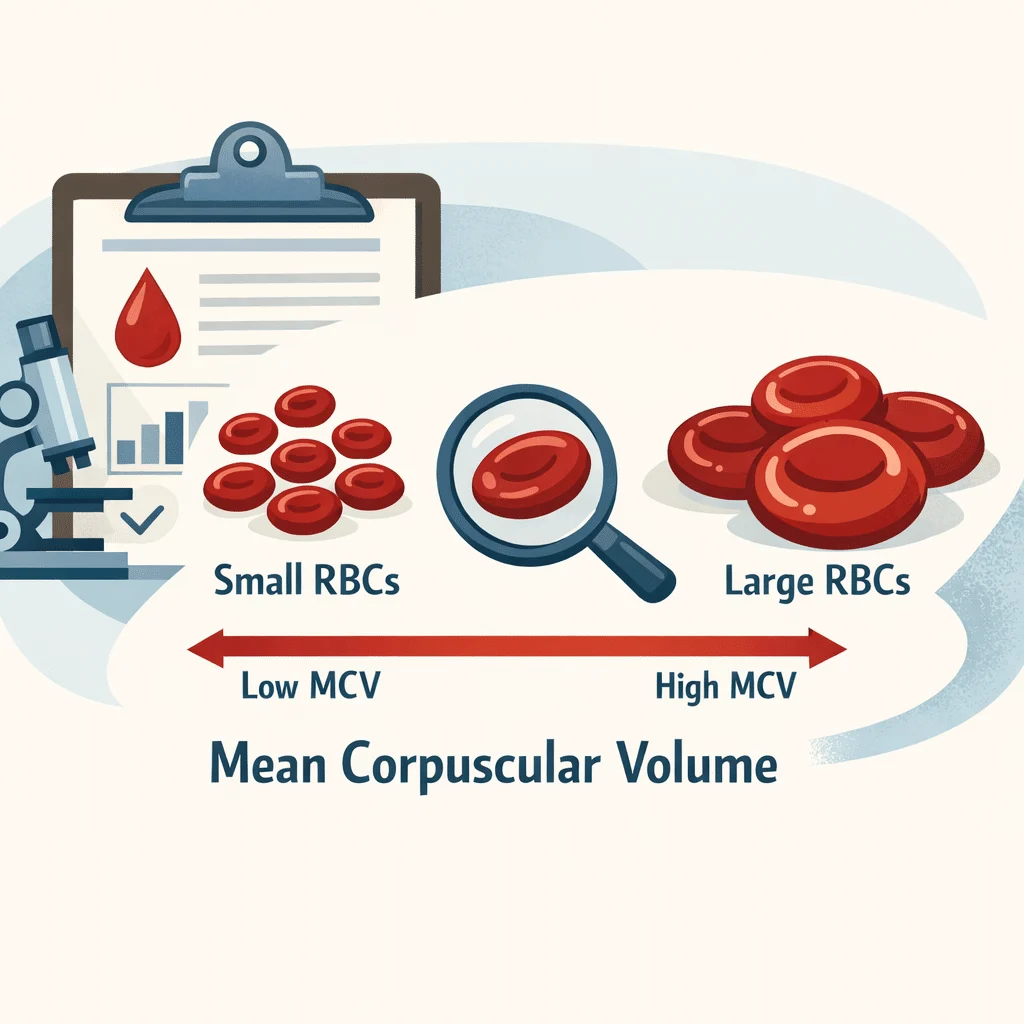
An MCV blood test measures the average size of your red blood cells and is one of the most common values reported on a complete blood count. If your report shows an MCV result flagged high or low, it is a useful clue rather than a diagnosis on its own. In this article you’ll learn what the MCV blood test measures, why red blood cell size matters, how to read your number against the normal range, and what high or low results can point to, with links to deeper guides if your value falls outside the typical range.
What does an MCV blood test measure?
MCV stands for mean corpuscular volume, the average volume of a single red blood cell, expressed in femtoliters (fL), an extremely small unit of volume. Red blood cells, also called erythrocytes, are made in your bone marrow and carry oxygen from your lungs to every tissue in your body, then carry carbon dioxide back to be exhaled.
The size of these cells affects how efficiently they do that job. An MCV blood test tells your doctor whether your red blood cells are a typical size, smaller than expected (a pattern called microcytosis), or larger than expected (macrocytosis). Because cell size often reflects what is happening inside the cell, MCV gives an early hint about nutritional status, bone marrow function, and certain inherited conditions.
Why the MCV blood test matters
The MCV blood test is not ordered on its own. It is one of several red blood cell indices reported automatically as part of a complete blood count, alongside mean corpuscular hemoglobin (MCH) and mean corpuscular hemoglobin concentration (MCHC). Together, these values help your doctor narrow down the cause of anemia or other red blood cell problems, often before you have any symptoms.
A window into nutritional status
MCV often mirrors your body’s reserves of iron, vitamin B12, and folate (vitamin B9). A low MCV frequently signals iron deficiency, since insufficient iron limits hemoglobin production and shrinks red blood cells. A high MCV, by contrast, often points to a shortage of vitamin B12 or folate, both of which are needed for normal DNA synthesis during red blood cell formation.
A clue to conditions beyond diet
An abnormal MCV can also reflect inherited conditions such as thalassemia, chronic liver disease, low thyroid function, certain medications, or, less commonly, bone marrow disorders. Because the list of possible causes is broad, doctors interpret MCV alongside your symptoms, other blood counts, and sometimes a blood smear examined under a microscope.
How results guide next steps
An out-of-range MCV blood test result often determines what your doctor orders next. A low MCV typically prompts iron studies, while a high MCV usually leads to vitamin B12 and folate testing, and sometimes liver or thyroid function tests. MCV can also help track how well a treatment, such as iron or B12 supplementation, is working over time.
Normal MCV range and how to read your result
On a lab report, MCV usually appears in the hematology or complete blood count section. For most adults, the standard reference range for the MCV blood test is about 80 to 100 fL. Values below roughly 80 fL are generally classified as low (microcytic), and values above roughly 100 fL as high (macrocytic).
Reference ranges are not perfectly universal. Each laboratory sets its own range based on the equipment it uses and the population it serves, so you may see minor variations between labs. Always compare your result to the range printed on your own report rather than to a number found online. Look for symbols such as an upward arrow (high) or downward arrow (low), or an asterisk marking an atypical value; some labs use multiple asterisks to show how far a result sits from the expected range.
High MCV vs. low MCV: a quick comparison
The table below summarizes how the two directions typically differ. It is a starting point for understanding your report, not a substitute for your doctor’s interpretation.
| Feature | Low MCV (microcytosis) | High MCV (macrocytosis) |
|---|---|---|
| Typical threshold | Below about 80 fL | Above about 100 fL |
| Most common cause | Iron deficiency | Vitamin B12 or folate deficiency |
| Other possible causes | Thalassemia, chronic inflammation, sideroblastic anemia, lead exposure | Chronic alcohol use, liver disease, hypothyroidism, some medications, myelodysplastic syndrome |
| Typical follow-up tests | Iron studies, ferritin, reticulocyte count | Vitamin B12 and folate levels, liver and thyroid tests |
For a deeper dive into either direction, including symptoms, treatment options, and what to expect from follow-up care, see our dedicated guides to low MCV causes, symptoms, and treatments and understanding high MCV levels and their causes.
Can MCV be normal and still signal a problem?
Yes. It is possible to have anemia with a completely normal MCV, sometimes called normocytic anemia. This pattern can occur with sudden blood loss, kidney failure, or a combination of deficiencies that cancel each other out, such as concurrent iron and vitamin B12 deficiency. This is one reason MCV is always read alongside hemoglobin, hematocrit, and your red blood cell count rather than in isolation. Our guide to reading a complete blood count walks through how all of these values fit together.
When to see a doctor about your MCV blood test
Most mildly abnormal MCV results are not emergencies and simply prompt further testing or a repeat blood draw. Still, some situations deserve prompter attention.
The draw itself is changing: see what an FDA-cleared robotic blood draw changes for patients.
Consider contacting a healthcare provider sooner if you notice:
Persistent fatigue, weakness, or shortness of breath with activity, which can accompany anemia regardless of cell size. Pale skin, brittle nails, or unusual cravings for non-food items such as ice, which can suggest iron deficiency. Numbness, tingling, balance problems, or memory changes, which can occur with vitamin B12 deficiency affecting the nervous system. A markedly abnormal MCV, especially alongside low hemoglobin, or any result your doctor has specifically flagged for follow-up. Chest pain, fainting, or a rapid heartbeat, which warrant urgent evaluation rather than waiting for a scheduled appointment.
A single mildly out-of-range MCV blood test result, with no symptoms, is often simply rechecked at a later date rather than treated immediately.
How doctors investigate an abnormal MCV blood test
When your MCV falls outside the reference range, your doctor typically looks at the broader pattern before ordering more tests. They will check whether hemoglobin and hematocrit are also low, since MCV combined with these values helps classify the type of anemia present. A reticulocyte count, which measures how many new red blood cells your bone marrow is producing, can show whether your body is responding appropriately to a deficiency.
For a low MCV, iron studies, including ferritin, serum iron, and total iron-binding capacity, are the usual next step; our iron studies panel guide explains how these markers fit together. For a high MCV, vitamin B12 and folate levels are typically checked first, alongside liver and thyroid function; you can learn more in our guides to the folic acid blood test and to interpreting elevated vitamin B12 results. In some cases, doctors also examine a blood smear under a microscope or order hemoglobin electrophoresis to rule out thalassemia.
Diet and lifestyle factors that influence MCV
Because MCV often reflects nutrient status, diet plays a meaningful role in prevention and recovery once a cause is identified. If a low MCV traces back to iron deficiency, iron-rich foods such as red meat, poultry, legumes, and dark leafy greens can help, especially when paired with a vitamin C source like citrus fruit, which improves iron absorption. Tea and coffee taken with meals can reduce iron uptake, so spacing them apart from iron-rich meals is a simple, practical habit.
If a high MCV relates to vitamin B12 or folate deficiency, prioritizing dairy, eggs, fish, and fortified cereals for B12, plus leafy greens and legumes for folate, supports recovery. Limiting alcohol intake matters too, since chronic alcohol use is a common, often overlooked, cause of macrocytosis independent of any vitamin deficiency. These dietary steps support treatment; they do not replace it, and any suspected deficiency should still be confirmed and monitored by a clinician.
How the MCV blood test is performed
The MCV blood test requires nothing more than a standard blood draw. A healthcare professional collects a small blood sample from a vein in your arm, and the value is calculated automatically by the same analyzer that processes your complete blood count. No fasting or special preparation is needed unless the same blood draw includes other tests, such as a fasting glucose or lipid panel, that do require it. Results are typically available within hours to a couple of days, depending on the laboratory.
Latest scientific advances
Recent research has focused on making better use of the MCV blood test and related red blood cell indices, particularly by combining them with computer-based pattern recognition to speed up diagnosis.
A 2025 study analyzed complete blood count data, including MCV, to build a computer model that could help tell apart iron deficiency anemia from aplastic anemia, a rarer and more serious bone marrow condition, using routine blood values already collected during standard testing. What this means for you: MCV and related red blood cell measurements may increasingly support faster, more consistent distinctions between common and rare causes of anemia, potentially shortening the path from an abnormal blood count to the right follow-up test. This research is still preliminary and based on a single hospital dataset, so it has not yet changed everyday clinical practice, but it points toward MCV becoming an even more useful early signal over time.
A related 2024 study built and tested a computer model using MCV, along with mean corpuscular hemoglobin (MCH) and red cell distribution width (a measure of how much red blood cell size varies), to distinguish iron deficiency anemia from thalassemia trait, a genetic condition that can look similar on a basic blood count. What this means for you: telling these two conditions apart matters practically, because thalassemia trait does not respond to iron supplements and unnecessary iron can build up harmfully over time, while true iron deficiency does need iron replacement. The model performed well in the study population, but it was developed and tested at specific hospitals, so its accuracy in other populations and laboratories is still being confirmed. For now, these approaches are research tools rather than something your local lab uses directly, but they illustrate how the humble MCV blood test continues to generate new diagnostic value well over a century after it was first described.
Frequently asked questions
Does the MCV blood test require fasting?
No. The MCV blood test is calculated as part of a complete blood count, and eating or drinking beforehand does not meaningfully change red blood cell size. You only need to fast if the same blood draw includes another test that requires it, such as a fasting glucose or cholesterol panel. If you are unsure, check the instructions given with your test order.
Can MCV change quickly, or does it stay stable?
MCV is a fairly stable value day to day. Red blood cells live for about 120 days, so the average size of your circulating cells does not shift dramatically overnight. Meaningful changes in MCV usually develop over weeks to months as new red blood cells, shaped by your current iron or vitamin status, gradually replace older ones.
What does it mean if my MCV is normal but I still feel unwell?
A normal MCV does not rule out every red blood cell problem. Some people have early iron deficiency without anemia, a combination of deficiencies that offset each other, or an unrelated condition entirely, such as thyroid dysfunction or a sleep disorder. If your MCV is normal but symptoms persist, mention them to your doctor rather than assuming the blood count has ruled everything out.
How does the MCV blood test change during pregnancy?
Pregnancy causes real physiological shifts in MCV. In the second trimester, MCV can decrease slightly because plasma volume rises faster than red blood cell mass while iron demands increase. Later in pregnancy, inadequate folate intake can push MCV upward. This is why iron and folic acid supplementation is commonly recommended throughout pregnancy.
Can ethnicity affect what counts as a normal MCV?
Yes, to a degree. People of Mediterranean, African, or Southeast Asian descent can have slightly lower average MCV values, often linked to a higher prevalence of thalassemia trait, a generally benign inherited condition. Clinicians take this background into account to avoid unnecessary testing when a mildly low MCV fits a known family pattern rather than a new problem.
Is a low or high MCV always something to worry about?
Not necessarily. A mildly abnormal MCV with no symptoms and no other abnormal blood values is often simply monitored with a repeat test in a few months. What matters most is the size of the deviation from the reference range, whether other red blood cell values are also affected, and whether you have symptoms. Your doctor is best placed to decide whether your specific result needs further investigation.
Sources
- MCV (Mean Corpuscular Volume) — MedlinePlus, National Library of Medicine (NIH) — https://medlineplus.gov/lab-tests/mcv-mean-corpuscular-volume/
- Mean Corpuscular Volume (MCV) Blood Test — Cleveland Clinic — https://my.clevelandclinic.org/health/diagnostics/24641-mcv-blood-test
- Maner BS, Moosavi L. Mean Corpuscular Volume — StatPearls, NCBI Bookshelf (National Library of Medicine, NIH) — https://www.ncbi.nlm.nih.gov/books/NBK545275/
- Darshan BSD, Sampathila N, Bairy GM, et al. Differential diagnosis of iron deficiency anemia from aplastic anemia using machine learning and explainable Artificial Intelligence utilizing blood attributes — Scientific Reports, 2025 — https://doi.org/10.1038/s41598-024-84120-w
- Wang W, Ye R, Tang B, Qi Y. MultiThal-classifier, a machine learning-based multi-class model for thalassemia diagnosis and classification — Clinica Chimica Acta, 2024 — https://doi.org/10.1016/j.cca.2024.120025
Reading a single flagged value like MCV rarely tells the whole story on its own. Pairing it with related results such as hemoglobin, ferritin, or a full iron panel gives a much clearer picture of what is happening and helps you understand, not diagnose, what your report may be pointing to. AI DiagMe can help you see how your MCV fits alongside these other markers, translating the pattern into plain language before your next appointment. It is designed to help you understand your results; it does not diagnose you and does not replace your doctor.
Understand your lab results with AI DiagMe
Get your results interpreted in minutes
Further reading
- Low MCV causes, symptoms, and treatments
- Understanding high MCV levels and their causes
- Complete blood count results explained
- Iron studies panel and what each marker means
- Normal blood test ranges by panel
Glossary
| Term | Definition |
|---|---|
| Mean corpuscular volume (MCV) | The average volume of a single red blood cell, measured in femtoliters (fL). |
| Microcytosis | A pattern of red blood cells that are smaller than the typical reference range, usually below about 80 fL. |
| Macrocytosis | A pattern of red blood cells that are larger than the typical reference range, usually above about 100 fL. |
| Complete blood count (CBC) | A common blood test that measures red blood cells, white blood cells, platelets, and related values including MCV. |
| Hemoglobin | The iron-containing protein inside red blood cells that carries oxygen through the body. |
| Iron deficiency anemia | The most common cause of low MCV, caused by insufficient iron to support normal hemoglobin production. |
| Folate (vitamin B9) | A B vitamin needed for DNA synthesis during red blood cell formation; deficiency can raise MCV. |
| Thalassemia | A group of inherited conditions that reduce normal hemoglobin production and can lower MCV. |
| Reticulocyte count | A test measuring how many new, immature red blood cells are present, reflecting bone marrow activity. |