



El examen de VCM (volumen corpuscular medio) mide el tamaño promedio de tus glóbulos rojos y es uno de los valores más comunes que aparecen en una biometría hemática (BH). Si tu reporte muestra un resultado de VCM marcado como alto o bajo, es una pista útil, no un diagnóstico por sí solo. En este artículo aprenderás qué mide el examen de VCM, por qué importa el tamaño de los glóbulos rojos, cómo interpretar tu número frente al rango normal, y qué pueden indicar los resultados altos o bajos, con enlaces a guías más detalladas si tu valor está fuera del rango habitual.
¿Qué mide el examen de VCM en sangre?
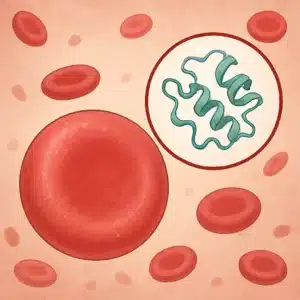
VCM significa volumen corpuscular medio, es decir, el volumen promedio de un solo glóbulo rojo, expresado en fentolitros (fL), una unidad de volumen extremadamente pequeña. Los glóbulos rojos, también llamados eritrocitos, se producen en la médula ósea y transportan oxígeno desde los pulmones hacia todos los tejidos del cuerpo, y luego llevan el dióxido de carbono de regreso para ser exhalado.
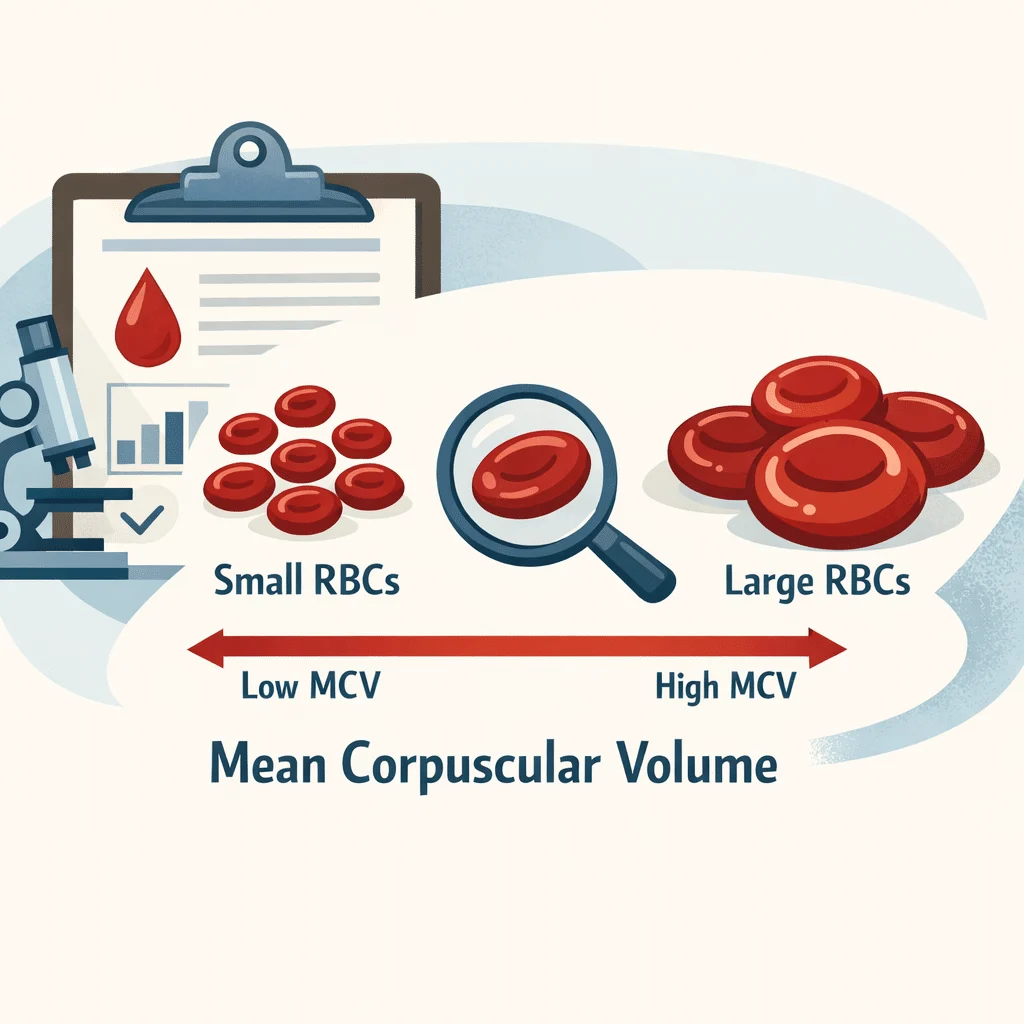
El tamaño de estas células afecta qué tan eficientemente realizan su función. Un análisis de MCV en sangre le indica a tu médico si tus glóbulos rojos tienen un tamaño normal, son más pequeños de lo esperado (un patrón llamado microcitosis) o más grandes de lo esperado (macrocitosis). Como el tamaño de las células suele reflejar lo que ocurre en su interior, el MCV da una señal temprana sobre el estado nutricional, el funcionamiento de la médula ósea y ciertas condiciones hereditarias.
Por qué importa el análisis de MCV en sangre
El análisis de MCV en sangre no se solicita de forma aislada. Es uno de varios índices de glóbulos rojos que se reportan automáticamente como parte de una biometría hemática (BH), junto con la hemoglobina corpuscular media (HCM) y la concentración de hemoglobina corpuscular media (CHCM). En conjunto, estos valores ayudan a tu médico a identificar la causa de la anemia u otros problemas de glóbulos rojos, muchas veces antes de que presentes síntomas.
Una ventana al estado nutricional
El MCV suele reflejar las reservas de hierro, vitamina B12 y folato (vitamina B9) en tu cuerpo. Un MCV bajo frecuentemente indica deficiencia de hierro, ya que cuando el hierro es insuficiente se limita la producción de hemoglobina y los glóbulos rojos se vuelven más pequeños. Un MCV alto, en cambio, suele apuntar a una falta de vitamina B12 o folato, ambas necesarias para la síntesis normal de ADN durante la formación de los glóbulos rojos.
Una pista hacia condiciones más allá de la alimentación
Un MCV anormal también puede reflejar condiciones hereditarias como la talasemia, enfermedad hepática crónica, hipotiroidismo, ciertos medicamentos o, con menos frecuencia, trastornos de la médula ósea. Dado que la lista de posibles causas es amplia, los médicos interpretan el MCV junto con tus síntomas, otros resultados de la biometría hemática y, en ocasiones, un frotis de sangre examinado al microscopio.
Cómo los resultados orientan los siguientes pasos
Un resultado de MCV fuera de rango suele determinar qué estudios solicita tu médico a continuación. Un MCV bajo generalmente lleva a estudios de hierro, mientras que un MCV alto suele derivar en pruebas de vitamina B12 y folato, y a veces en pruebas de función hepática o tiroidea. El MCV también puede ayudar a monitorear qué tan bien está funcionando un tratamiento, como la suplementación con hierro o B12, a lo largo del tiempo.
Rango normal del MCV y cómo leer tu resultado
En un reporte de laboratorio, el MCV generalmente aparece en la sección de hematología o biometría hemática (BH). Para la mayoría de los adultos, el rango de referencia estándar del MCV es de aproximadamente 80 a 100 fL. Los valores por debajo de 80 fL se clasifican generalmente como bajos (microcíticos), y los valores por encima de 100 fL como altos (macrocíticos).
Los rangos de referencia no son completamente universales. Cada laboratorio establece su propio rango según el equipo que utiliza y la población a la que atiende, por lo que puedes ver pequeñas variaciones entre laboratorios. Siempre compara tu resultado con el rango impreso en tu propio reporte, no con un número que encuentres en internet. Busca símbolos como una flecha hacia arriba (alto) o hacia abajo (bajo), o un asterisco que marca un valor atípico; algunos laboratorios usan varios asteriscos para indicar qué tan lejos está un resultado del rango esperado.
MCV alto vs. MCV bajo: comparación rápida
La tabla a continuación resume las diferencias típicas entre ambas situaciones. Es un punto de partida para entender tu reporte, no un sustituto de la interpretación de tu médico.
| Característica | MCV bajo (microcitosis) | MCV alto (macrocitosis) |
|---|---|---|
| Umbral típico | Por debajo de aproximadamente 80 fL | Por encima de aproximadamente 100 fL |
| Causa más común | Deficiencia de hierro | Deficiencia de vitamina B12 o folato |
| Otras posibles causas | Talasemia, inflamación crónica, anemia sideroblástica, exposición al plomo | Consumo crónico de alcohol, enfermedad hepática, hipotiroidismo, algunos medicamentos, síndrome mielodisplásico |
| Estudios de seguimiento típicos | Estudios de hierro, ferritina, conteo de reticulocitos | Niveles de vitamina B12 y ácido fólico, pruebas de hígado y tiroides |
Para profundizar en cualquiera de las dos situaciones, incluyendo síntomas, opciones de tratamiento y qué esperar del seguimiento médico, consulta nuestras guías dedicadas a causas, síntomas y tratamientos del MCV bajo y cómo entender el MCV alto y sus causas.
¿Puede el MCV estar normal y aun así indicar un problema?
Sí. Es posible tener anemia con un MCV completamente normal, lo que a veces se llama anemia normocítica. Este patrón puede presentarse con pérdida súbita de sangre, insuficiencia renal, o una combinación de deficiencias que se anulan entre sí, como la deficiencia simultánea de hierro y vitamina B12. Por eso el MCV siempre se interpreta junto con la hemoglobina, el hematocrito y el conteo de glóbulos rojos, y no de forma aislada. Nuestra guía sobre cómo leer una biometría hemática (BH) explica cómo encajan todos estos valores.
Cuándo consultar a un médico por tu resultado de MCV en la biometría hemática
La mayoría de los resultados de MCV levemente anormales no son una urgencia y simplemente llevan a más estudios o a repetir el análisis de sangre. Sin embargo, algunas situaciones merecen atención más pronto.
El proceso de extracción está cambiando: descubre qué cambia para los pacientes con una extracción de sangre robótica aprobada por la FDA.
Considera contactar a un médico antes si notas:
Fatiga persistente, debilidad o falta de aire al hacer algún esfuerzo, que pueden acompañar a la anemia sin importar el tamaño de los glóbulos rojos. Piel pálida, uñas quebradizas o antojos inusuales de cosas que no son alimentos, como hielo, lo que puede sugerir deficiencia de hierro. Entumecimiento, hormigueo, problemas de equilibrio o cambios en la memoria, que pueden presentarse cuando la deficiencia de vitamina B12 afecta el sistema nervioso. Un VCM muy alterado, especialmente junto con hemoglobina baja, o cualquier resultado que tu médico haya señalado específicamente para seguimiento. Dolor en el pecho, desmayos o latidos acelerados, que requieren atención urgente en lugar de esperar una cita programada.
Un resultado de VCM ligeramente fuera del rango de referencia, sin síntomas, generalmente solo se vuelve a revisar en una fecha posterior en lugar de tratarse de inmediato.
Cómo investigan los médicos un resultado anormal de VCM en los estudios de laboratorio
Cuando tu VCM cae fuera del rango de referencia, tu médico generalmente analiza el patrón general antes de pedir más estudios. Revisará si la hemoglobina y el hematocrito también están bajos, ya que el VCM combinado con estos valores ayuda a clasificar el tipo de anemia presente. Un conteo de reticulocitos, que mide cuántos glóbulos rojos nuevos está produciendo tu médula ósea, puede mostrar si tu cuerpo está respondiendo adecuadamente a una deficiencia.
Para un VCM bajo, los estudios de hierro —que incluyen ferritina, hierro sérico y capacidad total de fijación de hierro— son el siguiente paso habitual; nuestra guía del panel de estudios de hierro explica cómo encajan estos marcadores. Para un VCM alto, los niveles de vitamina B12 y folato se revisan primero, junto con la función hepática y tiroidea; puedes aprender más en nuestras guías sobre análisis de sangre de ácido fólico y sobre cómo interpretar resultados elevados de vitamina B12. En algunos casos, los médicos también examinan un frotis de sangre bajo el microscopio u ordenan una electroforesis de hemoglobina para descartar talasemia.
Factores de dieta y estilo de vida que influyen en el VCM
Como el VCM frecuentemente refleja el estado nutricional, la alimentación juega un papel importante en la prevención y la recuperación una vez que se identifica la causa. Si un VCM bajo se debe a deficiencia de hierro, los alimentos ricos en este mineral —como carne roja, pollo, leguminosas y verduras de hoja verde oscura— pueden ayudar, especialmente si se combinan con una fuente de vitamina C, como los cítricos, que mejora la absorción del hierro. El té y el café tomados durante las comidas pueden reducir la absorción de hierro, por lo que espaciarlos de las comidas ricas en este mineral es un hábito sencillo y práctico.
Si un VCM elevado está relacionado con deficiencia de vitamina B12 o folato, priorizar lácteos, huevos, pescado y cereales fortificados para la B12, además de verduras de hoja verde y leguminosas para el folato, favorece la recuperación. También es importante reducir el consumo de alcohol, ya que su uso crónico es una causa común y frecuentemente ignorada de macrocitosis, independientemente de cualquier deficiencia vitamínica. Estos pasos en la alimentación complementan el tratamiento, pero no lo reemplazan; cualquier deficiencia sospechada debe ser confirmada y monitoreada por un médico.
Cómo se realiza el análisis de sangre para el VCM
El análisis de sangre para el VCM no requiere más que una extracción de sangre estándar. Un profesional de la salud toma una pequeña muestra de sangre de una vena en tu brazo, y el valor se calcula automáticamente con el mismo analizador que procesa tu biometría hemática (BH). No es necesario ayunar ni hacer ninguna preparación especial, a menos que la misma extracción incluya otros estudios —como glucosa en ayuno o un perfil de lípidos— que sí lo requieran. Los resultados suelen estar disponibles en unas horas o un par de días, según el laboratorio.
Avances científicos recientes
Las investigaciones recientes se han enfocado en aprovechar mejor el análisis de VCM y los índices relacionados de glóbulos rojos, en particular combinándolos con reconocimiento de patrones asistido por computadora para agilizar el diagnóstico.
Un estudio de 2025 analizó datos de biometría hemática (BH), incluyendo el VCM, para construir un modelo computacional que ayudara a distinguir la anemia por deficiencia de hierro de la anemia aplásica, una enfermedad de la médula ósea más rara y grave, utilizando valores sanguíneos de rutina ya obtenidos durante los estudios estándar. Lo que esto significa para ti: el VCM y otras mediciones de los glóbulos rojos podrían apoyar cada vez más una distinción más rápida y consistente entre las causas comunes y raras de anemia, acortando potencialmente el camino desde un conteo sanguíneo anormal hasta el estudio de seguimiento adecuado. Esta investigación aún es preliminar y se basa en los datos de un solo hospital, por lo que todavía no ha cambiado la práctica clínica cotidiana, pero apunta a que el VCM se convierta en una señal temprana aún más útil con el tiempo.
Un estudio relacionado de 2024 desarrolló y evaluó un modelo computacional usando el VCM, junto con la hemoglobina corpuscular media (HCM) y el ancho de distribución eritrocitaria (una medida de cuánto varía el tamaño de los glóbulos rojos), para distinguir la anemia por deficiencia de hierro del rasgo talasémico, una condición genética que puede verse similar en una biometría hemática básica. Lo que esto significa para ti: diferenciar estas dos condiciones tiene importancia práctica, ya que el rasgo talasémico no responde a los suplementos de hierro y el hierro innecesario puede acumularse de forma dañina con el tiempo, mientras que la verdadera deficiencia de hierro sí requiere reposición de hierro. El modelo tuvo buen desempeño en la población del estudio, pero fue desarrollado y evaluado en hospitales específicos, por lo que su precisión en otras poblaciones y laboratorios aún está siendo confirmada. Por ahora, estos enfoques son herramientas de investigación y no algo que tu laboratorio local use directamente, pero ilustran cómo el sencillo análisis de VCM sigue generando nuevo valor diagnóstico más de un siglo después de que fue descrito por primera vez.
Preguntas frecuentes
¿El análisis de VCM requiere ayuno?
No. El VCM se calcula como parte de la biometría hemática (BH), y comer o beber antes no cambia de manera significativa el tamaño de los glóbulos rojos. Solo necesitas ayunar si la misma toma de sangre incluye otro estudio que lo requiera, como una glucosa en ayuno o un perfil de lípidos. Si tienes dudas, revisa las indicaciones que te dieron con tu orden de laboratorio.
¿El VCM puede cambiar rápidamente o se mantiene estable?
El VCM es un valor bastante estable de un día para otro. Los glóbulos rojos viven aproximadamente 120 días, por lo que el tamaño promedio de las células en circulación no cambia drásticamente de la noche a la mañana. Los cambios significativos en el VCM suelen desarrollarse a lo largo de semanas o meses, a medida que los nuevos glóbulos rojos —formados según tu estado actual de hierro o vitaminas— van reemplazando gradualmente a los más viejos.
¿Qué significa que mi VCM sea normal pero aún me sienta mal?
Un VCM normal no descarta todos los problemas relacionados con los glóbulos rojos. Algunas personas tienen deficiencia de hierro temprana sin anemia, una combinación de deficiencias que se compensan entre sí, o una condición completamente diferente, como disfunción tiroidea o un trastorno del sueño. Si tu VCM es normal pero los síntomas persisten, coméntaselo a tu médico en lugar de asumir que la biometría hemática descartó todo.
¿Cómo cambia el VCM en los estudios de laboratorio durante el embarazo?
El embarazo provoca cambios fisiológicos reales en el VCM. En el segundo trimestre, el VCM puede disminuir ligeramente porque el volumen plasmático aumenta más rápido que la masa de glóbulos rojos, mientras que la demanda de hierro se incrementa. Más adelante en el embarazo, una ingesta insuficiente de folato puede elevar el VCM. Por eso se recomienda comúnmente la suplementación con hierro y ácido fólico durante todo el embarazo.
¿La etnia puede influir en lo que se considera un VCM normal?
Sí, en cierta medida. Las personas de ascendencia mediterránea, africana o del sudeste asiático pueden tener valores promedio de VCM ligeramente más bajos, lo que suele estar relacionado con una mayor prevalencia del rasgo de talasemia, una condición hereditaria generalmente benigna. Los médicos toman esto en cuenta para evitar estudios innecesarios cuando un VCM levemente bajo encaja con un patrón familiar conocido y no con un problema nuevo.
¿Un VCM bajo o alto siempre es motivo de preocupación?
No necesariamente. Un VCM levemente anormal sin síntomas y sin otros valores alterados en los estudios de sangre generalmente solo se vigila con un análisis de seguimiento en unos meses. Lo más importante es qué tan alejado está el valor del rango de referencia, si otros valores de los glóbulos rojos también están afectados y si tienes síntomas. Tu médico es quien mejor puede decidir si tu resultado específico requiere más estudios.
Fuentes
- VCM (Volumen Corpuscular Medio) — MedlinePlus, Biblioteca Nacional de Medicina (NIH) — https://medlineplus.gov/lab-tests/mcv-mean-corpuscular-volume/
- Análisis de sangre de Volumen Corpuscular Medio (VCM) — Cleveland Clinic — https://my.clevelandclinic.org/health/diagnostics/24641-mcv-blood-test
- Maner BS, Moosavi L. Mean Corpuscular Volume — StatPearls, NCBI Bookshelf (National Library of Medicine, NIH) — https://www.ncbi.nlm.nih.gov/books/NBK545275/
- Darshan BSD, Sampathila N, Bairy GM, et al. Differential diagnosis of iron deficiency anemia from aplastic anemia using machine learning and explainable Artificial Intelligence utilizing blood attributes — Scientific Reports, 2025 — https://doi.org/10.1038/s41598-024-84120-w
- Wang W, Ye R, Tang B, Qi Y. MultiThal-classifier, a machine learning-based multi-class model for thalassemia diagnosis and classification — Clinica Chimica Acta, 2024 — https://doi.org/10.1016/j.cca.2024.120025
Leer un solo valor marcado como el VCM rara vez cuenta toda la historia por sí solo. Combinarlo con otros resultados relacionados, como la hemoglobina, la ferritina o un panel completo de hierro, da una imagen mucho más clara de lo que está ocurriendo y te ayuda a entender —no a diagnosticar— lo que tu reporte podría estar indicando. AI DiagMe puede ayudarte a ver cómo encaja tu VCM junto con estos otros marcadores, traduciendo el patrón a un lenguaje sencillo antes de tu próxima cita. Está diseñado para ayudarte a entender tus resultados; no te diagnostica ni reemplaza a tu médico.
Entiende tus resultados de laboratorio con AI DiagMe
Obtén la lectura de tus resultados en minutos
Lecturas recomendadas
- Causas, síntomas y tratamientos del VCM bajo
- Cómo entender los niveles altos de VCM y sus causas
- Cómo leer los resultados de la biometría hemática (BH)
- Panel de estudios de hierro y qué significa cada marcador
- Rangos normales de análisis de sangre por panel
Glosario
| Término | Definición |
|---|---|
| Volumen corpuscular medio (VCM) | El volumen promedio de un solo glóbulo rojo, medido en femtolitros (fL). |
| Microcitosis | Un patrón de glóbulos rojos más pequeños de lo normal, generalmente por debajo de unos 80 fL. |
| Macrocitosis | Un patrón de glóbulos rojos más grandes de lo normal, generalmente por encima de unos 100 fL. |
| Biometría hemática (BH) | Un análisis de sangre común que mide los glóbulos rojos, los glóbulos blancos, las plaquetas y otros valores relacionados, incluido el VCM. |
| Hemoglobina | La proteína que contiene hierro dentro de los glóbulos rojos y que transporta el oxígeno por todo el cuerpo. |
| Anemia por deficiencia de hierro | La causa más frecuente de VCM bajo; ocurre cuando no hay suficiente hierro para sostener una producción normal de hemoglobina. |
| Folato (vitamina B9) | Una vitamina del complejo B necesaria para la síntesis de ADN durante la formación de glóbulos rojos; su deficiencia puede elevar el VCM. |
| Talasemia | Un grupo de enfermedades hereditarias que reducen la producción normal de hemoglobina y pueden disminuir el VCM. |
| Conteo de reticulocitos | Un análisis que mide cuántos glóbulos rojos nuevos e inmaduros están presentes, lo que refleja la actividad de la médula ósea. |