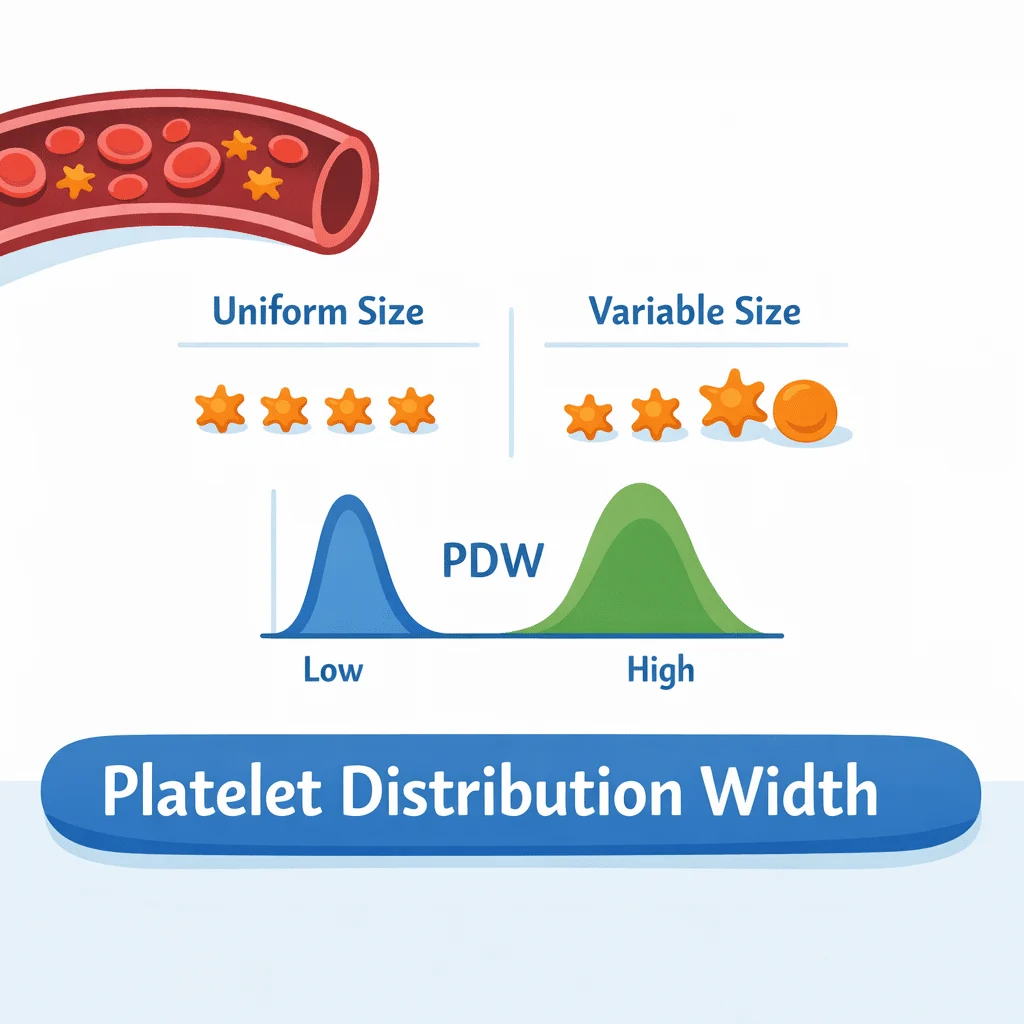
A PDW blood test measures how much your platelets vary in size, and it usually appears as one line among many on a complete blood count (CBC) report. PDW stands for platelet distribution width, and it reflects whether your platelets, the tiny cell fragments that help your blood clot, are fairly uniform or widely different in size. Many people notice this abbreviation only after receiving lab results and wonder what it means, especially if it is flagged high or low. In this article you will learn what PDW measures, how to read your result against the reference range, what a high or a low value can suggest, and when it is worth a conversation with your doctor.
What does a PDW blood test measure?
Platelets, also called thrombocytes, are small blood cells made in your bone marrow. They circulate in your bloodstream and gather at the site of an injury to form a clot, a process called hemostasis. Platelets are not identical; some are freshly made and larger, while others are older and smaller. The PDW blood test captures this variation as a single number, expressed as a coefficient of variation, usually written as a percentage.
A narrow range of platelet sizes gives a low PDW. A wide spread, with many small and many large platelets mixed together, gives a high PDW. Because your bone marrow normally produces platelets of a fairly consistent size, a wider-than-usual spread can be an early clue that something is changing platelet production or turnover.
Why platelet size variation matters
Bigger, younger platelets tend to be more metabolically active and more reactive than older, smaller ones. When your bone marrow ramps up platelet production, for example after blood loss or during ongoing inflammation, it releases these larger, younger platelets faster than usual. This can widen the size distribution before the total platelet count itself has moved, which is part of why some doctors find PDW a useful early signal alongside other complete blood count values.
PDW blood test normal range and how to read your result
On your lab report, PDW usually sits in the platelet section, sometimes labeled “Platelet Indices” or grouped near your platelet count and mean platelet volume (MPV). A typical adult reference range for PDW is about 9 percent to 17 percent, though this varies by laboratory and testing method. Your report will show your own lab’s specific range next to your result, and that is the number that matters most, not a figure you find online.
Most reports flag an abnormal value with a color, an asterisk, or an arrow. A result inside the printed range is generally reported as normal. A result above or below it is flagged high or low, but a flag alone does not diagnose anything. It simply tells you the value sits outside the statistical band built from a large group of healthy people.
Reading PDW alongside other platelet values
PDW rarely stands alone in a meaningful interpretation. Doctors typically read it together with your total platelet count and your mean platelet volume, since the combination of these three numbers tells a more complete story than any one of them alone. For example, a high PDW paired with a low platelet count suggests active, possibly compensatory production, while a high PDW with a normal or high platelet count points toward a different mechanism. If you want a refresher on how platelet count itself is measured and interpreted, our guide to the platelet count blood test and its reference ranges walks through that companion marker in detail.
PDW vs MPV: what is the difference?
PDW and MPV are often confused because both describe platelet size, but they answer different questions. MPV (mean platelet volume) reports the average size of your platelets in femtoliters. PDW reports how much variation exists around that average, as a percentage. Two people can have the same MPV yet very different PDW values, because one might have platelets clustered tightly around the average size while the other has a much wider spread. The table below summarizes the main differences.
| Feature | PDW (platelet distribution width) | MPV (mean platelet volume) |
|---|---|---|
| What it measures | Variation in platelet size (uniformity) | Average platelet size |
| Typical unit | Percent (%) | Femtoliters (fL) |
| Typical adult range | About 9-17% | About 7.5-11.5 fL |
| Rises when | Platelets of many different sizes circulate together | Platelets are, on average, larger than usual |
| Most useful when read | Alongside MPV and platelet count | Alongside PDW and platelet count |
Because the two markers complement each other, our dedicated explainer on mean platelet volume and what high or low MPV results can mean is a natural next read if your report lists both values.
What does a high PDW blood test result mean?
A PDW above the reference range means your platelets vary more in size than typical. This usually reflects active or irregular platelet production. Common, generally non-alarming explanations include recent infection, inflammation, or recovery after blood loss, since the bone marrow releases a fresh wave of larger, younger platelets during these situations. Several conditions are more specifically associated with a high PDW.
Immune thrombocytopenia is one example, where the immune system destroys platelets and the bone marrow compensates by rapidly producing new, larger ones. Deficiency anemias, particularly low iron, vitamin B12, or folate, can also disrupt normal platelet maturation and widen the size distribution. Myeloproliferative conditions, which are less common bone marrow disorders that cause excessive blood cell production, can produce platelets of very uneven size. In pregnancy, mild platelet changes are common and are usually monitored rather than treated, though your obstetric team will interpret any flagged value in context.
What does a low PDW blood test result mean?
A PDW below the reference range means your platelets are unusually uniform in size. This is less commonly discussed than a high result, and on its own it is not typically dangerous, but it can still be a useful clue in the right clinical context. Chronic inflammatory conditions can sometimes standardize platelet production, leading to platelets that are consistent in size but not necessarily functioning at their best. Certain chemotherapy agents can also narrow the size range by affecting the cells in bone marrow that give rise to platelets. Thrombotic microangiopathies, a group of rare but serious conditions in which small platelets are consumed within tiny clots, can leave a more homogeneous population of larger platelets behind, another route to a low reading.
When to see a doctor about a PDW result
Most flagged PDW results are picked up incidentally on a routine CBC and do not, by themselves, signal an emergency. Context and symptoms make the difference between a value worth watching and one that needs prompt attention.
A mildly abnormal PDW, roughly within 2 percentage points of the reference range, with no symptoms, is often simply worth rechecking in a few months. A moderately abnormal result, off by around 5 percentage points, is reasonable to discuss with your primary care doctor within the coming weeks, particularly if it is a new finding. A markedly abnormal PDW, especially alongside symptoms, deserves more prompt evaluation.
Contact a doctor sooner, ideally within days, if an abnormal PDW appears alongside any of the following:
- Unexplained or unusually heavy bleeding, including nosebleeds or bleeding gums.
- Bruising that appears without an obvious injury, or that seems excessive.
- Persistent, unexplained fatigue that does not improve with rest.
- A fever without a clear cause.
- Pain, swelling, or warmth in a limb, which can suggest a clotting problem.
By contrast, an isolated, mild PDW abnormality in someone who feels well is usually appropriate for simple follow-up with a primary care provider rather than an urgent referral. A hematologist, a specialist in blood disorders, becomes more relevant when the abnormality is significant, persistent, or paired with other unexplained blood count changes.
How lifestyle and diet may support healthy platelet production
There is no specific diet that directly changes your PDW number, but general habits that support healthy bone marrow function can help in situations linked to nutrient gaps or inflammation. If a high PDW is thought to relate to iron, vitamin B12, or folate deficiency, increasing dietary sources of these nutrients, such as lean meats, leafy greens, legumes, and fortified grains, is a reasonable starting point alongside your doctor’s guidance. An anti-inflammatory eating pattern rich in omega-3 fatty acids, from fatty fish or plant sources like walnuts and flaxseed, along with plenty of fruits and vegetables, may support overall vascular health when inflammation is a contributing factor.
General habits that support healthy blood cell production include getting adequate sleep, managing stress, staying physically active, and avoiding tobacco. If your PDW abnormality is linked to a low platelet count, your doctor may advise avoiding contact sports or activities with a high fall risk, since bleeding risk is tied more closely to platelet count and function than to PDW itself. Moderate, low-impact activities such as walking or swimming are usually well tolerated.
Latest scientific advances
Research on platelet distribution width has expanded in recent years, particularly around its potential as a marker of broader health risk rather than a purely hematological curiosity. Because the findings below come from population studies and specific patient groups, they describe associations, not proof that an abnormal PDW causes a particular outcome, and none of this should be used to self-diagnose.
A large analysis of a nationally representative United States health survey followed more than 15,000 adults and found that a higher PDW was linked to a greater risk of death from any cause over the following years, with the strongest association seen in the first five years after testing. What this means for you: if your PDW is flagged high on a routine test, it is one more data point your doctor may weigh alongside your overall risk profile, not a standalone red flag. This finding is preliminary in the sense that it shows a statistical association in a large population, and researchers still need to work out the underlying biology before it changes day-to-day clinical practice.
In people already living with chronic heart failure, a condition where the heart cannot pump blood as efficiently as it should, a multi-year study found that those with higher PDW values had a greater likelihood of dying during follow-up compared with those with lower values. What this means for you: in patients who already have a diagnosed heart condition, PDW may add useful information for risk stratification, helping clinicians decide who needs closer monitoring. This evidence is still being confirmed and PDW is not yet a standard part of heart failure risk scoring.
Interestingly, a systematic review pooling data from 21 studies on platelet volume indices in heart failure found that while mean platelet volume (MPV) showed a fairly consistent link to worse outcomes, the evidence for PDW specifically was less clear-cut and did not reach statistical significance overall. What this means for you: not every platelet index carries the same weight, and a high PDW should not automatically be read as equivalent to a high MPV in terms of concern; more research is needed to clarify PDW’s independent role.
Separately, a study combining a meta-analysis of tens of thousands of lung cancer patients with a genetic method called Mendelian randomization, which helps researchers test whether an association might reflect a cause-and-effect relationship rather than coincidence, found that higher PDW was linked to a modestly increased lung cancer risk. What this means for you: this is an emerging research direction rather than a screening tool, and a high PDW on your CBC is not a signal to seek cancer testing on its own; it simply adds to a growing picture of platelets as more than passive clotting cells. As with the other findings here, this connection is still being investigated and should be treated as preliminary.
Further reading
- Learn how to interpret your complete blood count results across all three cell lines.
- Understand the broader context by reading how to read your blood test results with confidence.
- Compare your PDW against general normal blood test ranges across common panels.
- See how clotting-specific tests differ by reviewing our guide to the coagulation panel and what PT, PTT, and INR measure.
- Explore how vitamin status affects clotting in our article on the vitamin K blood test and its link to PT/INR results.
Sources
- MedlinePlus, National Library of Medicine (NIH) — Platelet Tests — https://medlineplus.gov/lab-tests/platelet-tests/
- Cleveland Clinic — MPV Blood Test: High MPV, Low MPV & Normal Ranges — https://my.clevelandclinic.org/health/diagnostics/23572-mpv-blood-test
- National Heart, Lung, and Blood Institute (NHLBI), NIH — What Are Platelet Disorders? — https://www.nhlbi.nih.gov/health/platelet-disorders
- Botros L, et al. — Association of platelet distribution width with all-cause and cause-specific mortality in US adults — International Journal of Cardiology, 2024 — https://consensus.app/papers/details/12b7ce6906745fb385ddc578a9198f87/?utm_source=claude_code
- Neves A, et al. — Platelet distribution width, a prognosis marker in patients with chronic heart failure — Porto Biomedical Journal, 2025 — https://consensus.app/papers/details/2492bb3db4f25b7ab6ecefa4325f4cdb/?utm_source=claude_code
- Abhari AP, et al. — Prognostic value of platelet volume indices in heart failure: a systematic review and meta-analysis — American Journal of Blood Research, 2025 — https://pubmed.ncbi.nlm.nih.gov/40995194/
- Yuan M, et al. — Platelet indices as prognostic biomarkers in lung cancer: A meta-analysis and Mendelian randomization study — Medicine, 2026 — https://pubmed.ncbi.nlm.nih.gov/41650072/
Blood test results like PDW rarely tell the full story on their own, which is why doctors read them alongside related complete blood count values such as platelet count, mean platelet volume, and hemoglobin, plus any coagulation panel results if clotting is a concern. AI DiagMe helps you make sense of these numbers in plain language so you can see the pattern across your report before your appointment. This tool helps you understand your results, it does not diagnose you, and it never replaces the judgment of your doctor.
Understand your lab results with AI DiagMe
Get your results interpreted in minutes
Frequently asked questions about the PDW blood test
What is the normal PDW blood test range?
Most laboratories consider a PDW between about 9 percent and 17 percent to be within the normal adult range, though the exact figures depend on the lab’s equipment and methods. Your printed report will show the specific range used by the lab that processed your sample, and that is the range you should compare your result against rather than a generic number found online. A single value slightly outside this range, with no symptoms, is usually not a cause for concern and is often simply rechecked at a later date.
What causes a high PDW blood test result?
A high PDW usually reflects active or uneven platelet production by the bone marrow. Common causes include recent infection or inflammation, recovery after blood loss, iron or vitamin B12 or folate deficiency, and conditions like immune thrombocytopenia where the immune system destroys platelets faster than usual. Less commonly, certain bone marrow disorders can also raise PDW. Your doctor will look at the value alongside your platelet count, your mean platelet volume, and your symptoms to narrow down the likely cause.
What does a low PDW blood test result mean?
A low PDW means your platelets are unusually similar in size. It is less frequently discussed than a high result and, on its own, is not typically considered dangerous. It can sometimes accompany chronic inflammatory conditions, certain chemotherapy treatments, or rare disorders that consume smaller platelets within tiny clots. As with a high result, a low PDW is interpreted together with your other blood counts rather than in isolation.
Can a PDW blood test be high during pregnancy?
Yes, mild platelet changes, including shifts in PDW, are relatively common during pregnancy as your blood volume and cell production adapt. In most cases, this is a normal physiological adjustment rather than a sign of a problem. Your obstetric care team monitors these values as part of routine prenatal blood work and will flag anything that falls outside the expected pattern for pregnancy, so there is usually no need to interpret a single flagged value on your own.
Does a high PDW blood test result mean I have cancer?
No. A high PDW result does not diagnose cancer or any other specific disease. It is a nonspecific finding that can arise from many common and usually benign situations, including infection, inflammation, or nutrient deficiency. While some research has explored statistical links between platelet indices and certain conditions, these are population-level associations, not individual diagnostic signals, and a flagged PDW on its own is not a reason to pursue cancer testing.
How is the PDW blood test performed and do I need to prepare?
PDW is measured automatically as part of a standard complete blood count, using a small blood sample drawn from a vein in your arm. No special preparation, such as fasting, is typically required for this specific value, though you may need to fast if other tests are being run from the same blood draw. Results are usually available within a day, and your doctor will review the PDW alongside your platelet count and mean platelet volume when discussing your results with you.