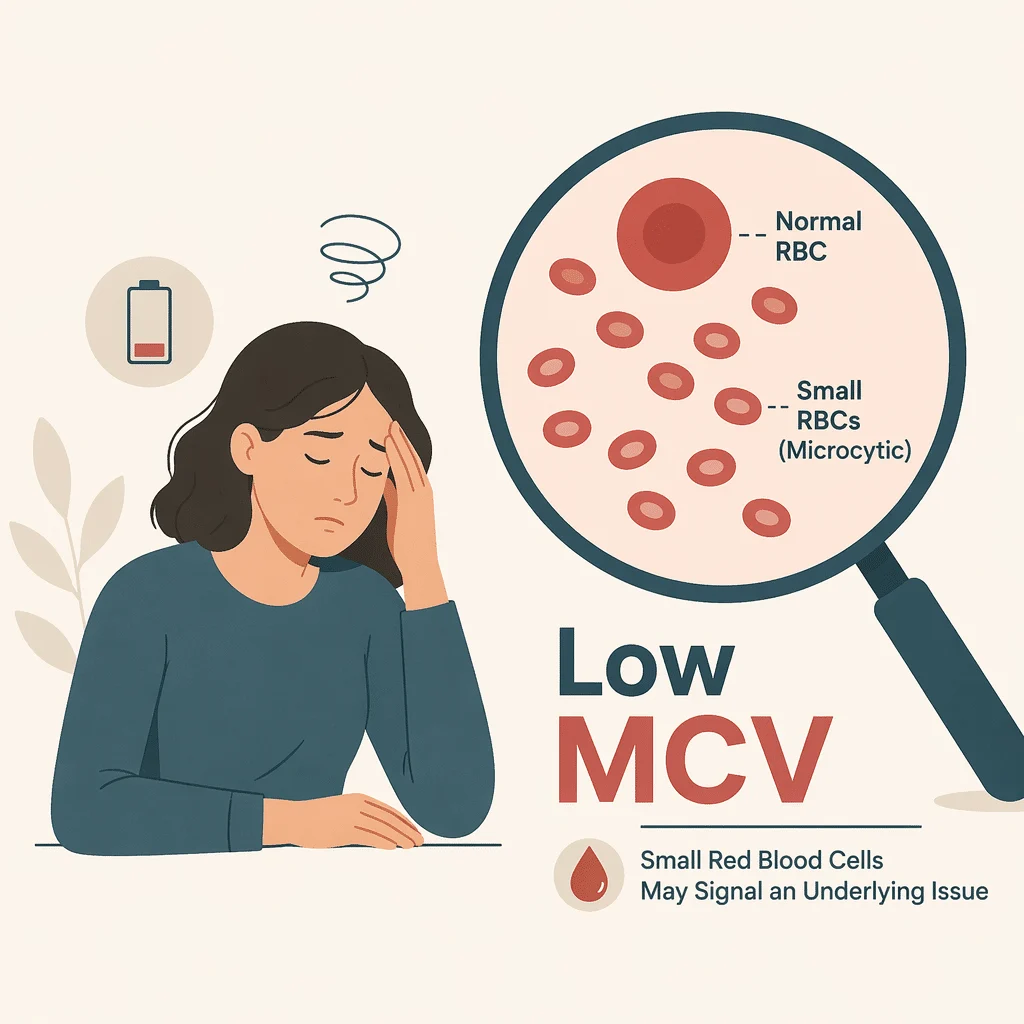
A low MCV means your red blood cells are smaller than average. It is one of the commonest abnormal results people notice on a full blood count, and it is a clue rather than a diagnosis. Two very different explanations account for most cases: iron deficiency, which needs treating and needs a cause found, and thalassemia trait, a harmless inherited carrier state needing no treatment at all. Telling them apart matters enormously, because the wrong answer can mean years of pointless iron tablets or a missed source of bleeding.
In this article you’ll learn what the MCV measures, what a small red cell can and cannot tell you, how doctors separate iron deficiency from thalassemia trait using numbers already on your report, the less common causes, and what your doctor is likely to check next.
What the MCV actually measures
MCV stands for mean corpuscular volume: the average size of a single red blood cell, reported in femtoliters (fL). It appears on every complete blood count alongside hemoglobin, hematocrit and the white cell and platelet counts. Most laboratories treat roughly 80 to 100 fL as the adult reference range, so a result below 80 fL is usually flagged. Cut-offs vary between laboratories and differ in children, so read your number against the range printed on your own report.
The analyzer sizes tens of thousands of cells in seconds, producing both an average size (the MCV) and a measure of how much those sizes vary: the red cell distribution width, or RDW. It is one of the most useful figures on the page.
Red cell size is not random. A red blood cell is essentially a bag of hemoglobin, so when the body cannot make enough hemoglobin it makes smaller cells. That single mechanism sits behind almost every cause of a low MCV: something is limiting hemoglobin production, either the iron needed to build it or the globin protein chains that form its structure. Our guide to the MCV blood test explains how the value is reported.
What a low MCV does and does not tell you
A low MCV, on its own, tells you one thing: the cells are small. Doctors call this microcytosis. It does not tell you whether you are anemic, how you feel, or what caused it. Microcytosis and anemia are not the same thing.
Anemia means a low hemoglobin level. You can have a low MCV with a perfectly normal hemoglobin, which is common in thalassemia trait and in the earliest stage of iron depletion, and you can be anemic with a normal MCV. The two numbers answer different questions.
It also says nothing reliable about symptoms. Small red cells themselves cause nothing: any tiredness, breathlessness on exertion or pallor comes from anemia if it is present, or from the underlying condition. Plenty of people with a persistently low MCV feel completely well for decades.
What it does do is narrow the field. It rules out the entirely different causes behind a high MCV, where large cells point towards vitamin B12 or folate deficiency, alcohol, liver disease or thyroid problems. A small cell points mostly towards two conditions.
Iron deficiency versus thalassemia trait: the pattern on your report
This is the question that matters most, and much of the answer is already in front of you. Both conditions produce small, pale red cells, so the MCV alone will not separate them. Three or four numbers read together usually will.
The red cell count is the most telling single clue
The red blood cell count (RBC) is the number of red cells per unit of blood, printed near the MCV on most reports. In iron deficiency the body cannot build enough hemoglobin, so it makes fewer cells and they are small: the red cell count is typically low or normal. In thalassemia trait the bone marrow compensates by producing large numbers of small cells, so the red cell count is often normal or frankly high, even when hemoglobin is only mildly reduced.
A low MCV sitting next to a high red cell count is the pattern that should make a clinician think carefully before reaching for iron.
The RDW tells you whether the cells are uniformly small
The RDW measures how much red cell sizes vary. In iron deficiency, iron runs out gradually, so your blood holds a mixture of older normal-sized cells and newer small ones, and that variation pushes the RDW up. In thalassemia trait the defect has been present since birth and affects every cell equally, so the cells are uniformly small and the RDW is usually normal.
Raised RDW with a low MCV leans towards iron deficiency. Normal RDW with a low MCV leans towards trait. Neither is absolute, but the direction is genuinely informative.
Ferritin settles most cases
Ferritin reflects your iron stores and usually decides the question: low in iron deficiency, normal in thalassemia trait. Interpreting it has complications, because inflammation can push the value up and hide a true deficiency, which is why doctors sometimes add transferrin saturation or an inflammatory marker. Our companion article on low ferritin covers those pitfalls, the causes of iron deficiency and how it is investigated; this page stays with what the red cell indices themselves are telling you.
Where the Mentzer index fits
Clinicians sometimes use a quick shortcut called the Mentzer index: the MCV divided by the red cell count. A result below 13 has traditionally been read as favoring thalassemia trait, above 13 as favoring iron deficiency. It is a screening rule of thumb, not a test. It formalizes the observation above, that trait produces many small cells while iron deficiency produces fewer, and it is wrong often enough that no one should use it to reach a conclusion. Several similar formulas exist, and none replaces ferritin and confirmatory testing.
How thalassemia trait is actually confirmed
Suspicion is not diagnosis. Trait is confirmed with hemoglobin electrophoresis or high-performance liquid chromatography (HPLC), laboratory methods that separate and measure the different types of hemoglobin. In beta thalassemia trait, a raised hemoglobin A2 fraction gives the answer; alpha thalassemia trait does not always show up this way and may need genetic testing.
| Feature on your report | Iron deficiency | Thalassemia trait |
|---|---|---|
| MCV (average cell size) | Low, and tends to fall further over time if untreated | Low, and stable across years of previous tests |
| Red cell count (RBC) | Usually low or normal | Often normal or high |
| RDW (variation in cell size) | Usually raised, cells vary in size | Typically normal, cells uniformly small |
| Ferritin | Low | Normal |
| Family origin and history | Any background; often linked to diet, periods or blood loss | More common in some ancestries; relatives may have the same picture |
| Confirmatory test | Ferritin and iron studies, then finding the cause | Hemoglobin electrophoresis or HPLC |
One caution: the two can coexist, and the mixed picture blurs every pattern above. That is one reason ferritin is measured rather than assumed.
Why getting this right matters so much
Thalassemia trait is routinely mistaken for iron deficiency. The result is people taking iron for years, sometimes decades, for a condition iron cannot touch.
Iron that was never going to help
In thalassemia trait the problem is not a shortage of iron but a genetic variation in how the globin chains of hemoglobin are made, and supplying more iron does not change that. The MCV stays low, the person keeps taking tablets, and everyone assumes the deficiency is stubborn rather than absent.
This is not harmless. Iron supplements commonly cause constipation, nausea and abdominal discomfort, and prolonged unnecessary iron can contribute to iron overload, the accumulation problem seen in hemochromatosis. Taking iron for an unexplained low MCV is riskier still in the opposite situation: if you genuinely are iron deficient because you are losing blood somewhere, iron may lift your numbers just enough to mask the problem while the source goes unfound.
The rule is simple: find out why the MCV is low before treating it, and let your doctor decide whether iron is appropriate and for how long.
What carrying the trait means for your family
Thalassemia trait itself usually causes no symptoms and needs no treatment. People with trait may have a mild, lifelong, stable anemia or none at all, and life expectancy is normal. Being told that a mild anemia carried since childhood is actually a harmless carrier state is genuinely good news.
The one real implication is for family planning. Trait is inherited, and if both partners carry a trait affecting the same globin chain, each pregnancy carries a chance of a child with a serious, transfusion-dependent form of thalassemia. That is precisely why carrier detection exists and why genetic counseling is offered. According to the CDC, anyone with relatives who have thalassemia, or whose family comes from a region where it is common, can speak to a genetic counselor about their own risk.
On ancestry: thalassemia traits are more common in people with Mediterranean, Middle Eastern, South and Southeast Asian, and African family origins. That is a reason testing is offered more readily, not a diagnosis. People of every background carry these traits, and people of every background develop iron deficiency. Your ancestry may prompt the test; only the test gives the answer.
The less common causes of a low MCV
Anemia of chronic disease, also called anemia of inflammation, is the third most common. Inflammation from rheumatoid arthritis, inflammatory bowel disease, chronic infection, kidney disease or cancer changes how the body handles iron: there is enough in storage, but the body locks it away. The MCV here is usually normal, though it can drift low when the condition is long-standing. A raised inflammatory marker such as CRP alongside a normal or high ferritin points this way.
Lead poisoning is rare but important, particularly in children. Lead interferes with the enzymes that build heme, the iron-containing core of hemoglobin, and can produce a microcytic anemia. The CDC notes that no safe blood lead level in children has been identified and that most children with lead in their blood have no obvious symptoms, which is why a blood lead test is the only way to know. Old paint in homes built before 1978, some imported remedies and cookware, and certain water pipes remain the usual sources.
Sideroblastic anemia is an uncommon group of disorders in which the marrow has iron available but cannot build it into hemoglobin. Some forms are inherited; others follow alcohol, certain medications or marrow disease, and diagnosis usually requires a bone marrow examination.
Copper deficiency is rare but can mimic other anemias, sometimes with a low white cell count too. It follows bariatric surgery, malabsorption, or excessive zinc intake, which blocks copper absorption. A copper blood test settles it when the picture is unexplained.
When a low MCV needs its cause found urgently
One scenario every reader should know. When iron deficiency is confirmed in a man of any age, or in a woman past the menopause, it should not simply be treated with iron. The body has no normal route for losing significant iron in these groups, so a source of blood loss must be looked for, usually in the gastrointestinal tract. That investigation exists to find ulcers, inflammation and, importantly, colorectal cancer at a stage when it is treatable. Our article on low ferritin sets out how that assessment is approached.
In menstruating women, heavy periods are by far the commonest explanation, and that should be discussed rather than assumed. In young children, iron deficiency, diet, lead exposure and growth need considering together, which is why pediatric assessment beats a supplement bought over the counter.
What your doctor will check next
Expect ferritin first, often with a full iron studies panel covering serum iron, transferrin and transferrin saturation. Your doctor will read the RDW and red cell count already on your report, and will look at older blood counts: a low MCV stable for ten years tells a very different story from one that has just appeared.
Where the pattern suggests a carrier state, or iron studies come back normal, hemoglobin electrophoresis or HPLC is the confirmatory step, and a blood film may be examined. If iron deficiency is confirmed without an obvious explanation, celiac disease is an easily missed cause of poor iron absorption, and celiac serology is often added. Depending on your age, sex and symptoms, investigation of the gut may follow, and in children a blood lead level may be checked.
Red flags: when to seek medical advice
Contact a doctor promptly, or seek urgent care, if a low MCV comes with any of the following:
- Breathlessness at rest, chest pain or palpitations
- Black tarry stools, visible blood in the stool, or vomiting blood
- Unexplained weight loss
- A low MCV in a man of any age, or in a woman past the menopause, which needs a cause found rather than iron alone
- Heavy periods causing flooding or the passage of clots
- Any low MCV in a child, where lead exposure and growth need proper assessment
Do not start iron supplements for an unexplained low MCV before your doctor knows the reason for it.
Latest scientific advances in interpreting a low MCV
Recent research has focused on exactly this problem: separating iron deficiency from thalassemia trait quickly and reliably. According to PubMed, several strands stand out.
A 2024 comparative study in Cureus tested eight discrimination formulas in people with small, pale red cells against the reference standards of ferritin and hemoglobin HPLC. Those with iron deficiency had lower cell size and hemoglobin content and a higher RDW than those with thalassemia trait, and the Mentzer index performed well, though a newer index performed better still (Hans A, Atreja CB, Batra N; DOI). What this means for you: the RDW and cell size differences described earlier are real and measurable, and clinicians have several rules of thumb, none treated as definitive.
A 2025 study in Computers in Biology and Medicine tested 25 discrimination formulas and four machine-learning algorithms in a mixed population that also included healthy people and carriers of other hemoglobin variants. The formulas lost accuracy in that realistic mixture while the machine-learning models held up (Saha S, Sharma P, Jain AK, and colleagues; DOI). What this means for you: index formulas were built for a two-way choice, and real clinics see more possibilities than that, which is a good reason not to run the arithmetic on yourself.
A 2023 study in Clinica Chimica Acta built a machine-learning tool for the same task and reported something clinically important: among the carriers in their group, a substantial minority also had iron deficiency at the same time (Zhang F, Yang J, Wang Y, and colleagues; DOI). What this means for you: trait does not protect you from also becoming iron deficient, so a carrier diagnosis does not close the file for good.
A 2024 study in Clinical Pediatrics built and externally validated a model specifically for children referred for evaluation of small red cells, combining the RDW, hemoglobin concentration and red cell count (Ogino J, Wilson ML, Hofstra TC, Chan RY; DOI). What this means for you: a child’s low MCV deserves pediatric assessment rather than adult rules applied loosely.
A 2026 study in Cureus screened pregnant women with small, pale red cells using red cell indices plus ferritin before confirmatory HPLC. The authors framed the purpose plainly: accurate differentiation prevents unnecessary iron therapy and identifies carriers, and indices combined with ferritin performed well (Bamrah D, Nautiyal R, Kala M, and colleagues; DOI). What this means for you: preventing pointless iron treatment is an explicit goal of this testing, not an afterthought.
Frequently asked questions
Does a low MCV always mean iron deficiency?
No, and this is the single most important thing to take from this page. Iron deficiency is the commonest cause of a low MCV, but thalassemia trait produces an almost identical small-cell picture and needs no iron at all. Anemia of chronic inflammation, lead exposure, sideroblastic anemia and copper deficiency account for a smaller share. The way to tell them apart is to look at the red cell count, the RDW and ferritin together, not the MCV alone, and then confirm with the appropriate test. Assuming iron deficiency is exactly the mistake that leads to years of ineffective treatment.
Should I take iron for a low MCV?
Not without knowing why the MCV is low. If the cause is thalassemia trait, iron will do nothing for the result and may cause stomach upset, and prolonged unnecessary iron risks iron overload. If the cause is iron deficiency from bleeding, taking iron on your own can improve the numbers enough to delay finding the source. Iron treatment is appropriate when a doctor has confirmed deficiency and considered where the iron is going, and the dose, form and duration are decisions for your clinician.
Is thalassemia trait serious?
For you personally, usually not. Thalassemia trait typically causes no symptoms, needs no treatment and does not shorten life. Some people have a mild, stable anemia that has been there since childhood. Where it does matter is family planning: if both partners carry a trait affecting the same part of hemoglobin, a child can inherit a severe, transfusion-dependent form. That is why carrier identification and genetic counseling are offered, and why a diagnosis in one family member often prompts testing in others.
What MCV number counts as low?
Most adult laboratories use approximately 80 to 100 fL as the reference range, so results below 80 fL are usually flagged. Ranges differ between laboratories and between age groups, and children’s values are lower and change with age. A result just under the cut-off in someone who feels well is a very different matter from a markedly low value, and your doctor will interpret it against your hemoglobin, your other indices and your previous results rather than against a fixed number.
Can you have a low MCV with a normal hemoglobin?
Yes, and it is common. Red cell size often falls before hemoglobin does, so early iron depletion can show a low MCV while the hemoglobin is still normal. Thalassemia trait frequently produces a low MCV with normal or only slightly reduced hemoglobin, because the marrow makes extra small cells to compensate. A low MCV with a normal hemoglobin still deserves an explanation, but it is not an emergency.
How long does it take for a low MCV to improve?
It depends entirely on the cause, and in some cases it will not improve at all. Red blood cells live about 120 days, so when a treatable deficiency is corrected the average size rises gradually over weeks to months as new cells replace old ones, and repeat testing is usually spaced accordingly. Where the cause is thalassemia trait, the MCV stays low permanently and that is expected, not a treatment failure. A stable low MCV across many years of test results is itself a useful clue.
Glossary of key terms
| Term | Definition |
|---|---|
| MCV (mean corpuscular volume) | The average size of a red blood cell, reported in femtoliters on a full blood count |
| Microcytosis | The medical word for red blood cells that are smaller than normal, meaning a low MCV |
| RDW (red cell distribution width) | A measure of how much red cell sizes vary from one another in the same sample |
| Red blood cell count (RBC) | The number of red blood cells in a set volume of blood |
| Ferritin | A protein that stores iron; the blood level reflects how much iron the body has in reserve |
| Thalassemia trait | An inherited carrier state that makes red cells small but usually causes no symptoms or illness |
| Hemoglobin electrophoresis | A laboratory method that separates the types of hemoglobin to identify thalassemia and related conditions |
| HPLC (high-performance liquid chromatography) | A precise laboratory technique used to measure hemoglobin fractions such as hemoglobin A2 |
| Mentzer index | The MCV divided by the red cell count, used as a rough screening clue and not as a diagnosis |
| Anemia of chronic disease | Anemia caused by long-standing inflammation, in which stored iron cannot be used properly |
Sources
- Centers for Disease Control and Prevention. About Thalassemia.
- National Heart, Lung, and Blood Institute. What Is Thalassemia?
- MedlinePlus Medical Encyclopedia, National Library of Medicine. RBC indices.
- Centers for Disease Control and Prevention. Preventing Childhood Lead Poisoning.
- Hans A, Atreja CB, Batra N. Distinguishing Iron Deficiency Anemia From Beta-Thalassemia Trait: Comparative Analysis of CRUISE Index and Other Traditional Diagnostic Indices. Cureus. 2024.
- Saha S, Sharma P, Jain AK, et al. Detection of beta-Thalassemia trait from a heterogeneous population with red cell indices and parameters. Computers in Biology and Medicine. 2025.
- Zhang F, Yang J, Wang Y, et al. TT@MHA: A machine learning-based webpage tool for discriminating thalassemia trait from microcytic hypochromic anemia patients. Clinica Chimica Acta. 2023.
- Ogino J, Wilson ML, Hofstra TC, Chan RY. A Novel Discriminating Tool for Microcytic Anemia in Childhood. Clinical Pediatrics. 2024.
- Bamrah D, Nautiyal R, Kala M, et al. Screening for beta-Thalassemia Trait in Pregnant Women With Microcytic Hypochromic Anemia and Its Impact on Pregnancy Outcomes. Cureus. 2026.
Further reading
- Understanding high MCV levels: causes and symptoms
- Low ferritin: causes, symptoms and treatment
- RDW blood test explained: what your red cell size variation means
- Iron saturation explained: levels and causes
- Transferrin: the iron transport blood test
Your MCV rarely means much on its own. Read next to your red cell count, your RDW and your ferritin, it starts to tell a coherent story about why your red cells are small. AI DiagMe reads those numbers together and explains in plain language what the pattern suggests and what to ask your doctor about. It helps you understand your results; it does not diagnose anemia and does not replace your doctor.
Understand your lab results with AI DiagMe
Get your results interpreted in minutes