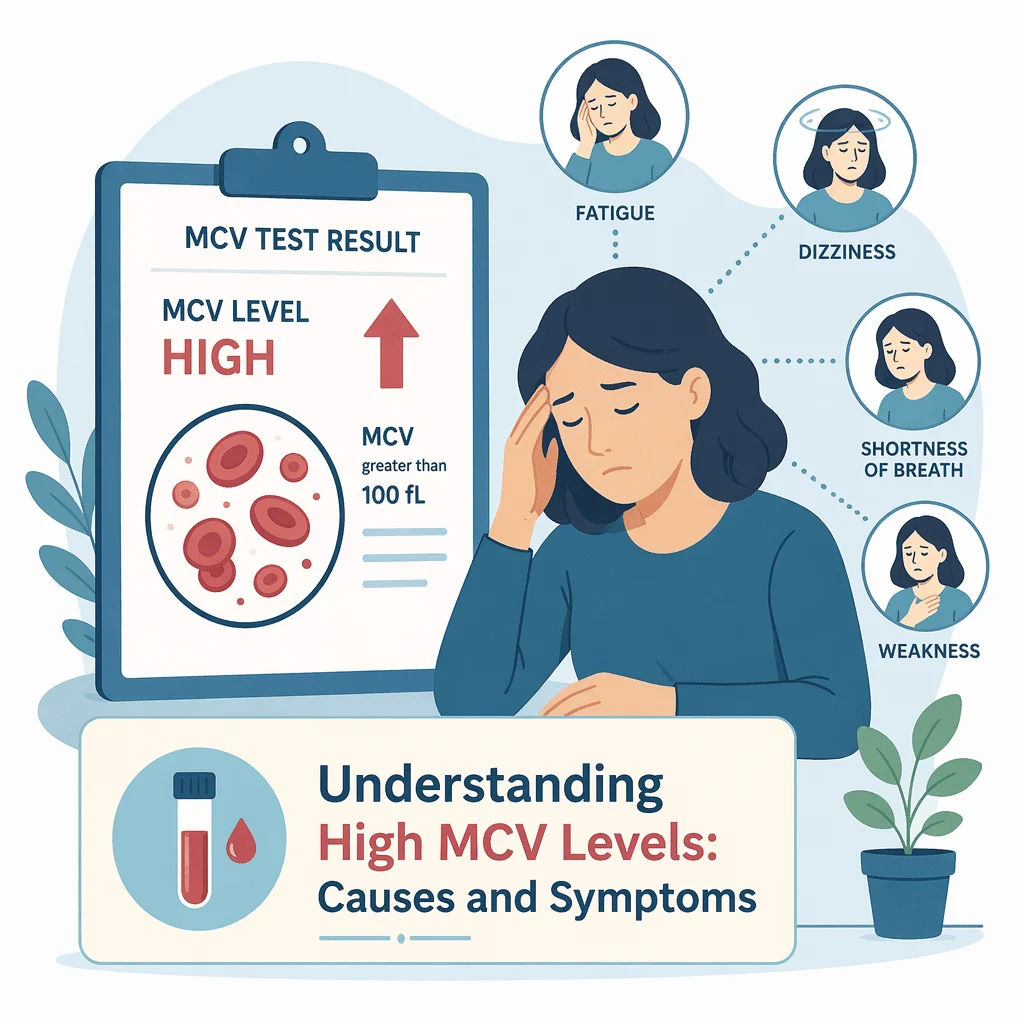
Seeing a high MCV flagged on your blood test results can be unsettling, especially when the report gives you a number and nothing else. In most people, a mildly raised MCV turns out to have a common, reversible explanation, and the number on its own is not a diagnosis. It is a clue that tells your doctor which questions to ask next.
In this article you’ll learn what MCV actually measures, why it is an average and what that average can hide, the honest list of causes in order of how often they occur, the situations that do deserve a proper look, and exactly what a doctor tends to check next.
What MCV measures, and why it is only an average
MCV stands for mean corpuscular volume. It is the average size of your red blood cells, reported in femtoliters (fL), and it comes as standard with a complete blood count. Most laboratories treat roughly 80 to 100 fL as the usual adult range, though the exact figures printed on your report belong to the machine that ran your sample.
When the average sits above about 100 fL, laboratories describe it as macrocytosis: red cells that are larger than expected. When it sits below the range, that is microcytosis. Neither word is a diagnosis. They are descriptions of shape and size that point toward different families of causes.
You can read more about the measurement itself in our guide to the MCV blood test, and about the opposite finding in our article on a low MCV.
Why a normal MCV does not prove that nothing is happening
Here is the part that most reports never explain. An average smooths out the extremes. If you have iron deficiency making some red cells small at the same time as a vitamin B12 or folate deficiency making others large, the two can pull the average in opposite directions and cancel each other out. The MCV comes back looking perfectly normal while two separate problems sit underneath it.
This is why the RDW matters so much. RDW stands for red cell distribution width, and it measures how much the sizes vary rather than what they average out to. A raised RDW alongside a normal or borderline MCV is a classic signal that a mixed picture may be present, and it is one reason doctors look at the blood film, which shows the cells directly.
The practical takeaway cuts both ways. A high MCV is not proof that something serious is wrong, and a normal MCV is not proof that nothing is. Both need reading in context, alongside vitamin B12, folate, iron markers such as iron saturation, and the rest of the count.
Alcohol: the most common single explanation in many populations
In a great many adult populations, alcohol is the single commonest reason for a raised MCV. Alcohol has a direct effect on developing red cells in the bone marrow, and the change in cell size can appear well before any damage shows up in liver enzymes or on a scan. A raised MCV in someone whose liver tests are entirely normal is a familiar pattern rather than a contradiction.
This is stated here as a fact of physiology, not a judgment. Intake that seems ordinary to one person may still be enough to nudge the average cell size upward, and the marker says nothing about anyone’s character. What it does do is change the workup: if your doctor knows roughly how much you drink, they can weigh that explanation properly instead of ordering a longer chain of tests to rule out possibilities that were never likely.
Being straightforward about alcohol intake in that conversation genuinely saves time, and the discussion is confidential. Because MCV responds slowly, a change in intake takes weeks to months to show up on a repeat count, since the cells already in circulation have to be replaced first.
Vitamin B12 and folate deficiency
Vitamin B12 and folate are both needed to build DNA inside developing red cells. When either runs short, the cell’s nucleus matures more slowly than its contents, and the cell is released larger than it should be. Laboratories call this a megaloblastic picture, and it is one of the classic causes of a high MCV.
The reasons for a shortfall vary. B12 absorption is a two-step process in the stomach and small intestine, so pernicious anemia, atrophic gastritis, celiac disease, Crohn’s disease, previous stomach or bowel surgery and long-term acid-reducing medicines can all interfere with it. A diet with little or no animal food is another route. Folate can fall with poor intake, in pregnancy, with certain medicines, or where absorption is impaired.
Testing usually means measuring both together, because the treatment differs. Our pages on the vitamin B12 blood test and the folate blood test explain what those results look like, and a high B12 result has its own separate set of explanations.
Why not to start B12 or folate on your own
This is the single most important safety point on this page, and it is a well-established one.
Folate on its own can partly correct the blood picture caused by a B12 deficiency. The red cells shrink back toward normal size, the MCV falls, the count starts to look reassuring, and the anemia improves. But folate does nothing for the nerve damage that a B12 deficiency causes. The neurological problems, such as numbness, pins and needles, unsteadiness on the feet and changes in memory, can carry on progressing quietly while the blood test that would have raised the alarm has been smoothed over.
That is the reason not to self-supplement. It is not that vitamins are dangerous. It is that taking them before the cause has been identified can remove the very signal your doctor needs, and can delay treatment for a problem where timing matters. Get the levels measured first, then let a clinician decide what, if anything, to take and in what form. Nerve symptoms in particular are treated as a reason to act quickly rather than to wait and see.
Medicines that raise MCV
A number of widely used medicines raise MCV, usually by interfering with DNA synthesis in the marrow or with B12 handling. Common examples include methotrexate, hydroxyurea, azathioprine, several anticonvulsants, some antiretroviral drugs used in HIV treatment, and many chemotherapy agents. Metformin works differently, by reducing vitamin B12 absorption over time, which is why B12 levels are often checked in people on long-term metformin.
In these situations a raised MCV is frequently an expected, monitored effect rather than a warning sign, and the medicine is doing its job.
Never stop or change a prescribed medicine because of an MCV result. That decision belongs to the prescriber, who can weigh the reason you are taking it against the change in the blood count and decide whether anything needs adjusting, whether a nutrient level needs checking, or whether the result simply needs watching. Bringing a full list of everything you take, including supplements and over-the-counter products, to the appointment is genuinely useful.
Thyroid and liver causes
An underactive thyroid slows metabolism throughout the body, and red cell production is no exception. Hypothyroidism is a recognized and easily tested cause of a mildly raised MCV, which is why a TSH test usually appears early in the workup. Treating the thyroid problem generally settles the MCV over the following months.
Liver disease raises MCV through a different mechanism. Changes in the fats that make up the red cell membrane cause the cells to take on extra surface area and read as larger on the analyzer. This can happen with liver disease of any cause, not only alcohol-related liver disease, so liver function tests sit alongside the thyroid check in most standard workups.
When a high MCV is actually a good sign
Not every raised MCV reflects a problem with production. Sometimes it reflects production working hard.
Young red cells, called reticulocytes, are larger than mature ones. When the marrow ramps up output after bleeding, after treatment for an iron or vitamin deficiency has started working, or in response to hemolysis, where red cells are being broken down faster than usual, the bloodstream fills with these bigger young cells and the average size rises. A high MCV in this setting means the marrow is responding well.
That is why a reticulocyte count is such a useful early test. It separates a marrow that is producing enthusiastically from one that is producing poorly, and those two situations lead in completely different directions. Pregnancy can also nudge MCV upward, partly through changes in blood volume and folate demand.
When a high MCV points toward the bone marrow
This section needs stating plainly and without drama, because it is the reason doctors do not simply ignore a persistent macrocytosis.
Myelodysplastic syndrome, sometimes abbreviated MDS, is a group of conditions in which the bone marrow produces blood cells that do not mature properly. It is uncommon, it is largely a condition of older adults, and a raised MCV is sometimes the first abnormality noticed on an otherwise routine blood test. Other marrow disorders can behave similarly.
The features that make a doctor look harder are specific rather than general. A macrocytosis that persists over months with no explanation found. A raised MCV in an older adult. And, most importantly, a raised MCV alongside changes in the other cell lines: a falling platelet count, a low white cell count, or an unexplained anemia developing at the same time. One abnormal index in isolation is a much weaker signal than several moving together.
Set against that, most people with a raised MCV have one of the ordinary causes described above, and finding it usually takes a handful of straightforward blood tests. The workup exists to identify the common explanation efficiently, and to notice the uncommon one if the common explanations do not fit.
What your doctor does next
The sequence is fairly standard and mostly involves blood you have already given or one further sample.
First, repeat the count. Single abnormal values happen, and sample handling can shift red cell indices. A result that normalizes on repeat needs nothing further.
Then look at the shape of the count as a whole: the RDW, the hemoglobin, the white cells and the platelets. A blood film, where a scientist examines the cells under a microscope, adds information no analyzer can: hypersegmented neutrophils suggest a B12 or folate problem, target cells point toward liver disease, and dysplastic changes point elsewhere.
Then the targeted tests: vitamin B12 and folate, TSH, liver function tests and a reticulocyte count. Alongside these, an honest medication list and an honest account of alcohol intake. Together these five or six pieces of information explain the large majority of raised MCV results. Only when they come back unremarkable, and the macrocytosis persists, would a doctor consider referral to a hematologist for further assessment.
| Pattern on your results | What it usually points to | Typical next step |
|---|---|---|
| Mildly high MCV with a clear explanation already known (alcohol, a listed medicine, treated thyroid disease) | The known cause, most often | Repeat the count later; no separate hunt needed unless it changes |
| High MCV with a low vitamin B12 or low folate | A megaloblastic picture from deficiency | Find why absorption or intake is short, and treat under medical supervision |
| High MCV with normal B12 and folate | Alcohol, liver, thyroid, medicines or a marrow response | TSH, liver function tests, reticulocyte count, medication and alcohol review |
| High MCV with low platelets or low white cells | More than one cell line affected, so the marrow itself is in question | Blood film and prompt medical assessment, often with hematology input |
| High MCV shortly after bleeding, surgery or starting treatment for anemia | Reticulocytosis: young, larger cells replacing losses | Reticulocyte count to confirm, then recheck once recovery settles |
This table describes common associations only. It cannot tell you which line applies to you, and it is not a substitute for a clinician reading your full results.
Red flags: when to get medical advice sooner
Contact a doctor promptly, rather than waiting for a routine appointment, if a raised MCV comes with any of the following.
- Breathlessness at rest or on mild effort, chest pain, palpitations or fainting, which can accompany significant anemia.
- Numbness, pins and needles, unsteadiness when walking, or a change in memory or concentration, which can reflect nerve involvement from vitamin B12 deficiency.
- Unexplained bruising, bleeding gums or nosebleeds, or repeated or unusually severe infections, which suggest other blood cell lines may be affected.
- A macrocytosis that persists across repeated tests with no cause identified, particularly in an older adult.
Chest pain, severe breathlessness or fainting should be treated as an emergency.
Latest scientific advances in understanding high MCV
Recent research has sharpened, and in places softened, how a raised MCV is interpreted. According to studies indexed in PubMed, the following are among the most useful findings for patients.
A 2025 study in the British Journal of Haematology sequenced everyone aged 60 and over with an MCV above 100 fL in a large Dutch population cohort, looking for clonal hematopoiesis, the early genetic changes in blood-forming cells that can precede marrow disease. What was found: macrocytosis on its own was not associated with clonal hematopoiesis or with other abnormalities in the blood count. A high RDW was. What this means for you: an isolated raised MCV in an older adult, with the rest of the count normal, is considerably less worrying than it is sometimes made to sound, and the pattern of the whole count matters more than any single index.
A 2026 analysis of more than 380,000 adults in the Stockholm Early Detection of Cancer Study looked at what happens after a newly developed anemia. What was found: new anemia was linked to a raised short-term risk of a cancer diagnosis and of death from any cause, with microcytic anemia most strongly linked to cancer, while macrocytic anemia was more strongly associated with other systemic illness and warranted broader assessment. What this means for you: the finding concerns new anemia rather than a raised MCV alone, and it explains why a doctor treats a falling hemoglobin as something to investigate rather than monitor indefinitely.
A 2026 cohort study from a Mexican referral center reviewed 270 adults with confirmed vitamin B12 deficiency. What was found: pernicious anemia was the commonest cause, and patients whose deficiency had other causes had a median MCV within the normal range. What this means for you: a normal MCV does not rule out B12 deficiency, so if you have symptoms that fit, ask for the level to be measured rather than assuming a normal cell size settles the question.
A 2025 review in Minerva Gastroenterology assessed the laboratory markers used to detect heavy alcohol use. What was found: MCV rises in a dose-dependent way with alcohol intake, but no single laboratory marker is reliable on its own, and the best approach combines several markers with clinical history. What this means for you: an MCV result cannot prove or disprove anything about drinking, which is precisely why a candid conversation with your doctor is more informative than the number.
A Swedish general-population study of 537,230 adults, published in Clinical Gastroenterology and Hepatology, tracked which routine blood markers predicted later alcohol-related liver cirrhosis. What was found: MCV was among the strongest predictors over five years, alongside AST and gamma-glutamyl transferase, but the positive predictive value was low, so most people with a raised value did not develop cirrhosis. What this means for you: a high MCV is worth explaining, and it is not a forecast.
Glossary of key terms
| Term | Definition |
|---|---|
| MCV (mean corpuscular volume) | The average size of your red blood cells, reported in femtoliters (fL) as part of a full blood count. |
| Macrocytosis | The laboratory term for red blood cells that are larger than expected, usually an MCV above about 100 fL. |
| RDW (red cell distribution width) | A measure of how much your red blood cells vary in size, rather than what their sizes average out to. |
| Megaloblastic | A pattern in which cells grow larger because DNA production is slowed, classically by low vitamin B12 or folate. |
| Reticulocyte | A young red blood cell, larger than a mature one; a high count means the marrow is producing actively. |
| Hemolysis | The breakdown of red blood cells faster than usual, which prompts the marrow to release more young cells. |
| Blood film | A drop of blood examined under a microscope so the shape and appearance of individual cells can be assessed. |
| Pernicious anemia | An autoimmune condition that blocks vitamin B12 absorption by stopping the stomach making intrinsic factor. |
| Myelodysplastic syndrome | An uncommon group of bone marrow conditions, mainly in older adults, in which blood cells do not mature normally. |
| Cell line | One of the three families of blood cells: red cells, white cells and platelets. |
Frequently asked questions
Is a high MCV serious?
Usually not on its own. A mildly raised MCV is a common finding, and in most people it traces back to something ordinary and reversible, such as alcohol intake, a medicine, a thyroid or liver issue, or a vitamin shortfall. What changes the picture is persistence and company: a macrocytosis that stays raised across repeated tests with no cause found, or one that appears alongside a low platelet count, a low white cell count or a new anemia, deserves a proper assessment. Your doctor is looking at the whole count and your history, not at one number.
Should I take vitamin B12 if my MCV is high?
Not on your own. There is a specific reason for this. Folate taken by itself can improve the blood picture caused by a vitamin B12 deficiency, so the MCV falls and the count looks better, while the nerve damage that B12 deficiency causes carries on progressing unchecked. Supplements taken before testing can also blur the results your doctor needs to identify the cause. Ask for vitamin B12 and folate to be measured first. If a deficiency is confirmed, your clinician will decide what to take, in what form and at what dose, and will look for why it developed.
Does alcohol cause a high MCV?
Yes, and in many adult populations it is the commonest single explanation. Alcohol acts directly on developing red cells in the bone marrow, and this can raise the MCV before any liver damage appears in blood tests or on imaging. The relationship is dose-related, but the marker is not precise enough to estimate anyone’s intake from a number, and a raised MCV on its own proves nothing about drinking. Telling your doctor honestly how much you drink is the fastest way to get the result interpreted correctly and to avoid a longer chain of unnecessary tests.
What MCV level counts as too high?
Most laboratories flag results above roughly 100 fL, but the exact cut-off printed on your report belongs to that laboratory and its analyzer, and normal ranges differ slightly between them. Clinicians pay more attention to how far above the range a value sits and whether it is stable, rising or falling than to any single threshold. A value a few points above the range with everything else normal is interpreted very differently from a markedly raised value alongside changes in other cell counts.
How long does a high MCV take to come down?
Slowly, because red blood cells live around three to four months and the cells already circulating have to be replaced before the average shifts. Whether the cause is a vitamin deficiency being treated, a change in alcohol intake, or thyroid treatment taking effect, expect the MCV to move over weeks to months rather than days. This is why doctors usually schedule a repeat count some months later rather than rechecking straight away, and why an unchanged result at two weeks means very little.
Can I have a high MCV without being anemic?
Yes, and it is common. MCV describes the size of your red blood cells, while anemia describes having too few of them or too little hemoglobin. The two are measured separately and can move independently. A raised MCV with a normal hemoglobin is often an early or mild version of the same underlying causes, and it is still worth explaining, because identifying a vitamin shortfall or a thyroid problem at that stage is easier than waiting until anemia develops.
Sources
- MCV (Mean Corpuscular Volume) — MedlinePlus, U.S. National Library of Medicine
- Anemia — National Heart, Lung, and Blood Institute (NHLBI), National Institutes of Health
- Vitamin B12 Fact Sheet for Consumers — NIH Office of Dietary Supplements
- Myelodysplastic Syndromes Treatment (PDQ) — National Cancer Institute
- Salzbrunn JB, van Zeventer IA, de Graaf AO, et al. Clonal haematopoiesis associates with distinct cytometric changes of red blood cells and platelets. British Journal of Haematology, 2025. Identified via PubMed. https://doi.org/10.1111/bjh.70031
- Nemlander E, Abedi E, Hasselström J, Ljungman P, Rosenblad A, Carlsson AC. Incident anaemia as a marker of cancer and all-cause mortality: evidence from 380 114 adults in the population-based Stockholm Early Detection of Cancer Study (STEADY-CAN) cohort. BMJ Oncology, 2026. Identified via PubMed. https://doi.org/10.1136/bmjonc-2025-001038
- Moreno-Mirón JM, Tavira-Carbajal DL, Sánchez-Martínez D, et al. Pernicious anemia predominates among Mexican adults with vitamin B12 deficiency: clinical and laboratory findings from a tertiary referral center. Revista de Investigación Clínica, 2026. Identified via PubMed. https://doi.org/10.1016/j.ric.2026.100041
- Caputo F, Casabianca A, Lungaro L, et al. Available markers of excessive alcohol use. Minerva Gastroenterology, 2025. Identified via PubMed. https://doi.org/10.23736/S2724-5985.25.03884-7
- Jakobsson G, Talbäck M, Hammar N, Shang Y, Hagström H. Biomarkers for Prediction of Alcohol-Related Liver Cirrhosis: A General Population-Based Swedish Study of 537,250 Individuals. Clinical Gastroenterology and Hepatology, 2025. Identified via PubMed. https://doi.org/10.1016/j.cgh.2024.07.009
Further reading
- MCV blood test explained
- RDW blood test: what red cell size variation means
- Low MCV: causes, symptoms and treatments
- Reticulocytes: the complete guide to your blood test
- Anemia: symptoms, causes and tests
A high MCV rarely makes sense on its own. It reads very differently depending on your hemoglobin, your RDW, your platelet and white cell counts, and on whether vitamin B12 and folate have been measured alongside it. AI DiagMe reads your full blood count as a whole and explains in plain language what each value means and which questions are worth raising. It helps you understand your results; it does not diagnose anything and it does not replace your doctor.
Understand your lab results with AI DiagMe
Get your results interpreted in minutes