








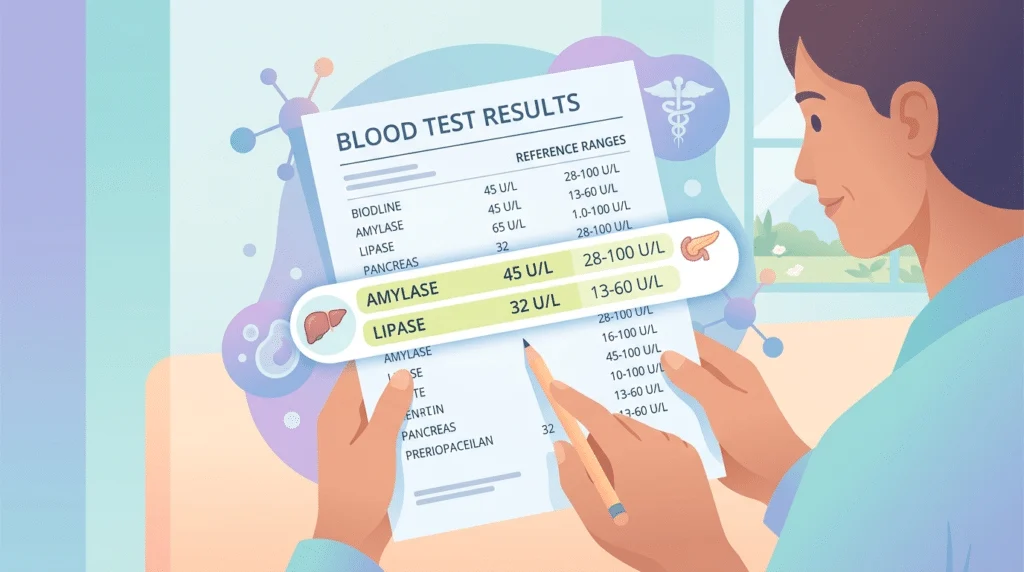
Amylase and lipase are two of the digestive enzymes your pancreas makes, and they are also the two values most likely to puzzle you on a blood test report. If a result came back marked “high” or “low,” it helps to know what these enzymes do, why a doctor checks them, and what changes in their levels can — and cannot — tell you. This article explains both enzymes in plain language: what they break down, the normal ranges you might see, what raised or lowered results may point to, and the warning signs that mean you should seek care quickly. The goal is to help you read your own report with more confidence before you discuss it with a health professional.
What are amylase and lipase?
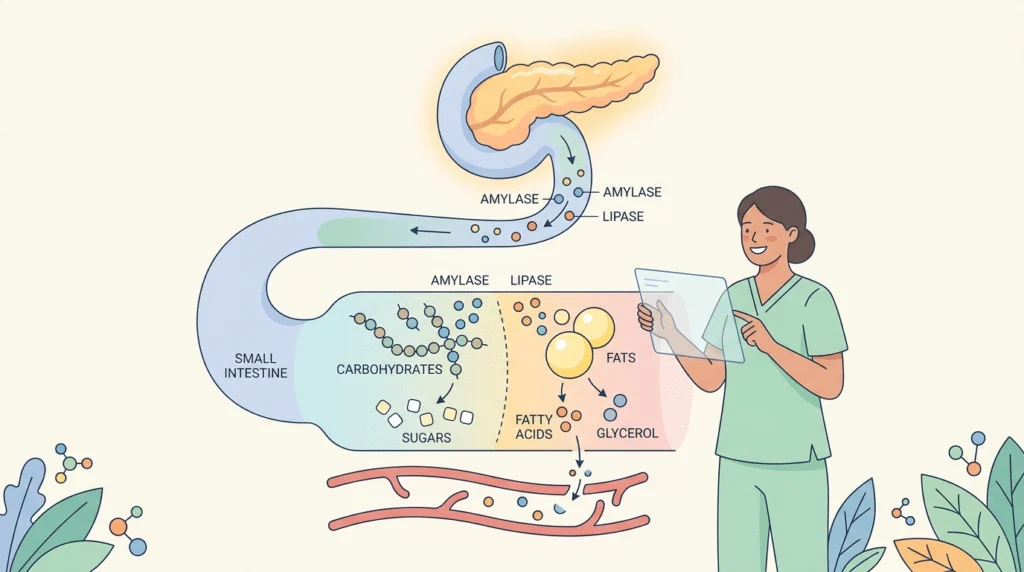
A digestive enzyme is a protein that speeds up the breakdown of food into smaller pieces your body can absorb. Your pancreas, a gland tucked behind the stomach, is the main factory for these enzymes. It releases them into the small intestine, where they help turn a meal into usable nutrients.
The pancreas has two jobs. Its exocrine side makes digestive enzymes such as amylase and lipase. Its endocrine side makes hormones, including the insulin measured in an insulin blood test. When people talk about “pancreatic enzymes,” they usually mean the exocrine ones described below.
In a healthy body, these enzymes do their work inside the digestive tract, so only small amounts circulate in the blood. When the pancreas is inflamed or injured, its cells leak more enzyme than usual into the bloodstream. That leak is what a blood test detects. It explains why doctors look for a clear rise in amylase and lipase rather than their mere presence, and why the size of that rise carries meaning.
What amylase does
Amylase breaks down carbohydrates and starches into simple sugars your gut can absorb. Most of your amylase comes from the pancreas, but your salivary glands also produce a share of it. That second source matters: a sore throat, mumps, or a salivary gland problem can raise amylase without the pancreas being involved at all.
What lipase does
Lipase breaks down fats into fatty acids. Unlike amylase, lipase comes almost entirely from the pancreas, which makes it a more focused signal of how the pancreas itself is doing. The pancreas also makes proteases, such as trypsin, that digest protein — but amylase and lipase are the two enzymes a lab usually measures in blood.
Why your doctor measures amylase and lipase
These tests are not part of a routine check-up. A doctor usually orders amylase and lipase to investigate abdominal pain, especially when the symptoms could point to the pancreas. They are the standard blood markers used to confirm or rule out pancreatitis — inflammation of the pancreas.
Doctors do not rely on the enzymes alone. Acute pancreatitis is generally diagnosed when at least two of three things are present: typical upper-abdominal pain, blood enzymes raised to about three times the upper limit of normal, and changes seen on a scan. The test itself is a simple blood draw from a vein in the arm and takes only a few minutes, with results often available within a day. For someone with a known long-term pancreatic condition, the same enzymes may be repeated over time to help track how things are changing.
The enzymes are not listed on a basic comprehensive metabolic panel; they are added when a doctor specifically suspects a pancreatic cause. Other tests are often run at the same time to build a fuller picture — for example, a kidney function panel, because kidney problems can also change these enzyme levels, or liver function tests, because gallstones that block the pancreas can affect the liver too. If you want a general primer first, our guide on how to read blood test results explains reference ranges and the “H” and “L” flags.
Normal ranges for amylase and lipase
Reference ranges differ from one laboratory to another, depending on the equipment and method used. The figures below are typical for adults, but the only range that applies to you is the one printed beside your own result.
| Test | Typical adult reference range* |
|---|---|
| Amylase | about 30–110 U/L |
| Lipase | about 0–160 U/L |
*Approximate values only. Ranges vary by lab, age, and sometimes sex. Always read your result against your own report.
The enzymes are usually reported in units per litre (U/L), a measure of enzyme activity rather than weight. Because each laboratory may use a slightly different method, two reports showing different numbers can both be “normal” — what counts is where your value sits within that lab’s own range. Amylase can also be measured in urine, which sometimes stays raised a little longer than blood amylase, although blood tests are used most often.
A result inside the range is reassuring. A result outside it earns a closer look, but a single number rarely tells the whole story. Doctors generally pay attention when these enzymes rise to roughly three times the upper limit of normal, which is a stronger pointer toward pancreatitis than a mild bump just over the line.
Amylase vs lipase: which test is more useful?
If both enzymes rise in pancreatitis, why does it matter which one a doctor uses? The two behave differently in the bloodstream, and that difference has made lipase the preferred test in most modern guidelines.
| Feature | Amylase | Lipase |
|---|---|---|
| Breaks down | Carbohydrates and starches | Fats |
| Main source | Pancreas and salivary glands | Mainly the pancreas |
| Specific to the pancreas? | Less specific | More specific |
| Rises after symptoms start | Within about 6–24 hours | Within about 4–8 hours |
| Stays raised for | About 3–5 days | About 8–14 days |
| Role in diagnosing pancreatitis | Used less often on its own | Preferred first test |
Lipase is more sensitive and more specific to the pancreas, and it stays elevated longer. That wider window means a lipase test can still catch pancreatitis when someone reaches care a few days after the pain began, a point at which amylase may already be falling back toward normal. Ordering both adds little when lipase is available, though many labs still report them together out of habit.
Neither enzyme is perfect. A normal result does not completely rule out a pancreatic problem, particularly if the blood is drawn very early or very late in an episode, and a raised result does not reveal how severe the inflammation is or what caused it. This is why enzymes are only one part of the assessment, read alongside symptoms, examination, and — when needed — imaging.
What high amylase and lipase levels mean
A high result is the one that worries most people. It is worth separating two situations: when the pancreas is the likely cause, and when it is not. One point applies to both: how high the enzymes climb does not reliably match how severe an episode is — a very high number is not always more dangerous, and a moderate rise can still need treatment.
When the rise points to the pancreas
Acute pancreatitis is the classic reason for both enzymes to climb sharply, often to several times the normal limit. Common triggers include gallstones and heavy alcohol use. Very high blood fats are another recognised cause, which is why a doctor may also check for a high triglyceride level. Less commonly, a blocked pancreatic duct, a cyst, or pancreatic cancer can raise the enzymes; in that setting a doctor might add a tumour marker such as CA 19-9. To judge how active the inflammation is, an inflammation marker like C-reactive protein is sometimes measured alongside.
When the rise is not about the pancreas
Raised enzymes do not automatically mean pancreatitis. Amylase can climb from salivary gland problems such as mumps, from kidney disease that slows enzyme clearance, from an intestinal blockage, or from certain medicines. Macroamylasemia is a harmless example: amylase binds to a large protein, cannot pass into the urine, and builds up in the blood, producing a high reading with no disease behind it. Lipase, too, can rise modestly outside pancreatitis — for instance with kidney disease or diabetic ketoacidosis. This is exactly why a number is read together with your symptoms, not on its own.
What low amylase levels mean
Low results draw less attention than high ones, and they are usually less urgent. A persistently low amylase or lipase can reflect long-term damage to the pancreas, so that it makes fewer enzymes than before. Chronic (long-standing) pancreatitis and cystic fibrosis are two examples. A single low reading on its own is rarely a cause for alarm, but a doctor may follow it up if you also have digestive symptoms or unexplained weight loss.
Low lipase can carry a similar meaning, since the pancreas is its main source. It also helps to separate two ideas that sound alike. A low enzyme level in the blood can reflect a pancreas that is producing less. A normal blood level but poor delivery of enzymes to the gut is a different problem — and it is the one behind the digestive symptoms in the next section. Blood tests measure the first; stool tests are better at revealing the second.
When the pancreas makes too few enzymes
Sometimes the issue is not the level of enzymes in the blood but the amount reaching the gut. When the pancreas cannot release enough digestive enzymes, food — especially fat — is poorly absorbed. Doctors call this exocrine pancreatic insufficiency (EPI), sometimes described as pancreatic enzyme deficiency.
The tell-tale sign is fatty stools (sometimes called steatorrhoea): pale, bulky, greasy bowel movements that may float and are hard to flush. Weight loss, bloating, and wind often go with it. Our guide on fatty stool covers these changes in detail.
To investigate EPI, a doctor typically uses a stool test that measures fecal elastase rather than a blood enzyme. When the pancreas is confirmed to be under-producing, treatment is usually pancreatic enzyme replacement therapy (PERT) — capsules taken with meals that supply lipase, amylase, and protease to do the work the pancreas cannot. EPI is linked to conditions such as chronic pancreatitis, cystic fibrosis, and pancreatic cancer, so the underlying cause is treated alongside it. Because its symptoms can be mistaken for ordinary indigestion, EPI is sometimes overlooked for a while; greasy, floating stools that do not match a recent fatty meal are a useful clue to mention to a doctor.
What to expect after an abnormal amylase or lipase result
An out-of-range enzyme result is a starting point, not a diagnosis. What happens next depends on how high the value is and how you feel. A small, isolated rise in someone who feels well is often simply repeated after a short interval to see whether it settles. A large rise, or one paired with significant pain, usually prompts further steps the same day.
Imaging is common, because the enzymes cannot show why the pancreas is upset. An abdominal ultrasound looks for gallstones, a frequent trigger, while a CT scan can show the pancreas in more detail when needed. Blood work is often broadened too — checking the kidneys, liver, and blood fats — to find a cause and to gauge how serious the situation is. The aim is to fit your enzyme numbers into the wider picture of your symptoms and history. Throughout, the person best placed to interpret that combination is your doctor, who can decide which of these steps actually applies to you.
When to see a doctor: warning signs
Most amylase and lipase results are checked precisely because someone already has symptoms. Knowing which symptoms are urgent helps you act in time. Seek medical care promptly — or go to an emergency department — if you have:
- Severe, constant pain in the upper abdomen, often spreading through to the back
- Pain that comes on suddenly and does not ease
- Persistent vomiting or being unable to keep fluids down
- Fever together with abdominal pain
- A swollen, tender belly
- Yellowing of the skin or eyes alongside abdominal pain
Acute pancreatitis can range from mild to serious, so sudden severe abdominal pain is not something to wait out at home. If your symptoms are milder but ongoing — such as recurring discomfort after fatty meals, loose greasy stools, or gradual weight loss — book a non-urgent appointment so a doctor can decide which tests, including amylase and lipase, are appropriate. Whatever the numbers show, the final interpretation belongs with a clinician who can weigh your full history.
Glossary
- Amylase: A digestive enzyme that breaks down carbohydrates and starches into simple sugars. It is made by the pancreas and the salivary glands.
- Digestive enzyme: A protein that speeds up the breakdown of food into smaller parts the body can absorb.
- Exocrine pancreatic insufficiency (EPI): A condition in which the pancreas does not release enough digestive enzymes, leading to poor absorption of food, especially fat.
- Fecal elastase test: A stool test that measures an enzyme called elastase to check how well the pancreas is producing digestive enzymes.
- Lipase: A digestive enzyme that breaks down fats into fatty acids. It comes almost entirely from the pancreas.
- Macroamylasemia: A harmless condition in which amylase is bound to a large protein and builds up in the blood, causing a high reading without pancreatic disease.
- Pancreatitis: Inflammation of the pancreas, which can be sudden (acute) or long-standing (chronic).
- Pancreatic enzyme replacement therapy (PERT): Capsules taken with meals that supply lipase, amylase, and protease when the pancreas cannot make enough.
- Reference range: The set of values a lab considers normal for a test, used to flag results as high or low.
- Trypsin: A pancreatic enzyme (a protease) that breaks down protein during digestion.
Frequently asked questions
Do I need to fast before an amylase and lipase blood test?
Sometimes. Many labs ask you to avoid food for several hours and to skip alcohol for about a day beforehand, because both can affect the results. Some medicines can also change enzyme levels, so it helps to share your full medication list. Always follow the specific instructions your doctor or laboratory gives you, since requirements vary. If you were not told to fast, the test can usually be done without special preparation, but checking ahead avoids a repeat visit.
Is a slightly raised amylase or lipase always serious?
Not necessarily. A mild bump just above the reference range is far less concerning than a level several times higher, which points more strongly toward pancreatitis. Small elevations can come from kidney problems, certain medicines, salivary gland issues, or harmless conditions such as macroamylasemia. A doctor reads the number together with your symptoms and other tests rather than reacting to one figure alone. If you feel well and the rise is small, it may simply need a repeat check rather than urgent action.
Why might my amylase be high while my lipase is normal?
This pattern is fairly common and often points away from the pancreas. Because the salivary glands also make amylase, problems there — or harmless macroamylasemia — can lift amylase while leaving lipase, which comes mainly from the pancreas, untouched. Since lipase is the more pancreas-specific marker, a normal lipase alongside a raised amylase makes a pancreatic cause less likely. Your doctor will look at the whole picture, including your symptoms, before deciding whether the result needs any follow-up.
Can pancreatitis affect my liver enzymes too?
It can. Gallstones are a frequent trigger of pancreatitis, and a stone that blocks the shared duct draining the pancreas and the liver can push liver values up at the same time. That is one reason a doctor often checks liver function tests alongside amylase and lipase when investigating upper abdominal pain. Raised liver enzymes do not confirm pancreatitis on their own, but the combination helps a clinician trace the cause and decide whether imaging, such as an ultrasound, is needed.
How long do pancreatic enzyme supplements take to work?
Pancreatic enzyme replacement therapy usually starts helping within days, as digestion of fat improves and symptoms such as greasy stools, bloating, and weight loss begin to settle. The capsules are taken with meals and snacks so the enzymes mix with food. Getting the dose and timing right can take some adjustment with your doctor or a dietitian. If symptoms do not improve, the dose may need changing, or another cause may need looking into. These supplements treat the digestion problem, not the underlying condition.
Can I increase my pancreatic enzymes naturally?
If your pancreas is healthy, it already makes the enzymes you need, and no food or supplement is required to boost them. When the pancreas is genuinely under-producing, over-the-counter products are not a reliable substitute for prescribed enzyme therapy, because the dose and quality are not matched to medical need. A balanced diet and limiting alcohol support pancreatic health in general, but persistent symptoms such as fatty stools or weight loss should be assessed by a doctor rather than self-treated.
Sources
- Pancreas Blood Tests: Types, Prep, Procedure & Results — Cleveland Clinic
- Amylase Test — MedlinePlus (U.S. National Library of Medicine)
- Symptoms & Causes of Pancreatitis — NIDDK (National Institutes of Health)
Further reading
- Understanding lipase levels: causes and risks
- Liver function tests: how to read results
- Fatty stool: causes, symptoms and treatment guide
- Read blood test results: a simple guide
- Comprehensive metabolic panel: how to read it
Understand your lab results with AI DiagMe
Seeing “amylase” or “lipase” flagged on a report — alongside tests like a liver panel (liver function tests) or a complete blood count — can be confusing without context. AI DiagMe reads your lab results and explains each value in plain language, including what a high or low pancreatic enzyme might point to and which questions to raise with your doctor. It is built to help you understand your results, not to diagnose or replace medical advice. Upload your blood, urine, or stool report to get a clear, personalized explanation.
➡️ Get your results interpreted in minutes