





































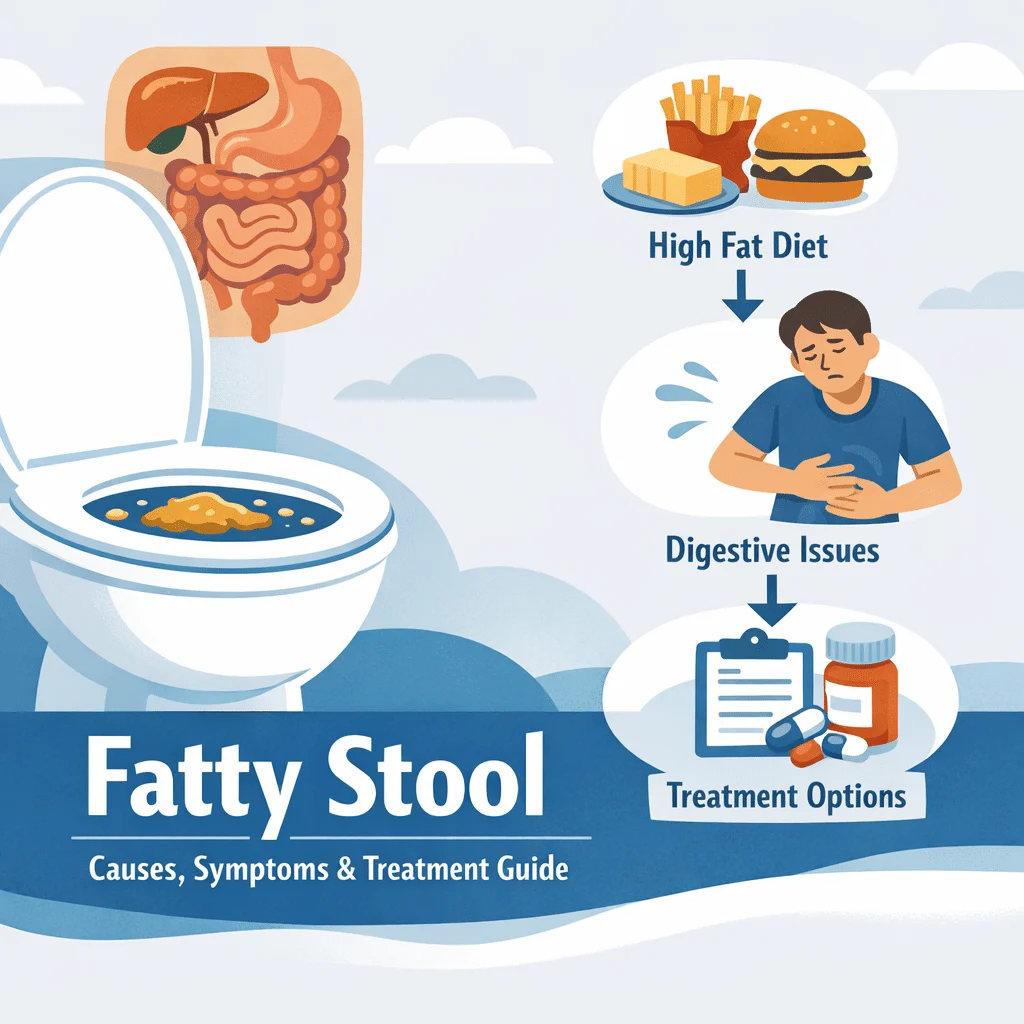
Fatty stool is stool that carries more fat than the gut managed to absorb, and it announces itself long before any blood test does: pale, bulky, greasy, hard to flush and unusually foul-smelling. The medical name for it is steatorrhea. It matters because fat is not the only thing lost: the vitamins that travel with it go too, which is how a symptom that sounds cosmetic becomes a nutritional problem. In this article you will learn what fatty stool actually looks like, how fat digestion works, the three points where that process breaks down, the tests that identify which point failed, and the principles behind treatment.
What fatty stool actually looks like
Few people arrive at a consultation saying “I have steatorrhea.” They describe a bowel movement unlike anything they are used to, and it is the combination of features that counts.
The signs that point to fat rather than to a passing upset
- Color: pale, light tan, putty-like or frankly clay-colored rather than mid-brown.
- Volume: noticeably bulkier than usual.
- Texture: greasy, soft and sticky, coating the bowl or smearing on the paper.
- Oil: visible droplets or an oily film on the water.
- Smell: markedly more offensive than usual.
- Flushing: it clings to the porcelain and needs a second flush.
Fatty stool is also persistent. One greasy movement after a heavy restaurant meal is not steatorrhea; a pattern repeating over weeks, especially alongside weight loss, is. Our team also describes the normal and abnormal changes in stool consistency, which helps you judge whether this is a real shift or ordinary variation.
Why floating alone is not enough
Floating is the sign most people fixate on, and the least reliable of the group. Stool floats mainly because it holds gas from colonic bacteria fermenting fiber and unabsorbed carbohydrate, so healthy people float after a fiber-rich meal while people with genuine fat malabsorption often sink. Floating counts only alongside pale color, greasiness, bulk, oil droplets and a changed smell.
How your body digests fat, step by step
Fat arrives in the small intestine as large droplets the body cannot absorb. Three systems have to work in sequence to change that.
Bile salts made by the liver and concentrated in the gallbladder act as detergents, breaking the droplets into a fine emulsion and multiplying the surface area enzymes can reach. The pancreas then releases lipase, the enzyme that cuts triglycerides into free fatty acids and monoglycerides, with a helper protein called colipase anchoring it to the droplet.
Finally, the lining of the small intestine — a vast carpet of finger-like villi — takes up those products and passes them into the lymphatic circulation.
Fat-soluble vitamins A, D, E and K ride along with dietary fat at every one of these steps. When fat absorption fails, those vitamins fail with it. That is why fatty stool is never only a stool problem.
The three points where fat digestion fails
Almost every cause of fatty stool traces back to one of three failure points: not enough pancreatic enzyme, not enough bile, or an intestinal lining that cannot do its job. Sorting a case into one of these boxes turns a vague symptom into a testable question.
| Where fat digestion fails | Conditions behind it | Clues that come with it | The test that usually settles it |
|---|---|---|---|
| Not enough pancreatic enzyme — too little lipase and colipase reach the food | Chronic pancreatitis, cystic fibrosis, pancreatic cancer, surgery that removed part of the pancreas | Bulky greasy stools, upper abdominal pain boring through to the back, weight loss despite a normal appetite, new or worsening diabetes | Fecal elastase-1 on a single stool sample, supported by imaging of the pancreas |
| Not enough bile — fat is never emulsified, so enzymes cannot reach it | A gallstone or tumor blocking the bile duct, cholestatic liver disease, bile acid loss after disease or surgery of the last part of the small intestine | Pale clay-colored stools with dark urine, yellowing of the skin or eyes, itching, discomfort under the right ribs | Liver and bile panel including direct bilirubin and alkaline phosphatase, plus ultrasound or MRI of the bile ducts |
| A damaged or overwhelmed intestinal lining — fat is split but never absorbed | Celiac disease, Crohn’s disease of the small bowel, bacterial overgrowth, short bowel after resection, some bariatric surgery, persistent giardiasis | Bloating and gas out of proportion to meals, iron or vitamin B12 deficiency, mouth ulcers, symptoms easing when specific foods are removed | tTG-IgA celiac serology with total IgA, breath testing for bacterial overgrowth, upper endoscopy with small bowel biopsies |
The boxes overlap — chronic pancreatitis can coexist with bacterial overgrowth, and celiac disease can blunt the signal telling the pancreas to secrete. But this is how most clinicians think: your history decides which test you are offered.
The conditions behind each failure point
When the pancreas cannot supply enough enzyme
Exocrine pancreatic insufficiency — the pancreas no longer making enough digestive enzyme for a normal meal — is the most common reason for genuinely fatty stool.
Chronic pancreatitis, usually after years of heavy alcohol use or repeated acute attacks, scars the enzyme-producing tissue; our team details the symptoms and causes of pancreatitis, including the pain that often precedes the digestive problem by years. Cystic fibrosis thickens pancreatic secretions from infancy, so most affected children have insufficiency early, and surgery removing part of the pancreas leaves less tissue to do the work. Pancreatic cancer can obstruct the duct carrying enzymes into the intestine, and fatty stool is occasionally among its first signals; a dedicated article describes the diagnosis and treatment of pancreatic cancer.
Blood enzyme levels are a poor guide here: a lipase result reflects pancreatic inflammation, not pancreatic output, so a normal value does not rule out insufficiency. We explain what raises and lowers blood lipase levels.
When bile is missing or blocked
Mechanical obstruction — a stone in the common bile duct, a tumor of the pancreatic head, a stricture — gives the most recognizable version: pale stools, dark urine, jaundice and itching together. Cholestatic liver disease blocks flow inside the liver itself, and when the last part of the small intestine is diseased or removed, bile acids are lost into the colon faster than the liver replaces them. These situations surface in the liver and bile panel first, and another article explains how to read a direct bilirubin test, the marker that points to a blockage rather than a liver-cell problem.
When the intestinal lining is the problem
Celiac disease flattens the villi in response to gluten, shrinking the absorptive surface until fat, iron and vitamins all suffer. We explain gluten intolerance and celiac disease in detail, including why testing must happen before gluten is removed from the diet.
Small intestinal bacterial overgrowth places too many bacteria too high in the gut, where they interfere with bile salts. Crohn’s disease of the small bowel damages the lining directly and may involve the bile-acid-absorbing segment. Short bowel syndrome leaves too little intestine after extensive resection, and some bariatric procedures deliberately bypass absorptive length, so mild fat malabsorption there is expected. Persistent giardiasis is a classic and easily missed cause after travel; our team covers the ova and parasites stool test used to look for it.
Medications and other contributors
Orlistat, a weight-loss drug, blocks pancreatic lipase, so oily stool is its expected pharmacological effect rather than a sign of disease. Fat substitutes, high doses of mineral oil and some lipid-lowering agents loosen stools similarly. A medication review belongs before any extensive workup.
The tests that identify the cause
Testing has two jobs: confirm that fat is genuinely being lost, then work out which failure point is responsible.
Fecal elastase-1
This measures an enzyme made only by the pancreas that survives the journey through the gut largely intact. A single random stool sample is enough and no special diet is needed. A low result points toward exocrine pancreatic insufficiency, which makes it the practical first step in most workups.
Fecal fat: the 72-hour collection and the Sudan stain
The reference method asks you to eat a defined amount of fat daily while every stool is collected over three days; the laboratory then measures how much fat came out. It is the most direct evidence of malabsorption there is, and the most demanding, so it is now reserved for uncertain cases. A quicker alternative treats a single sample with a dye that binds fat and looks for globules under the microscope — a useful screen that does not quantify the loss.
Celiac serology and small bowel biopsy
Tissue transglutaminase IgA antibodies, measured alongside total IgA to avoid a false negative, are the standard blood screen for celiac disease. Our team covers the tTG-IgA test used to diagnose celiac disease, including the crucial detail that you must still be eating gluten when the sample is taken. A positive result is generally confirmed by endoscopic biopsies.
Nutritional status
Because fat-soluble vitamins are lost with fat, their levels belong in the assessment from the start. Vitamin D is measured most often, and another article explains how to read a vitamin D 25-OH blood test; vitamin A, vitamin E and prothrombin time as a proxy for vitamin K complete the picture. Vitamin B12 is absorbed in the same terminal segment that reclaims bile acids, so it is often low in mucosal and post-surgical cases; we list the symptoms and causes of low vitamin B12.
Imaging and adjacent stool tests
CT, MRI with dedicated bile duct sequences, or endoscopic ultrasound examine the pancreas and biliary tree for scarring, stones and masses. Two other stool tests answer different questions: a separate article explains the fecal calprotectin test and its result bands, which flags intestinal inflammation rather than fat loss, while another guide reviews the causes of rectal bleeding, a different alarm signal altogether.
Why weight loss, fatigue and low vitamins matter most
The stool itself is the least important part of this picture. Fat is the densest source of energy in the diet, so when a meaningful share of it leaves the body undigested, weight falls even though appetite and intake are unchanged. Fatigue follows, partly from the calorie deficit and partly from the deficiencies behind it.
Each fat-soluble vitamin carries its own consequence when it runs low: vitamin D with bone density and muscle strength, vitamin A with night vision and dry eyes, vitamin E with nerve function, vitamin K with clotting and easy bruising. Iron and B12 deficiency add anemia in mucosal disease, and low albumin can appear when protein is lost too. This is why a clinician takes fatty stool seriously even when the person reporting it feels well: the deficiencies stay silent for a long time, and then they do not.
When to see a doctor
Book an appointment if greasy, pale or oily stools persist beyond two to three weeks, particularly alongside any of the following:
- You are losing weight without trying, or clothes have become loose.
- You have upper abdominal pain radiating to the back, or pain that worsens after fatty meals.
- Your skin or the whites of your eyes have turned yellow, or your urine has darkened.
- You bruise easily, notice new night-vision difficulty, or feel persistently exhausted.
- You have known pancreatic disease, cystic fibrosis, celiac disease, or previous pancreatic or intestinal surgery.
- A child is failing to gain weight or grow as expected.
Seek urgent care for severe abdominal pain with vomiting and fever, or for jaundice appearing over a few days. These point to obstruction or acute inflammation rather than slow malabsorption.
How fatty stool is managed
Treatment follows the diagnosis rather than the symptom, which is why the testing sequence matters. What follows describes general principles; it is not a plan for any individual, and none of it should be started without medical supervision.
Where the pancreas is the problem, pancreatic enzyme replacement therapy supplies the missing lipase in capsule form, taken with meals and snacks so the enzyme arrives with the food. Dosing is individualized and reviewed against symptoms and weight rather than set once and forgotten.
Where celiac disease is confirmed, a strict lifelong gluten-free diet lets the lining recover and fat absorption improves as the villi regenerate. Where bile flow is obstructed, treatment addresses the obstruction itself rather than the stool. Bacterial overgrowth is treated with targeted antibiotic courses, and bile acid malabsorption may be managed with binding agents.
Across all of these, fat-soluble vitamin repletion runs in parallel, guided by measured levels rather than assumption, and nutritional follow-up is permanent rather than temporary.
Latest scientific advances
Research published between 2023 and 2026 has focused less on new treatments and more on getting the diagnosis right — which test to trust, when to trust it, and what happens to nutrition afterwards.
The stool enzyme test is a good screen, not a final answer
A 2025 systematic review and meta-analysis found that fecal elastase-1 is good at picking up people who really do have pancreatic enzyme insufficiency, but less reliable at ruling it out — a fair number with a low result turn out not to have the condition. The same review confirms that the three-day fat collection remains the reference standard on paper, yet is now run only occasionally. What this means for you: expect the simple stool test first, treat a low result as a reason to look further rather than a diagnosis, and expect the three-day collection only if the answer stays unclear.
After pancreatic surgery, and in cystic fibrosis, one result is not enough
A 2025 systematic review found enzyme insufficiency to be common rather than rare after major pancreatic operations, while vitamin and mineral follow-up was documented far less often than it should have been. A 2026 comparison study added a caution: after surgery, the stool enzyme test and a breath-based test of fat digestion frequently disagree, and the stool test appears to over-call the problem. A 2026 scoping review reached a related conclusion in cystic fibrosis — assess pancreatic function at diagnosis, then repeat it, because modulator therapies can change how the pancreas behaves. What this means for you: in both settings, one normal result does not settle the question, and how you are eating and holding your weight matters as much as a single laboratory number.
Fat-soluble vitamin deficiency is common enough to look for routinely
A 2023 review of adults with chronic pancreatitis found deficiency in vitamins A, D, E and K to be frequent when enzyme insufficiency is present, and frequently unrecognized. A 2024 review of fat digestion and malabsorption set out the same three-stage framework used earlier in this article — bile, enzyme, absorptive surface — as the basis for choosing which test to run, and a further 2024 review reported that fat malabsorption in pancreatic cancer is both common and under-treated. What this means for you: vitamin testing is not an optional extra here. Reviews summarize the evidence available when they were written, and individual results always have to be read alongside symptoms, history and examination.
Glossary
| Term | Definition |
|---|---|
| Steatorrhea | The medical term for stool containing an abnormal amount of fat. It is the technical name for fatty stool. |
| Malabsorption | A failure to take up nutrients from food in the digestive tract. It can affect fat, carbohydrate, protein, vitamins or minerals, alone or together. |
| Exocrine pancreatic insufficiency | A state in which the pancreas no longer produces enough digestive enzyme to break down a normal meal. Often shortened to EPI. |
| Pancreatic lipase | The enzyme made by the pancreas that splits dietary fat into absorbable pieces. It needs a helper protein called colipase to work in the intestine. |
| Bile salts | Detergent-like substances made by the liver and released into the intestine that break large fat droplets into a fine emulsion enzymes can act on. |
| Fecal elastase-1 | A pancreatic enzyme measured in a single stool sample. Low levels suggest the pancreas is not producing enough digestive enzyme. |
| Sudan stain | A laboratory dye that binds fat, allowing fat globules in a stool sample to be seen under the microscope. It screens for fat loss without measuring it. |
| Fat-soluble vitamins | Vitamins A, D, E and K, which are absorbed together with dietary fat and therefore run low when fat absorption fails. |
| Pancreatic enzyme replacement therapy | Capsules containing digestive enzymes taken with food to replace what the pancreas can no longer supply. Often shortened to PERT. |
| Cholestasis | Reduced or blocked flow of bile from the liver into the intestine, whether from a mechanical obstruction or from disease within the liver itself. |
Frequently asked questions
What does fatty stool look like?
It is usually paler than normal — light tan, putty-colored or close to clay — noticeably bulkier, greasy or sticky in texture, and considerably more foul-smelling than usual. Visible oil droplets or an oily film on the water are strong clues, as is stool that clings to the bowl and needs a second flush. The color change and the greasiness together are more telling than any single feature. Occasional variation after a very fatty meal is normal; a pattern that repeats over several weeks is what warrants attention.
Why is my fatty stool yellow?
Stool gets its usual brown color from processed bile pigments. When fat passes through undigested, it dilutes and lightens that color, and the fat itself can add a yellow or orange tint. Rapid transit contributes too: if stool moves through the colon quickly, bile pigment has less time to be converted, leaving a yellower result. Yellow greasy stool therefore tends to point toward either fat malabsorption or reduced bile delivery, which is why it is usually assessed alongside liver and bile markers rather than in isolation.
Is oily stool a sign of cancer?
Usually not. The great majority of oily stool comes from far more common causes — chronic pancreatitis, celiac disease, bacterial overgrowth, gallbladder and bile duct problems, or medication such as orlistat. That said, pancreatic cancer can obstruct the flow of digestive enzymes, and fat malabsorption is occasionally among its earlier signals. This is why persistent greasy stool combined with unexplained weight loss, jaundice or new-onset diabetes should be assessed promptly rather than watched. The purpose of the workup is to identify the common causes and exclude the serious ones.
Can stress cause oily stool?
Stress genuinely affects the gut. It speeds transit, alters motility and can make stools looser, more frequent and more urgent. What it does not do is prevent the pancreas from making lipase or the liver from making bile. So stress can plausibly produce loose, poorly formed or floating stools, but it does not by itself cause true fat malabsorption. If stools are persistently pale, greasy and bulky, and especially if weight is falling, stress is not a sufficient explanation and the pattern deserves investigation.
Which foods can cause oily stool?
Very high-fat meals, large amounts of fried food, and foods containing non-absorbable fat substitutes can all produce a temporarily greasy stool in someone with a completely normal digestive system. Large doses of fish oil or mineral oil supplements can do the same, sometimes causing oil leakage independent of a bowel movement. The distinguishing feature is timing: food-related greasiness follows an identifiable meal and settles within a day or two, whereas malabsorption persists regardless of what is eaten.
Does fatty stool always float?
No, and this is one of the most common misconceptions. Floating is driven mainly by gas content, not fat content, so healthy people frequently pass floating stools after fiber-rich meals while people with genuine fat malabsorption may pass stools that sink. Floating is only informative when it appears alongside pallor, bulk, greasiness, oil droplets and a changed smell. If floating is the only thing you have noticed, gas is the far more likely explanation.
Sources
- Fecal fat — MedlinePlus Medical Encyclopedia, U.S. National Library of Medicine — https://medlineplus.gov/ency/article/003588.htm
- Treatment for Pancreatitis — National Institute of Diabetes and Digestive and Kidney Diseases (NIDDK) — https://www.niddk.nih.gov/health-information/digestive-diseases/pancreatitis/treatment
- Azer SA, Sankararaman S — Steatorrhea — StatPearls, NCBI Bookshelf, National Library of Medicine — https://www.ncbi.nlm.nih.gov/books/NBK541055/
- de la Iglesia D et al. — Diagnostic Accuracy of Fecal Elastase-1 Test for Pancreatic Exocrine Insufficiency: A Systematic Review and Meta-Analysis — United European Gastroenterology Journal, 2025 — https://doi.org/10.1002/ueg2.70061 (indexed in PubMed)
- Di Martino M et al. — Pancreatic exocrine insufficiency after pancreatic resection: a systematic review — BMC Surgery, 2025 — https://doi.org/10.1186/s12893-025-02787-y (indexed in PubMed)
- Sankararaman S et al. — Utility of Fecal Elastase-1 in Estimating Exocrine Pancreatic Function in Cystic Fibrosis: A Scoping Review — Pediatric Pulmonology, 2026 — https://doi.org/10.1002/ppul.71649 (indexed in PubMed)
- Hartman V et al. — Comparing faecal Elastase-1 and 13C mixed triglyceride breath test in patients undergoing pancreatic surgery — HPB (Oxford), 2026 — https://doi.org/10.1016/j.hpb.2026.01.001 (indexed in PubMed)
- Omer EM et al. — Fat digestion and absorption: Normal physiology and pathophysiology of malabsorption, including diagnostic testing — Nutrition in Clinical Practice, 2024 — https://consensus.app/papers/details/f6f2b707aecb5f249693fe72497c2dc5/
- Murray G et al. — Fat malabsorption in pancreatic cancer: Pathophysiology and management — Nutrition in Clinical Practice, 2024 — https://consensus.app/papers/details/3f0f764b5ba253b8aa4a9dc5764c9b2b/
- Estes-Doetsch H et al. — Fat-soluble vitamin deficiency and exocrine pancreatic insufficiency among adults with chronic pancreatitis — Nutrition in Clinical Practice, 2023 — https://consensus.app/papers/details/d632f338a17759b9bd8e07327472fbda/
Further reading
- Crohn’s Disease: Causes, Symptoms, and Treatments
- Liver Function Tests (LFTs): How to Read Your Liver Panel
- Low Albumin: Causes, Symptoms, and Risks
- Anemia: Symptoms, Causes, Types, and How It’s Diagnosed
- Folate Deficiency Symptoms: Causes and Treatments
Understand your lab results with AI DiagMe
Fatty stool is rarely investigated with a single test. The workup usually combines a stool sample, a liver and bile panel, celiac antibodies and vitamin levels, and the answer lies in how those results fit together rather than in any one number. AI DiagMe reads your uploaded lab report and explains what each value means in plain language, so you arrive at your appointment understanding what has been measured. It helps you understand your results; it does not diagnose, and it does not replace your doctor.
Get your results interpreted in minutes