






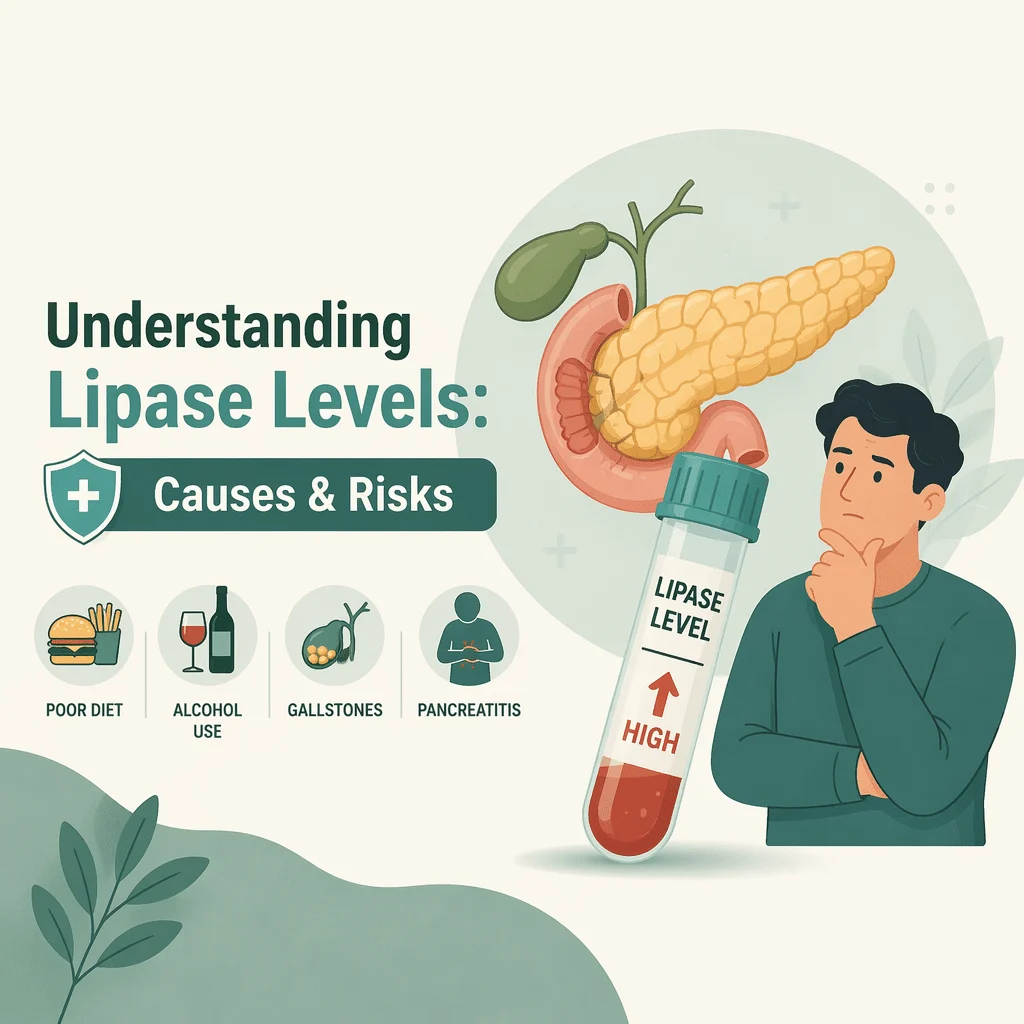
Your lipase levels tell your doctor how much of one specific digestive enzyme is circulating in your blood, and that number is one of the fastest ways to find out whether your pancreas is inflamed. Lipase is made almost entirely by the pancreas, so a result several times higher than normal usually points straight back to that gland. A raised number on its own is still not a diagnosis. Kidney disease, certain medicines, a blocked bowel and a harmless laboratory quirk called macrolipasemia can all push the value up in someone whose pancreas is perfectly healthy. In this article you will learn what the test measures, which symptoms turn a high result into an emergency, how lipase compares with amylase, which non-pancreatic causes matter, what a low result means, and what usually happens after an abnormal reading.
What a lipase blood test actually measures
Lipase is an enzyme, which simply means a protein that speeds up a chemical reaction. Its job is to break dietary fat into fragments small enough for your small intestine to absorb. Without it, fat passes through largely undigested.
Your pancreas is a flat, tongue-shaped gland tucked behind the stomach. It produces almost all of your lipase and releases it into the small intestine after you eat. A small amount always leaks into the bloodstream, which is why a healthy person still has a measurable, low-level result rather than a reading of zero.
Why the pancreas is the organ that matters here
When pancreatic cells are injured or inflamed, they spill their contents into the surrounding tissue and then into the blood. Lipase escapes far faster than the kidneys can clear it away, so the blood level climbs within a few hours of the injury starting. Because so little lipase comes from anywhere else in the body, this test is more specific to the pancreas than most other enzyme measurements a laboratory can run. Another guide on this site explains amylase and lipase side by side.
Why your doctor ordered it
The most common trigger is unexplained pain in the upper abdomen, particularly when nausea or vomiting comes with it. Emergency departments lean on lipase to separate pancreatitis from gallbladder attacks, stomach ulcers and bowel obstruction, all of which can produce similar pain. Doctors also check it when someone with known pancreatic disease seems to be flaring, when a new medicine is suspected of irritating the pancreas, and sometimes when routine bloodwork looks unexpectedly abnormal. Another guide walks through the comprehensive metabolic panel.
The test itself is an ordinary blood draw from a vein in your arm, and most laboratories report the result within a few hours. In an emergency setting it is often available in under an hour, because the answer changes what happens next.
When high lipase levels are a medical emergency
This section comes early on purpose. Acute pancreatitis can become severe quickly, and the combination of symptoms below matters more than the number on the report.
The pain pattern that should not wait
Classic acute pancreatitis produces steady, severe pain high in the middle of the abdomen, just under the breastbone, that bores through to the back. It usually builds over minutes to an hour rather than coming in waves, often worsens after eating, and frequently eases slightly when you lean forward or curl up. Nausea and vomiting that does not relieve the pain are typical. Fever, a racing pulse and a bloated, tender belly point toward a more serious episode.
When to seek emergency care
Go to an emergency department, or call emergency services, if you have any of the following:
- Severe upper abdominal pain that radiates to your back and does not settle within an hour or two
- Abdominal pain with repeated vomiting and an inability to keep fluids down
- Abdominal pain together with fever, chills or a rapid heartbeat
- Abdominal pain with yellowing of the eyes or skin, which can mean a gallstone is blocking a duct
- Pain with confusion, breathlessness, fainting or a drop in blood pressure
- Any severe abdominal pain if you already have a known pancreatic condition or have had pancreatitis before
Mayo Clinic advises seeking care for sudden abdominal pain or abdominal pain that does not improve. If your pain fits the pattern above, do not wait for a blood result to arrive before seeking help. A separate article on this site describes pancreatitis symptoms and warning signs.
Normal lipase levels and the three-times threshold
There is no single universal normal range for lipase. Different laboratories use different measurement methods and different reagents, so a value that is normal at one hospital can be flagged at another. Many adult ranges fall somewhere between roughly 10 and 60 units per liter, but the only range that applies to you is the one printed beside your own result.
Units matter as well. Laboratories in the United States usually report lipase in units per liter, written U/L, yet the numbers attached to that unit still depend on the assay the laboratory runs. Comparing your figure against a range copied from another laboratory’s website is one of the most common causes of unnecessary worry, and it is easily avoided.
Read your own laboratory’s range first
Reference ranges are built from a sample of healthy people, and by design a small proportion of perfectly healthy individuals sit just outside them. A result a few units above the top of the range, in someone with no symptoms, means something very different from a result ten times higher in someone doubled over in pain. A reference guide lists normal blood test ranges.
The rule doctors actually use
For diagnosing acute pancreatitis, clinicians do not simply ask whether lipase is high. They ask whether it is at least three times the upper limit of normal for that laboratory. A 2025 review of the diagnosis and management of acute pancreatitis, published in the journal Diagnostics and indexed in PubMed, sets out the standard requirement: a diagnosis needs two of three criteria, namely characteristic upper abdominal pain radiating to the back, a serum lipase or amylase at least three times the upper limit of normal, and imaging findings consistent with pancreatitis. A 2024 clinical review in FP Essentials describes the same three-part rule.
That threshold explains something patients often find confusing. A lipase of, say, 90 with an upper limit of 60 is above the range, but it is nowhere near three times higher, so on its own it does not diagnose pancreatitis. It flags a question rather than an answer.
The height of the number also does not reliably tell you how severe an attack is. Doctors judge severity from your vital signs, your organ function and other blood tests rather than from the lipase figure itself. Inflammation and kidney markers do part of that work, and a companion article covers high CRP levels and what raises them.
Lipase versus amylase: why lipase usually wins
Amylase, the enzyme that breaks down starch, was the traditional pancreatitis test for decades. Lipase has largely replaced it as the first-choice measurement, and there are two concrete reasons why.
First, specificity. Amylase is made by the pancreas but also by the salivary glands and the intestine, so salivary gland inflammation, mumps, bowel disease and even some ovarian conditions can raise it. Harvard Health Publishing makes exactly this point, noting that amylase is also produced by the intestine and the salivary glands, and that lipase elevation is more specific to a pancreatic problem.
Second, timing. Lipase stays elevated considerably longer, which matters a great deal if you waited two or three days before going to a doctor.
| What differs | Lipase | Amylase |
|---|---|---|
| Where it comes from | Almost entirely the pancreas | Pancreas, salivary glands and intestine |
| How soon it rises after pain starts | Typically within a few hours | Typically within a few hours, similar or slightly later |
| How long it stays up | Often a week or more | Often back to normal within a few days |
| Useful if you present late | Yes, frequently still raised | Often already normal, so a false reassurance |
| Specific to the pancreas | More specific | Less specific |
| Threshold used for diagnosis | Three times the upper limit of normal | Three times the upper limit of normal |
What the lipase-to-amylase ratio adds
Some laboratories report both enzymes, and clinicians occasionally compare them as a ratio. A 2023 systematic review and meta-analysis in Cureus, pooling nine studies and more than 1,800 patients, examined whether a lipase-to-amylase ratio above three could distinguish alcohol-related pancreatitis from other causes. It found only moderate accuracy, which is a useful piece of information for patients: the ratio can support a suspicion, but it cannot replace a history, an examination and imaging.
Causes of high lipase levels that are not pancreatitis
This is the part that most often surprises people whose scan comes back clean. Lipase can rise for reasons that have nothing to do with an inflamed pancreas.
Kidney disease
Your kidneys clear lipase from the blood. When kidney function falls, clearance slows and the level drifts upward even though the pancreas is behaving normally. A 2023 case series in Cureus documented exactly this in a patient with acute-on-chronic kidney disease whose lipase settled once the kidney problem was treated. This is one reason your doctor may look at kidney markers alongside the enzyme result, and a companion guide explains the kidney function panel.
Medicines
A long list of medicines has been linked to raised lipase, sometimes with genuine pancreatic irritation and sometimes without. Modern cancer immunotherapy is a well-studied example. A 2023 study of more than 6,000 patients treated with immune checkpoint inhibitors, published in the Journal of the National Comprehensive Cancer Network, found that when lipase rose during treatment, fewer than a third of those elevations were actually caused by the drug, and many patients with a raised enzyme but no symptoms continued treatment without interruption. Never stop a prescribed medicine on the strength of a laboratory value alone; that decision belongs to the doctor who prescribed it.
Bowel and abdominal conditions
Bowel obstruction, a perforated ulcer, inflammatory bowel disease and reduced blood supply to the intestine can all raise lipase, because the enzyme leaks across an inflamed or damaged bowel wall. The same 2023 case series reported hyperlipasemia in a patient later diagnosed with Crohn’s disease, and in patients with lupus affecting the kidneys and with organophosphate poisoning. In each case the enzyme returned to normal once the underlying problem was treated.
Macrolipasemia
This one is genuinely harmless and worth knowing about. Sometimes lipase binds to an antibody in the blood, forming a complex too large for the kidneys to filter out. The enzyme accumulates, the reported level looks alarming, and the pancreas is entirely normal. A 2024 case report in the National Medical Journal of India described a teenager whose raised lipase prompted a pancreatitis work-up until a simple laboratory test confirmed macrolipasemia and spared her further investigation. If your lipase is persistently high, your imaging is repeatedly clean and you have no symptoms, this is a possibility worth raising with your doctor.
Very high triglycerides
Severely raised blood fats are themselves a cause of pancreatitis, but they can also interfere with the laboratory measurement. A 2024 study in the Internal Medicine Journal reviewed patients with confirmed pancreatitis in the setting of severe hypertriglyceridemia and found that the lipase reading was actually within the normal range in a small number of them, and below the three-times threshold in almost half. In plain terms, a normal lipase does not completely rule out pancreatitis when triglycerides are extremely high. Another article covers high triglyceride levels and their management.
Low lipase levels: what they do and do not mean
A low lipase result attracts far less clinical attention than a high one, and that is not an oversight. Blood lipase is not a reliable way to measure how well your pancreas is producing digestive enzymes.
A result at the bottom of the range, or slightly below it, is common and usually means nothing at all in a person who feels well. It does not by itself indicate that your pancreas has stopped working.
Long-standing damage to the pancreas can eventually reduce enzyme production, a condition called exocrine pancreatic insufficiency. When that happens the symptoms, not the blood lipase, are what raise the alarm: pale, bulky, greasy stools that are hard to flush, unintentional weight loss, bloating and excess gas after fatty meals, and deficiencies in fat-soluble vitamins. A separate guide explains fatty stool and its causes.
To investigate that suspicion, doctors do not repeat a blood lipase. European guidelines published in 2024 recommend combining an assessment of symptoms and nutritional status with a dedicated pancreatic function test, most commonly a stool test measuring an enzyme called fecal elastase. Treatment, when it is needed, is pancreatic enzyme replacement therapy taken with meals, together with dietary support.
What happens after an abnormal lipase result
An unexpected number on a report is unsettling. Knowing the usual sequence makes it less so.
Tests that commonly come next
If pancreatitis is suspected, the work-up looks for both confirmation and cause. Expect some combination of the following:
- An abdominal ultrasound, which is the standard first look for gallstones, the single most common cause
- A CT scan or MRI if the diagnosis is unclear or a complication is suspected
- Liver enzymes and bilirubin, to check whether a gallstone is obstructing a duct
- Triglycerides and a lipid profile, since severely raised blood fats are a recognized trigger
- Calcium, blood glucose and kidney markers, which help gauge severity and look for contributing conditions
- A repeat lipase after a few days in selected cases, to see whether the level is falling as expected
Treatment for a confirmed attack is mostly supportive. The 2025 Diagnostics review describes the core of modern care as fluids given into a vein, adequate pain relief, and a return to eating as soon as it is tolerated, which is earlier than the prolonged fasting once recommended. Removing whatever caused the episode, such as a gallstone or a triggering medicine, is the part that prevents a repeat.
If pancreatitis is ruled out and the enzyme stays high, attention shifts to the non-pancreatic causes described above, and sometimes to a specific laboratory test for macrolipasemia. A dedicated guide explains diabetes blood tests, which matter here because pancreatic inflammation can affect insulin production over time.
Practical questions worth asking
Bring these to your appointment. What is my laboratory’s upper limit, and how many times above it is my result? Do my symptoms fit a pancreatic cause? Could any of my current medicines be responsible? Should we check my kidney function and triglycerides? Does this need imaging, and if so, when? If the result was a surprise on routine bloodwork, ask whether preparation could have played a part, since fasting instructions differ by test, and our guide covers fasting rules before a blood test.
Latest scientific advances
The studies below come from research indexed in PubMed and published between 2023 and 2026. They are grouped by what they change for someone holding a lipase result.
A normal lipase does not always mean no pancreatitis
Researchers reviewing patients with pancreatitis caused by very high blood fats found that the lipase reading was normal in a small number of them and below the usual diagnostic threshold in almost half. What this means for you: if you have severe abdominal pain and a known problem with very high triglycerides, a reassuring lipase number should not close the conversation. Mention the triglycerides to whoever is assessing you. This was a look back at hospital records rather than a large trial, so it flags a pitfall to be aware of rather than a rule that applies to everyone.
A high lipase during cancer immunotherapy is often not the drug
In a large hospital review of patients receiving immune checkpoint inhibitors, a modern class of cancer drug, fewer than a third of raised lipase results were traced back to the treatment itself. Most patients who had a raised enzyme without symptoms carried on with therapy uninterrupted. What this means for you: if you are on immunotherapy and your lipase rises, it is a reason for your team to look carefully, not an automatic reason to stop a treatment that is working.
Comparing lipase with amylase has limits
A pooled analysis of nine studies covering more than 1,800 patients tested whether the ratio between the two enzymes could identify alcohol-related pancreatitis. The accuracy was only moderate. What this means for you: no single enzyme calculation identifies the cause of an attack. Finding the cause still depends on your history, an examination and imaging, and that matters because preventing a second episode depends on knowing what triggered the first.
The first attack has consequences worth following up
A 2025 review in Gastroenterology, focused on pancreatitis in children, drew together evidence that a single episode can leave lasting effects, including reduced digestive enzyme production, disturbed blood sugar control, recurring pain and a measurable impact on quality of life. What this means for you, at any age: after an episode of pancreatitis, planned follow-up is not optional politeness. Ask what will be monitored and for how long.
Prevention is moving toward the underlying trigger
A 2025 review of hypertriglyceridemia-related pancreatitis reported that trials of newer drugs targeting a protein called apolipoprotein C-III achieved large reductions in triglycerides, and that bringing those blood fats down substantially was associated with a lower risk of pancreatitis. A companion expert review from the National Lipid Association described the same direction of travel for a rare inherited form of very high triglycerides. What this means for you: these are specialist treatments for a specific group of people, and they are still being evaluated rather than being routine. The wider point is more immediately useful, which is that treating the cause of very high triglycerides is a recognized way to reduce pancreatitis risk.
Frequently asked questions
What does a lipase level over 1,000 mean?
A value that high is far above three times the upper limit of most laboratory ranges, so in someone with severe upper abdominal pain it strongly supports acute pancreatitis and needs urgent assessment. It does not, however, tell you how severe the episode will be. Doctors judge severity from vital signs, organ function and other blood tests rather than from the size of the enzyme number. A very high value can occasionally occur without pancreatitis, particularly with significant kidney impairment or macrolipasemia, which is why imaging and the clinical picture are always part of the assessment.
Is a slightly elevated lipase level something to worry about?
Usually not on its own. A result a little above the top of the range in someone with no abdominal pain is a common finding, and Harvard Health Publishing notes that minor increases can be seen in people who are perfectly healthy. The number becomes meaningful when it lines up with symptoms. Your doctor will weigh how far above the range it sits, whether you have pain, your kidney function and your medicines before deciding whether anything needs doing. Often the sensible next step is simply repeating the test.
Can I lower my lipase levels myself?
There is no diet or supplement that lowers blood lipase directly, and treating the number itself is not the goal. What helps is addressing whatever is driving it. If the cause is pancreatitis, treatment is medical and often needs hospital care. If very high triglycerides are involved, reducing alcohol, managing diabetes and following the dietary and drug treatment your doctor recommends all lower that risk. If a medicine is responsible, only your prescriber should change it. Once the underlying cause is treated, the enzyme level typically settles on its own.
Do normal lipase levels change with age?
Reference ranges vary far more between laboratories than between age groups in adults, because different testing methods produce different numbers. Some laboratories publish separate ranges for children. Kidney function tends to decline gradually with age, and since the kidneys clear lipase, older adults can sit slightly higher within the range for that reason alone. The practical rule stays the same at any age: compare your result with the range printed on your own report, not with a figure found online.
Do I need to fast before a lipase test?
Many laboratories ask for a period without food, often eight to twelve hours, because eating stimulates the pancreas and a recent fatty meal can nudge the result upward. Requirements differ between laboratories and a lipase drawn in an emergency is never delayed for fasting. Follow the specific instructions you were given. If you ate beforehand and your result comes back mildly raised, tell whoever reviews it, because that context can change how the number is interpreted.
How quickly do lipase levels come back down?
After an episode of acute pancreatitis, lipase typically stays elevated for several days and often for a week or more before returning to normal, which is considerably longer than amylase. Doctors do not usually repeat the test daily, because a falling number does not reliably track how well someone is recovering. Symptoms, the ability to eat again and other blood tests are better guides. A level that stays high for weeks after recovery prompts a search for a different explanation, such as reduced kidney clearance or macrolipasemia.
Glossary of key terms
| Term | Definition |
|---|---|
| Lipase | A digestive enzyme, made mainly by the pancreas, that breaks dietary fat into pieces the intestine can absorb. |
| Pancreas | A flat gland behind the stomach that produces digestive enzymes and the hormones that control blood sugar, including insulin. |
| Amylase | A digestive enzyme that breaks down starch. It comes from the pancreas but also from the salivary glands and the intestine. |
| Acute pancreatitis | Sudden inflammation of the pancreas, usually causing severe upper abdominal pain that spreads to the back. |
| Chronic pancreatitis | Long-term inflammation that gradually scars the pancreas and can reduce its ability to make enzymes and insulin. |
| Upper limit of normal | The highest value a laboratory considers normal for a test. Pancreatitis criteria use three times this figure, not the figure itself. |
| Hyperlipasemia | The medical term for a blood lipase level above the normal range, whatever the cause. |
| Macrolipasemia | A harmless situation in which lipase binds to an antibody, forming a complex too large to be cleared, so the measured level looks high while the pancreas is normal. |
| Hypertriglyceridemia | A high level of triglycerides, the most common type of fat in the blood. Severe cases can trigger pancreatitis. |
| Exocrine pancreatic insufficiency | A state in which the pancreas no longer makes enough digestive enzymes, leading to greasy stools, weight loss and poor absorption of nutrients. |
| Fecal elastase | A stool test that estimates how much enzyme the pancreas is producing. It is used instead of blood lipase to investigate suspected enzyme insufficiency. |
Sources
- MedlinePlus, National Library of Medicine — Lipase Tests, 2025. MedlinePlus
- Mayo Clinic — Pancreatitis: Symptoms and Causes, 2025. Mayo Clinic
- Harvard Health Publishing — Do I need to be worried about elevated levels of pancreas enzymes?, 2026. Harvard Health
- Mittal N, Oza VM, Muniraj T, Kothari TH — Diagnosis and Management of Acute Pancreatitis — Diagnostics, 2025. PubMed — DOI
- Bailey JM — Gastrointestinal Conditions: Pancreatitis — FP Essentials, 2024. PubMed
- Morton A — Serum lipase in acute pancreatitis associated with hypertriglyceridaemia — Internal Medicine Journal, 2024. PubMed — DOI
- Ekka NM, Kujur AD, Guria R, et al. — Serum Lipase Amylase Ratio as an Indicator to Differentiate Alcoholic From Non-alcoholic Acute Pancreatitis: A Systematic Review and Meta-Analysis — Cureus, 2023. PubMed — DOI
- George J, Gnanamoorthy K, Suthakaran PK, Baliga KV — Hyperlipasemia Sans Pancreatitis: A Case Series — Cureus, 2023. PubMed — DOI
- Townsend MJ, Liu M, Giobbie-Hurder A, et al. — Pancreatitis and Hyperlipasemia in the Setting of Immune Checkpoint Inhibitor Therapy — Journal of the National Comprehensive Cancer Network, 2023. PubMed — DOI
- Sharma LK, Datta RR, Aggarwal A, Sharma N, Dutta D — Macrolipasemia variant of macroenzymes: An endocrine laboma — The National Medical Journal of India, 2024. PubMed
- Ahmed F, Abu-El-Haija M — Acute Pancreatitis in Children: It’s Not Just a Simple Attack — Gastroenterology, 2025. PubMed — DOI
- Subramanian S, Soran H, Sikora Kessler A, et al. — Prevention and treatment of hypertriglyceridemia-mediated acute pancreatitis: A narrative review — European Journal of Internal Medicine, 2025. PubMed — DOI
- Javed F, Hegele RA, Garg A, et al. — Familial chylomicronemia syndrome: An expert clinical review from the National Lipid Association — Journal of Clinical Lipidology, 2025. PubMed — DOI
- Dominguez-Munoz JE, Vujasinovic M, de la Iglesia D, et al. — European guidelines for the diagnosis and treatment of pancreatic exocrine insufficiency — United European Gastroenterology Journal, 2024. PubMed — DOI
Further reading
- Liver function tests: how to read your liver panel
- Pancreatic cancer: diagnosing and treating
- Lipid panel explained: cholesterol, LDL, HDL and triglycerides
- How to read your blood test results
- CA 19-9: what this blood marker shows
Understand your lab results with AI DiagMe
A lipase result only makes sense next to the rest of your report, your symptoms and your own laboratory’s reference range. AI DiagMe reads your results in context and explains them in plain language, whether that is lipase and amylase, kidney markers such as creatinine, triglycerides on a lipid panel, or liver enzymes. It helps you understand what your numbers mean and which questions are worth raising. It does not diagnose, and it does not replace your doctor.
Get your results interpreted in minutes