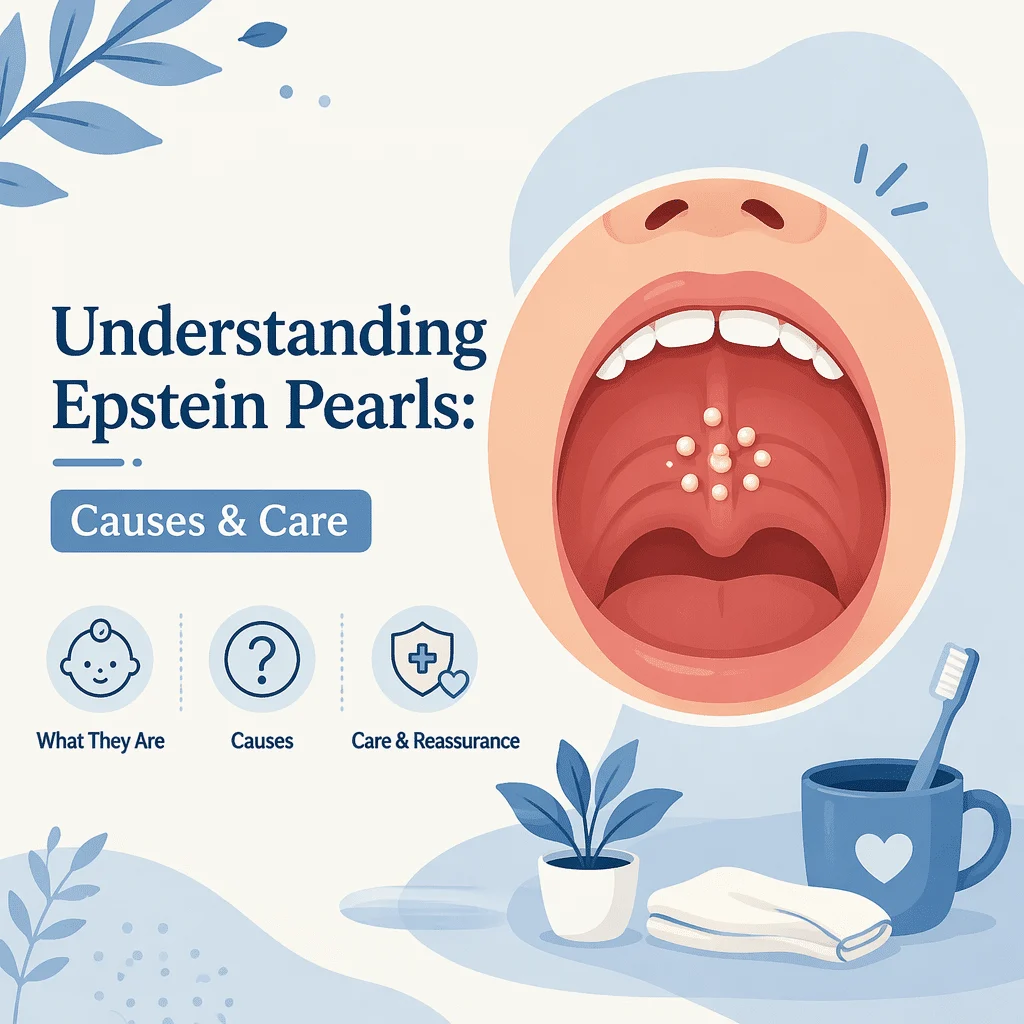
Perlele Epstein sunt micile umflături alb-sidefii pe care mulți părinți le observă pe cerul gurii nou-născutului, și sunt complet inofensive. Nu sunt dinți, nu reprezintă o infecție și nu sunt un semn că ceva a mers prost în timpul sarcinii sau al nașterii. Sunt mici punguțe de celule obișnuite de la suprafață, care au rămas prinse în timp ce palatul se forma înainte de naștere, și dispar de la sine, de obicei în câteva săptămâni, fără niciun tratament. Dacă tocmai te-ai uitat în gura bebelușului tău și ai simțit un val de îngrijorare, poți fi liniștit/ă. În acest articol vei afla unde apar perlele Epstein, de ce se formează, cât de frecvente sunt, cum le deosebești de celelalte câteva tipuri de umflături albe care pot apărea în gura unui bebeluș și care sunt semnele care justifică cu adevărat un apel la medicul pediatru.
Ce sunt perlele Epstein și de ce sunt inofensive
O perlă Epstein este un chist minuscul: o pungă închisă care conține keratină, proteina rezistentă din care este alcătuit stratul exterior al pielii și unghiile. Nimic din interior nu poate infecta, nu se poate răspândi și nu se poate transforma în altceva. Punga nu are nicio deschidere, nicio sursă de sânge care să alimenteze o creștere și nicio inflamație în jur. De aceea, toate marile lucrări de referință din pediatrie indică observația drept singurul pas de urmat.
Unde apar în gura bebelușului tău
Poziția este cel mai sigur indiciu. Conform StatPearls, referința clinică găzduită de NIH, perlele Epstein se află pe palatul dur, fie de-a lungul liniei mediane care parcurge cerul gurii de la față spre spate, fie la joncțiunea dintre palatul dur și țesutul mai moale din spate. Această linie mediană este locul unde cele două jumătăți ale palatului s-au unit înainte de naștere, motiv pentru care celulele rămân prinse exact acolo.
Umflăturile de pe crestele gingivale au denumiri diferite, prezentate mai jos. Concluzia practică: o umflătură albă aproape de mijlocul palatului, la un bebeluș de câteva zile sau săptămâni, este aproape sigur acest lucru benign.
Cum arată și cum se simt la atingere
Sunt mici: de obicei între unu și trei milimetri în diametru, aproximativ cât un bob de sare grunjoasă. Sunt albe până la galben pal, ferme mai degrabă decât moi, și nu se mișcă sub suprafață la atingere. Rareori apar singure. Grupurile de două până la șase sunt norma, motiv pentru care la prima vedere pot părea mai îngrijorătoare decât sunt în realitate. Sunt adesea confundate cu un dinte care iese, dar un dinte are o margine dură și se află pe creasta gingiei, nu pe palat.
De ce se formează perlele Epstein
Explicația este de natură dezvoltativă, nu medicală. În jurul celei de-a doua luni de sarcină, cerul gurii se formează din două straturi de țesut care cresc unul spre celălalt și se unesc de-a lungul liniei mediane. Pe măsură ce se sudează, câteva celule de suprafață rămân prinse în interiorul țesutului, în loc să fie la suprafața lui. Aceste celule rătăcite continuă să facă ceea ce fac celulele de suprafață, adică produc keratină și se descuamează. Neavând unde să se descuameze, se acumulează într-o mică pungă sigilată, iar acea pungă este umflătura albă pe care o poți vedea.
Nimic din ceea ce ai făcut sau nu ai făcut nu le-a cauzat
Merită spus clar, pentru că aceasta este întrebarea nerostită din spatele majorității căutărilor. Perlele Epstein nu au legătură cu ce ai mâncat, cu medicamentele, cu modul în care a decurs nașterea, cu laptele praf față de alăptare sau cu modul în care cureți gura bebelușului. Studiile care au analizat greutatea la naștere, vârsta mamei, sexul bebelușului, metoda de naștere și complicațiile sarcinii nu au găsit nicio asociere semnificativă cu niciunul dintre acestea. Sunt aceleași celule de suprafață care apar inofensiv și în alte descoperiri de rutină, iar noi explicăm celulele epiteliale dintr-o probă de urină.
Cât de frecvente sunt perlele Epstein
Suficient de frecvente încât descoperirea lor să fie ceva obișnuit. MedlinePlus, resursa de referință pentru pacienți a Bibliotecii Naționale de Medicină din SUA, estimează că aproximativ patru din cinci nou-născuți le prezintă. Studiile clinice se situează într-un interval similar: StatPearls raportează chisturi palatine la aproximativ 30 până la 50 la sută dintre nou-născuți și chisturi pe creasta gingivală la 13 până la 50 la sută, diferența reflectând cât de atent și cât de devreme a analizat fiecare studiu.
Bebeluși născuți la termen și prematuri
Ambele tipuri de bebeluși le pot avea. Sunt ceva mai frecvente la bebelușii născuți la termen, ceea ce se potrivește cu explicația de dezvoltare, deoarece chisturile se formează și devin vizibile pe parcursul gestației. Dar nu lipsesc nici la prematuri. Un studiu din 2023 realizat pe 341 de nou-născuți prematuri a plasat perlele Epstein printre cele mai frecvente zece modificări cutanate și de suprafață la acest grup. Dacă bebelușul tău s-a născut prematur și are umflături albe pe palat, este un aspect obișnuit, nu o complicație a prematurității.
Umflături albe în gura bebelușului: cum le deosebești
“Inofensiv” ajută doar atunci când ești sigur că te uiți la lucrul inofensiv. Șase aspecte explică aproape toate umflăturile palide din gura unui bebeluș. Cinci nu necesită nimic altceva decât o mențiune la următoarea vizită. Unul, candidoza orală, este o infecție tratabilă, motiv pentru care merită să citești cu atenție acest tabel.
Cel mai util test pe care îl poți face acasă: se șterge?
Ia o cârpă curată și umedă sau un deget curat și șterge ușor zona albă. O perlă Epstein este un chist sigilat sub suprafață, deci nu se mișcă, nu se întinde și nu lasă nimic în urmă. Candidoza orală este un strat depus pe suprafață, deci se șterge parțial și tinde să lase o zonă roșie, iritată, care poate sângera puțin. Mayo Clinic descrie leziunile de candidoză ca arătând ca brânza de vaci și menționează o ușoară sângerare atunci când petele sunt frecate sau răzuite. Țesutul care sângerează la cea mai ușoară atingere are un termen medical, iar noi explicăm țesutul friabil și de ce contează. Șterge ușor o singură dată și nu freca sau repeta.
| Umflătură albă sau palidă | Localizare tipică | Cum arată | Se șterge? | Ce să faci |
|---|---|---|---|---|
| Perlele Epstein | Cerul gurii, de-a lungul cusăturii mediane sau la locul unde palatul dur întâlnește palatul moale | Unu până la trei milimetri, alb până la galben pal, ferm, de obicei două până la șase grupate împreună | Nu | Nimic. Menționează-l la următoarea vizită de rutină și așteaptă-te să dispară în câteva săptămâni |
| Nodulii Bohn | Suprafața gingiei dinspre obraz sau dinspre limbă | Aceleași mici umflături alb-gălbui, dar pe suprafața gingiei, nu pe palat | Nu | Nimic. Același curs benign și același interval de timp |
| Chisturi ale lamelei dentare | Pe creasta gingiei superioare sau inferioare, acolo unde vor ieși mai târziu dinții | Mici, netede, în formă de cupolă, albicioase, uneori ușor translucide | Nu | Nimic. Nu întârzie apariția dinților |
| Candidoza orală | Limbă, obraji interiori, buze, gingii și palat, adesea în mai multe zone simultan | Pete alb-cremoase cu o textură asemănătoare brânzei de vaci; țesutul de dedesubt poate arăta roșu | Parțial, lăsând o zonă roșie, crudă, care poate sângera ușor | Sună-ți pediatrul. Este o infecție fungică și se tratează de obicei cu un antifungic, cum ar fi nistatina |
| Dinți natali sau neonatali | Ieșind prin creasta gingiei, cel mai adesea la nivelul gingiei frontale inferioare | O structură dură, în formă de dinte, cu margine bine definită, uneori mobilă | Nu | Consultați un medic. Majoritatea sunt lăsați pe loc, dar un dinte foarte mobil este evaluat pentru siguranța alimentației și a căilor respiratorii |
| Mucocel | Interiorul buzei, interiorul obrajilor sau sub limbă | O veziculă moale, albăstruie sau translucidă, care poate varia în dimensiune de la o zi la alta | Nu | Consultați un medic dacă persistă, crește sau interferează cu alimentația |
Dacă suspectezi candidoză orală în loc de perle Epstein
Candidoza orală este o proliferare excesivă a Candida, o ciupercă prezentă în mod inofensiv în majoritatea organismelor, până când condițiile îi permit să se înmulțească. Academia Americană de Pediatrie descrie petele rezultate ca dureroase și menționează că pot apărea pe limbă, buze, gingii, palat și obraji interiori. Tratamentul le elimină de obicei în aproximativ două săptămâni, iar suzetele sau biberoanele nesterilizate sunt un motiv frecvent pentru care infecția reapare. Același organism apare și în alte rezultate de analize, iar noi explicăm ce înseamnă prezența ciupercii în urina recoltată.
Cât durează perlele Epstein
Dispar de la sine, iar intervalul de timp este reconfortant de scurt. MedlinePlus precizează că perlele Epstein dispar în una până la două săptămâni de la naștere. Referințele clinice permit o fereastră ceva mai largă: StatPearls descrie regresia spontană în câteva săptămâni până la câteva luni și menționează că leziunile sunt rareori observate după vârsta de trei luni.
Cohorta de nou-născuți din 2025 descrisă mai jos a stabilit o limită fermă pentru capătul îndepărtat: practic toate aceste chisturi dispar până la primul an de viață, iar majoritatea dispar mult mai devreme.
Nu există nimic de urmărit între timp și niciun reper de bifat. Punga de keratină își face drum spre suprafață, se deschide, iar conținutul este înghițit odată cu saliva. Cel mai probabil nu vei observa niciodată momentul în care se întâmplă.
Îngrijirea bebelușului tău acasă
Nu există nimic de făcut, iar așteptarea activă este îngrijirea recomandată, nu o simplă ignorare. Chiar și în cazurile neobișnuite descrise în cercetările de mai jos, specialiștii aleg să observe și să aștepte.
Ce să nu faci
- Nu le sparge, nu le stoarce, nu le înțepa și nu le zgâria. Nu există lichid de eliminat, iar ruperea suprafeței introduce un risc de infecție acolo unde nu exista niciunul.
- Nu aplica geluri pentru dentiție, produse anestezice, antiseptice sau remedii casnice. Perlele Epstein nu sunt dureroase, deci nu există nimic de amorțit.
- Nu freca zona în mod repetat pentru a o verifica. Frecarea persistentă poate irita țesuturile delicate.
Alimentația nu este afectată
Aceasta este îngrijorarea pe care o ridică primii cei mai mulți părinți, iar dovezile în acest sens sunt acum clare. Studiul de cohortă din 2025 a testat în mod specific dacă aceste chisturi interferează cu alăptarea în prima oră de viață și la treizeci de zile, fără a constata niciun efect. Același studiu a verificat dacă acestea întârzie apariția primilor dinți și, din nou, nu a constatat niciun efect. Dacă bebelușul tău se alimentează greu, perlele Epstein nu sunt motivul și altceva merită investigat.
Îngrijirea obișnuită a gurii este suficientă
Continuă cu rutina blândă pe care o folosești deja: un prosop curat și umed trecut peste gingii o dată pe zi este mai mult decât suficient pentru un bebeluș fără dinți. Sterilizează suzetele și tetinele ca de obicei, ceea ce reduce riscul apariției candidozei orale pe lângă o descoperire benignă. Părinții care urmăresc apariția primului dinte citesc adesea ghidul nostru despre simptomele dentiției la bebeluși.
Când să suni la pediatru
Perlele Epstein în sine nu sunt un motiv să suni în afara consultațiilor de rutină; menționează-le la următoarea vizită de monitorizare a bebelușului și este suficient. Cele de mai jos acoperă câteva situații în care o umflătură albă nu este explicația, sau în care se întâmplă altceva în același timp.
Contactează pediatrul dacă bebelușul tău prezintă oricare dintre următoarele:
- Pete albe care se șterg parțial și lasă o zonă crudă sau roșie, sau care se extind pe limbă și pe interiorul obrajilor — ceea ce indică mai degrabă candidoză orală decât un chist.
- Refuzul de a se alimenta, alimentație mult mai redusă decât de obicei sau retragere și plâns în timpul meselor.
- Febră. La un bebeluș sub trei luni, orice febră justifică un apel telefonic imediat, indiferent de ce altceva ai observat.
- Sângerare din gură sau o umflătură care pare inflamată, roșie sau umflată la bază.
- O umflătură care crește, este vizibil mai mare de câțiva milimetri sau este moale și asemănătoare unei vezicule, nu mică și fermă.
- O umflătură care persistă după vârsta de trei luni sau care apare pentru prima dată la câteva săptămâni după naștere.
- Orice structură dură, în formă de dinte, pe creasta gingivală, mai ales dacă pare mobilă.
- Respirație zgomotoasă sau orice semn că o leziune interferează cu căile respiratorii.
Febra la un bebeluș mic poate avea multe cauze posibile și descriem semnele unei infecții de ureche. Când un medic trebuie să stabilească dacă o infecție este bacteriană, poate solicita un marker de inflamație, iar noi explicăm proteina C reactivă și ce înseamnă valorile crescute.
Cele mai recente progrese științifice
Perlele Epstein atrag foarte puține cercetări noi, iar acest lucru în sine este grăitor: descoperirea este atât de bine documentată și atât de constant inofensivă, încât nu mai există nimic de studiat. Lucrările recente sunt studii de prevalență, analize de diagnostic diferențial și rapoarte de caz ocazionale, nu studii de tratament. Iată ce au adăugat ultimii trei ani, pe înțelesul tuturor.
Un studiu de un an a clarificat întrebările despre alimentație și dentiție
Cea mai utilă descoperire recentă provine dintr-un studiu de cohortă din 2025, realizat în sudul Braziliei, care a urmărit peste 1.100 de perechi mamă-bebeluș de la naștere până la primul an de viață. O cohortă este pur și simplu un grup urmărit în timp, nu o simplă fotografie de moment. Cercetătorii au găsit aceste chisturi la aproximativ șapte din zece nou-născuți la naștere și doar la aproximativ unul din o sută un an mai târziu. Au testat și cele două lucruri pe care părinții le întreabă cel mai des și au constatat că chisturile nu au niciun efect asupra alăptării și niciun efect asupra momentului în care apar primii dinți.
Ce înseamnă asta pentru tine: cele două mari îngrijorări practice au acum un răspuns direct, bazat pe bebeluși reali urmăriți pe parcursul unui an întreg, iar răspunsul la ambele este nu.
Studiile de prevalență confirmă că bebelușul tău face parte din majoritate
Un studiu din 2025 realizat pe 241 de nou-născuți sănătoși din Quito, Ecuador, a descoperit o modificare benignă a cavității bucale la aproximativ șapte din zece bebeluși. Perlele Epstein au fost cele mai frecvente, cu o marjă clară, prezente la aproximativ jumătate dintre bebelușii examinați, în timp ce dinții natali nu au apărut deloc.
Ce înseamnă asta pentru tine: indiferent dacă bebelușul tău s-a născut la termen sau prematur, micile umflături albe de pe palat îl plasează în rândul majorității, nu al excepțiilor — lucru important de știut atunci când o descoperire pare alarmantă tocmai pentru că nu ai mai auzit niciodată de ea. Modificările de culoare din alte zone ale gurii au propriile explicații, iar noi acoperim cauzele unei pete negre pe limbă.
Ghidurile clinice continuă să recomande supravegherea atentă
O analiză din 2025 publicată în Pediatric Annals a inclus chisturile de incluziune orală printre descoperirile la nou-născuți care necesită doar liniștirea părinților, separându-le de micul grup care necesită trimitere la specialist. Un raport de caz din 2026 a mers mai departe: în fața unui nou-născut cu chisturi bucale neobișnuit de mari și numeroase, echipa medicală a ales să monitorizeze în loc să opereze, iar leziunile s-au redus semnificativ până la patru luni. Este vorba despre un singur caz, nu o regulă, deci interpretează-l ca un semn încurajator, nu definitiv.
Ce înseamnă asta pentru tine: dacă pediatrul tău aruncă o privire la umflături și trece mai departe fără să recomande nimic, înseamnă că ghidul funcționează exact cum trebuie, nu că s-a sărit peste ceva. Aceeași întrebare apare constant în cazul formațiunilor cutanate, iar noi comparăm keratoza seboreică și melanomul.
Confuzia legată de denumiri este o problemă cunoscută
O analiză din 2023 privind patologia orală pediatrică și-a propus să clarifice termenii suprapuși folosiți pentru chisturile de pe gingii și palat la nou-născuți, observând că denumirile sună similar și că trăsăturile tisulare se suprapun uneori. Ce înseamnă asta pentru tine: terminologia inconsistentă între doi medici reflectă stadiul vocabularului medical, nu incertitudinea cu privire la starea de sănătate a bebelușului tău.
Glosar
| Termen | Definiție |
|---|---|
| Creasta alveolară | Creasta gingivală, banda de țesut ferm din maxilarul superior și inferior de unde erup în cele din urmă dinții. |
| Nodulii Bohn | Chisturi benigne mici pe suprafețele dinspre obraz sau dinspre limbă ale crestelor gingivale. Strâns legate de perlele Epstein și la fel de inofensive. |
| Candida | O ciupercă ce trăiește inofensiv în și pe corpul majorității oamenilor. Când se înmulțește excesiv în cavitatea bucală, provoacă candidoză orală (mătreață bucală). |
| Studiu de cohortă | Un tip de studiu care urmărește același grup de persoane în timp, pentru a vedea ce li se întâmplă, în loc să facă o singură evaluare la un moment dat. |
| Chist | O pungă închisă de țesut cu conținut în interior. Multe chisturi, inclusiv perlele Epstein, sunt complet inofensive și dispar de la sine. |
| Chist al lamelei dentare | Un chist benign mic pe creasta gingivală, care apare din țesutul ce va forma ulterior dinții. |
| Celule epiteliale | Celulele care formează stratul de suprafață al pielii, al gurii și al altor suprafețe ale corpului. Celulele epiteliale prinse în țesut sunt cele care creează perlele Epstein. |
| Keratina | O proteină structurală rezistentă, prezentă în piele, păr și unghii. Este materialul care umple o perlă Epstein. |
| Mucocel | O umflătură moale, adesea albăstruie, cauzată de o glandă salivară blocată sau lezată, de obicei pe fața interioară a buzei sau a obrajilor. |
| Dinți natali | Dinți prezenți deja la naștere sau în prima lună de viață. Neobișnuiți și fără legătură cu perlele Epstein, deși uneori sunt confundați cu acestea. |
| Palat | Cerul gurii. Partea din față este palatul dur (osos); partea din spate este palatul moale (flexibil). |
Întrebări frecvente
Perlele Epstein sunt normale sau sunt un semn că ceva nu este în regulă?
Sunt normale și reprezintă una dintre cele mai frecvente descoperiri în gura unui nou-născut. MedlinePlus le descrie ca fiind inofensive și le întâlnește la aproximativ patru din cinci nou-născuți; studii recente efectuate pe nou-născuți au găsit cel puțin o modificare benignă în cavitatea bucală la aproximativ șapte din zece bebeluși examinați. Nu sunt asociate cu greutatea la naștere, sexul bebelușului, vârsta mamei, modul de naștere sau complicațiile sarcinii. Prezența lor nu indică nicio problemă legată de sănătatea, creșterea sau dezvoltarea bebelușului tău și nu necesită niciun tratament.
Perlele Epstein îl dor pe bebelușul meu?
Nu. Sunt nedureroase. Se află sub o suprafață intactă, nu sunt inflamate și nu apasă pe niciun terminație nervoasă. Un bebeluș cu perle Epstein mănâncă, doarme și se comportă exact ca unul fără ele. Dacă bebelușul tău pare totuși să aibă disconfort în gură, refuză să mănânce sau este neobișnuit de agitat în timpul alăptării, caută o altă explicație și vorbește cu medicul pediatru. Candidoza orală (muguetul), de exemplu, provoacă durere reală — aceasta este una dintre diferențele practice dintre cele două afecțiuni.
Pot apărea perle Epstein și la adulți?
Nu în sensul propriu. Perlele Epstein sunt o descoperire specifică nou-născuților, formate din celule prinse în timpul dezvoltării palatului înainte de naștere, și dispar în perioada sugarului. Adulții care observă o umflătură albă și fermă pe cerul gurii se confruntă aproape sigur cu altceva, cum ar fi o creastă osoasă numită torus palatinus (de asemenea inofensivă), un mucocel sau o zonă iritată. Orice umflătură persistentă în gura unui adult trebuie examinată, fără a fi considerată automat benignă; descriem leziunile HPV de pe limbă.
Bebelușul meu are un an și încă are o umflătură albă pe gingii. Ar putea fi tot o perlă Epstein?
Este puțin probabil. Aceste chisturi sunt rareori observate după vârsta de trei luni, iar la doisprezece luni, cohorta de nou-născuți din 2025 le-a găsit la doar aproximativ unul sau doi bebeluși din o sută. O umflătură albă sau palidă care persistă la un an merită o examinare atentă — nu pentru că ar fi probabil ceva grav, ci pentru că acum există mai multe șanse să fie vorba de altceva, cum ar fi un chist de erupție deasupra unui dinte care urmează să iasă, un mucocel sau candidoză orală. Menționează acest lucru la următoarea consultație și lasă un medic să îl identifice.
De ce se numesc perle Epstein?
Sunt numite după Alois Epstein, pediatrul ceh care le-a descris în secolul al XIX-lea, iar „perle" reflectă aspectul lor: mici, rotunde și palide, situate pe cerul gurii. Numele este descriptiv, nu diagnostic, ceea ce explică parțial de ce există mai multe denumiri pentru același tip de descoperire, inclusiv chisturi palatine ale nou-născutului și chisturi de incluziune orală. Dacă doi medici folosesc termeni diferiți pentru umflătura bebelușului tău, este o diferență de vocabular, nu un dezacord privind diagnosticul.
Pot reveni perlele Epstein după ce dispar?
Nu. Odată ce o perlă ajunge la suprafață și se golește, acel chist dispare definitiv și nu se reumple. Ce se poate întâmpla este ca un chist să se rezolve în timp ce altul din același grup rămâne vizibil, creând impresia că umflătura a revenit. Dacă apare o nouă umflătură albă la săptămâni sau luni după naștere, într-o gură care se curățase, tratează-o ca pe o descoperire nouă ce merită menționată medicului pediatru, nu ca pe o perlă Epstein care a revenit. Pielea nou-născutului și țesuturile de suprafață produc și alte modificări inofensive, pe care le analizăm cauzele frecvente ale unei erupții cutanate.
Surse
- Biblioteca Națională de Medicină a SUA — Perle Epstein — Enciclopedia Medicală MedlinePlus — https://medlineplus.gov/ency/article/001603.htm
- Daley JO, Mendez MD — Chisturi palatine și gingivale ale nou-născutului — StatPearls, NCBI Bookshelf, 2025 — https://www.ncbi.nlm.nih.gov/books/NBK493177/
- Academia Americană de Pediatrie — Candidoza orală și alte infecții cu Candida — HealthyChildren.org — HealthyChildren.org
- Mayo Clinic — Candidoză orală: Simptome și cauze — https://www.mayoclinic.org/diseases-conditions/oral-thrush/symptoms-causes/syc-20353533
- Kramer PF, Scharlau JMM, de Barros Coelho EMR, Dos Santos GFK, Gonçalves EJL, Feldens CA — Chisturi de incluziune orală: un studiu de cohortă prospectiv privind distribuția, factorii asociați și prognosticul în primul an de viață — European Archives of Paediatric Dentistry, 2025 — https://doi.org/10.1007/s40368-025-01148-w
- Vélez-León E, Guerrero E, Carrillo MO, Cabrera M, Tello G, Pinos P — Prevalența anomaliilor orale la nou-născuții sănătoși dintr-un spital ginecologic-obstetrical din Quito, Ecuador: un studiu observațional transversal — Dentistry Journal, 2025 — https://doi.org/10.3390/dj13040158
- Reeves S, Kamat D — Anomalii congenitale frecvente — Pediatric Annals, 2025 — https://doi.org/10.3928/19382359-20250612-06
- Lara FR, Chen JL, Shehan JN, Levi JR — Un caz neobișnuit de chisturi orale bilaterale superioare și inferioare la un nou-născut — HCA Healthcare Journal of Medicine, 2026 — https://doi.org/10.36518/2689-0216.2358
- Summersgill KF — Patologie orală pediatrică: Chisturi odontogene — Pediatric and Developmental Pathology, 2023 — https://doi.org/10.1177/10935266231176245
- Zanatta DA, Carvalho VO, da Silva RPGVC — Ce spune pielea a 341 de nou-născuți prematuri: un studiu transversal — Jornal de Pediatria, 2023 — https://doi.org/10.1016/j.jped.2023.04.005
Lectură suplimentară
- Afte bucale: cauze, simptome și tratamente
- Eczema și cum afectează pielea
- Limfocitele și rolul lor în sistemul imunitar
- Procalcitonina, un marker al infecției bacteriene
- Ce se întâmplă în timpul unui test de sânge
Înțelege-ți rezultatele analizelor cu AI DiagMe
Perlele Epstein nu necesită niciun test, ceea ce este una dintre veștile cu adevărat bune în îngrijirea nou-născuților. Dar când o umflătură în gură se dovedește a fi o infecție, nu un chist inofensiv, sau când apare febră odată cu ea, medicul poate solicita o hemoleucogramă, o proteină C reactivă sau un nivel de procalcitonină pentru a evalua inflamația, ori o cultură din tampon pentru a identifica agentul patogen. Acele rezultate vin pline de cifre și abrevieri care rareori sunt explicate. AI DiagMe îți citește analizele de laborator și le traduce în limbaj simplu, astfel încât să ajungi la consultație înțelegând ce s-a măsurat și ce înseamnă valorile. Te ajută să îți înțelegi rezultatele; nu pune diagnostice și nu înlocuiește medicul tău.
Obține interpretarea rezultatelor în câteva minute