
































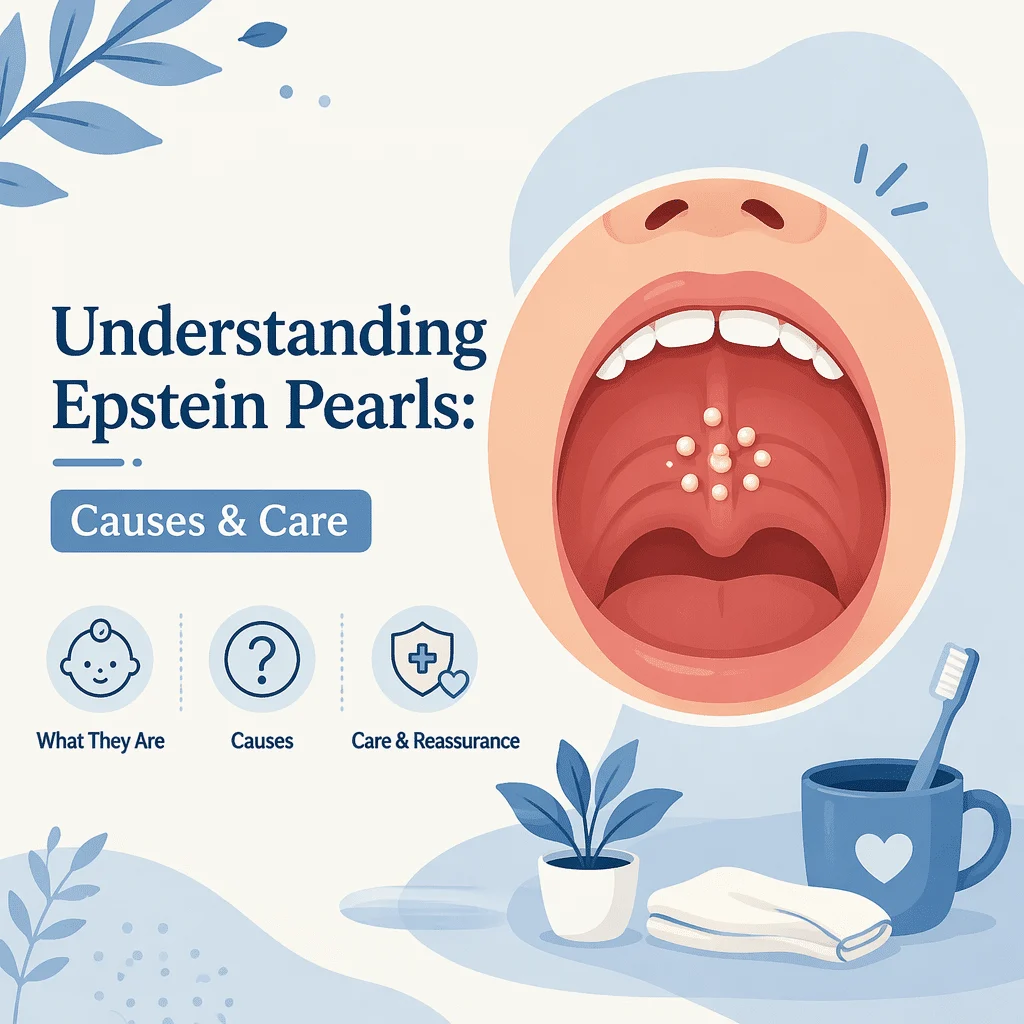
Epstein pearls are the small, pearly white bumps that many parents notice on the roof of a newborn’s mouth, and they are harmless. They are not teeth, not an infection, and not a sign that anything went wrong during pregnancy or delivery. They are tiny pockets of ordinary surface cells that were sealed in while the palate was forming before birth, and they clear on their own, usually within a few weeks, with no treatment at all. If you have just looked into your baby’s mouth and felt a jolt of worry, that worry can settle. In this article you’ll learn where Epstein pearls appear, why they form, how common they are, how to tell them apart from the handful of other white bumps that can show up in a baby’s mouth, and the specific signs that genuinely warrant a call to your pediatrician.
What Epstein pearls are, and why they are harmless
An Epstein pearl is a miniature cyst: a closed sac holding keratin, the tough protein that makes up the outer layer of skin and your fingernails. Nothing inside could infect, spread or turn into something else. The sac has no opening, no blood supply feeding a growth, and no inflammation around it. That is why every major pediatric reference lists observation as the only management step.
Where they show up in your baby’s mouth
Position is the most reliable clue. According to StatPearls, the NIH-hosted clinical reference, Epstein pearls sit on the hard palate, either along the midline seam that runs front to back down the roof of the mouth or at the junction where the hard palate meets the softer tissue further back. That midline seam is where two halves of the palate fused together before birth, which is precisely why cells get caught there.
Bumps on the gum ridges themselves have different names, covered below. The practical point: a white bump near the middle of the palate, in a baby days or weeks old, is overwhelmingly likely to be this one benign thing.
What they look and feel like
They are small: typically one to three millimeters across, roughly the size of a grain of coarse salt. They are white to pale yellow, firm rather than squishy, and they do not move under the surface when touched. They rarely appear alone. Clusters of two to six are the norm, which is why a first glance can look more dramatic than the finding actually is. They are often mistaken for a tooth pushing through, but a tooth has a hard edge and sits on the gum ridge, not on the palate.
Why Epstein pearls form
The explanation is developmental, not medical. Around the second month of pregnancy, the roof of the mouth forms as two shelves of tissue that grow toward each other and fuse along the midline. As they seal, a few surface cells get left behind inside the tissue instead of on top of it. Those stranded cells keep doing what surface cells do, which is produce keratin and shed. With nowhere to shed to, they accumulate into a tiny sealed pocket, and that pocket is the white bump you can see.
Nothing you did or did not do caused them
This bears saying plainly, because it is the unspoken question behind most searches. Epstein pearls are not related to what you ate, to medications, to how the birth went, to formula versus breast milk, or to how you clean your baby’s mouth. Studies that tested birth weight, maternal age, the baby’s sex, delivery method and pregnancy complications found no meaningful association with any of them. These are the same surface cells that turn up harmlessly in other routine findings, and we explain epithelial cells in a urine sample.
How common Epstein pearls are
Common enough that finding them is unremarkable. MedlinePlus, the patient reference from the U.S. National Library of Medicine, puts the figure at roughly four out of five newborns. Clinical surveys land in a similar range: StatPearls reports palatal cysts in about 30 to 50 percent of newborns and gum-ridge cysts in 13 to 50 percent, the spread reflecting how carefully and how early each study looked.
Full-term and premature babies
Both can have them. They are somewhat more frequent in babies born at term, which fits the developmental explanation, since the cysts form and become visible over the course of gestation. But they are far from absent in premature infants. A 2023 study of 341 premature newborns placed Epstein pearls among the ten most frequent skin and surface findings in that group. If your baby arrived early and has white bumps on the palate, that is an ordinary finding, not a complication of prematurity.
White bumps in a baby’s mouth: how to tell them apart
“Harmless” only helps once you are confident you are looking at the harmless thing. Six findings account for almost all pale bumps in an infant’s mouth. Five need nothing beyond a mention at the next visit. One, oral thrush, is a treatable infection, which is why this table is worth reading properly.
The most useful test you can do at home: does it wipe away?
Take a clean, damp cloth or a clean finger and wipe gently across the white area. An Epstein pearl is a sealed cyst under the surface, so it does not budge, does not smear, and leaves nothing behind. Thrush is a coating on top of the surface, so it partly wipes off and tends to leave a raw, reddened patch that can bleed a little. Mayo Clinic describes thrush lesions as looking like cottage cheese and notes slight bleeding when the patches are rubbed or scraped. Tissue that bleeds at the lightest touch has a medical name, and we explain friable tissue and why it matters. Wipe gently once, and do not scrub or repeat.
| White or pale bump | Typical location | What it looks like | Wipes away? | What to do |
|---|---|---|---|---|
| Epstein pearls | Roof of the mouth, along the midline seam or where hard and soft palate meet | One to three millimeters, white to pale yellow, firm, usually two to six clustered together | No | Nothing. Mention it at the next well-baby visit and expect it to fade over a few weeks |
| Bohn’s nodules | Cheek-side or tongue-side surface of the gum ridges | The same small firm white-yellow bumps, but on the gum surfaces rather than the palate | No | Nothing. Same benign course and same timeline |
| Dental lamina cysts | On the crest of the upper or lower gum ridge, where teeth will later come through | Small, smooth, dome-shaped, whitish, sometimes slightly translucent | No | Nothing. They do not delay teething |
| Oral thrush | Tongue, inner cheeks, lips, gums and palate, often several areas at once | Creamy white patches with a cottage-cheese texture; the tissue underneath can look red | Partly, leaving a raw red area that may bleed slightly | Call your pediatrician. This is a yeast infection and is usually treated with an antifungal such as nystatin |
| Natal or neonatal teeth | Emerging through the crest of the gum ridge, most often the lower front gums | A hard, tooth-shaped structure with a defined edge, sometimes loose | No | Have it looked at. Most are left in place, but a very loose tooth is checked for feeding and airway safety |
| Mucocele | Inner lip, inner cheek, or under the tongue | A soft, bluish or translucent blister that can change size from day to day | No | Have it looked at if it persists, grows, or gets in the way of feeding |
If you suspect thrush rather than Epstein pearls
Thrush is an overgrowth of Candida, a yeast that lives harmlessly in most bodies until conditions let it multiply. The American Academy of Pediatrics describes the resulting patches as painful and notes they can appear on the tongue, lips, gums, palate and inner cheeks. Treatment usually clears it in about two weeks, and unsterilized pacifiers or bottles are a common reason it returns. The same organism shows up in other test results, and we explain what yeast in a urine sample means.
How long Epstein pearls last
They go away on their own, and the timeline is reassuringly short. MedlinePlus states that Epstein pearls disappear within one to two weeks of birth. Clinical references allow a somewhat wider window: StatPearls describes spontaneous regression over a few weeks to a few months, and notes the lesions are rarely seen beyond three months of age.
The 2025 birth cohort described below put a firm number on the far end: essentially all of these cysts are gone by the first birthday, and most disappear far sooner.
There is nothing to watch for in the meantime and no milestone to track. The pocket of keratin works its way to the surface, opens, and the contents are swallowed with saliva. You will most likely never notice the moment it happens.
Caring for your baby at home
There is nothing to do, and doing nothing is the recommended care rather than a shrug. Even in the unusual cases described in the research below, watching and waiting is what specialists choose.
What not to do
- Do not pop, squeeze, lance or scrape them. There is no fluid to release, and breaking the surface introduces an infection risk where none existed.
- Do not apply teething gels, numbing products, antiseptics or home remedies. Epstein pearls are not painful, so there is nothing to numb.
- Do not rub the area repeatedly to check on it. Persistent friction can irritate delicate tissue.
Feeding is not affected
This is the worry most parents raise first, and the evidence on it is now clear. The 2025 birth cohort specifically tested whether these cysts interfered with breastfeeding in the first hour of life and at thirty days, and found no effect. The same study checked whether they delayed the arrival of the first teeth, and again found no effect. If your baby is feeding poorly, the Epstein pearls are not the reason and something else deserves attention.
Ordinary mouth care is enough
Keep to whatever gentle routine you already use: a clean, damp cloth over the gums once a day is plenty for a baby without teeth. Sterilize pacifiers and bottle nipples as usual, which lowers the chance of thrush arriving on top of a benign finding. Parents watching for a first tooth often read our guide to teething symptoms in babies.
When to call your pediatrician
Epstein pearls themselves are not a reason to call outside routine appointments; mention them at the next well-baby visit and that is enough. What follows covers the few situations where a white bump is not the explanation, or where something else is happening alongside it.
Reach out to your pediatrician if your baby has any of the following:
- White patches that partly wipe off and leave a raw or red area, or that spread across the tongue and inner cheeks, which points toward thrush rather than a cyst.
- Refusing to feed, feeding much less than usual, or pulling away and crying during feeds.
- A fever. In a baby under three months, any fever warrants a prompt call regardless of what else you have noticed.
- Bleeding from the mouth, or a bump that looks inflamed, red or swollen at its base.
- A bump that is growing, is noticeably larger than a few millimeters, or is soft and blister-like rather than small and firm.
- A bump still present after three months of age, or one that appears for the first time weeks after birth.
- Any hard, tooth-shaped structure on the gum ridge, especially if it feels loose.
- Noisy breathing, or any sense that a lesion is interfering with the airway.
Fever in a young baby has many possible sources, and we describe the signs of an ear infection. When a clinician needs to know whether an infection is bacterial, they may order an inflammation marker, and we explain C-reactive protein and what raised levels mean.
Latest scientific advances
Epstein pearls attract very little new research, and that itself is informative: the finding is so well established and so consistently harmless that there is nothing left to trial. Recent work is prevalence surveys, differential-diagnosis reviews and occasional case reports, not treatment studies. Here is what the past three years added, in plain terms.
A year-long study settled the feeding and teething questions
The most useful recent finding comes from a 2025 birth cohort in southern Brazil, which followed more than 1,100 mother and baby pairs from delivery through the first birthday. A cohort is simply a group followed over time rather than a snapshot. The researchers found these cysts in roughly seven of every ten newborns at birth, and in only about one in a hundred a year later. They also tested the two things parents ask about most, and found the cysts had no effect on breastfeeding and no effect on when the first teeth came through.
What this means for you: the two biggest practical worries now have a direct answer drawn from real babies tracked over a full year, and the answer to both is no.
Prevalence surveys confirm your baby is in the majority
A 2025 study of 241 healthy newborns in Quito, Ecuador, found some benign mouth finding in about seven in ten. Epstein pearls were the most common by a clear margin, present in around half of the babies examined, while natal teeth did not turn up at all.
What this means for you: whether your baby was born at term or early, white palate bumps put your baby with the majority, not the exception, which is worth knowing when a finding looks alarming precisely because you have never heard it named. Color changes elsewhere in the mouth have their own explanations, and we cover the causes of a black spot on the tongue.
Clinical guidance keeps pointing toward watchful waiting
A 2025 review in Pediatric Annals grouped oral inclusion cysts with the newborn findings that call for reassurance only, separating them from the small set requiring referral. A 2026 case report went further: faced with a newborn whose mouth cysts were unusually large and numerous, the team chose to watch rather than operate, and the lesions had reduced markedly by four months. That is one case, not a rule, so read it as encouraging rather than definitive.
What this means for you: if your pediatrician glances at the bumps and moves on without ordering anything, that is the guidance working as intended, not a corner being cut. The same question comes up constantly with skin growths, and we compare seborrheic keratosis and melanoma.
The naming confusion is a known problem
A 2023 review of pediatric oral pathology set out to untangle the overlapping terms used for newborn gum and palate cysts, noting that the names sound alike and the tissue features sometimes overlap. What this means for you: inconsistent terminology between two clinicians reflects the state of the vocabulary, not uncertainty about whether your baby is well.
Glossary
| Term | Definition |
|---|---|
| Alveolar ridge | The gum ridge, the band of firm tissue in the upper and lower jaw where teeth eventually come through. |
| Bohn’s nodules | Small benign cysts on the cheek-side or tongue-side surfaces of the gum ridges. Closely related to Epstein pearls and equally harmless. |
| Candida | A yeast that lives harmlessly in and on most human bodies. When it overgrows in the mouth it causes oral thrush. |
| Cohort study | A study design that follows the same group of people forward over time to see what happens to them, rather than taking a single snapshot. |
| Cyst | A closed sac of tissue with contents inside. Many cysts, including Epstein pearls, are entirely harmless and resolve on their own. |
| Dental lamina cyst | A small benign cyst on the crest of the gum ridge, arising from the tissue that goes on to form teeth. |
| Epithelial cells | The cells that form the surface lining of the skin, the mouth and other body surfaces. Trapped epithelial cells are what create Epstein pearls. |
| Keratin | A tough structural protein found in skin, hair and nails. It is the material that fills an Epstein pearl. |
| Mucocele | A soft, often bluish swelling caused by a blocked or injured saliva gland, usually on the inner lip or cheek. |
| Natal teeth | Teeth already present at birth, or in the first month of life. Uncommon, and unrelated to Epstein pearls despite sometimes being confused with them. |
| Palate | The roof of the mouth. The front portion is the bony hard palate; the rear portion is the flexible soft palate. |
Frequently asked questions
Are Epstein pearls normal, or a sign that something is wrong?
They are normal, and they are one of the most common findings in a newborn’s mouth. MedlinePlus describes them as harmless and puts them in roughly four out of five newborns, and recent newborn surveys found some benign mouth finding in around seven in ten babies examined. They are not associated with birth weight, the baby’s sex, maternal age, delivery method or pregnancy complications. Nothing about their presence suggests a problem with your baby’s health, growth or development, and they require no treatment.
Do Epstein pearls hurt my baby?
No. They are painless. They sit under an intact surface, they are not inflamed, and there are no nerve endings being pressed on. A baby with Epstein pearls feeds, sleeps and behaves exactly as a baby without them. If your baby does seem to be in discomfort in the mouth, is refusing feeds, or is unusually fussy during feeding, look for a different explanation and speak to your pediatrician. Thrush, for instance, does cause real soreness, which is one of the practical differences between the two.
Can adults get Epstein pearls?
Not in the true sense. Epstein pearls are specifically a newborn finding, formed by cells trapped during the development of the palate before birth, and they clear during infancy. Adults who notice a firm white bump on the roof of the mouth are almost certainly looking at something else, such as a bony ridge called a torus palatinus that is also harmless, a mucocele, or an irritated area. Any persistent lump in an adult mouth should be examined rather than assumed benign, and we describe HPV lesions on the tongue.
My baby is a year old and still has a white bump on the gums. Could it still be an Epstein pearl?
It is unlikely. These cysts are rarely seen beyond three months of age, and by twelve months the 2025 birth cohort found them in only about one or two babies in a hundred. A white or pale bump that is still there at a year deserves a proper look, not because it is likely to be serious, but because the odds now favor a different explanation, such as an eruption cyst over a tooth about to come through, a mucocele, or thrush. Bring it up at the next appointment and let a clinician identify it.
Why are they called Epstein pearls?
They are named after Alois Epstein, the Czech pediatrician who described them in the nineteenth century, and “pearls” reflects how they look: small, round and pale, sitting on the roof of the mouth. The name is descriptive rather than diagnostic, which is part of why several other labels exist for the same family of finding, including palatal cysts of the newborn and oral inclusion cysts. If two clinicians use two different words for your baby’s bump, that is a vocabulary difference, not a disagreement about the diagnosis.
Can Epstein pearls come back after they disappear?
No. Once a pearl works its way to the surface and empties, that particular cyst is gone for good and does not refill. What can happen is that one cyst clears while another in the same cluster is still visible, which can give the impression that a bump has returned. If a genuinely new white bump appears weeks or months after birth, in a mouth that had cleared, treat it as a new finding worth mentioning to your pediatrician rather than a returning Epstein pearl. Newborn skin and surface tissue produce plenty of harmless findings too, and we review the common causes of a skin rash.
Sources
- U.S. National Library of Medicine — Epstein pearls — MedlinePlus Medical Encyclopedia — https://medlineplus.gov/ency/article/001603.htm
- Daley JO, Mendez MD — Palatal and Gingival Cysts of the Newborn — StatPearls, NCBI Bookshelf, 2025 — https://www.ncbi.nlm.nih.gov/books/NBK493177/
- American Academy of Pediatrics — Thrush and Other Candida Infections — HealthyChildren.org — HealthyChildren.org
- Mayo Clinic — Oral thrush: Symptoms and causes — https://www.mayoclinic.org/diseases-conditions/oral-thrush/symptoms-causes/syc-20353533
- Kramer PF, Scharlau JMM, de Barros Coelho EMR, Dos Santos GFK, Gonçalves EJL, Feldens CA — Oral inclusion cysts: a prospective cohort study on distribution, associated factors and prognosis in the first year of life — European Archives of Paediatric Dentistry, 2025 — https://doi.org/10.1007/s40368-025-01148-w
- Vélez-León E, Guerrero E, Carrillo MO, Cabrera M, Tello G, Pinos P — The Prevalence of Oral Anomalies Among Healthy Newborns at a Gynecological Obstetric Hospital in Quito, Ecuador: An Observational, Cross-Sectional Study — Dentistry Journal, 2025 — https://doi.org/10.3390/dj13040158
- Reeves S, Kamat D — Common Congenital Anomalies — Pediatric Annals, 2025 — https://doi.org/10.3928/19382359-20250612-06
- Lara FR, Chen JL, Shehan JN, Levi JR — An Unusual Case of Bilateral Upper and Lower Oral Cavity Cysts in a Newborn — HCA Healthcare Journal of Medicine, 2026 — https://doi.org/10.36518/2689-0216.2358
- Summersgill KF — Pediatric Oral Pathology: Odontogenic Cysts — Pediatric and Developmental Pathology, 2023 — https://doi.org/10.1177/10935266231176245
- Zanatta DA, Carvalho VO, da Silva RPGVC — What the skin of 341 premature newborns says: a transversal study — Jornal de Pediatria, 2023 — https://doi.org/10.1016/j.jped.2023.04.005
Further reading
- Canker sores: causes, symptoms and treatments
- Eczema and how it affects the skin
- Lymphocytes and their role in the immune system
- Procalcitonin, a marker of bacterial infection
- What happens during a blood test
Understand your lab results with AI DiagMe
Epstein pearls need no testing at all, which is one of the genuinely good pieces of news in newborn care. But when a bump in the mouth turns out to be an infection rather than a harmless cyst, or when a fever arrives alongside it, a doctor may order a blood count, a C-reactive protein or procalcitonin level to gauge inflammation, or a swab culture to identify the organism. Those reports come back full of numbers and abbreviations that are rarely explained. AI DiagMe reads your lab results and puts them in plain language, so you can arrive at the appointment understanding what was measured and what the values mean. It helps you understand your results; it does not diagnose, and it does not replace your doctor.
Get your results interpreted in minutes