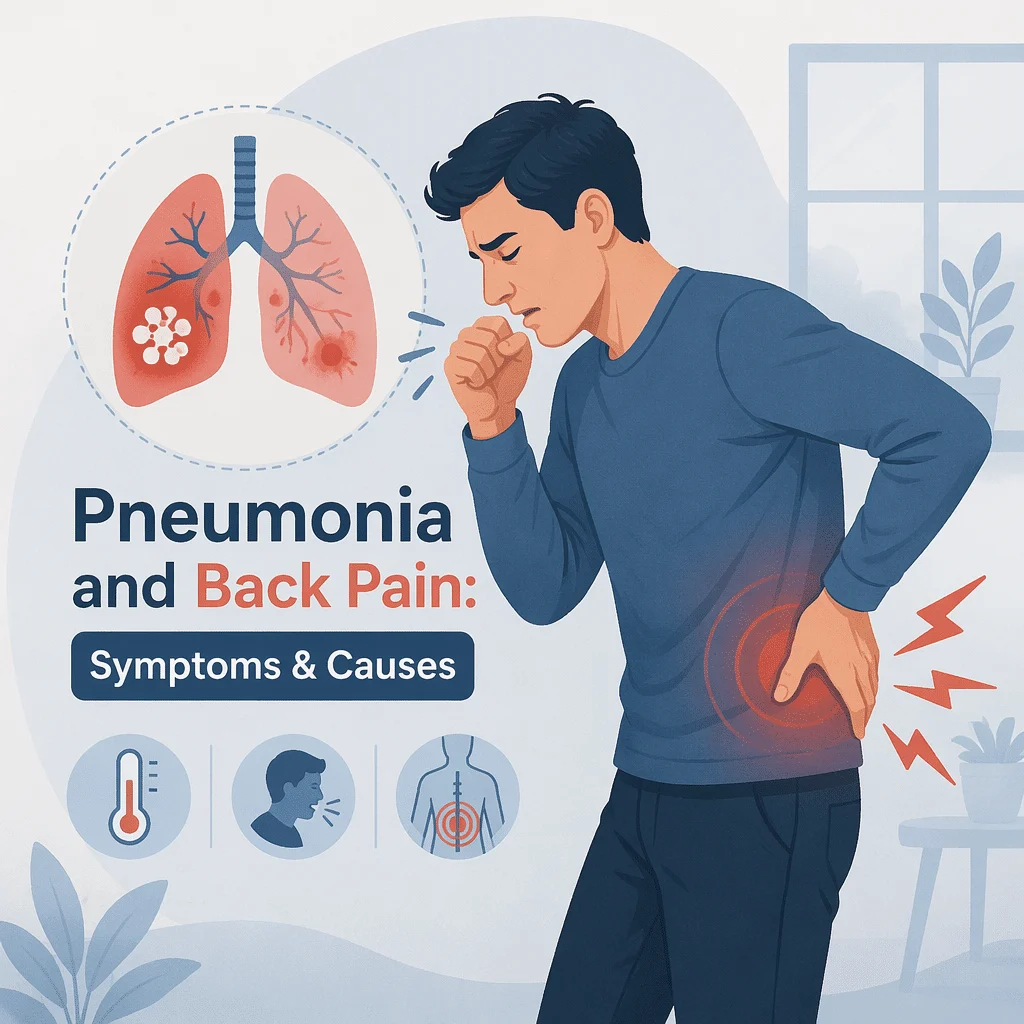
Pneumonia and back pain turn up together far more often than most people expect, and the pairing is unsettling: a chest infection is supposed to hurt in the chest. The explanation is anatomical. Lung tissue itself carries almost no pain nerves, so an infection is only felt once the inflammation reaches the membrane wrapped around the outside of the lung. When the affected part of the lung sits low down or toward the back of the rib cage, the pain is felt in the back rather than the front. In this article you’ll learn why the two are linked, what the pain feels like, which conditions look similar, the warning signs that need urgent attention, and which blood tests help doctors separate an infection from everything else.
Why pneumonia and back pain occur together
The lungs themselves cannot feel pain
The deep tissue of the lung, including the alveoli where oxygen crosses into the blood, contains virtually no pain fibers. Those air sacs can fill with infected fluid and hurt not at all. What does carry pain fibers is the pleura, the thin double membrane wrapping each lung. Its inner layer is largely insensitive; its outer layer, the parietal pleura, lines the inside of the chest wall and is densely supplied with nerves. Pain appears once inflammation reaches that outer layer and the two irritated surfaces rub together with every breath. Doctors call this pleuritic pain, and it explains almost everything else here.
Where the pain lands depends on which part of the lung is affected
The parietal pleura reports pain to the section of chest wall directly above it, so the ache tracks the infection. An upper lobe pneumonia tends to be felt at the front of the chest. A lower lobe, or a posterior segment sitting against the back of the rib cage, is felt between or below the shoulder blades, along the flank, or across the mid back. That is why upper back pain, not chest pain, is often what people notice first.
One extra pattern is worth knowing. The central diaphragm sends its sensation through the phrenic nerve, which enters the spinal cord high in the neck, at levels C3 to C5. When inflammation irritates that region, the brain misreads the signal and the pain is felt at the tip of the shoulder. Johns Hopkins Medicine describes the same spread of pleuritic pain toward the shoulder or the back.
What the pain actually feels like
Pleuritic pain has a recognizable character. It is usually sharp or stabbing rather than dull, clearly worse on a deep breath, a cough or a sneeze, and it often eases when you breathe shallowly or lie on the painful side. People describe holding themselves still to avoid a full breath.
A second, more mechanical source of back pain runs alongside it. Days of forceful coughing strain the intercostal muscles between the ribs and the long muscles either side of the spine. That pain is duller, spread wider, tender when pressed, and worse on twisting than on breathing. Both can be present at once, which is part of why the symptom feels so confusing. Our library also explains the causes of rib cramps.
Milder infections, often called walking pneumonia, can produce aching across the back and chest with only a dry cough and unusual tiredness. That is why some people report back pain with barely any cough, and why a mild picture should not be dismissed.
The symptoms that travel with pneumonia and back pain
The most useful single point in this article: in pneumonia, back pain almost never travels alone. It sits inside a cluster of symptoms pointing to a chest infection.
- Fever and chills, sometimes with violent shaking
- A cough, often bringing up thick yellow, green or rust-colored phlegm
- Breathlessness, or breathing noticeably faster than usual
- Marked fatigue, weakness and loss of appetite
- A fast heartbeat, sometimes with sweating
MedlinePlus lists chest pain when you breathe or cough among the standard symptoms of pneumonia, alongside fever, chills and shortness of breath. Isolated back pain with normal breathing, no fever and no cough is far more likely to have another cause. Because early viral illness overlaps heavily, a separate guide sets out the symptoms of influenza.
One exception matters. The National Heart, Lung, and Blood Institute notes that older adults and people with serious illness or weakened immunity may not show the typical picture: they may run a lower than normal temperature instead of a fever, and may simply feel weak or suddenly confused. New confusion in an older adult with any respiratory symptom deserves a same-day assessment.
Pneumonia and back pain versus the main look-alikes
Several conditions produce back pain that resembles a chest infection.
| Condition | Where the pain is felt | What it feels like | Usual companions |
|---|---|---|---|
| Pneumonia with pleural irritation | Mid or lower back, flank or between the shoulder blades, on the infected side | Sharp or stabbing, clearly worse on a deep breath or a cough | Fever, chills, productive cough, breathlessness, fatigue |
| Muscle or rib strain | Broad area of the back, tender to press on | Dull and aching, worse on twisting or pressing | Recent coughing bout, exertion or injury; no fever |
| Kidney infection or kidney stones | Flank below the ribs, one side, sometimes radiating to the groin | Deep, cramping or wave-like; not linked to breathing | Burning on urination, urgency, blood in the urine, fever if infected |
| Shingles | A band on one side of the trunk, following a single nerve | Burning, tingling or electric; skin sensitive before any rash | Rash appearing days later; no cough or breathlessness |
| Pulmonary embolism | Chest or back, on one side | Sharp and pleuritic, but starting abruptly | Sudden breathlessness, fast heart rate, coughing blood, leg swelling |
| Aortic emergency | Between the shoulder blades or in the mid back | Tearing or ripping, maximal within seconds | Sweating, faintness, looking severely unwell |
Three rows deserve attention. Our library sets out the warning signs of a pulmonary embolism, which can imitate pleuritic pneumonia pain almost exactly but begins abruptly and is an emergency. Separate articles describe the typical signs of kidney stones and the symptoms of a urinary tract infection. Shingles can hurt for days before anything shows on the skin, and one guide covers the early symptoms of shingles.
Red flags that mean urgent care
Call emergency services or go to an emergency department if back or chest pain comes with any of the following.
- Breathlessness at rest, or being unable to finish a sentence in one breath
- New confusion, drowsiness or difficulty waking, especially in an older adult
- Blue or gray lips, face or fingertips
- Chest pain that starts suddenly together with sudden breathlessness
- Coughing up blood
- A high fever with violent shaking chills
- Tearing pain between the shoulder blades that peaks within seconds
One caution runs through the list: the absence of fever is not reassurance. Older adults, people on immune-suppressing medication and people receiving chemotherapy can develop serious pneumonia with a normal or even low temperature. A low temperature in someone who looks unwell is itself a warning sign.
The lab tests that help doctors tell infection from everything else
Blood tests that point toward infection
No blood test diagnoses pneumonia by itself; blood work shifts the probabilities, and knowing what each result can and cannot settle makes a report less frightening. The first test ordered is usually a full blood panel, and our team explains how to read a complete blood count. A rise in white cells, particularly neutrophils, suggests the immune system is fighting a bacterial infection, though the same pattern appears with other stresses; a dedicated article covers what high neutrophil counts mean. A normal white cell count does not rule out pneumonia, and very low counts in an unwell person are a concern in their own right.
C-reactive protein rises within hours of significant inflammation and falls as it settles, which makes it better for tracking progress than for naming a cause. Our library details the causes of high CRP levels. Procalcitonin rises more selectively in bacterial infection, and one guide explains the procalcitonin infection marker. Blood cultures, which grow bacteria from a blood sample, are reserved for people ill enough to be admitted to hospital and are often negative even in genuine pneumonia.
Where imaging and other tests fit
A chest X-ray, not a blood test, is what confirms pneumonia, by showing the shadow of fluid and inflammation in a segment of lung. It also shows which lobe is affected, explaining where the pain is felt. A CT scan is used when the X-ray is unclear, and pulse oximetry, the fingertip clip, measures how well oxygen reaches the blood. When a clot in the lung is a serious possibility, doctors may add the D-dimer blood test.
Latest scientific advances
Research from the last three years has refined how clinicians judge severity, decide on antibiotics and think about recovery. None of it changes what you should do about your own symptoms.
Severity scoring has been compared head to head. A 2023 meta-analysis, a study that pools many earlier studies, examined two bedside tools, the Pneumonia Severity Index and CURB-65, and found both identify high-risk patients well, with CURB-65 slightly better at flagging those needing intensive care. What this means for you: questions about confusion, breathing rate, blood pressure and age are part of a validated calculation, not a guess.
Older adults remain the hardest group to assess. A 2026 review of pneumonia in frail older adults found the illness often shows up with vague, atypical signs, and that standard severity scores work less well here because outcomes depend as much on frailty and general health as on the infection. What this means for you: an older relative who is simply confused, weak or off their food may need to be seen even without a fever.
Biomarker-guided antibiotic decisions are real but not automatic. A 2023 review of procalcitonin concluded it should not be used as a standalone diagnostic test: a low result helps rule out bacterial infection only in people already at low risk, and anyone seriously unwell needs antibiotics regardless of the number. A large 2025 intensive care trial combining rapid multi-pathogen testing with procalcitonin did not reduce overall antibiotic exposure compared with usual care, though total days on antibiotics were fewer. What this means for you: laboratory numbers support clinical judgment rather than replacing it.
Recovery is finally being studied properly. A 2026 review of non-antibiotic support after community-acquired pneumonia found that breathing physiotherapy, early movement and good nutrition may shorten hospital stays and reduce readmissions, though the evidence is uneven. What this means for you: lingering tiredness and back soreness for weeks after pneumonia is a recognized part of recovery.
Glossary
| Term | Definition |
|---|---|
| Alveoli | The microscopic air sacs where oxygen passes into the blood. Pneumonia fills them with fluid and immune cells. |
| Pleura | The thin double membrane that wraps each lung and lines the chest wall, with a lubricating film between the layers. |
| Parietal pleura | The outer layer, attached to the chest wall. It is richly supplied with nerves and is the actual source of the pain. |
| Pleuritic pain | Sharp chest, flank or back pain that worsens on a deep breath, a cough or a sneeze. |
| Phrenic nerve | The nerve supplying the diaphragm. Because it originates high in the neck, irritation there can be felt at the shoulder tip. |
| Lobe | One of the large divisions of a lung, three on the right and two on the left. Which lobe is infected influences where pain is felt. |
| C-reactive protein (CRP) | A blood protein that rises quickly with inflammation of any cause and falls as it settles. |
| Procalcitonin | A blood marker that rises more selectively in bacterial infection and is used to support, not replace, decisions about antibiotics. |
| CURB-65 | A bedside score using confusion, breathing rate, blood pressure, a kidney result and age of 65 or over to estimate severity. |
Frequently asked questions
Can pneumonia cause back pain without a cough?
It can, though it is uncommon. Milder infections sometimes begin with pleuritic aching in the back or side, fatigue and a low fever before any cough develops. What matters is the rest of the picture: back pain with breathlessness, fever or unusual exhaustion should be assessed even without a cough. Back pain on its own points more toward a muscular, spinal or kidney cause.
Where in the back is pneumonia pain usually felt?
Most often on one side, in the mid or lower back, along the flank or between the shoulder blades, matching the inflamed part of the lung. Lower lobe infections sit against the back of the rib cage, so they refer pain there rather than to the front. The pain intensifies on a deep breath; pain that is central and unchanged by breathing is less typical.
Can walking pneumonia cause back pain?
Yes. Walking pneumonia is an informal term for a milder infection that does not confine someone to bed, often caused by bacteria such as Mycoplasma pneumoniae. It can still irritate the pleural surface, producing aching or sharp back and chest pain with a dry cough, headache and prolonged tiredness. Because the person keeps functioning, it is often blamed on a pulled muscle rather than the lungs.
How long does back pain last after pneumonia?
Pleuritic pain usually improves within one to two weeks as the inflammation settles, often earlier than the cough does. Muscular soreness from coughing can persist longer, and general fatigue may take several weeks to resolve. Pain still worsening after two weeks, returning after improving, or arriving with a new fever should be reassessed rather than waited out.
Is back pain alone enough to suspect pneumonia?
Generally no. Pneumonia is a whole-body illness, and back pain is one feature among several rather than the presenting complaint. The combination that should raise suspicion is back or side pain that hurts more on breathing, together with fever, cough, breathlessness or unusual fatigue. In older adults the threshold is lower, because fever may be absent. Only an examination and a chest X-ray can confirm the diagnosis.
Sources
- National Heart, Lung, and Blood Institute — Pneumonia Symptoms — National Institutes of Health — nhlbi.nih.gov
- MedlinePlus — Pneumonia — U.S. National Library of Medicine — medlineplus.gov
- Johns Hopkins Medicine — Pleurisy — hopkinsmedicine.org
- Zaki HA, et al. — The Battle of the Pneumonia Predictors: A Comprehensive Meta-Analysis Comparing the Pneumonia Severity Index (PSI) and the CURB-65 Score in Predicting Mortality and the Need for ICU Support — Cureus, 2023 — pubmed.ncbi.nlm.nih.gov
- Komiya K, et al. — Pneumonia in frail older adults: from diagnosis to optimized management — Journal of Infection and Chemotherapy, 2026 — pubmed.ncbi.nlm.nih.gov
- Schuetz P — How to best use procalcitonin to diagnose infections and manage antibiotic treatment — Clinical Chemistry and Laboratory Medicine, 2023 — pubmed.ncbi.nlm.nih.gov
- Voiriot G, et al. — Combined use of a multiplex PCR and serum procalcitonin to reduce antibiotic exposure in critically ill patients with community-acquired pneumonia: the MULTI-CAP randomized controlled trial — Intensive Care Medicine, 2025 — pubmed.ncbi.nlm.nih.gov
- Lansbury L, et al. — Non-antimicrobial interventions in recovery from community-acquired pneumonia in adults — Current Opinion in Infectious Diseases, 2026 — pubmed.ncbi.nlm.nih.gov
Further reading
- How to read your blood test results
- Normal blood test ranges explained
- The ESR blood test and what a sed rate shows
- Tingling in the chest and its causes
- Asthma symptoms, triggers and tests
Understand your lab results with AI DiagMe
Back pain during a respiratory illness raises a question a symptom list cannot answer: is there really an infection, and how significant is it? That is where a lab report helps, and where AI DiagMe fits in. Upload a blood panel and the platform explains, in plain language, what your white cell and neutrophil counts, your CRP level and your inflammation markers actually indicate. It is built to help you understand your results, not to diagnose you, and it never replaces the doctor who examines you.
Get your results interpreted in minutes