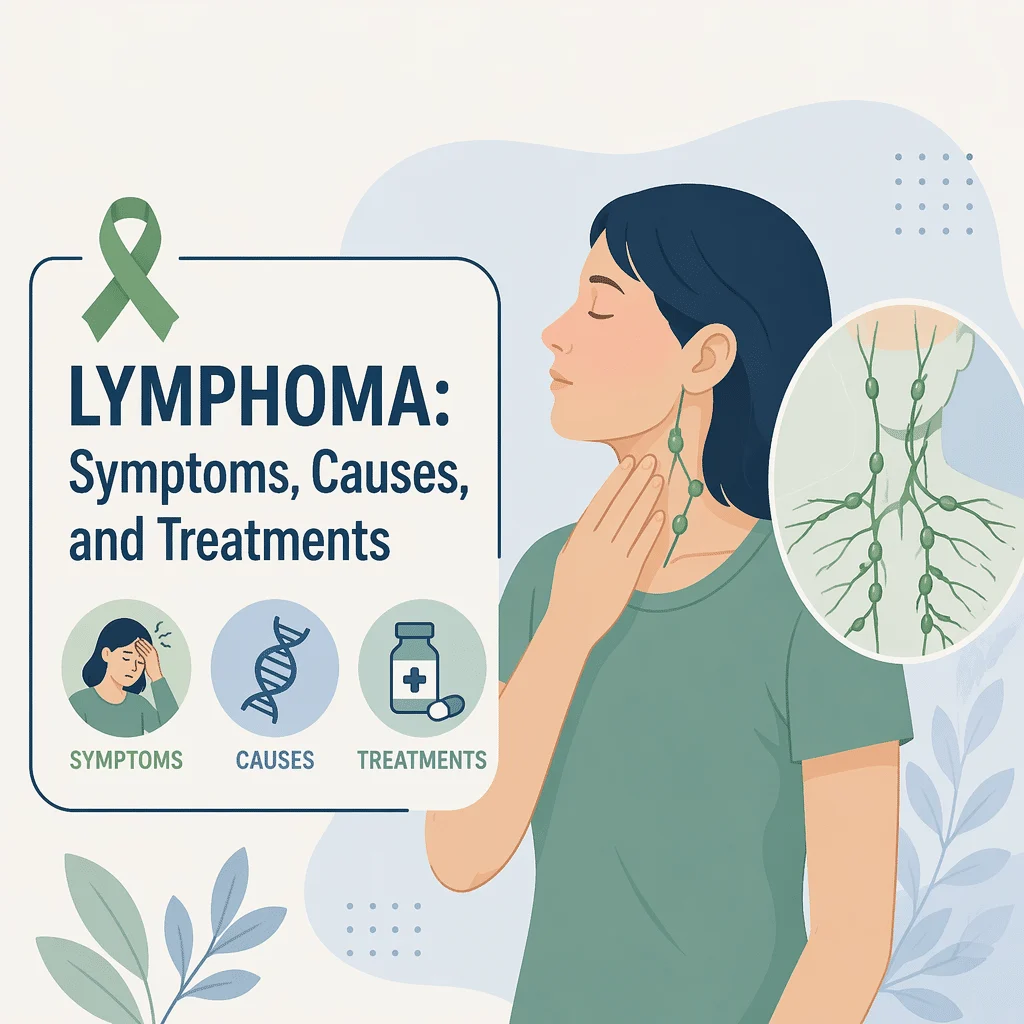
Lymphoma symptoms are easy to overlook, because the most common one, a swollen lymph node, is usually caused by something ordinary such as an infection. Lymphoma is a cancer beginning in the lymphatic system, the network of vessels, nodes and organs that helps the body fight infection and drain fluid. It is not one disease but a family of related conditions, several of which respond very well to treatment.
In this article you will learn which lymphoma symptoms deserve a medical assessment, how Hodgkin and non-Hodgkin lymphoma differ, what actually confirms the diagnosis (a biopsy, never a blood test on its own), what blood tests can and cannot show, and where treatment stands today.
What lymphoma is and where it starts
Lymph flows through thin vessels linking hundreds of small filtering stations called lymph nodes to the spleen, the thymus, the tonsils and the bone marrow. The cells patrolling this network are lymphocytes, white blood cells divided into B cells and T cells. Lymphoma begins when one lymphocyte acquires genetic changes, stops dying when it should, and multiplies. Because lymphocytes travel everywhere, it can appear in the neck, the chest or abdomen, or occasionally in an organ such as the stomach or the skin.
That is why lymphoma behaves differently from a solid tumor. It is not confined to one site, so surgery is almost never the treatment: therapy must reach lymphocytes wherever they went.
The two main families: Hodgkin and non-Hodgkin
Pathologists sort lymphomas into two families, and the split is not academic: it changes the drugs, the schedule, the monitoring and the expected outcome. Hodgkin lymphoma is defined by a distinctive abnormal cell, the Reed-Sternberg cell. Everything else is non-Hodgkin lymphoma, the larger and far more varied group. Among its subtypes, diffuse large B-cell lymphoma is the most frequently diagnosed and grows quickly, while follicular lymphoma is typically slow-growing.
| What differs | Hodgkin lymphoma | Non-Hodgkin lymphoma |
|---|---|---|
| How common it is | The less common of the two | The more common of the two |
| What the pathologist sees | Reed-Sternberg cells, a distinctive abnormal cell, are the hallmark | No Reed-Sternberg cells; many subtypes, grouped mainly as B-cell or T-cell |
| Typical age pattern | Often diagnosed in teenagers and young adults, with a second rise later | Risk climbs steadily with age |
| How it usually spreads | Tends to move in order from one node group to the next | May appear in several node groups, or outside the nodes, at once |
| Usual treatment approach | Chemotherapy, sometimes with radiation, adjusted using scans done during treatment | Depends on the subtype: monitoring, chemoimmunotherapy, radiation or cell therapy |
| General outlook | Often curable, particularly when found and treated early | Varies by subtype; several are curable, others managed as long-term conditions |
Aggressive or indolent: the distinction that shapes treatment
Hematologists also describe lymphomas as aggressive or indolent. An aggressive lymphoma grows fast and causes symptoms within weeks, so treatment starts almost immediately, with the intention of cure. An indolent lymphoma may grow over years and often responds to treatment without ever being fully eliminated. That is why two people can leave the same clinic on the same day, one starting chemotherapy next week and the other booked for a check-up in three months. Neither has been neglected: the second approach is a deliberate strategy called active monitoring.
Lymphoma symptoms: the signs that matter most
The National Cancer Institute lists a recognizable cluster of lymphoma symptoms, and the pattern matters more than any single item. What follows is the classic presentation, not a checklist anyone will match exactly.
Painless swollen lymph nodes
The most frequent first sign is a lump in the neck, above the collarbone, in an armpit or in the groin. It does not hurt, it feels firm rather than squashy, and it does not come and go with a cold. Nodes deeper in the chest or abdomen cause no lump at all and may instead produce a persistent cough, breathlessness, fullness after small meals, or back discomfort. Our team also explains lymphoma behind the knee, an uncommon location.
The B symptoms
Cancer teams give a formal name to three systemic symptoms, because their presence changes how the disease is staged: drenching night sweats that soak bedding, fever with no infection to explain it, and unexplained weight loss over six months without dieting. The word drenching is deliberate. It means changing the sheets, not throwing off a blanket.
Itching, fatigue and one unusual clue
Persistent itching without a rash affects a minority of patients, particularly in Hodgkin lymphoma, and can precede other lymphoma symptoms by months. Fatigue is common but too non-specific to point anywhere alone. One striking clue, described occasionally in Hodgkin lymphoma, is pain in a swollen node within minutes of drinking alcohol. Its absence means nothing, but noticing it is worth mentioning.
When a swollen lymph node needs a doctor assessment
This is the question that brings most people here, so it deserves a direct answer. Swollen lymph nodes are extremely common, usually the immune system doing its job against an infection, and they usually settle within a few weeks. A tender, mobile node that appears with a sore throat and shrinks over the following days is behaving exactly as expected.
Clinicians look more closely when a node shows these features:
- It is painless and firm, and does not move easily under the skin.
- It is growing rather than shrinking week by week.
- It measures more than roughly two centimeters, the width of a grape.
- It has persisted beyond two to four weeks with no infection to explain it.
- It sits above the collarbone, a location that is always worth checking.
- It comes with any of the B symptoms, whatever its size.
None of these proves lymphoma, and most people examined for them turn out to have something benign. They mark the point at which examination and, if needed, imaging become sensible.
Risk factors for lymphoma, and what they do not mean
Most people diagnosed with lymphoma have no identifiable cause, and the reverse matters even more: the large majority of people carrying risk factors never develop the disease. Risk factors shift the odds slightly across a population, not for an individual.
- Age. Risk rises with age for most non-Hodgkin subtypes, while Hodgkin lymphoma also peaks early in young adults.
- A weakened immune system, from an inherited condition, an organ transplant or long-term immunosuppressive medication.
- Certain infections, including Epstein-Barr virus, HIV, hepatitis C and the stomach bacterium Helicobacter pylori. Our library explains HIV testing and treatment.
- Autoimmune conditions such as rheumatoid arthritis, Sjogren syndrome or celiac disease. We also cover rheumatoid arthritis and its diagnosis.
- A family history of lymphoma, which raises risk modestly without being passed down like an inherited disease.
No lifestyle change and no supplement has been shown to prevent lymphoma. What is within reach is treating the treatable infections and keeping any autoimmune condition controlled.
How doctors actually confirm a lymphoma diagnosis
The pathway begins with a physical examination of the node areas, the abdomen and the spleen, then blood work and imaging such as an ultrasound or a CT scan. None of that confirms anything. According to the National Cancer Institute, the diagnosis is made when a pathologist examines lymph node tissue under a microscope.
Why the type of biopsy matters
This detail is often missed. Diagnosing lymphoma depends on seeing how the cells are arranged inside the node, not on identifying individual cells. An excisional biopsy, removing the whole node, is the reference method. A core needle biopsy, taking a small intact cylinder of tissue, can suffice when the node is deep or surgery is risky. A fine-needle aspiration draws out loose cells only, destroying that architecture, and cannot reliably diagnose or subtype a lymphoma. If a fine-needle sample was reassuring but a node keeps growing, it is reasonable to ask about a larger biopsy.
Staging, and what happens after the diagnosis
Once lymphoma is confirmed, a PET-CT scan maps where the disease sits and how active it is. Some subtypes also call for a bone marrow biopsy from the hip. Staging is not a verdict on survival: it is a map used to choose treatment intensity and to give a reference point for later scans. B symptoms are recorded as part of the stage.
What blood tests can and cannot tell you about lymphoma
No blood test diagnoses lymphoma, and no normal blood test rules it out. People with early lymphoma frequently have a completely normal panel. Blood tests describe the situation around the disease: how the bone marrow is coping, how much tissue is turning over, and whether treatment can safely begin.
The panels most often ordered
- Complete blood count. It can reveal anemia, a low platelet count or an abnormal white cell pattern when the bone marrow is involved. Our team explains how to read a complete blood count.
- Lymphocyte count. It may be high, low or normal in lymphoma, so it cannot stand alone. AI DiagMe covers high lymphocyte counts and low lymphocyte counts separately.
- LDH, or lactate dehydrogenase. It rises when cells break down quickly and feeds risk scores for aggressive lymphomas. Our library explains the LDH blood test and its interpretation.
- Erythrocyte sedimentation rate. This inflammation marker is used mainly in Hodgkin lymphoma to help grade risk. We also describe the erythrocyte sedimentation rate.
- Beta-2 microglobulin. A small protein whose level can reflect how much disease is present. AI DiagMe covers the beta-2 globulins blood test.
Because these markers overlap with other blood cancers, patients often ask how the picture differs from leukemia. Our library covers the blood tests used in leukemia.
Infection screening before treatment starts
One group of blood tests has a practical purpose. Before antibody-based treatment begins, teams screen for hepatitis B, hepatitis C and HIV, because drugs that deplete B cells can let a dormant hepatitis B infection reactivate. Our team also explains the hepatitis B surface antigen test. Heart, kidney and liver function are checked at the same time, since they determine safe drug doses.
Treatment options for lymphoma
Treatment is chosen from the subtype, the stage, the symptoms and the person, so two people with the same diagnosis may follow different paths. Your hematologist works from your pathology report, not from an article.
Active monitoring
For some indolent lymphomas causing no symptoms, the evidence supports observing rather than treating, with regular examinations and scans, and starting therapy when the disease progresses. It feels counterintuitive and is hard to accept. It exists because treating earlier in these subtypes has not been shown to help people live longer, while it does expose them to side effects sooner.
Chemoimmunotherapy and radiation
Most aggressive lymphomas are treated with chemotherapy plus an antibody targeting a marker on the lymphoma cells, most often CD20 on B cells. Radiation may be added to a limited area, particularly in early-stage Hodgkin lymphoma. Treatment runs in cycles over several months, with scans partway through. According to the National Cancer Institute, Hodgkin lymphoma can usually be cured when found and treated early, and several non-Hodgkin subtypes are also curable, although outcomes vary from person to person.
Cell therapy and bispecific antibodies
When an aggressive B-cell lymphoma comes back or does not respond, two newer options may be considered. CAR T-cell therapy collects a patient T cells, reprograms them in a laboratory to recognize the lymphoma, and gives them back. Bispecific antibodies grab a T cell with one arm and a lymphoma cell with the other. Both carry side effects requiring experienced centers, and both apply only to particular subtypes and points in the treatment path, not as alternatives to first-line treatment.
Latest scientific advances
Research has moved quickly over the past three years. The findings below were published between 2023 and 2026. All apply to specific subtypes and situations, most often aggressive B-cell lymphoma already treated once, and none changes what happens at a first appointment for a swollen node.
Bispecific antibodies moved from trials into everyday practice
What was found: two ready-made antibody drugs, glofitamab and epcoritamab, were approved for diffuse large B-cell lymphoma that came back after earlier treatment, and a 2025 review in Haematologica traced how they work. A separate 2025 study in Blood followed 245 patients treated with them in ordinary American hospitals rather than in trials. Roughly half responded, close to the trial figures, but remissions tended to be shorter, partly because these patients were sicker. Results were poorer when the CD20 marker the drugs rely on had disappeared.
What this means for you: these drugs are a genuine option for some people whose lymphoma has returned, with no personalized cell product to manufacture. They are not a first treatment, and the researchers are clear that a lasting cure with them alone has not yet been shown.
CAR T-cell therapy earned a place earlier in the treatment path
What was found: a randomized trial reported in the New England Journal of Medicine in 2023 followed people whose large B-cell lymphoma relapsed early or never responded to first treatment. Those given CAR T-cell therapy second were more likely to be alive four years later than those given the older approach of salvage chemotherapy plus a stem cell transplant. A 2024 review comparing the two modern immune therapies noted that CAR T-cell therapy has produced long-lasting, disease-free outcomes in a meaningful minority.
What this means for you: for the specific group whose lymphoma returns quickly, moving cell therapy earlier is now supported by strong evidence. It remains a demanding treatment at specialized centers, and eligibility is decided case by case.
A blood test that tracks lymphoma DNA is being studied for follow-up
What was found: a 2025 study in the Journal of Clinical Oncology pooled five trials and looked for circulating tumor DNA, tiny fragments of lymphoma genetic material floating in the blood, after standard first treatment. Almost everyone with no detectable fragments stayed free of the disease, while most of those with detectable fragments relapsed or died. This measurement predicted what happened next more accurately than the PET scan alone.
What this means for you: this is a research tool rather than a routine test, not yet part of standard follow-up in most hospitals. If your team mentions it, it refines the definition of remission rather than replacing your scans.
Scan-guided treatment adjustment in Hodgkin lymphoma
What was found: in Hodgkin lymphoma, a scan performed partway through chemotherapy decides whether to drop a drug with lung side effects or to intensify treatment. A 2025 real-world report followed 169 patients treated this way outside a trial and found most did well over several years, in line with the trial that established the approach. Based on a single center, it confirms rather than extends what was known.
What this means for you: a scan in the middle of treatment does not mean something has gone wrong. It is a planned decision point designed to give you the least treatment that works.
Glossary of key terms
| Term | What it means |
|---|---|
| Lymphatic system | The network of vessels, lymph nodes, the spleen and other tissues that drains fluid from the body and carries immune cells. |
| Lymphocyte | A type of white blood cell, either a B cell or a T cell, that fights infection. Lymphoma begins when one of these cells starts multiplying abnormally. |
| B symptoms | A specific trio used by cancer teams: drenching night sweats, unexplained fever and unexplained weight loss. Their presence changes how a lymphoma is staged. |
| Excisional biopsy | An operation that removes a whole lymph node so the pathologist can study its full architecture. It is the reference method for diagnosing lymphoma. |
| Core needle biopsy | A biopsy that takes a small cylinder of tissue with a hollow needle. It can be enough when surgery is difficult, because it preserves tissue structure. |
| Fine-needle aspiration | A thin needle that draws out loose cells only. It cannot reliably diagnose lymphoma, because the pattern of the tissue is lost. |
| PET-CT | A scan combining positron emission tomography with computed tomography. It shows both where abnormal tissue sits and how metabolically active it is. |
| LDH (lactate dehydrogenase) | An enzyme released when cells break down quickly. A raised level is non-specific, but it is used as one ingredient in lymphoma risk scores. |
| Beta-2 microglobulin | A small protein shed by most cells. Higher blood levels can reflect a larger disease burden and are used in some prognostic scores. |
| Chemoimmunotherapy | Chemotherapy combined with an antibody that targets a marker on the lymphoma cells, most often CD20 on B cells. |
Frequently asked questions
Will lymphoma show up on a blood test?
Not reliably. Some people with lymphoma have a normal complete blood count, especially early on, while others show anemia, a low platelet count or an abnormal lymphocyte count. A raised LDH or sedimentation rate can suggest that something is going on, but both rise in dozens of ordinary conditions, from an infection to a recent injury. Blood tests help doctors judge how the body is coping and how much disease may be present, and they are essential for planning treatment, but only a biopsy establishes the diagnosis.
How is lymphoma diagnosed?
A doctor examines the lymph node areas, the abdomen and the spleen, then usually orders blood tests and imaging. If a node remains suspicious, it is biopsied. An excisional biopsy removing the whole node is the reference method, because the pathologist needs to see how the cells are organized; a core needle biopsy may be used when surgery is difficult. Once lymphoma is confirmed, a PET-CT scan and sometimes a bone marrow sample determine the stage. The whole sequence typically takes a few weeks.
How big does a lymph node need to be before it is a concern?
There is no single cut-off, and size alone is a poor guide. Clinicians tend to look more carefully at a node larger than roughly two centimeters, but they weigh several things together: whether it hurts, whether it is firm and fixed, whether it is growing, where it sits, and whether the person has fever, night sweats or weight loss. A small hard node above the collarbone that keeps growing is more concerning than a larger tender node in the neck during a throat infection.
Is lymphoma curable?
Many lymphomas respond very well to treatment. The National Cancer Institute states that Hodgkin lymphoma can usually be cured when it is found and treated early, and several non-Hodgkin subtypes, including diffuse large B-cell lymphoma, are treated with the intention of cure. Slow-growing subtypes such as follicular lymphoma are more often managed as long-term conditions, with periods of treatment and periods of monitoring. Individual outlook depends on the subtype, the stage and the person, which is why your hematologist is the only reliable source on your own situation.
Is lymphoma hereditary?
Lymphoma is not inherited in the way that conditions caused by a single faulty gene are. Having a parent, sibling or child with lymphoma raises your own risk modestly, probably through a mix of shared genetic susceptibility and shared environment, but the great majority of people with an affected relative never develop it. There is no genetic test offered to relatives, and no screening program based on family history. What is worth doing is mentioning the family history to your doctor if you develop persistent symptoms.
Is there a screening test for lymphoma in people without symptoms?
No. Unlike breast, cervical or colorectal cancer, lymphoma has no screening program, because there is no test accurate enough to justify applying it to healthy people. Detection therefore relies on symptoms being recognized and investigated. That is why a node that stays swollen for more than a few weeks with no infection to explain it, or any of the B symptoms, deserves an appointment rather than a wait-and-see approach at home.
Sources
- National Cancer Institute – Hodgkin Lymphoma Treatment (PDQ), Patient Version – cancer.gov
- MedlinePlus, National Library of Medicine – Lymphoma – medlineplus.gov
- Mayo Clinic – Lymphoma: Symptoms and causes – mayoclinic.org
- Minson AG, Dickinson MJ – New bispecific antibodies in diffuse large B-cell lymphoma – Haematologica, 2025 – doi.org/10.3324/haematol.2024.285343
- Brooks TR, Zabor EC, Bedelu YB, et al. – Real-world outcomes of patients with aggressive B-cell lymphoma treated with epcoritamab or glofitamab – Blood, 2025 – doi.org/10.1182/blood.2025029117
- Westin JR, Oluwole OO, Kersten MJ, et al. – Survival with axicabtagene ciloleucel in large B-cell lymphoma – New England Journal of Medicine, 2023 – doi.org/10.1056/NEJMoa2301665
- Trabolsi A, Arumov A, Schatz JH – Bispecific antibodies and CAR-T cells: dueling immunotherapies for large B-cell lymphomas – Blood Cancer Journal, 2024 – doi.org/10.1038/s41408-024-00997-w
- Roschewski M, Kurtz DM, Westin JR, et al. – Remission assessment by circulating tumor DNA in large B-cell lymphoma – Journal of Clinical Oncology, 2025 – doi.org/10.1200/JCO-25-01534
- Iftikhar I, Abbas M, Afzal M, et al. – Real-world outcomes of PET-adapted treatment for classic Hodgkin lymphoma – Cureus, 2025 – doi.org/10.7759/cureus.83836
Further reading
- CBC vs CMP: understanding the two tests
- Anemia: symptoms, causes and tests
- CRP, the C-reactive protein inflammation marker
- High neutrophils: causes and risks
- Anti-HCV, the hepatitis C marker
Understand your lab results with AI DiagMe
If you are waiting on results after a swollen node was investigated, the numbers on the report are rarely self-explanatory. AI DiagMe reads your lab results and explains them in plain language, whether that is a complete blood count, an LDH level, a sedimentation rate or a hepatitis screening panel done before treatment. It helps you understand what each value describes and which questions are worth raising at your next appointment. It does not diagnose lymphoma or any other condition, and it does not replace your doctor.
Get your results interpreted in minutes