



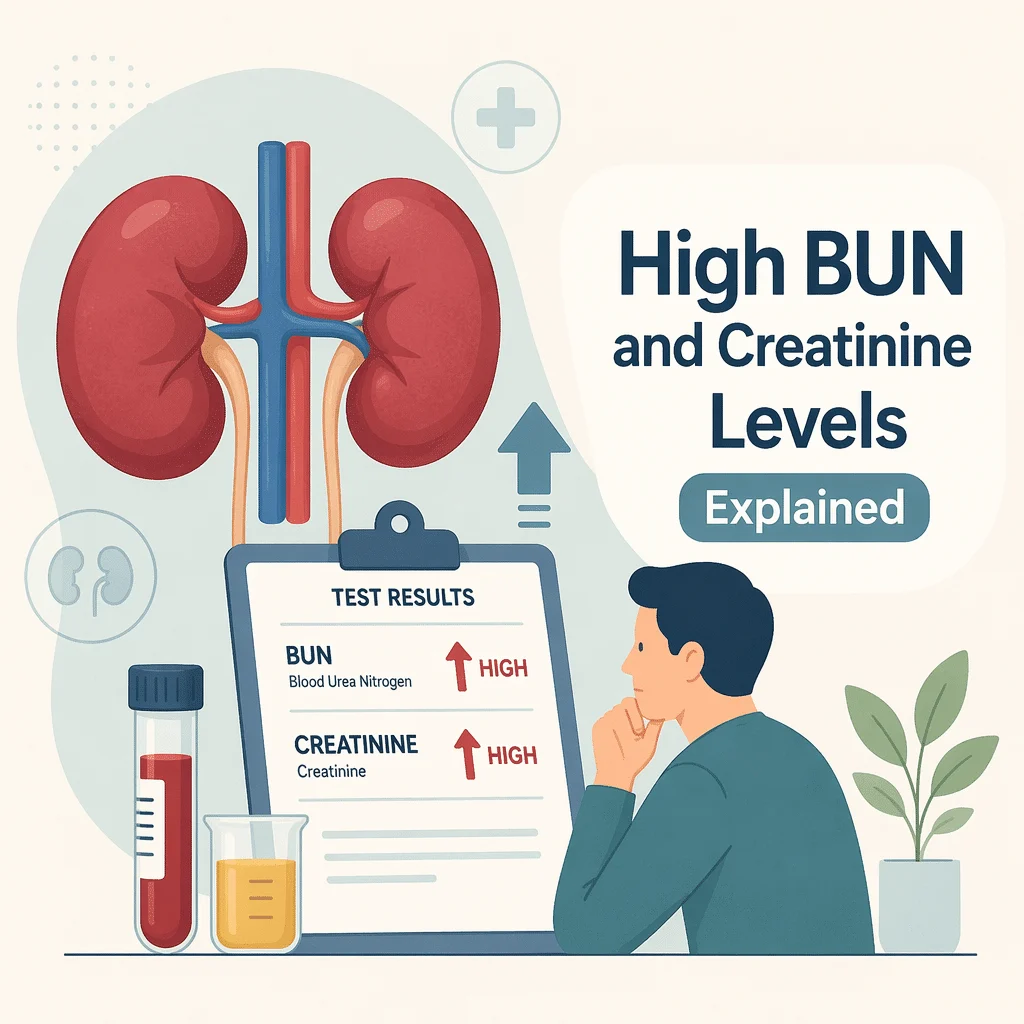
Seeing high BUN and creatinine on a blood test is unsettling, but those two numbers rarely tell the whole story on their own. BUN (blood urea nitrogen) and creatinine are waste products that your kidneys clear from the blood, and both can climb for reasons that have nothing to do with kidney damage: a bout of dehydration, a heavily muscled build, a new prescription, a stomach bug, or a hard training session. A mildly raised result with an obvious explanation is common and often settles once that explanation is dealt with.
In this article you’ll learn what each test actually measures, why the two are ordered together, which everyday factors push them up, why muscle mass makes creatinine a slippery number, how a sudden change differs from a long-standing one, and what your doctor is likely to do next.
What BUN and creatinine actually measure
Your kidneys work as a continuous filter. Blood passes through millions of tiny filtering units, waste molecules are pushed out, and most of the water is reclaimed while the waste leaves in the urine. BUN and creatinine are two of those waste molecules, so measuring them gives an indirect view of how the filter is performing.
Where BUN comes from
BUN stands for blood urea nitrogen. When your body breaks down protein, both from food and from the normal turnover of your own tissues, the liver converts the leftover nitrogen into urea. Urea travels in the blood to the kidneys and leaves in the urine. A BUN test measures the nitrogen carried inside that urea.
Because the value depends on how much protein is being processed as well as on how well the kidneys clear it, BUN is sensitive but not specific: it moves for kidney and non-kidney reasons alike. Our dedicated page explains the blood urea nitrogen test.
Where creatinine comes from
Creatinine is the waste left over from creatine phosphate, the small energy store inside muscle cells. Muscle tissue turns over at a fairly steady daily rate, so a given person produces creatinine at a fairly steady rate too. The kidneys filter it out, and blood levels stay reasonably constant unless production changes or filtration slows.
That steadiness makes creatinine a more reliable filtration marker than BUN. It also creates the single biggest trap in kidney testing, because production depends on how much muscle you carry. Our marker page describes the creatinine blood test.
Why BUN and creatinine are measured together
The two markers travel through the kidney differently. Once urea has been filtered, a proportion of it is reabsorbed back into the blood along with water, and that proportion rises when the body is trying to conserve fluid. Creatinine is barely reabsorbed at all. So when circulation to the kidneys drops, urea tends to rise earlier and further than creatinine, while a problem inside the kidney tissue itself tends to move both together.
Reading the pair therefore says more than reading either one. Both appear on a standard kidney function panel, alongside electrolytes and an estimated filtration rate.
Many laboratories also report the arithmetic relationship between the two values. That single figure has its own logic, uses and limitations, and it deserves more space than a paragraph here: a companion article covers the BUN/creatinine ratio.
Dehydration is the most common reversible cause
If your BUN and creatinine come back high and you were unwell, vomiting, feverish, sweating heavily or simply drinking very little before the blood draw, dehydration is the first thing your clinician will think of. With less fluid in circulation, less blood reaches the kidneys each minute, filtration slows, and the kidneys hold on to water and urea. Waste markers rise even though the kidney tissue is entirely healthy, and a repeat test a few days later often looks normal.
Several other situations raise these markers without any kidney disease being present:
- Bleeding into the stomach or bowel, because digested blood is a large protein load that the liver converts into urea
- A very high protein intake, including protein supplements taken in large amounts
- Catabolic states in which the body breaks down its own tissue faster than usual, such as major surgery, severe infection, extensive burns, or a course of corticosteroids
- Heart failure, which reduces the volume of blood the kidneys receive even when the person is not dehydrated
- A blockage below the kidneys, for example from an enlarged prostate or a stone, which backs pressure up into the filtering units
- Severe muscle injury, including rhabdomyolysis after a crush injury or extreme exertion; clinicians then also check creatine phosphokinase
One caution matters here. Reading that protein intake influences BUN is not a reason to change what you eat. Protein restriction is a clinical decision that belongs to your doctor and, where relevant, a renal dietitian, because cutting protein without supervision causes malnutrition and muscle loss, which brings its own harm. This article does not recommend any dietary change.
The muscle mass problem, and why eGFR and cystatin C exist
Here is the most useful thing to understand about creatinine: the laboratory reference range is a population average, and you are not a population. A young weightlifter carrying a lot of muscle produces a lot of creatinine daily, so the blood level can sit above the printed range even though the kidneys are filtering perfectly. A frail eighty-year-old with very little muscle produces very little creatinine, so the level can land comfortably inside the range even though a substantial share of filtering capacity has been lost.
The same logic applies after an amputation, a long illness, advanced liver disease or significant weight loss: creatinine understates the problem.
Two tools exist because of this. The first is estimated glomerular filtration rate, which feeds creatinine into an equation adjusted for age and sex to approximate how many milliliters of blood the kidneys clear per minute. It is a better guide than creatinine alone, and it is what clinicians stage kidney disease on. Our marker page explains the estimated glomerular filtration rate.
The second is cystatin C, a small protein made by nearly all cells at a rate independent of muscle bulk. When creatinine and cystatin C disagree, the disagreement is itself informative, and muscle usually explains the gap. A separate article examines muscle loss and the cystatin C test.
One refinement is worth knowing about. In 2021 a joint task force of the National Kidney Foundation and the American Society of Nephrology recommended new creatinine-based equations that no longer include a race coefficient, along with wider use of cystatin C. US laboratories have largely adopted them, so an eGFR reported today may differ slightly from one calculated a few years ago on the same creatinine value.
Medicines that raise creatinine without harming filtration
Some drugs push the creatinine number up without the kidneys filtering any less well. Trimethoprim and cimetidine are the classic examples: a small share of creatinine normally leaves the blood through an active transport route in the kidney tubules rather than by filtration, and these drugs block that route. Blood creatinine rises, eGFR appears to fall, and true filtration is unchanged. Some HIV and cancer medicines behave the same way.
ACE inhibitors and angiotensin receptor blockers work differently again. They deliberately relax pressure inside the filtering units, so a small rise in creatinine shortly after starting or increasing them is expected and often signals that the drug is doing its job. Over years, these medicines protect kidneys rather than damage them.
Other drugs can genuinely reduce kidney blood flow or injure kidney tissue, particularly anti-inflammatory painkillers such as ibuprofen and naproxen, diuretics when fluid loss goes too far, some antibiotics, and imaging contrast agents in vulnerable patients.
This section carries an absolute rule: never stop, reduce or change a prescribed medicine because you have read that it affects creatinine. That decision belongs to the person who prescribed it, and stopping an ACE inhibitor, an angiotensin receptor blocker or a diuretic on your own can be far more dangerous than the lab value that prompted it. Bring the result and a full list of what you take, including over-the-counter painkillers and supplements, to your next appointment.
Sudden or long-standing: why the time course matters more than the number
Clinicians care less about how high a single value is than about how fast it got there.
Acute kidney injury describes a rise developing over hours to days. It usually has an identifiable trigger such as dehydration, severe infection, blood loss, a blockage or a drug, and it is frequently reversible if the trigger is corrected quickly. Symptoms are more likely to be noticeable: reduced urine output, swelling, nausea, confusion.
Chronic kidney disease describes reduced filtration persisting for at least three months. It develops slowly, most often on a background of diabetes or high blood pressure, and it is notoriously silent: people commonly feel entirely well until a large share of kidney function has gone. That silence is why a persistent elevation, or a value drifting upward across successive tests, deserves proper assessment rather than reassurance.
This is why your old results matter so much. A creatinine that has sat at the same modest elevation for five years tells a very different story from the identical number in someone whose reading was normal three months ago. If you have previous blood tests, take them with you.
Four common patterns and what they usually point to
The table below sketches how clinicians tend to read frequent combinations. It illustrates the reasoning rather than replacing assessment of your own results.
| What the results show | What it often points to | Usual next step |
|---|---|---|
| One mildly high reading with an obvious explanation, such as a vomiting illness, hot weather or a hard workout the day before | A temporary, non-kidney influence on the numbers, most often reduced fluid volume | Repeat the blood test once you are well and normally hydrated |
| Creatinine above the printed range but estimated filtration rate normal for your age and sex | High muscle mass, or a medicine that blocks creatinine transport rather than reduced filtration | A medication review, and sometimes a cystatin C measurement to cross-check |
| Both markers creeping upward across several tests spread over months | Possible chronic kidney disease, frequently linked to diabetes or blood pressure | Filtration rate trend, a urine albumin test, and a review of blood pressure and glucose control |
| A rapid rise over days, with little urine passed, swelling or breathlessness | Possible acute kidney injury | Same-day medical assessment, not a routine appointment |
What your doctor does next
Repeating the blood test comes first, because single readings are noisy and because correcting an obvious cause such as dehydration often resolves the question outright. Your clinician will read estimated filtration rate rather than creatinine alone, and will compare it against any earlier results.
A urine sample follows. The key test is the urine albumin-to-creatinine ratio, which detects small amounts of albumin leaking through damaged filters long before filtration itself declines. Damage and filtration are separate axes, and staging uses both. Our page explains the urine albumin-to-creatinine ratio, and a broader guide covers protein in urine. Persistent bubbles in the toilet bowl can be one visible clue; we discuss foamy urine separately.
Blood chemistry is reviewed alongside, since failing kidneys struggle to regulate salts and acid. Your clinician will check potassium and sodium, plus bicarbonate, calcium, phosphate and hemoglobin when disease looks established.
Imaging is added when a structural cause is plausible: an ultrasound scan shows kidney size and shape and detects obstruction. Referral to a kidney specialist follows when filtration is substantially reduced, when protein loss is heavy, when the cause is unclear, or when the decline is fast.
When to seek medical care
Most raised results are handled with a routine appointment and repeat test. A few are not.
Seek urgent medical assessment if you have
- Passing very little urine, or none at all
- Swelling of the legs or face together with breathlessness, especially when lying flat
- New confusion, drowsiness or difficulty concentrating
- Severe or persistent vomiting that stops you keeping fluids down
- Chest pain, or a very irregular heartbeat
- A creatinine result that has risen sharply over days, or a message from your care team telling you to be seen
Otherwise, book a routine appointment if the elevation persists on repeat testing, if the value keeps climbing, or if you live with diabetes, high blood pressure, heart disease or a family history of kidney failure. Finding kidney disease early, while it is still silent, is the whole point of testing.
Latest scientific advances in kidney function testing
Research over the past three years has concentrated on one practical question: what to do when creatinine and cystatin C tell different stories. According to PubMed, the studies below are among the most relevant for anyone interpreting a raised result.
A 2025 individual-participant meta-analysis in JAMA, pooling data from more than twenty outpatient cohorts, found that a large gap between the two estimates is far from rare. It appeared in roughly one in nine outpatients and one in three hospitalized patients, and it was linked to higher later rates of death, cardiovascular events and kidney failure. What this means for you: if cystatin C and creatinine disagree, the disagreement is a finding in its own right rather than a laboratory error, and it deserves follow-up.
A 2025 systematic review and meta-analysis in Clinical Kidney Journal pooled eighteen studies and reached a consistent conclusion, while noting that researchers have not yet agreed where the cut-off for a meaningful gap should sit. What this means for you: the direction of travel is established, but the exact threshold is unsettled, so interpretation stays a clinical judgment rather than an automatic rule.
A 2024 study in the Journal of Cachexia, Sarcopenia and Muscle measured body composition directly on CT scans in adults with cancer. Both low skeletal muscle and high body fat were independently associated with a large gap, and the gap widened steadily as muscle fell. What this means for you: if you have lost muscle through illness, aging or inactivity, creatinine alone may make your kidneys look better than they are.
A 2024 review in Nephrology Dialysis Transplantation set out the current standard for assessing filtration. It underlines that creatinine-based estimates are imprecise for an individual because of factors unrelated to filtration, above all atypical muscle mass, and that cystatin C complements rather than replaces creatinine. What this means for you: the most accurate estimates generally combine the two markers instead of choosing between them.
Finally, a 2024 article in Health Equity, written by the National Kidney Foundation, documented how the joint NKF and American Society of Nephrology task force reviewed more than twenty approaches before recommending the race-free 2021 estimating equations and expanded cystatin C testing. What this means for you: the equation behind your eGFR has changed in recent years, so comparing a current result with an older one is not always like-for-like, and your clinician can tell you which equation your laboratory uses.
Glossary of key terms
| Term | Definition |
|---|---|
| BUN (blood urea nitrogen) | The nitrogen carried in urea, the waste compound the liver makes when protein is broken down and the kidneys clear into urine |
| Creatinine | A waste product generated at a steady rate by muscle tissue and removed from the blood by the kidneys |
| eGFR | Estimated glomerular filtration rate: a calculation that turns creatinine, age and sex into an estimate of how much blood the kidneys filter each minute |
| Cystatin C | A small protein produced by most cells at a rate that does not depend on muscle mass, used as an alternative or complementary filtration marker |
| Urine albumin-to-creatinine ratio | A urine test that detects small amounts of albumin leaking through damaged kidney filters, often before filtration declines |
| Acute kidney injury | A fall in kidney filtration developing over hours to days, frequently reversible when the trigger is treated promptly |
| Chronic kidney disease | Reduced kidney filtration or evidence of kidney damage lasting three months or longer |
| Prerenal | A cause of raised waste markers that lies before the kidney, usually reduced blood flow reaching it |
| Tubular secretion | An active transport route that moves a small share of creatinine out of the blood without filtration, and that some medicines block |
| Reference range | The span of values seen in most of a healthy reference population, which may not fit an individual with unusual body composition |
Frequently asked questions
Does dehydration raise creatinine, or only BUN?
It raises both, though not equally. Dehydration reduces the volume of blood reaching the kidneys, so filtration slows and both waste markers accumulate. Urea rises earlier and further because the kidney reabsorbs it along with water when the body is conserving fluid, whereas creatinine is barely reabsorbed. That is why a dehydrated person often shows a markedly raised BUN with a creatinine that is only modestly above range. Correcting the fluid deficit usually brings both back down, which is one reason repeat testing after rehydration is such a standard first step.
Can I lower high BUN and creatinine by drinking more water?
Only in the specific case where dehydration caused the rise. Restoring normal hydration corrects a fluid-driven elevation, and that is a real effect. But drinking extra water is not a treatment for kidney disease, and drinking large volumes does not protect kidneys or improve filtration in someone who is already well hydrated. In some conditions, particularly heart failure or advanced kidney disease, a high fluid intake can be actively harmful. This article does not recommend any specific fluid volume. Ask your own clinician what is appropriate for you.
Does a high creatinine mean kidney failure?
No. Kidney failure is a specific, advanced stage in which filtration has fallen far enough to require dialysis or a transplant, and it is not what most raised creatinine results represent. A single elevated value can reflect dehydration, muscle mass, a medicine, recent intense exercise, or a large meat meal before the test. Even a genuine reduction in filtration usually means early or moderate kidney disease, which is manageable. What matters is whether the elevation persists, whether it is rising, and what the estimated filtration rate and urine tests show alongside it.
Can hard exercise or a high-protein meal change my results?
Yes, temporarily. Intense or unaccustomed exercise breaks down muscle and can lift creatinine for a day or two. A large portion of cooked meat before the blood draw can do the same, because cooking converts some muscle creatine into creatinine that is then absorbed. A high protein load also raises BUN. None of this indicates kidney damage. If your test followed a heavy workout or a big meat meal, mention it, because your clinician may simply repeat the test under more ordinary conditions.
My creatinine is normal. Can my kidneys still be damaged?
Yes, and this is an important limitation. Creatinine often stays inside the reference range through the early stages of kidney disease, and it stays there especially easily in people with little muscle, such as older or frail adults. Kidney damage can also be present with normal filtration, showing up instead as albumin leaking into the urine. That is why a urine albumin-to-creatinine ratio is checked alongside blood tests in anyone at risk, and why cystatin C is sometimes added when the clinical picture and the creatinine do not match.
How soon should the test be repeated?
That depends on the size of the change and on why it happened, so your clinician sets the interval. Broadly, a rapid rise is rechecked within days, a mild elevation with an obvious explanation is often rechecked after a week or two once you have recovered, and a stable long-standing elevation is monitored at planned intervals rather than urgently. Chronic kidney disease is defined by abnormalities persisting for at least three months, so confirming a diagnosis inevitably requires more than one set of results spread over time.
Sources
- National Institute of Diabetes and Digestive and Kidney Diseases. Chronic Kidney Disease Tests & Diagnosis. niddk.nih.gov
- MedlinePlus, National Library of Medicine. BUN (Blood Urea Nitrogen). medlineplus.gov
- MedlinePlus, National Library of Medicine. Creatinine Test. medlineplus.gov
- Gounden V, Bhatt H, Jialal I. Renal Function Tests. StatPearls, NCBI Bookshelf. ncbi.nlm.nih.gov
- National Kidney Foundation. Estimated Glomerular Filtration Rate (eGFR). kidney.org
- Estrella MM, Ballew SH, Sang Y, et al. Discordance in Creatinine- and Cystatin C-Based eGFR and Clinical Outcomes: A Meta-Analysis. JAMA, 2025. Retrieved via PubMed. DOI
- Liu Q, Welsh P, Celis-Morales C, et al. Discordance between cystatin C-based and creatinine-based estimated glomerular filtration rate and health outcomes in adults: a systematic review and meta-analysis. Clinical Kidney Journal, 2025. Retrieved via PubMed. DOI
- Hanna PE, Ouyang T, Tahir I, et al. Sarcopenia, adiposity and large discordance between cystatin C and creatinine-based estimated glomerular filtration rate in patients with cancer. Journal of Cachexia, Sarcopenia and Muscle, 2024. Retrieved via PubMed. DOI
- Delanaye P, Pottel H, Cavalier E, et al. Diagnostic standard: assessing glomerular filtration rate. Nephrology Dialysis Transplantation, 2024. Retrieved via PubMed. DOI
- Charles K, Lewis MJ, Montgomery E, Reid M. The 2021 Chronic Kidney Disease Epidemiology Collaboration Race-Free Estimated Glomerular Filtration Rate Equations in Kidney Disease: Leading the Way in Ending Disparities. Health Equity, 2024. Retrieved via PubMed. DOI
Further reading
- Kidney function panel
- Low BUN levels explained
- Microalbuminuria as a kidney marker
- Dehydration and blood pressure
- Urine electrolytes and how to read them
Understand your lab results with AI DiagMe
A report listing creatinine, BUN, eGFR and a urine albumin-to-creatinine ratio is hard to read when nobody has explained how the pieces fit together. AI DiagMe turns those values into plain language and helps you arrive at your appointment with better questions. It helps you understand your results; it does not diagnose you, and it does not replace your doctor.
Get your results interpreted in minutes