





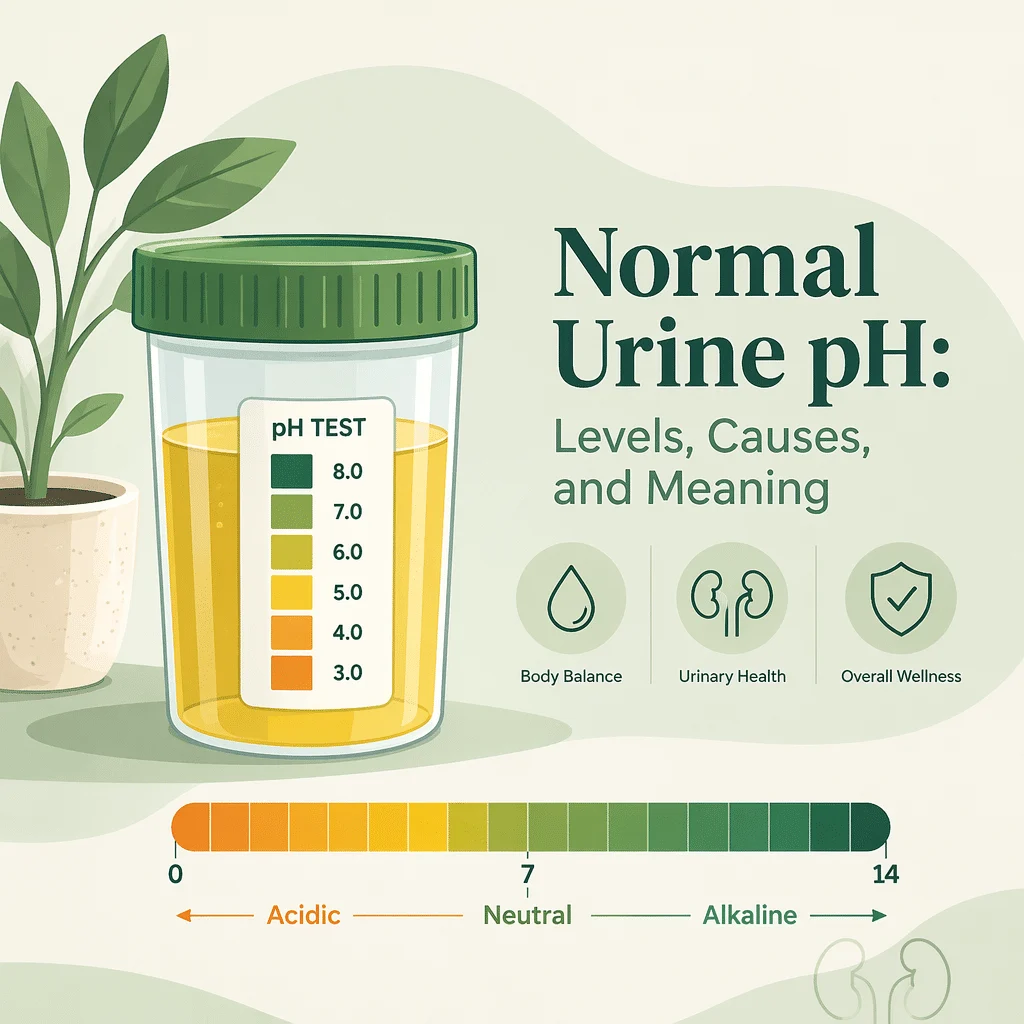
Normal urine pH sits somewhere between about 4.5 and 8.0, and for most people it hovers around 6. That is a wide window, and it is meant to be. Your kidneys move urine pH up and down all day as they balance the acid load from your food, your fluids and your own metabolism. A single number on a lab report is a snapshot of one moment, not a verdict on your health.
In this article you’ll learn what urine pH measures, why it is more acidic in the morning and more alkaline after a meal, what genuinely shifts it, and the few situations where it carries real clinical weight: kidney stones, certain urinary infections and rare kidney tubule disorders. You’ll also find a clear answer to the alkaline diet question.
What urine pH measures, and the normal range
pH is a scale from 0 to 14 describing how acidic or alkaline a liquid is. Seven is neutral, below 7 is acidic, above 7 is alkaline. Urine pH tells you how much acid your kidneys poured into the urine at the moment that sample was produced.
It is measured on one small colored pad of a dipstick, usually as part of a wider urinalysis, or on a laboratory pH meter when precision matters. The MedlinePlus urine pH test page gives normal values as pH 4.6 to 8.0; most laboratories quote a similar band of roughly 4.5 to 8.0.
Healthy urine usually lands slightly on the acidic side, near 6, because a typical Western diet leaves the body with a small net acid load each day and the kidneys export it. Slightly acidic urine is a sign the system is working, not a problem to correct.
Why urine pH swings through the day
Urine pH is not a fixed personal trait. It moves predictably, and the two biggest drivers are the clock and your last meal. Overnight you eat nothing, breathing slows a little, and acid quietly accumulates. The kidneys clear it while you sleep, which is why the first urine of the morning is typically the most acidic sample you produce all day.
After a meal the opposite happens. To digest food the stomach secretes hydrochloric acid, and for every unit of acid it pushes into the stomach it releases a unit of bicarbonate into the bloodstream. The kidneys excrete that bicarbonate, and urine turns more alkaline for an hour or two. Clinicians call this the postprandial alkaline tide. It is entirely normal, and it is the commonest reason a home test strip reads “alkaline” in someone who is perfectly well.
Timing therefore matters more than the number itself, much as urine color shifts through the day with hydration.
| Reading | What it usually means | What to do |
|---|---|---|
| Acidic, around 5.0 to 6.0, first thing in the morning | Expected after an overnight fast, as the kidneys clear the acid built up during sleep | Nothing. The usual finding in healthy people |
| Alkaline, 7.0 or above, an hour or two after eating | The normal alkaline tide, as the kidney excretes bicarbonate released during digestion | Nothing. Note the timing before reading anything into the number |
| Persistently alkaline with burning, urgency or cloudy urine | Possibly infection with a urea-splitting organism, though other explanations are common | See a doctor. A urine culture, not a pH strip, settles it |
| Persistently acidic, below 5.5, with a history of stones | Conditions favoring uric acid and cystine stones, poorly soluble in acid urine | Ask your doctor about a metabolic stone assessment |
| Alkaline in a sample that sat for several hours | Often a false reading, as bacteria in the sample split urea and drive pH upward | Repeat on a fresh sample tested promptly |
What makes urine more acidic or more alkaline
Food and drink
Animal protein is the main acidifier. Meat, fish, eggs and cheese are rich in sulfur-containing amino acids, and breaking them down generates acid the kidney must excrete, lowering urine pH. Fruit and vegetables do the reverse: their organic salts are metabolized to bicarbonate, and urine pH rises. The NIDDK guidance on eating and kidney stones reflects the same chemistry.
These effects are real but short-lived. They appear within hours and fade once the meal has been processed.
Fluids, illness and metabolism
Dehydration concentrates urine and pushes it toward the acidic end. Prolonged vomiting strips the body of stomach acid and tends to leave urine more alkaline. Diarrhea does the opposite: the gut loses bicarbonate, the blood turns more acidic, and the kidney dumps more acid into the urine. Uncontrolled diabetes, prolonged fasting and very low-carbohydrate eating produce ketones in urine and a distinctly acidic result.
Medicines
Several drugs move urine pH by design. Acetazolamide, potassium citrate and sodium bicarbonate raise it, and thiazide diuretics can too. Ammonium chloride, methenamine and high-dose vitamin C lower it. MedlinePlus lists exactly these as medicines a clinician may pause before a urine pH test, and adds a warning worth repeating: never stop a prescribed medicine on your own. The reverse matters just as much. None of these substances should be taken to change your urine pH unless a doctor has prescribed them and is checking the result.
Urine pH and kidney stones
This is where urine pH genuinely earns its place on a lab report. Whether a mineral stays dissolved or drops out as a solid depends heavily on how acidic the urine is, and different stone types have opposite preferences.
Persistently acidic urine, especially below about 5.5, favors uric acid and cystine stones. Uric acid is poorly soluble in acid urine, which is why people with gout, obesity, type 2 diabetes or chronic diarrhea are at higher risk. Persistently alkaline urine favors the other camp: calcium phosphate stones and struvite stones, the latter linked to infection.
Raising urine pH on purpose, known as urinary alkalinization, is an established treatment for uric acid stones. Potassium citrate is the usual agent, and NIDDK lists it among the medicines prescribed for stone prevention. Used properly it can dissolve existing uric acid stones without surgery, and what makes it work is repeated urine pH measurement with dose adjustment by a clinician. Pushed too far it swaps one problem for another, because strongly alkaline urine encourages calcium phosphate stones instead. This is prescribed, monitored treatment, not something to attempt with baking soda from the kitchen cupboard.
Our guides to kidney stones, the uric acid blood test and the calcium blood test cover the wider picture. Urine pH also influences which crystals appear under the microscope on a urinalysis slide; their shapes, types and meaning are covered separately in our guide to urine crystals.
Urine pH and urinary infection: what it can and cannot tell you
Some bacteria produce an enzyme called urease, which splits urea into ammonia. Ammonia is alkaline, so these organisms push urine pH up. Proteus is the classic example, and certain Klebsiella and staphylococcal species do the same. This is also the mechanism behind struvite stones, which grow quickly in infected, alkaline urine.
So a persistently alkaline urine in someone with urinary symptoms is a clue worth mentioning to a doctor. It is not a diagnosis, and this distinction matters more than almost anything else on this page. Most urinary tract infections are caused by Escherichia coli, which does not produce urease, so pH is often completely normal. Meanwhile plenty of alkaline samples come from people with no infection at all. Urine pH neither confirms nor rules out infection.
The dipstick markers that carry diagnostic weight are nitrites and leukocyte esterase, and the definitive answer comes from a urine culture. Please do not use a home pH strip to decide whether you have a urinary tract infection, or whether one is settling. Untreated infections can climb to the kidneys, and a reassuring pH reading is not reassurance.
When an abnormal urine pH points to a kidney problem
There is one situation where urine pH becomes a genuinely powerful diagnostic signal, and it depends on context rather than on the number alone. Normally, when blood becomes too acidic, the kidney responds by excreting more acid. Blood improves, urine becomes more acidic. In renal tubular acidosis, the tubules that do this work are faulty. The result is a mismatch that should not exist: acid in the blood, yet urine that stays stubbornly alkaline. A doctor seeing that combination knows the kidney tubules are not responding, and will investigate.
The distal form, sometimes called type 1, classically comes with alkaline urine, low blood potassium, calcium deposits in the kidney and recurrent calcium phosphate stones. It can be inherited or acquired, and in children it may affect growth and bone health.
Two things follow. A high urine pH on its own means very little; it becomes meaningful only alongside blood tests showing acidosis. And the diagnosis is made with blood gases, electrolytes and sometimes specialist testing in a clinic. Urine pH is not a way to screen yourself for kidney disease, and it should never be used to monitor known kidney disease at home.
Why a delayed sample can give a falsely high urine pH
Here is a practical point that explains a surprising number of odd results. Urine is not sterile once it leaves the body, and even a few bacteria will start splitting urea into ammonia if the sample sits at room temperature, so the pH drifts upward hour by hour. Dissolved carbon dioxide also escapes from an open container, nudging it higher still. This is why laboratories ask for prompt testing, refrigeration or preservative tubes. A sample that traveled in a bag all afternoon may be telling you about its journey rather than your kidneys, so repeating a surprising result on a fresh sample is the sensible first step.
What the alkaline diet does and does not do
If you have arrived here after reading about alkaline diets or alkaline water, you are in good company, and the question deserves a straight answer rather than mockery.
The claim is that modern food makes the body acidic, and that restoring alkalinity prevents or treats cancer, arthritis or osteoporosis. The physiology does not support it. Blood pH is held within an extremely narrow band, roughly 7.35 to 7.45. The lungs adjust it within minutes by changing how much carbon dioxide you breathe off; the kidneys adjust it over hours through bicarbonate and acid excretion. Drifting meaningfully outside that band is a hospital emergency, not something a food choice produces.
Urine pH is where the confusion begins. Eat a large salad and your urine will indeed turn more alkaline. That is the kidney exporting surplus base to protect the blood: evidence the system is working as designed, not that the body has been alkalinized. And the pH strips sold for monitoring “body alkalinity” measure urine, not blood. They report what your kidneys just discarded.
Alkaline water runs into the same wall. Whatever pH it has in the bottle, it meets stomach acid within minutes and is neutralized before absorption. No diet or drink has been shown to treat or prevent cancer through pH; the National Cancer Institute’s page on common cancer myths is a useful corrective on dietary cancer claims generally.
None of this makes the eating pattern worthless. Most alkaline diets amount to more vegetables and fruit, fewer processed and cured meats and less salt, which is sound advice for blood pressure, weight, fiber and potassium. You can keep the food and drop the theory without losing anything.
One genuine exception deserves stating precisely. In people who already have chronic kidney disease with metabolic acidosis, doctors do use base as treatment, as bicarbonate tablets or a deliberately fruit-and-vegetable-rich diet. That is a supervised intervention in kidneys that can no longer excrete acid, not a wellness practice for healthy people.
When to see a doctor about urine pH
An isolated abnormal urine pH, with no symptoms and no history of stones or kidney disease, almost never needs action on its own; bring it up at your next appointment with the rest of the urinalysis. Do ask for a review if the pattern persists across several properly collected samples, if you have had stones, or if you notice other changes such as persistently foamy urine.
Red flags: seek medical care
- Fever together with back or flank pain
- Blood in the urine, or urine that looks pink, red or brown
- Severe one-sided loin pain that comes in waves
- Being unable to pass urine at all
- Repeated urinary tract infections
These signs point to possible infection, obstruction or a stone on the move, and need prompt assessment rather than another test strip.
Latest scientific advances in urine pH testing
Recent research has clarified where urine pH is useful and where it is over-read. The studies below were identified through PubMed and are linked by DOI in the Sources section.
Alkalinization works for uric acid stones, when it is monitored
What was found: in a large series reported in the Canadian Urological Association Journal in 2024, adults with uric acid stones were treated with potassium citrate, a prescribed alkalinizing salt, with regular urine pH checks. Most stones dissolved completely without surgery, and the treatment was well tolerated.
What this means for you: raising urine pH is a real and effective treatment for one specific stone type. The authors are explicit that it works because pH is measured repeatedly and the dose adjusted. That is a clinical process, not a home remedy.
For urinary infection, pH is not the marker that counts
What was found: a multicenter study in Pediatrics in 2025 compared point-of-care dipsticks with laboratory urinalysis in thousands of infants with fever. The dipstick performed at least as well for identifying urinary tract infection, and the signals doing the work were leukocyte esterase and nitrite.
What this means for you: even where dipsticks are relied on most heavily, urine pH plays no diagnostic role in spotting infection. Those other pads and a urine culture are what answer that question.
How long a sample waits changes the result
What was found: a hospital study in the European Journal of Clinical Microbiology and Infectious Diseases in 2024 tracked how long urine samples waited before processing. Samples that sat longer were more likely to grow bacteria, and preservative-containing transport tubes reduced that effect for samples handled within a working day.
What this means for you: because the same bacterial growth that inflates a culture also drives pH upward, delay is an under-appreciated reason for an unexpectedly alkaline reading. It is reasonable to ask how quickly your sample will be tested.
Where the alkaline diet idea has real footing
What was found: a systematic review and meta-analysis in Nephrology Dialysis Transplantation in 2025 pooled trials in adults with chronic kidney disease and metabolic acidosis. Diets designed to lower the dietary acid load, largely by adding fruit and vegetables, improved blood bicarbonate and measures of kidney filtration compared with usual care, without harming nutrition or raising potassium. The authors note the underlying trials were small and varied.
What this means for you: this is the closest thing to a scientific version of the alkaline diet, and it shows where the idea holds and where it does not. The benefit appeared in people whose kidneys could no longer excrete acid properly, under medical supervision.
Frequently asked questions
What does a high urine pH mean?
Most often it means very little. A reading of 7.0 or above is common after a meal, particularly a vegetarian one, and it is the expected result of the normal alkaline tide. It can also appear when a sample has been left standing, when someone has been vomiting, or during an infection with a urea-splitting organism. Persistently alkaline urine matters more, especially alongside urinary symptoms, a history of calcium phosphate or struvite stones, or blood tests showing acidosis. A doctor interprets it in that wider context rather than as a standalone finding.
Can urine pH tell me if I have a UTI?
No, and this is an important point. Most urinary infections are caused by organisms that do not change urine pH at all, so a normal pH gives no reassurance. Equally, alkaline urine is common in people with no infection. Using a pH strip to decide whether you have an infection risks both unnecessary worry and, more dangerously, a delay in treating a real infection that could spread to the kidneys. If you have burning, urgency, fever or flank pain, see a clinician. A urine culture identifies the organism and guides treatment.
Does alkaline water change your body’s pH?
Not in any meaningful way. Blood pH is held between roughly 7.35 and 7.45 by the lungs and kidneys, and it does not move with what you drink. Alkaline water meets stomach acid within minutes and is neutralized before it is absorbed. You may well see your urine pH rise afterward, but that reflects the kidney exporting surplus base rather than the body becoming alkaline. Many people try alkaline water in good faith, and drinking more water is genuinely helpful for kidney stone prevention. The benefit comes from the water, not from the pH.
What causes a low urine pH?
A first-morning sample is usually the most acidic of the day, so a low value then is expected. Beyond that, a diet heavy in meat, fish, eggs and cheese lowers urine pH, as does dehydration. Diarrhea, prolonged fasting, very low-carbohydrate eating and poorly controlled diabetes all push it down further. Some medicines, including high-dose vitamin C and ammonium chloride, have the same effect. Consistently acidic urine matters most in people who form uric acid or cystine stones, which is a conversation to have with a doctor rather than something to self-correct.
Should I test my urine pH at home?
For most people there is no reason to. Home strips are inexpensive and easy to misread, and a single value carries almost no information without the clinical context around it. The exception is a person under specialist care for kidney stones, who may be asked to log urine pH so that a prescribed treatment can be adjusted. That is monitoring on medical instruction, with a target set by the clinician. Testing on your own initiative to guide diet or supplements is not useful and can be misleading.
Can urine pH show whether my kidneys are healthy?
No. Urine pH says nothing about how well the kidneys are filtering. Kidney function is assessed with blood creatinine and an estimated filtration rate, and with urine albumin or protein measurements. Urine pH becomes relevant only for specific questions, such as identifying renal tubular acidosis, where it is read alongside blood tests, or guiding stone treatment. If you are worried about your kidneys, ask for the appropriate blood and urine tests rather than watching a pH strip.
Glossary of key terms
| Term | Definition |
|---|---|
| pH | A scale from 0 to 14 describing how acidic or alkaline a liquid is, with 7 as neutral |
| Urinalysis | A panel of urine tests covering appearance, chemistry including pH, and examination under a microscope |
| Dipstick | A plastic strip with colored pads that change shade to estimate several urine values at once |
| Alkaline tide | The normal rise in urine pH for an hour or two after a meal, caused by bicarbonate released during digestion |
| Urease | A bacterial enzyme that splits urea into ammonia, raising urine pH |
| Urinary alkalinization | A prescribed and monitored treatment that raises urine pH, mainly to dissolve or prevent uric acid stones |
| Metabolic acidosis | A state in which the blood holds too much acid, diagnosed on blood tests rather than urine tests |
| Renal tubular acidosis | A condition in which the kidney tubules cannot excrete acid normally, leaving urine inappropriately alkaline despite acid in the blood |
| Struvite stone | A stone made of magnesium ammonium phosphate that forms in alkaline urine, typically linked to infection |
| Clean-catch sample | A urine collection method that reduces contamination from skin and surrounding areas |
Sources
- MedlinePlus, U.S. National Library of Medicine. Urine pH test.
- National Institute of Diabetes and Digestive and Kidney Diseases. Eating, Diet and Nutrition for Kidney Stones.
- National Institute of Diabetes and Digestive and Kidney Diseases. Treatment for Kidney Stones.
- National Cancer Institute. Common Cancer Myths and Misconceptions.
- Normand M, Haymann JP, Daudon M. Medical treatment of uric acid kidney stones. Canadian Urological Association Journal, 2024. https://doi.org/10.5489/cuaj.8774
- Hunt KM, Green RS, Sartori LF, et al. Urine Dipstick for the Diagnosis of Urinary Tract Infection in Febrile Infants Aged 2 to 6 Months. Pediatrics, 2025. https://doi.org/10.1542/peds.2024-068671
- Ben-David D, Cohen Y, Zohar I, Maor Y, Schwartz O. The impact of Boric Acid tubes on quantitative urinary bacterial cultures in hospitalized patients. European Journal of Clinical Microbiology and Infectious Diseases, 2024. https://doi.org/10.1007/s10096-024-04874-z
- Mahboobi S, Mollard R, Tangri N, et al. Effects of dietary interventions for metabolic acidosis in chronic kidney disease: a systematic review and meta-analysis. Nephrology Dialysis Transplantation, 2025. https://doi.org/10.1093/ndt/gfae200
Further reading
- Urine creatinine levels: guide and interpretation
- BUN to creatinine ratio: meaning and levels
- High BUN and creatinine levels explained
- Bacteriuria: symptoms, causes and treatment
- Magnesium deficiency: symptoms, causes and treatments
Understand your lab results with AI DiagMe
A urinalysis rarely comes back with urine pH alone. It usually arrives beside creatinine, uric acid and half a dozen other values, and the meaning lies in how they fit together. AI DiagMe reads your report and explains each line in plain language, including what a given urine pH does and does not indicate. It is a tool to help you understand your results and prepare better questions. It does not diagnose anything and it does not replace your doctor.
Get your results interpreted in minutes