






























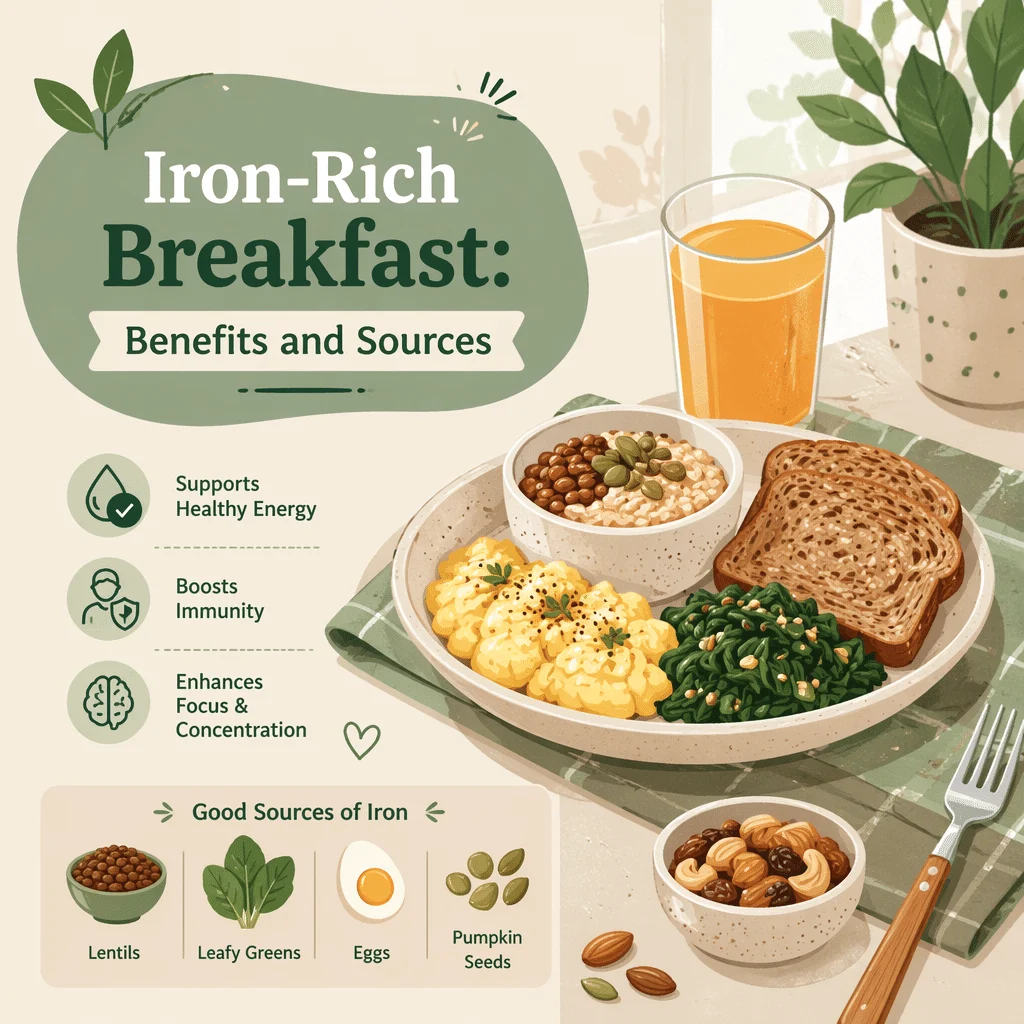
An iron rich breakfast is one of the simplest ways to add iron to your day, but the number printed on a label is not the number your body keeps. Dietary iron comes in two forms that behave very differently, and what you drink or eat alongside it changes how much of that iron actually crosses into your bloodstream. In this article you will learn how the two forms differ, which breakfast foods carry the most iron, which pairings genuinely help, which ones quietly work against you, and who needs to pay closer attention. You will also learn why a good breakfast cannot tell you whether your iron stores are low, and which blood tests can.
What makes a breakfast iron-rich
Two things decide whether a morning meal counts as an iron rich breakfast: how much iron the food contains, and how much of it your gut can take up. The second point is the one most food lists skip.
Heme iron: efficient, and only from animal foods
Heme iron is the form bound inside hemoglobin and myoglobin in meat, seafood and poultry. Your intestine has a dedicated route for it, so it is absorbed comparatively well and is barely affected by the rest of the meal. According to the National Institutes of Health Office of Dietary Supplements, heme iron makes up only about 10 to 15 percent of total iron intake in Western populations, yet it contributes a disproportionate share of the iron people actually absorb. At breakfast, that means sardines on toast, a slice of liver pate or leftover chicken in an omelet quietly outperform their milligram figures.
Non-heme iron: everywhere, but fragile
Non-heme iron is the form in plants, eggs, and every fortified product. It is by far the larger part of most people’s intake, and it is the form that responds to context. Phytates in whole grains and legumes, polyphenols in coffee and tea, and calcium from dairy or supplements all reduce how much of it you take up. Vitamin C pushes in the other direction. The practical consequence is that two breakfasts with identical iron on paper can deliver very different amounts of iron to your body.
How much iron you actually need
Requirements differ more by life stage than most people expect. The Office of Dietary Supplements sets the recommended dietary allowance at 8 mg a day for adult men and for women aged 51 and over, 18 mg a day for women aged 19 to 50, and 27 mg a day during pregnancy. The tolerable upper intake level for adults is 45 mg a day from all sources.
Two figures matter more than the headline numbers. Iron availability runs roughly 14 to 18 percent from mixed diets containing meat, seafood and vitamin C, but only about 5 to 12 percent from vegetarian diets. And because plant iron is absorbed less efficiently, the iron requirement for people following vegetarian diets is 1.8 times higher than for people who eat animal products. Breakfast is a sensible place to close part of that gap, because it is the meal people repeat most reliably.
Iron-rich breakfast foods, and what to serve with them
The table below pairs common breakfast foods with their iron type and a practical pairing note. The milligram figures follow the iron fact sheet published by the NIH Office of Dietary Supplements; the pairing column applies the enhancer and inhibitor rules described in the next section.
| Breakfast food | Iron type | Iron per serving | Pair it with, or keep apart |
|---|---|---|---|
| Breakfast cereal fortified to 100% of the Daily Value, 1 serving | Non-heme | 18 mg | Add citrus or kiwi; hold the coffee until later |
| White beans, canned, 1 cup | Non-heme | 8 mg | Tomato or salsa helps; a large glass of milk does not |
| Beef liver, pan fried, 3 oz | Heme | 5 mg | Absorbed well on its own; pairing is optional |
| Lentils, boiled, 1/2 cup | Non-heme | 3 mg | Peppers or tomato help; delay the tea |
| Tofu, firm, 1/2 cup | Non-heme | 3 mg | Scramble it with bell pepper or broccoli |
| Spinach, boiled, 1/2 cup | Non-heme | 3 mg | Fold into eggs with tomato; not alongside a calcium supplement |
| Canned sardines, 3 oz | Heme | 2 mg | Robust to the rest of the meal; lemon is for flavor |
| Egg, hard boiled, 1 large | Non-heme | 1 mg | Serve with tomato or peppers rather than tea |
What helps and what blocks iron absorption at breakfast
The one enhancer that reliably works
Vitamin C is the enhancer with the longest track record. It converts non-heme iron into the form your intestine absorbs more readily, and it has to be in the same meal, not later in the day. Citrus segments, kiwi, bell peppers, tomato and strawberries are the usual breakfast candidates. Meat, poultry and seafood also improve the absorption of non-heme iron eaten alongside them, which is why a small amount of animal protein lifts the value of a plant-heavy plate. Our library covers the benefits, sources and risks of vitamin C in more detail.
The three inhibitors worth knowing
- Polyphenols in coffee and black tea bind dietary iron so the body cannot use it. This is the single most common own goal at breakfast, because coffee and cereal arrive together.
- Calcium, from milk, yogurt or a supplement, is unusual in that it can reduce the absorption of both non-heme and heme iron.
- Phytate, present in whole grains and beans, lowers absorption from exactly the foods people choose for their iron content. Soaking, sprouting and fermenting reduce it, which is part of why sourdough behaves differently from plain whole wheat.
Timing advice you can actually keep
The useful version of this advice is not a stopwatch. Move coffee or tea to about an hour after the meal rather than during it, keep a large dairy serving for a different eating occasion when the breakfast is your main iron meal, and put a vitamin C food on the same plate. That is three habits, not a regimen. If you enjoy milk in your cereal every morning, the fix is not to give it up but to make sure the day contains at least one iron-focused meal where dairy is not the headline.
Realistic breakfast builds
If you eat animal foods
A two-egg scramble with spinach and diced tomato, a slice of sourdough, and orange segments covers non-heme iron from eggs and spinach with vitamin C from two directions. Sardines on toast with lemon and a side of kiwi leans on heme iron and needs less help. Leftover roast chicken folded into a bean and pepper hash gives you heme iron and the enhancing effect animal protein has on the beans.
If you eat plant-based
A tofu scramble with bell pepper and a small glass of orange juice is the highest-yield plant breakfast on this list, because it stacks a solid iron source with a strong enhancer. Oatmeal made with fortified plant milk, topped with pumpkin seeds and strawberries, works well provided you drink your coffee afterward. Beans on toast with salsa is unglamorous and effective. Because plant iron is absorbed less efficiently, the pairing rules stop being optional and start being the point.
Fortified cereals and how to read the label
Fortified breakfast cereal is the single densest iron source on most supermarket shelves, and a serving fortified to 100 percent of the Daily Value supplies 18 mg. That is more iron than most whole foods deliver in a bowl, and it is why cereals feature in almost every dietary iron strategy. Three label habits make the difference. Check the percent Daily Value for iron rather than the marketing on the front, since fortification levels range from token to complete. Check the serving size, because the stated percentage applies to a measured portion rather than the bowl you poured. And remember that the iron added to cereal is non-heme, so it is the form most sensitive to the milk you pour on it and the coffee beside it.
Who actually needs to pay attention
For most healthy adults eating a varied diet, iron takes care of itself. A handful of groups have either higher needs or higher losses, and for them breakfast is worth planning rather than leaving to chance:
- People who menstruate, especially with heavy or prolonged periods, who lose iron every cycle.
- Pregnancy, where the requirement rises to 27 mg a day and iron status is monitored by the care team.
- Regular blood donors, who give away a meaningful amount of iron with each donation.
- Vegetarians and vegans, whose requirement is 1.8 times higher because plant iron is absorbed less efficiently.
- Endurance athletes, who combine higher turnover with losses through sweat and foot strike.
- Anyone recovering from surgery, injury or another episode of blood loss.
What breakfast cannot tell you, and the tests that can
Here is the honest limit of any food article: you cannot judge your iron status from how you feel or from what you eat. Fatigue is a poor guide, since it accompanies dozens of unrelated conditions, and a well-built plate says nothing about what your body has stored. Only blood tests answer that question. Ferritin reflects your iron stores and usually falls first. Hemoglobin and the rest of the complete blood count show whether low iron has started to affect red cell production. Serum iron, transferrin saturation and total iron-binding capacity describe how much iron is circulating and how much spare carrying capacity is available. Read together, they separate low stores from inflammation and from iron overload. Our team explains the full iron studies panel, and a companion article covers how to read a complete blood count. Two further guides cover the causes and treatment of low ferritin and a high total iron-binding capacity result, and another explains the role of transferrin in iron transport.
Three cautions belong with any article about dietary iron. Do not start an iron supplement on your own: too much iron is harmful, hereditary hemochromatosis and other forms of iron overload exist, and the decision belongs to a clinician who has seen your results. A separate guide covers safe ways to lower high iron levels. Iron-containing products are also a leading cause of poisoning deaths in young children and must be stored out of reach and sight. And newly discovered iron deficiency in an adult, particularly in a man or a woman past menopause, needs its cause investigated rather than simply corrected, because gastrointestinal blood loss is a common explanation.
See a healthcare professional if you have unexplained fatigue, breathlessness on mild exertion, a racing heart, pale skin, unusual cravings for ice or non-food items, heavy periods, blood in the stool or black stools, or a known deficiency that is not improving. Diet alone rarely corrects an established deficiency quickly. Our library also explains the symptoms and causes of anemia.
Latest scientific advances
Research published since 2023 has refined three assumptions that food articles usually treat as settled. None of it changes what belongs on your plate tomorrow, but it does change how confidently anyone should read a food label.
Iron supplements may work better every other day than every day
A randomized trial in young women with depleted iron stores compared the same total dose of iron given daily versus on alternate days. Alternate-day dosing did not raise iron stores higher, but it caused fewer digestive side effects and left fewer women iron deficient after six months. The likely reason is hepcidin, a hormone that briefly closes the door on iron absorption for a day or so after a dose, so consecutive doses partly cancel each other out. What this means for you: this is a conversation to have with your doctor if you have been prescribed iron, not a reason to start taking any. A later trial in pregnancy compared daily, alternate-day and three-times-weekly schedules and found iron status declined across pregnancy whatever the schedule, suggesting the demands of pregnancy outweigh the dosing pattern. Those authors describe their result as needing confirmation in larger studies.
Vitamin C helps, but a vitamin C-rich food is not automatically iron-friendly
A small study measured non-heme iron absorption in adult women given iron with or without fresh blueberries, with and without a standard breakfast. Despite blueberries containing vitamin C, adding them significantly reduced iron absorption, most likely because their polyphenol content outweighed the benefit. The researchers call the finding preliminary given the small number of participants. What this means for you: the enhancer with the reliable evidence behind it is vitamin C itself, which is why citrus, peppers and tomato remain the dependable pairings, while a polyphenol-heavy fruit can pull in both directions at once.
Eating more iron is not the same as having more iron
An observational study of several hundred Swedish teenage girls found that those following vegetarian or vegan diets had lower ferritin and were considerably more likely to be iron deficient than those eating meat, even though plant-based eaters typically record higher iron intakes on paper. A larger review pooling dozens of studies of vegetarian and vegan children reached the same conclusion: higher iron intake, lower ferritin, more iron deficiency. What this means for you: intake and status are two different measurements, and if you eat plant-based, a ferritin test tells you something a food diary never will.
Glossary
| Term | Definition |
|---|---|
| Heme iron | The form of iron found in meat, seafood and poultry. It is absorbed through a dedicated route and is little affected by the rest of the meal. |
| Non-heme iron | The form of iron in plants, eggs and fortified foods. It makes up most of what people eat and is strongly influenced by enhancers and inhibitors. |
| Ferritin | A protein that stores iron. The blood ferritin level reflects your iron reserves and usually falls before anemia appears. |
| Hemoglobin | The iron-containing protein in red blood cells that carries oxygen. A low value is what defines anemia. |
| Total iron-binding capacity (TIBC) | A measure of how much iron your blood proteins could carry in total. It tends to rise when iron is scarce. |
| Transferrin saturation | The percentage of your iron-carrying capacity currently occupied by iron. Low values suggest deficiency, high values suggest overload. |
| Hepcidin | A hormone that regulates iron absorption. It rises after an iron dose and temporarily limits how much further iron the gut takes up. |
| Phytate | A compound in whole grains and beans that binds iron and lowers its absorption. Soaking, sprouting and fermenting reduce it. |
| Polyphenols | Plant compounds found in coffee, tea and many fruits. They bind dietary iron and reduce how much of it the body can use. |
| Daily Value (DV) | The reference amount used on US nutrition labels. A cereal listing 100% DV for iron supplies 18 mg per stated serving. |
Frequently asked questions
Can a vegetarian breakfast supply enough iron?
Yes, but it takes more deliberate assembly than an omnivorous plate. Plant iron is absorbed less efficiently, and the requirement for people following vegetarian diets is 1.8 times higher than for people who eat animal products. The practical approach is to combine a genuine iron source such as tofu, lentils, beans or fortified cereal with a vitamin C food in the same meal, and to move coffee or tea away from the meal. Recent research also shows that plant-based eaters often have lower iron stores despite higher iron intakes, which is a good reason to check ferritin rather than assume.
Does orange juice with cereal really improve iron absorption?
Yes, this is one of the better-supported pairings. Vitamin C converts non-heme iron into a form the intestine absorbs more readily, and fortified cereal is entirely non-heme iron, so the pairing targets exactly the form that needs help. The vitamin C has to be in the same meal to matter. A whole orange, kiwi, strawberries or bell peppers do the same job as juice, with more fiber.
How long should I keep coffee or tea away from an iron-rich meal?
Aim for about an hour after the meal rather than during it. Polyphenols in coffee and black tea bind dietary iron so your body cannot use it, and the effect is greatest when they are consumed with the food. There is no need to give up either drink; simply shifting the cup from alongside your breakfast to after it removes most of the interference for the meal that matters.
Are fortified breakfast cereals a good way to get iron?
They are among the most concentrated dietary iron sources available, since a serving fortified to 100 percent of the Daily Value supplies 18 mg. The caveats are that fortification levels vary widely between brands, that the percentage applies to a measured serving rather than a generous bowl, and that the added iron is non-heme and therefore sensitive to what surrounds it. Read the percent Daily Value on the panel rather than the front of the box.
Can an iron-rich breakfast correct iron deficiency anemia?
Usually not on its own, and not quickly. Diet is excellent at maintaining iron status and at slowing a gradual decline, but an established deficiency generally needs medical assessment and treatment. More importantly, a new deficiency in an adult needs its cause identified, because bleeding somewhere in the digestive tract is a common explanation that a better breakfast will not address. Speak with a healthcare professional before taking any iron supplement.
Sources
- National Institutes of Health, Office of Dietary Supplements — Iron: Fact Sheet for Health Professionals, 2025 — ods.od.nih.gov
- MedlinePlus Medical Encyclopedia, US National Library of Medicine — Iron in diet, 2025 — medlineplus.gov
- Mayo Clinic — Iron deficiency anemia: symptoms and causes, 2025 — mayoclinic.org
- von Siebenthal HK, Gessler S, Vallelian F, et al. — Alternate day versus consecutive day oral iron supplementation in iron-depleted women: a randomized double-blind placebo-controlled study — EClinicalMedicine, 2023 — doi.org/10.1016/j.eclinm.2023.102286
- Haynes S, Armitage AE, Roy NBA, et al. — Impact of oral iron dosing regimens on iron biomarkers during pregnancy: insights from the PANDA trial — Blood Advances, 2026 — doi.org/10.1182/bloodadvances.2026019740
- Galan-Ramirez G, Moya D, Olivares M, et al. — Effect of blueberries on non-heme iron absorption in adult women — Journal of Trace Elements in Medicine and Biology, 2025 — doi.org/10.1016/j.jtemb.2025.127753
- Stubbendorff A, Borgstrom Bolmsjo B, Bejersten T, et al. — Iron insight: exploring dietary patterns and iron deficiency among teenage girls in Sweden — European Journal of Nutrition, 2025 — doi.org/10.1007/s00394-025-03630-z
- Lotti S, Panizza G, Martini D, et al. — Lacto-ovo-vegetarian and vegan diets in children and adolescents: a systematic review and meta-analysis of nutritional and health outcomes — Critical Reviews in Food Science and Nutrition, 2025 — doi.org/10.1080/10408398.2025.2572983
Further reading
- Iron saturation explained: levels and causes
- High ferritin levels: causes, symptoms and risks
- Low iron and bruising: causes and symptoms
- Low vitamin B12: symptoms, causes and treatments
- Folate deficiency: symptoms, causes and treatments
Understand your lab results with AI DiagMe
A well-built breakfast supports your iron intake, but only a blood test shows what your body has actually stored. If you already have results in hand, AI DiagMe reads markers such as ferritin, hemoglobin, serum iron and transferrin saturation and explains in plain language what each value means and how they fit together. It helps you understand your report and prepare better questions for your appointment. It does not diagnose, and it does not replace your doctor.
Get your results interpreted in minutes