




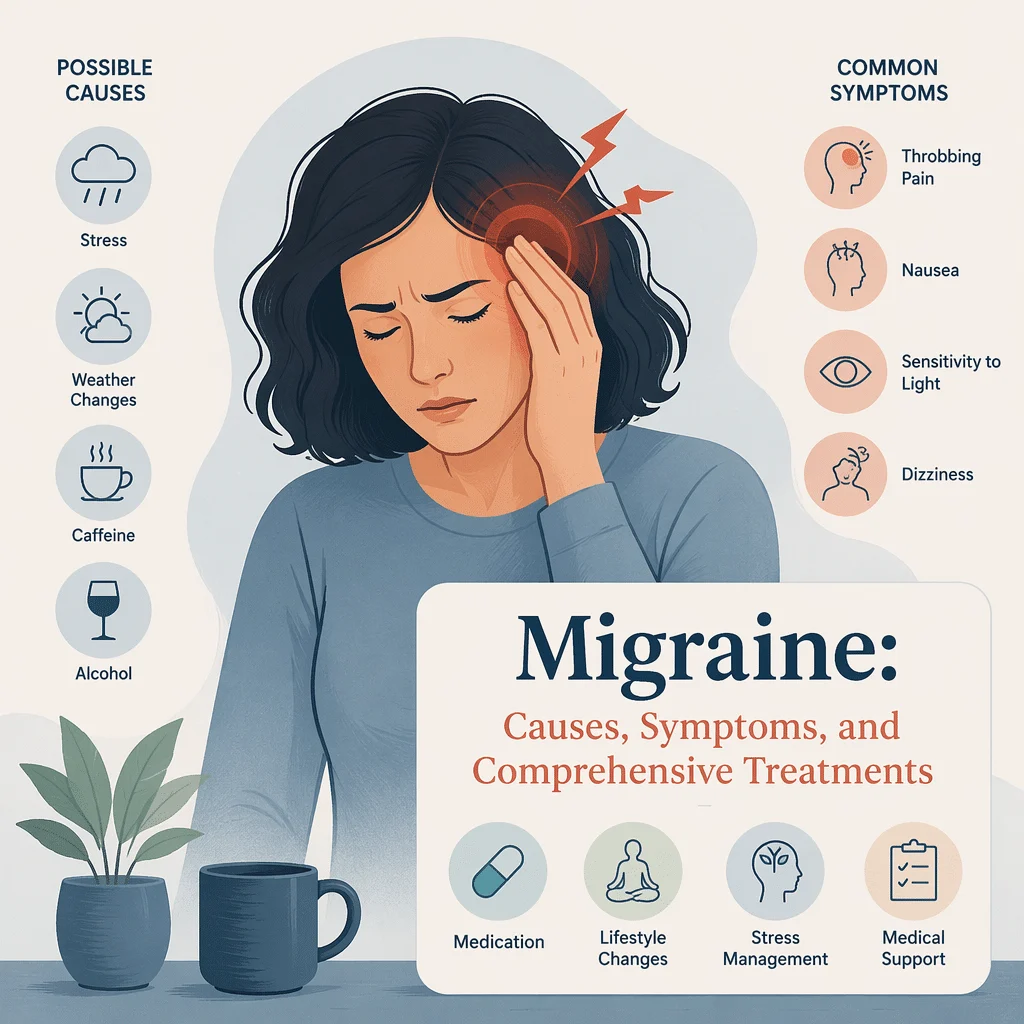
A migraine is far more than an ordinary headache. It is a common neurological condition that brings intense, often throbbing head pain, usually on one side, together with nausea and a strong sensitivity to light and sound. A single attack can last from a few hours to three days and can make work, study, and family life difficult. Around one in seven people worldwide lives with this condition, and it ranks among the leading causes of disability in adults under 50. This article explains what a migraine is, the phases of an attack, the causes and triggers, how doctors reach a diagnosis, and the treatments available today, including the newest options. You will also learn which blood tests can help rule out other causes of recurring headaches.
What is a migraine?
A migraine is a genetic neurological disease that affects the brain and its blood vessels. It is not simply a reaction to stress or tiredness. During an attack, waves of electrical and chemical activity spread across the brain, facial nerves such as the trigeminal nerve become activated, and levels of a signalling molecule called CGRP (calcitonin gene-related peptide) rise. This cascade produces the pain and the other symptoms that people know so well.
Migraine tends to run in families and is more common in women, largely because of hormonal influences. It often begins in adolescence or early adulthood and can change in pattern over a lifetime, sometimes easing after the age of 50.
Migraine is common and often underestimated. Global health surveys rank it among the most disabling conditions in people of working age, yet many who live with it have never received a formal diagnosis. Seeing migraine as a genuine neurological disease, rather than a minor complaint, is the first step towards better care, and it helps explain why the symptoms can differ so much from one person to the next and even from one attack to the next.
Common types of migraine
Doctors recognise several forms:
- Migraine without aura: the most common type, with head pain and associated symptoms but no warning neurological signs.
- Migraine with aura: pain preceded or accompanied by temporary visual, sensory, or speech disturbances.
- Chronic migraine: headache on 15 or more days per month for at least three months, with migraine features on at least eight of those days.
- Vestibular migraine: attacks dominated by dizziness and balance problems, sometimes with little head pain.
- Menstrual migraine: attacks tied closely to the menstrual cycle and falling oestrogen levels.
The four phases of a migraine attack
Not every attack includes every phase, but many migraines follow a recognisable pattern. Learning these phases helps people act early, take medicine at the right moment, and plan their day.
| Phase | What happens | Typical timing |
|---|---|---|
| Prodrome | Subtle warning signs such as mood changes, food cravings, yawning, neck stiffness, or thirst | Hours to one or two days before the pain |
| Aura | Reversible visual signs (flashing lights, blind spots), tingling, or speech trouble | 5 to 60 minutes, usually just before the pain |
| Attack (headache) | Throbbing pain, often one-sided, with nausea and sensitivity to light, sound, and smell | 4 to 72 hours |
| Postdrome | A migraine hangover with fatigue, low mood, and trouble concentrating | Up to one or two days after the pain |
Causes and common triggers
There is no single cause of migraine. Instead, an inherited sensitivity of the nervous system makes the brain more reactive to certain internal and external changes. These changes are called triggers. Triggers do not cause migraine on their own, but they can set off an attack in someone who is already prone to them. Keeping a headache diary is one of the most useful ways to spot personal patterns.
Some triggers relate to body chemistry that can be measured. Dehydration, for example, is a frequent trigger, and a clinician can explain the risks of dehydration and low blood pressure. Low magnesium is also linked to migraine, and when attacks are frequent a doctor may order a magnesium blood test. Many people also have a personal threshold: one trigger may be harmless, but several together, such as a poor night of sleep, a skipped meal, and a stressful morning, can tip the balance and start an attack. This is why prevention often focuses on steady daily habits rather than on avoiding a single food.
Common migraine triggers
| Category | Examples |
|---|---|
| Hormonal | Menstrual periods, falling oestrogen, pregnancy, menopause |
| Dietary | Skipped meals, alcohol (especially red wine), aged cheese, cured meats, sudden caffeine changes |
| Sleep | Too little or too much sleep, jet lag, shift work |
| Stress | Emotional stress, or the let-down period right after a stressful time |
| Sensory | Bright or flickering lights, loud noise, strong smells |
| Physical and environmental | Dehydration, weather or pressure changes, intense exertion |
| Medication overuse | Frequent use of pain relievers or triptans |
Because hormones matter so much, and especially when attacks track with the menstrual cycle, some people ask a lab to measure their oestradiol hormone level. Stress is another powerful trigger, and to gauge its long-term effects a doctor may order a cortisol blood test.
Migraine versus other headaches
Because headache is such a broad word, it helps to compare migraine with two other common types: tension-type headache and cluster headache. The table below highlights the main differences.
| Feature | Migraine | Tension-type headache | Cluster headache |
|---|---|---|---|
| Pain quality | Throbbing, pulsating | Dull, pressing, like a tight band | Severe, burning, piercing |
| Location | Usually one side | Both sides, forehead or back of head | Around or behind one eye |
| Duration | 4 to 72 hours | 30 minutes to 7 days | 15 minutes to 3 hours, in clusters |
| Other symptoms | Nausea, light and sound sensitivity, sometimes aura | Little or no nausea | Watery eye, runny nose, restlessness |
| Effect of movement | Usually worse with activity | Not usually worse | Person often paces or rocks |
Very high blood pressure can also cause head pain, so when readings are elevated it helps to understand the link between high blood pressure and headaches.
How a migraine is diagnosed
No blood test or scan can confirm a migraine. Diagnosis is clinical, which means a doctor makes it from your history and a physical and neurological examination. They will ask how often attacks happen, how long they last, what the pain feels like, and what makes it better or worse. Widely used criteria from the International Classification of Headache Disorders guide this process.
Tests are used mainly to rule out other conditions that can cause similar symptoms. Blood work will not diagnose migraine, but it can reveal contributors and mimics. Thyroid problems can trigger headaches, so a doctor may check a thyroid-stimulating hormone (TSH) test. Low red blood cell counts can cause head pain and fatigue, and blood tests can reveal anaemia and its causes. When symptoms suggest a fluid or salt imbalance, your doctor may order an electrolyte panel. Low vitamin D has been linked to headache in some people, so you can ask your doctor to check a vitamin D (25-OH) blood test. During the examination, the doctor may also measure blood pressure, look at the back of the eyes, and test reflexes and coordination to confirm the nervous system is working normally. Brain imaging such as MRI is reserved for cases with unusual features or warning signs, not for typical migraine.
When to see a doctor: headache red flags
Most migraines are not dangerous, but certain features can signal a more serious problem and need urgent medical attention.
| Warning sign | Why it matters |
|---|---|
| Thunderclap headache (the worst ever, peaking within seconds) | May signal bleeding in or around the brain |
| A new or different headache that starts after the age of 50 | Raises the chance of another underlying cause |
| Fever with a stiff neck | Can point to meningitis |
| Weakness, numbness, trouble speaking, or vision loss | May indicate a stroke |
| Headache after a head injury | Needs assessment for bleeding or concussion |
| Pain that steadily worsens over days or weeks | Warrants further evaluation |
If any of these appear, seek emergency care rather than waiting for the headache to pass.
Treatments and management of migraine
Migraine care has two goals: relieving attacks quickly (acute treatment) and reducing how often they happen (preventive treatment). The right mix depends on how frequent and disabling the attacks are, and on your other health conditions.
Acute treatments to stop an attack
- Over-the-counter pain relievers such as ibuprofen, naproxen, aspirin, or paracetamol, taken as early as possible.
- Triptans, a prescription class that targets migraine specifically.
- Gepants (for example ubrogepant and rimegepant) and ditans (lasmiditan), newer options that can help when triptans are unsuitable.
- Anti-nausea medicines to ease sickness and help other drugs work.
Using acute medicines too often, on more than about 10 to 15 days a month, can lead to medication-overuse headache, so keeping track of how many days you take them matters.
Preventive treatments to reduce attacks
Prevention is considered when attacks are frequent, long, or hard to treat. Options include:
- Blood pressure medicines such as beta-blockers.
- Certain antidepressants, for example amitriptyline.
- Some anti-seizure medicines, such as topiramate.
- CGRP monoclonal antibodies, given by injection.
- Atogepant and rimegepant, gepants taken as preventive tablets.
- Botulinum toxin injections for chronic migraine.
- Non-drug approaches, including regular exercise and neuromodulation devices.
Latest scientific advances
Migraine treatment has changed quickly in recent years, largely because researchers learnt to target CGRP, the signalling molecule involved in attacks. Here is what recent studies suggest, in plain terms.
CGRP antibodies for prevention
The injectable CGRP antibodies (erenumab, fremanezumab, galcanezumab, and eptinezumab) block this pain pathway to prevent attacks. A 2026 network meta-analysis, which pools many trials to compare treatments, looked at episodic migraine and found these antibodies work in a broadly similar way to lower the number of migraine days each month. What this means for you: if one of these medicines is an option, the choice often comes down to dosing schedule, side effects, and cost rather than large differences in effectiveness. A 2025 systematic review also reported that many people keep taking these antibodies over the long term and tolerate them well, which is reassuring if you need a preventive treatment for years.
Clearer prevention guidance
In 2025 the American College of Physicians, a major United States professional body, issued updated guidance on preventive medicines for episodic migraine in everyday practice. It supports starting with well-studied options and adding CGRP-based medicines when first choices do not work or are not tolerated. An earlier network meta-analysis that compared preventive drugs against one another helped inform these kinds of decisions. What this means for you: there is now a clearer, step-by-step path your doctor can follow, so finding a preventive treatment involves less trial and error than before.
Gepants that treat and prevent
Gepants are pills that block CGRP. Some, such as atogepant and rimegepant, can now prevent attacks, not just stop them. A 2025 real-life study of atogepant taken daily followed patients in ordinary clinics (a cohort, meaning a group tracked over time) and found it reduced monthly migraine days, matching what earlier trials had shown. A separate year-long study of rimegepant taken every other day for prevention reported steady benefit and good safety over 12 months. What this means for you: for some people, a single medicine can both treat and prevent migraine, which can simplify a daily routine.
Devices that calm the nerves
Neuromodulation devices gently stimulate nerves with mild electrical or magnetic pulses, without drugs. In 2025 the International Headache Society published evidence-based guidelines on non-invasive neuromodulation devices for treating and preventing migraine, and a 2025 review described how these tools are being used in more situations than before. What this means for you: if you cannot take, or prefer to avoid, certain medicines, for example during pregnancy, a device may be worth discussing with your doctor. Many of these findings are encouraging but still developing, and no single treatment works for everyone.
Living with migraine and prevention
Beyond medicines, daily habits can lower how often attacks strike and how severe they feel.
- Keep steady routines for sleep, meals, and hydration, since sudden changes are common triggers.
- Identify and, where possible, limit personal triggers using a headache diary.
- Manage stress with regular activity, relaxation techniques, or cognitive behavioural therapy.
- Address low magnesium through diet or supplements when advised, and learn to recognise the signs of magnesium deficiency.
- Treat sleep problems, because poor sleep both triggers and results from migraine. When loud snoring and daytime sleepiness are present, a specialist can diagnose obstructive sleep apnoea.
Support from family, employers, and, when needed, mental health professionals also helps people cope with a condition that can feel isolating.
Glossary
| Term | Definition |
|---|---|
| Aura | Temporary, reversible neurological symptoms, often visual, that can appear before or during a migraine. |
| CGRP | Calcitonin gene-related peptide, a molecule in the nervous system that helps carry migraine pain; many new treatments block it. |
| Prodrome | The early warning phase before the headache, with signs such as yawning, cravings, or mood changes. |
| Postdrome | The recovery phase after the pain, often described as a migraine hangover. |
| Trigeminal nerve | A major facial nerve involved in producing migraine pain. |
| Photophobia | Increased sensitivity to light during an attack. |
| Phonophobia | Increased sensitivity to sound during an attack. |
| Triptan | A prescription medicine class used to stop a migraine attack once it starts. |
| Gepant | A newer drug type that blocks CGRP and can treat or prevent migraine. |
| Chronic migraine | Headache on 15 or more days a month for at least three months. |
Frequently asked questions about migraine
What are the most common migraine symptoms?
The classic sign is a throbbing or pulsating headache, often on one side of the head, that gets worse with movement. Many people also feel nauseated and become sensitive to light, sound, and sometimes smell. Some notice warning signs beforehand, such as yawning, food cravings, or mood changes, and about one in four experience an aura with visual or sensory disturbances. After the pain eases, a tired, foggy feeling can linger for a day or two.
What is the difference between a migraine and a regular headache?
A tension-type headache usually feels like a steady, mild-to-moderate pressure on both sides of the head, and it rarely stops you from carrying on with your day. A migraine is typically more intense, often one-sided and throbbing, and it comes with extra symptoms such as nausea and sensitivity to light and sound. Migraine attacks also tend to last longer and often force people to rest in a dark, quiet room.
What triggers a migraine?
Triggers vary from person to person, but common ones include stress, missed meals, dehydration, poor or irregular sleep, hormonal changes around menstruation, bright or flickering lights, strong smells, alcohol, and sudden changes in caffeine. Weather and pressure shifts affect some people. A single trigger may not be enough on its own; often several combine. Keeping a headache diary for a few weeks is the best way to identify your personal triggers.
What does a migraine with aura feel like?
An aura is a set of temporary neurological symptoms that usually build over a few minutes and last less than an hour. The most common is visual: shimmering zigzag lines, flashing lights, or a blind spot that drifts across your vision. Some people feel tingling or numbness spreading up an arm, or have trouble finding words. Aura most often comes just before the headache, though it can occur without pain. New or sudden visual symptoms should always be checked by a doctor.
What is the best treatment for migraines?
There is no single best treatment, because the right choice depends on how often attacks occur and how severe they are. Mild, occasional attacks may respond to over-the-counter pain relievers taken early. More disabling attacks often need prescription options such as triptans, gepants, or ditans. When migraines are frequent, a preventive treatment, taken regularly to reduce attacks, may help, from tablets and injections to neuromodulation devices. A doctor can tailor a plan to your history.
Can blood tests diagnose a migraine?
No. Migraine is diagnosed clinically, from your symptoms and examination, not from a blood test or scan. However, blood tests are still useful to rule out other conditions that can cause or worsen headaches, such as thyroid problems, anaemia, dehydration, or a low level of certain minerals. Understanding these results can help you and your doctor see the fuller picture behind your headaches.
Sources
- National Institute of Neurological Disorders and Stroke (NINDS) — Migraine — ninds.nih.gov
- MedlinePlus, U.S. National Library of Medicine — Migraine — medlineplus.gov
- Mayo Clinic — Migraine: Symptoms and causes — mayoclinic.org
- Qaseem A. et al. — Prevention of Episodic Migraine Headache Using Pharmacologic Treatments: A Clinical Guideline From the American College of Physicians — Annals of Internal Medicine, 2025 — doi.org/10.7326/ANNALS-24-01052
- Shakir M. et al. — Efficacy and safety of CGRP monoclonal antibodies for migraine prevention in episodic migraine: a network meta-analysis — European Journal of Clinical Pharmacology, 2026 — doi.org/10.1007/s00228-025-03934-3
- Ray S. et al. — Patient Adherence and Long-Term Tolerability of Anti-CGRP Monoclonal Antibodies in Migraine Prevention: A Systematic Review — Cureus, 2025 — doi.org/10.7759/cureus.91347
- Lampl C. et al. — The comparative effectiveness of migraine preventive drugs: a systematic review and network meta-analysis — The Journal of Headache and Pain, 2023 — doi.org/10.1186/s10194-023-01594-1
- Vernieri F. et al. — Effectiveness and tolerability of atogepant in the prevention of migraine: a real-life, prospective, multicentric study (STAR) — Cephalalgia, 2025 — doi.org/10.1177/03331024251335927
- Kudrow D. et al. — A 52-week open-label extension study of oral rimegepant for the preventive treatment of migraine — Headache, 2025 — doi.org/10.1111/head.15002
- Yuan H. et al. — International Headache Society evidence-based guidelines on non-invasive neuromodulation devices for the acute and preventive treatment of migraine — Cephalalgia, 2025 — doi.org/10.1177/03331024251388377
- Cocores A. et al. — Update on Neuromodulation for Migraine and Other Primary Headache Disorders: Recent Advances and New Indications — Current Pain and Headache Reports, 2025 — doi.org/10.1007/s11916-024-01314-7
Further reading
- Understand vestibular migraine and vertigo: vertigo, causes, and diagnosis
- Learn how migraine relates to anxiety: anxiety and its management
- Recognise the overlap with depression: depression, symptoms and treatments
- See how to manage high blood pressure: high blood pressure control
- Explore the causes of night-time nausea: night-time nausea explained
Understand your lab results with AI DiagMe
Migraine is a clinical diagnosis, but blood tests still play a supporting role by helping rule out contributors such as thyroid problems, anaemia, dehydration, or low magnesium. AI DiagMe turns those lab reports into clear, plain-language explanations so you can arrive at your appointment better informed. It helps you understand your results; it does not diagnose migraine and never replaces your doctor.
Get your results interpreted in minutes