




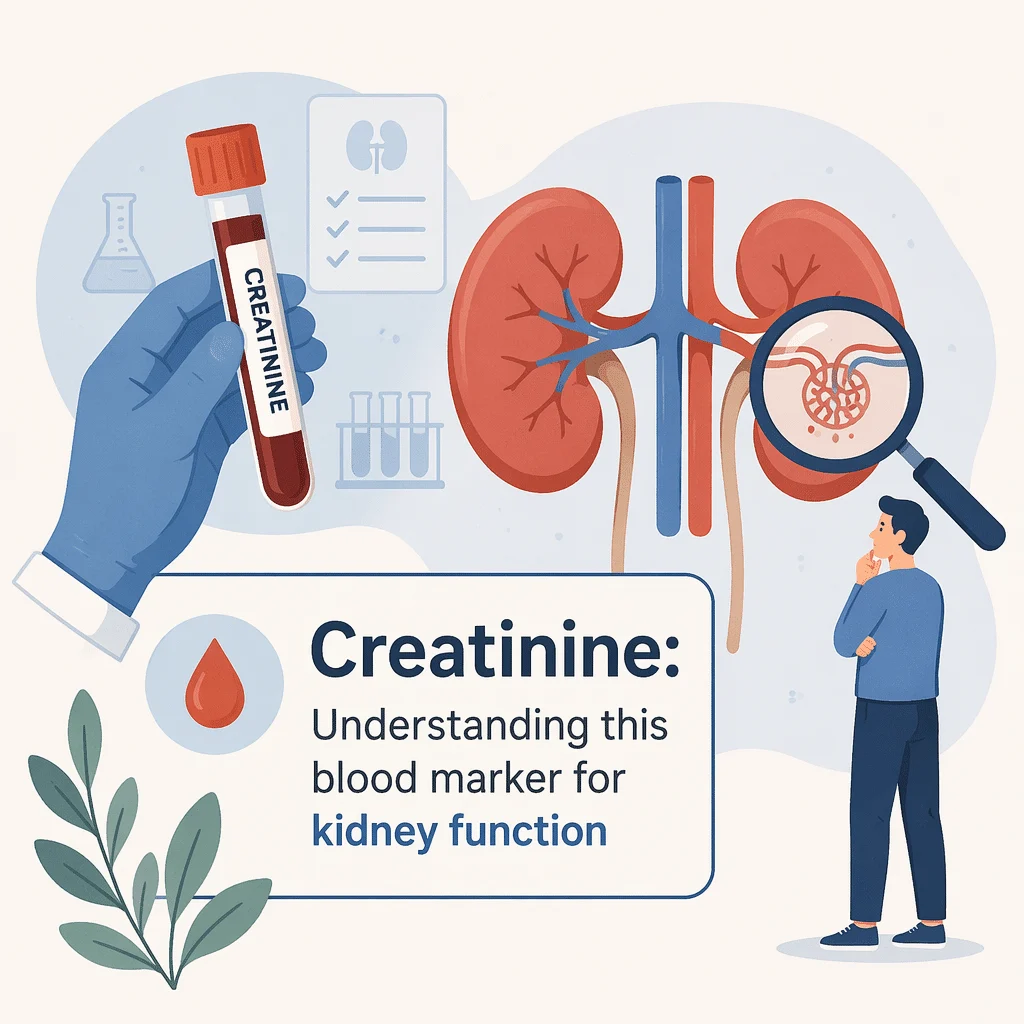
Creatinine levels are one of the most common values checked on a routine blood test, and for good reason: this single number offers a window into how well your kidneys are filtering waste from your blood. If a lab report has flagged your creatinine as high or low, that does not automatically mean something is wrong. In this article, you’ll learn what creatinine measures, what counts as a normal range for adults, what pushes the number up or down, and how this marker connects to eGFR and your muscle mass.
What creatinine is and why it matters
Creatinine is a waste product that your muscles generate continuously as a byproduct of normal energy use. It comes from the breakdown of a compound called creatine phosphate, which supplies quick energy to muscle fibres. Your body makes this waste at a fairly steady daily rate, which is exactly what makes it useful as a marker.
Heart patients are now screened differently: see what the new guidelines change for kidney function testing.
Creatinine itself serves no purpose once it forms. Your kidneys treat it as waste to be removed, filtering it out of the blood and passing it into urine. Because production stays steady and the kidneys filter it efficiently without reabsorbing much of it back into the bloodstream, doctors can use the blood concentration of creatinine as a practical stand-in for asking a bigger question: how well are the kidneys filtering everything else?
How the kidneys handle it
Picture your kidneys as a pair of round-the-clock filtration stations, cleaning your entire blood supply many times over each day. Tiny filtering units called nephrons pull waste, including creatinine, out of the blood and route it into urine for elimination. When this filtering slows down for any reason, creatinine has nowhere to go, so it builds up in the bloodstream and the number on your lab report climbs.
Normal creatinine levels by age and sex
Reference ranges for creatinine levels vary slightly between laboratories depending on the exact measurement method used, so always compare your result to the range printed on your own report rather than a generic chart. That said, the table below gives a useful approximation of normal creatinine levels for healthy adults.
| Group | Typical range (mg/dL) | Typical range (micromol/L) |
|---|---|---|
| Adult men | 0.74 – 1.35 | 65 – 119 |
| Adult women | 0.59 – 1.04 | 52 – 92 |
| Older adults | Often at the lower end of the adult range | Often at the lower end of the adult range |
| Children | Lower than adult values, rising with growth | Lower than adult values, rising with growth |
Notice that the range for men sits higher than the range for women. This is not a marker of health status; it reflects the fact that men generally carry more muscle mass on average, and muscle mass is the main driver of how much creatinine the body produces each day. A very active or muscular woman can have a naturally higher creatinine than a small-framed, sedentary man, and neither pattern signals a problem on its own.
Understanding the two units
You may see creatinine reported in milligrams per decilitre (mg/dL), the standard unit in the United States, or in micromoles per litre (micromol/L), which is common internationally. To convert mg/dL to micromol/L, multiply by 88.4. Knowing this conversion is handy if you are comparing results from different laboratories or reading international research.
What causes high creatinine levels
A high creatinine level most often points to reduced kidney filtration, but the underlying reasons split broadly into short-term and long-term causes, plus a set of factors that have nothing to do with kidney disease at all.
Short-term causes
Acute kidney injury describes a sudden drop in kidney filtering that develops over hours to days. Common triggers include severe dehydration, a serious infection that lowers blood pressure and blood flow to the kidneys, or exposure to a substance that is toxic to kidney tissue. The encouraging news is that acute kidney injury often improves once the underlying cause is treated, though it needs prompt medical attention.
Long-term causes
Chronic kidney disease develops gradually and represents the more common source of a persistently elevated creatinine. Several conditions can drive it:
- Diabetic kidney disease, in which years of elevated blood sugar gradually injures the small blood vessels inside the kidney’s filtering units
- Hypertensive kidney damage, in which uncontrolled blood pressure wears down the renal arteries over time
- Glomerulonephritis, a group of inflammatory conditions that directly damage the glomeruli, the kidney’s microscopic filters
- Polycystic kidney disease and other inherited conditions that alter kidney structure over a lifetime
If you live with diabetes or high blood pressure, your doctor will likely monitor your creatinine and eGFR (estimated glomerular filtration rate) regularly, since these two conditions account for most cases of chronic kidney disease in the United Kingdom.
Non-kidney causes of a high result
Not every elevated result reflects kidney disease. A blocked urinary tract from a kidney stone, an enlarged prostate, severe heart failure that reduces blood flow to the kidneys, and rhabdomyolysis (a serious breakdown of muscle tissue, often after extreme exertion or injury) can all raise creatinine levels without the kidneys themselves being the primary problem. Even everyday factors like a recent high-protein meal, intense exercise the day before your blood test, mild dehydration, or certain medications such as cimetidine can nudge the number upward temporarily.
What causes low creatinine levels
Low creatinine levels are far less common than high ones and usually carry less urgency, but a below-range reading still deserves context. Because creatinine mirrors muscle mass, anything that reduces muscle tissue can lower the result. This includes advanced age, prolonged bed rest, malnutrition, and certain muscle-wasting diseases. Pregnancy also lowers creatinine somewhat as a normal physiological change, since blood volume expands and kidney filtration temporarily increases.
Severe liver disease is another cause worth knowing about, since the liver contributes to the production of creatine, the molecule that eventually breaks down into creatinine. When liver function is significantly impaired, this upstream supply can shrink, pulling creatinine down along with it. In this scenario, other liver-related blood markers are typically abnormal as well, which helps a doctor join the dots.
How creatinine connects to eGFR and muscle mass
Because creatinine production depends so heavily on muscle mass, a raw creatinine level alone can be misleading. A frail, low-muscle older adult and a heavily muscled athlete could theoretically post the same creatinine value while having very different kidney filtration rates. This is exactly why doctors developed eGFR, a calculation that adjusts the creatinine level for a person’s age and sex to produce a more standardised estimate of kidney filtering capacity. You can read a full breakdown in our guide to how eGFR is calculated and interpreted.
The relationship works both ways. If you have unusually high muscle mass, your creatinine may sit at the upper end of normal or slightly above it even though your kidneys filter perfectly well, since the eGFR formula can only approximate the muscle-mass adjustment. Conversely, someone with very low muscle mass from advanced age or chronic illness can have a creatinine that looks reassuringly normal even when kidney function has already declined, because there is simply less creatinine being produced to reveal the problem. This is one reason doctors sometimes pair creatinine with a urine-based test; our guide to interpreting urine creatinine results explains how that complementary measurement works.
Creatinine clearance as an alternative measurement
Before eGFR calculations became standard, doctors often relied on creatinine clearance, a test that compares the creatinine measured in a timed urine collection (usually 24 hours) against the creatinine measured in blood. A typical adult clearance falls between roughly 90 and 120 mL per minute, gradually declining with age. Creatinine clearance still has a role today, particularly in people with very high or very low muscle mass, where the standard eGFR equation is known to be less precise.
Reading your results in the context of a full panel, and when to see a doctor
Creatinine levels rarely appear alone on a lab report. The result is typically bundled into a broader kidney function panel alongside eGFR, BUN (blood urea nitrogen), and electrolytes. Comparing creatinine against BUN can be particularly informative. Our guide to the BUN-to-creatinine ratio explains how a disproportionate rise in one marker relative to the other can point doctors towards dehydration versus a true kidney problem, and our article on what it means when both BUN and creatinine rise together goes into more depth on that specific pattern.
You may also encounter creatinine levels reported as part of a comprehensive metabolic panel, since kidney markers are a standard component of that broader chemistry screen. If your BUN result looks unusually low rather than high, our separate guide on low BUN levels covers what that pattern can mean.
A single test result outside the reference range is rarely, by itself, a reason for alarm. Kidneys have considerable reserve capacity, and many everyday factors can nudge creatinine levels temporarily. That said, certain situations call for a prompt conversation with your doctor or a referral to a nephrologist, a specialist in kidney health:
- Your creatinine has risen significantly and quickly compared with a previous test
- You notice swelling in the legs or around the eyes, unusual fatigue, or foamy urine
- A high creatinine level appears alongside blood pressure that is difficult to control
- Your eGFR has fallen below 60 mL/min/1.73m² on more than one occasion
- You have diabetes or high blood pressure and have not had kidney function checked in the past year
On the other hand, if your creatinine level sits just above the reference range and can reasonably be explained by high muscle mass, older age, or a recent protein-heavy meal, simple monitoring over time is often all that is needed. Doctors look for a consistent trend across several tests rather than reacting to one isolated number.
Everyday habits that support healthy creatinine levels
Whether your creatinine levels are normal or borderline, a few consistent habits support kidney health over the long run. Staying well hydrated, generally around 1.5 to 2 litres of water daily unless your doctor has advised otherwise, helps the kidneys filter efficiently. Moderating red meat and emphasising plant-based proteins can ease the daily workload on the filtering system, and a diet built around fruits and vegetables supports this further. Regular, moderate activity such as walking, swimming, or cycling benefits the kidneys much like it benefits the heart, whilst very extreme or prolonged exertion should be approached cautiously if you already have reduced kidney function. Perhaps most importantly, keeping diabetes and blood pressure well controlled remains the single most effective way to protect kidney filtration over decades, since these two conditions cause the majority of chronic kidney disease cases.
Recent scientific advances
Kidney function testing has evolved meaningfully in recent years, particularly around how creatinine is converted into an eGFR estimate. A joint task force convened by the National Kidney Foundation and the American Society of Nephrology reassessed how race was used in the eGFR formula and recommended race-free calculations for adults, a change adopted across most major U.S. laboratories starting in 2021 (National Kidney Foundation, CKD-EPI Creatinine Equation, 2021). What this means for you: if your eGFR was calculated before 2021, it may have used an older formula, and a repeat test today would use the current, refined calculation. In practical terms, the change mainly affects how the number is derived rather than what a healthy or reduced value looks like for you personally, so the reference thresholds you read about here still apply.
Following that update, the National Kidney Foundation convened a workgroup that examined how kidney filtration is estimated for medication dosing specifically, since certain drugs need dose adjustments when the kidneys filter more slowly. Their 2025 consensus recommended shifting away from an older calculation method (called Cockcroft-Gault creatinine clearance) towards the newer race-free eGFR equations for these decisions, whilst also accounting for a person’s body size (St. Peter et al., American Journal of Health-System Pharmacy, 2025). What this means for you: if you take medications that require kidney-based dose adjustments, your care team is increasingly likely to base those decisions on eGFR rather than older formulae, which is intended to make dosing more consistent and accurate across different patients.
Researchers have also continued to study how creatinine, when combined with a second blood marker called cystatin C (a protein produced by all cells in the body at a steady rate, largely independent of muscle mass), can sharpen kidney assessments in people whose muscle mass makes creatinine alone less reliable. A 2024 review noted that combining creatinine with cystatin C reduces some of the accuracy gaps seen when muscle mass, diet, or certain medications skew creatinine-only estimates, and highlighted that low creatinine from reduced muscle mass, whether from a vegetarian diet, limb loss, or muscle-wasting conditions, can make a creatinine-only eGFR look falsely reassuring (Vișinescu et al., International Journal of Molecular Sciences, 2024). What this means for you: if you have very low or very high muscle mass, or if your doctor suspects your creatinine may not be telling the full story, a cystatin C test alongside creatinine can offer a more complete picture, though it remains a specialised addition rather than a routine test for most people.
Finally, a 2025 study following a large cohort of people with chronic kidney disease compared the new race-free eGFR equations against the older formulas to see whether they changed how well doctors could predict kidney-related complications such as anaemia and mineral imbalances. The researchers found that the newer and older equations performed similarly well at flagging these complications, which offers reassurance that the updated, race-free calculation does not lose predictive accuracy compared with what came before (Koh et al., American Journal of Nephrology, 2025, KNOW-CKD Study). What this means for you: the shift to race-free eGFR reporting is a refinement in fairness and consistency rather than a change that makes kidney monitoring less reliable, so you can expect the same level of protection from routine testing under the current formula.
Further reading
- BUN (Urea): Understanding your test results
- ACR (Albumin/Creatinine Ratio): decoding this renal marker
- Microalbuminuria: understanding this kidney marker
- High Blood Pressure: Understanding, Treating, and Preventing
- Diabetes: Causes, symptoms, and treatments
Glossary
| Term | Definition |
|---|---|
| Creatinine | A waste product made continuously by muscle activity and cleared from the blood by the kidneys. |
| eGFR (estimated glomerular filtration rate) | A calculation that uses creatinine, age, and sex to estimate how much blood the kidneys filter each minute. |
| CKD-EPI equation | The formula most laboratories currently use to convert a creatinine result into an eGFR estimate. It was updated in 2021 to remove race as a variable. |
| Chronic kidney disease (CKD) | A long-term reduction in kidney filtering ability, generally defined as reduced function lasting more than three months. |
| Acute kidney injury (AKI) | A sudden drop in kidney function developing over hours to days, often reversible if the cause is treated quickly. |
| Creatinine clearance | An older method of estimating kidney filtration by comparing creatinine in a timed urine sample with creatinine in the blood. |
| Cystatin C | A protein made by all cells at a steady rate, sometimes measured alongside creatinine for a more precise kidney estimate. |
| Rhabdomyolysis | A serious breakdown of muscle tissue that releases large amounts of muscle content, including creatinine, into the blood. |
Frequently asked questions
What is considered a dangerous creatinine level?
There is no single cut-off that applies to everyone, since normal creatinine depends on your muscle mass, age, and sex. Doctors generally become concerned when a result sits well above the laboratory’s reference range, rises sharply compared with a previous test, or is accompanied by a falling eGFR or symptoms such as swelling and reduced urination. A modestly elevated value in a muscular, otherwise healthy person is interpreted very differently from the same number in someone who is frail or has known kidney disease. Your doctor is best placed to say whether a specific result warrants concern in your case.
Why do normal creatinine levels differ by age?
Creatinine reflects muscle mass, and muscle mass naturally changes across the lifespan. Children have less muscle than adults, so their reference ranges run lower and rise gradually as they grow. Older adults often lose some muscle mass over time, a process called sarcopenia, which can pull creatinine towards the lower end of the adult range even if kidney filtration has also declined somewhat with age. This is part of why doctors rely on eGFR, which factors in age, rather than raw creatinine alone.
Can dehydration really raise my creatinine level?
Yes, dehydration is one of the most common reasons for a temporary rise in creatinine. When you have less fluid in your bloodstream, waste products including creatinine become more concentrated, and reduced blood flow to the kidneys can also modestly slow filtration. This effect usually reverses once you rehydrate, which is why doctors often recommend repeating a mildly elevated creatinine test after ensuring you have had enough water beforehand, rather than assuming kidney disease from a single result.
Does eating meat before a blood test affect creatinine?
A large meal that is very high in cooked meat can temporarily raise your creatinine level, because meat itself contains creatine and creatinine that gets absorbed into your bloodstream. This is a short-lived effect rather than a sign of kidney trouble. If your lab visit involves other tests that require fasting, follow those instructions, and mention to your provider if you had an unusually large meat-heavy meal shortly before your last blood draw so they can factor that into the interpretation.
How often should creatinine be checked if I have diabetes or high blood pressure?
Because diabetes and high blood pressure are the two leading causes of chronic kidney disease, most guidelines recommend annual kidney function testing, including creatinine and eGFR, for people living with either condition, even without symptoms. Your doctor may recommend more frequent checks, sometimes every three to six months, if your kidney function has already shown some decline or if your diabetes or blood pressure has been difficult to control. Ask your care team what testing schedule fits your specific situation.
Can creatinine be normal even with kidney disease?
Yes, this can happen, particularly in people with reduced muscle mass, such as some older or chronically ill adults. Because creatinine production depends on muscle, someone who has lost significant muscle may generate so little creatinine that even a meaningfully reduced kidney filtration rate still produces a result that looks normal on paper. This is one reason doctors calculate eGFR rather than relying on creatinine in isolation, and why unexplained symptoms should still prompt further evaluation even when a creatinine result looks reassuring.
Sources
- National Kidney Foundation — eGFR Calculator and CKD-EPI Creatinine Equation (2021) — kidney.org
- National Kidney Foundation — Creatinine — kidney.org
- MedlinePlus (National Library of Medicine, NIH) — Creatinine Test — medlineplus.gov
- Mayo Clinic — Creatinine test — mayoclinic.org
- St. Peter WL, et al. — Moving forward from Cockcroft-Gault creatinine clearance to race-free estimated glomerular filtration rate to improve medication-related decision-making: A consensus of the National Kidney Foundation Workgroup — American Journal of Health-System Pharmacy, 2025 — doi.org/10.1093/ajhp/zxae317
- Vișinescu AM, et al. — Cystatin C: A Monitoring Perspective of Chronic Kidney Disease in Patients with Diabetes — International Journal of Molecular Sciences, 2024 — doi.org/10.3390/ijms25158135
- Koh J, et al. — Performance of New Race-Free eGFR Equations for Predicting Complications in Chronic Kidney Disease: From the KNOW-CKD Study — American Journal of Nephrology, 2025 — doi.org/10.1159/000543324
Creatinine is just one piece of a bigger puzzle, and it is usually read alongside eGFR, BUN, and electrolytes to build a full picture of kidney health. Understanding how these values relate to each other, rather than fixating on one number, is what turns a confusing lab report into something useful for your care. AI DiagMe helps you make sense of these values together, turning a page of unfamiliar numbers into plain-language context you can bring to your next appointment. This tool is designed to support your understanding between visits; it does not diagnose conditions or replace the judgement of your doctor.
Understand your lab results with AI DiagMe
Get your results interpreted in minutes