








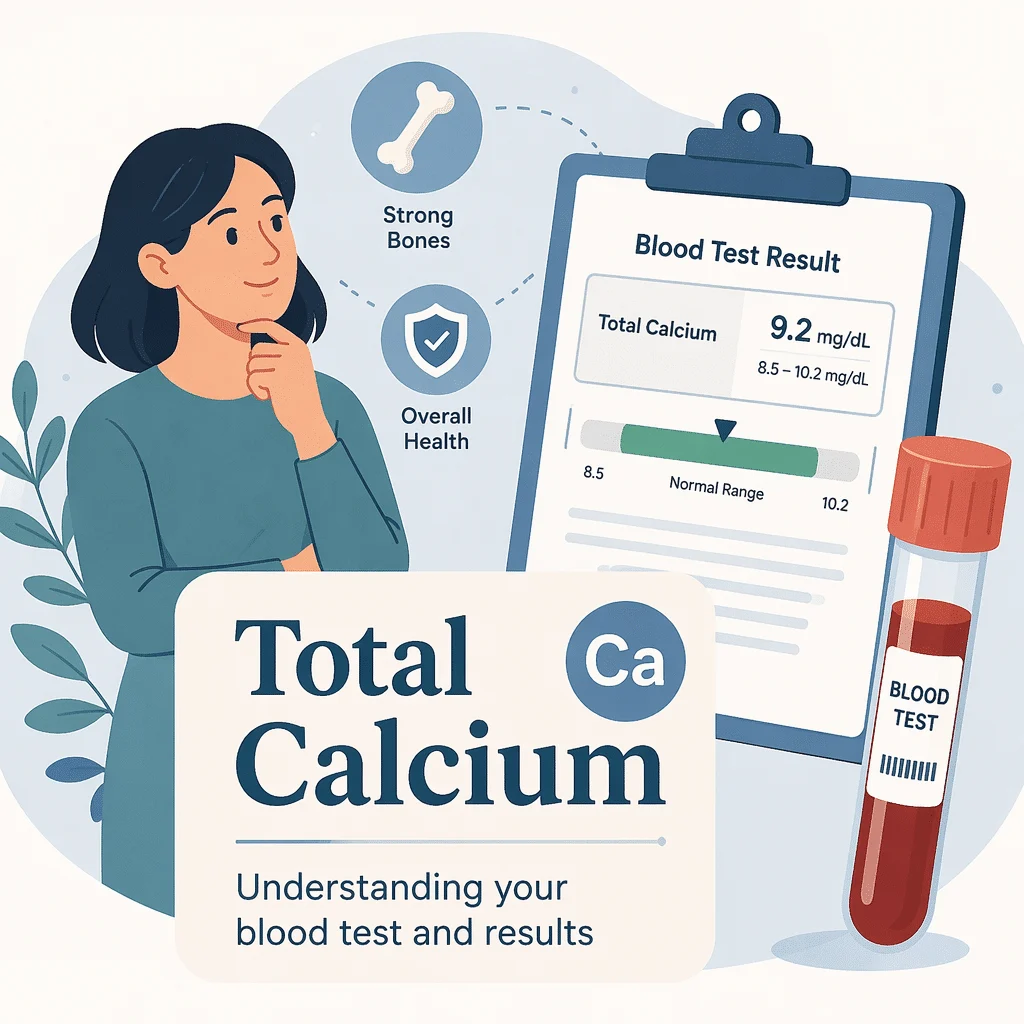
A calcium blood test measures how much calcium is circulating in your blood, and it is one of the most frequently ordered lab values in routine care. If your report shows a number flagged high or low, this article explains what the test measures, what the normal range looks like, and what commonly causes hypercalcaemia (high calcium) or hypocalcaemia (low calcium). In this article, you’ll learn how calcium is regulated in your body, why albumin affects how the result should be read, and when a result deserves a conversation with your doctor rather than concern.
What a calcium blood test measures
Calcium is the most abundant mineral in your body, but only about 1% of it circulates in your blood at any moment. The other 99% is stored in your bones and teeth, acting as a long-term reserve. A calcium blood test reports that small circulating fraction, not your bone density, which is why a normal result does not by itself confirm strong bones.
Blood calcium exists in two main forms. Roughly half is bound to proteins, mainly albumin, and travels through your bloodstream attached to them. The other half is “free,” or ionised, and this unbound fraction is the biologically active portion that your nerves, muscles, and heart actually use. A standard test usually reports total calcium, meaning both forms added together.
Your body defends this circulating level with remarkable precision through a feedback loop involving parathyroid hormone (PTH) and vitamin D. When calcium drops even slightly, the parathyroid glands respond within minutes. This tight control is why calcium usually stays inside a narrow range and why a value drifting outside it is worth investigating rather than ignoring.
Four tiny parathyroid glands sit behind your thyroid in your neck. Their job is to sense blood calcium constantly and release parathyroid hormone (PTH) whenever the level dips. PTH then acts on three organs at once to restore balance.
- In the bones, PTH signals the release of stored calcium into the bloodstream.
- In the kidneys, PTH reduces how much calcium is lost in urine and activates vitamin D into its usable form.
- In the intestines, active vitamin D increases how efficiently you absorb calcium from food.
Vitamin D itself needs a two-step conversion before it can help. Your skin or diet supplies an inactive form, your liver converts it to 25-hydroxyvitamin D (the storage form measured on a standard vitamin D test), and your kidneys finish the job by converting it into the active hormone that boosts calcium absorption in the gut. A problem at any step, whether it is limited sun exposure, liver disease, or reduced kidney function, can disrupt this pathway and eventually show up as an abnormal calcium level.
This system explains why calcium rarely moves in isolation. Your doctor frequently orders a parathyroid hormone (PTH) test alongside calcium, since comparing the two reveals whether your glands are behaving appropriately or driving an abnormal result themselves.
Normal calcium blood test ranges
Reference ranges vary slightly between laboratories, so always compare your result to the range printed on your own report rather than a figure found online. As a general guide, most adult total calcium results fall within the following bands.
| Measurement | Typical adult range |
|---|---|
| Total calcium (mg/dL) | 8.5 – 10.5 mg/dL |
| Total calcium (mmol/L) | 2.20 – 2.60 mmol/L |
| Ionised (free) calcium | 4.6 – 5.3 mg/dL (1.15 – 1.33 mmol/L) |
| Unit conversion | 1 mmol/L ≈ 4 mg/dL (approximately 40 mg/L) |
Laboratories often use a colour code or a symbol such as an asterisk to flag values outside this range. A result just past the boundary, with no symptoms, is common and often explained by hydration, a recent meal, or normal lab-to-lab variation rather than disease. What matters more is how far the value sits from the range, whether it persists on a repeat test, and whether other markers such as PTH or vitamin D point the same way.
Why albumin matters: reading total calcium correctly
Because roughly half of your blood calcium travels attached to albumin, an abnormal albumin level can distort how your total calcium result looks. If your albumin runs low, for example from malnutrition, liver disease, or inflammation, your total calcium can appear falsely low even though the biologically active (ionised) portion is completely normal. The reverse is also possible with a high albumin level.
To account for this, doctors calculate a “corrected calcium” that adjusts the raw total calcium value based on your albumin result. This calculation is genuinely useful when albumin is abnormal, but it involves its own formula and interpretation nuances that go beyond what this article covers. Our dedicated guide on the corrected calcium blood test walks through the albumin-adjustment calculation and how to interpret the adjusted value step by step.
If your own albumin result looks unusual on its own, independent of calcium, our guides to low albumin causes and risks and to normal albumin reference ranges explain what a low or borderline protein level can mean on its own.
Hypercalcaemia: causes of high total calcium
Hypercalcaemia means your total calcium sits above the reference range. Many mild elevations are picked up incidentally on routine blood tests and cause no symptoms at all; more pronounced or persistent elevations warrant a closer look at the underlying cause.
Common causes
- Primary hyperparathyroidism: one or more parathyroid glands produce excess PTH independently of your body’s needs, usually because of a small benign growth. This is the most common cause of hypercalcaemia found on routine testing in otherwise healthy adults.
- Cancer-related hypercalcaemia: certain tumours release substances that raise blood calcium directly or that increase calcium release from bone. This form tends to develop faster and reach higher levels than parathyroid-related hypercalcaemia.
- Excess vitamin D: long-term, poorly supervised high-dose vitamin D supplementation can push intestinal calcium absorption too high.
Less common causes
- Sarcoidosis and similar inflammatory conditions can cause abnormal, uncontrolled production of active vitamin D.
- Prolonged immobilisation from extended bed rest accelerates the release of calcium from bone.
- Certain medications, including thiazide diuretics and lithium, can each raise blood calcium.
Symptoms of high calcium, when present, often affect several systems at once: persistent thirst and frequent urination, constipation or nausea, bone or muscle aches, and sometimes difficulty concentrating or low mood. Untreated, chronic hypercalcaemia can contribute to kidney stones and bone thinning over time.
Hypocalcaemia: causes of low total calcium
Hypocalcaemia means your total calcium sits below the reference range. As with hypercalcaemia, a mild drop with no symptoms is frequently reversible and worth rechecking rather than acting on immediately.
Common causes
- Vitamin D deficiency: since vitamin D drives intestinal calcium absorption, a shortage (common in people with limited sun exposure) reduces how much calcium the gut takes in.
- Hypoparathyroidism: insufficient PTH production, often following thyroid or neck surgery, prevents the body from maintaining a normal calcium level.
- Chronic kidney disease: reduced kidney function impairs the final activation step of vitamin D, disrupting the entire calcium-regulation loop.
- Low albumin: because roughly half of blood calcium binds to albumin, a low albumin level can make total calcium appear reduced even when the active, ionised fraction is fine. See our guide to understanding hypoalbuminaemia for more on this specific pattern.
Less common causes
- Intestinal malabsorption from conditions such as coeliac disease limits how much dietary calcium the gut can absorb.
- Low magnesium can blunt the parathyroid glands’ ability to release PTH normally.
- Tumour lysis syndrome, occurring during certain cancer treatments, can disrupt calcium balance acutely through rapid destruction of tumour cells.
Low calcium symptoms often centre on nerves and muscles: tingling around the mouth or fingertips, muscle cramps or spasms, and general fatigue. Severe, rapid drops are less common but can cause more serious neuromuscular effects, which is one reason a markedly low result deserves prompt medical attention.
Related tests and a quick comparison
| Feature | Hypercalcaemia (high) | Hypocalcaemia (low) |
|---|---|---|
| Leading cause in adults | Primary hyperparathyroidism | Vitamin D deficiency |
| Typical symptoms | Thirst, constipation, fatigue, bone pain | Tingling, muscle cramps, spasms |
| Common follow-up tests | PTH, vitamin D, kidney function | PTH, vitamin D, magnesium, albumin |
| Long-term risk if untreated | Kidney stones, bone thinning | Bone weakening, neuromuscular symptoms |
Calcium is rarely interpreted alone. Because the regulatory loop involves several organs and hormones, doctors typically read calcium alongside a small group of related markers to understand what is driving an abnormal result.
Parathyroid hormone tells you whether your glands are responding appropriately or causing the problem themselves; a PTH test paired with calcium is the single most informative combination for sorting out hypercalcaemia and hypocalcaemia. Vitamin D status, checked through a vitamin D (25-OH) test, explains how well your gut can absorb calcium from food. Phosphorus often moves in the opposite direction to calcium, so a phosphorus blood test is frequently checked alongside calcium, especially when parathyroid or kidney disease is suspected. Because the kidneys both filter calcium and activate vitamin D, a kidney function panel rounds out the picture when calcium is persistently abnormal.
Calcium also frequently appears bundled inside broader panels. If your result came from a routine visit, it may have been part of a comprehensive metabolic panel or an electrolyte panel, both of which measure calcium alongside other minerals and organ-function markers. For a deeper look at how calcium fits into the wider bone and mineral picture, our guide to the calcium blood test and bone panel covers calcium, phosphate, PTH, and vitamin D together as one interconnected system.
When to see a doctor
Most single abnormal calcium results are mild and best discussed at a routine follow-up rather than treated as an emergency. That said, certain situations call for more prompt medical attention.
- Your calcium level is significantly outside the reference range, not just slightly.
- You have symptoms such as confusion, muscle spasms, severe bone pain, or an irregular heartbeat.
- An abnormal result persists across more than one test.
- You have known kidney disease, a parathyroid condition, or cancer and notice a new or worsening calcium abnormality.
- You experience severe or worsening thirst, vomiting, or confusion alongside a known high calcium result, which can occasionally require urgent evaluation.
Simple monitoring is often reasonable if the deviation from the normal range is minimal, you have no symptoms, and a temporary explanation (such as dehydration or a recent supplement) seems likely. Your doctor is best placed to decide whether a repeat test, additional blood tests, or imaging is the right next step.
Recent scientific advances
According to PubMed, an international panel of over 50 specialists updated the global clinical guidelines for evaluating and managing primary hyperparathyroidism, the leading cause of hypercalcaemia in otherwise healthy adults (Bilezikian et al., 2022, Journal of Bone and Mineral Research). What this means for you: the update sharpened the criteria doctors use to decide between monitoring and surgery, and it formally recognised “normocalcaemic” primary hyperparathyroidism (elevated PTH with a calcium level that stays inside the normal range) as a distinct pattern worth watching, not just a lab curiosity. In practice, this means an elevated PTH alongside a normal-looking calcium result is not automatically reassuring and may still deserve follow-up.
A related cohort study from Mayo Clinic examined outcomes after parathyroid surgery across the three recognised biochemical patterns of primary hyperparathyroidism (classic, normocalcaemic, and normohormonal) (Armstrong et al., 2022, Surgery). What this means for you: patients with the normocalcaemic pattern had a higher chance of kidney stones recurring after surgery and of the underlying gland problem persisting, even though bone density still tended to improve. This is a reminder that “normal calcium” on its own does not rule out a parathyroid problem if PTH is elevated, which is exactly why doctors read calcium and PTH together rather than in isolation.
A 2024 review focused specifically on hypercalcaemia in people with cancer, a setting where high calcium can develop faster and reach higher levels than with a parathyroid problem (Bartkiewicz et al., 2024, Cells). According to PubMed, the review notes that hypercalcaemia of malignancy affects a substantial proportion of people with certain advanced cancers, most often through a tumour-related protein that mimics the action of PTH (parathyroid hormone-related peptide, or PTHrP) on bone. What this means for you: if hypercalcaemia develops alongside a new cancer diagnosis or unexplained weight loss, it is evaluated differently and often more urgently than an isolated finding in someone otherwise well, which is one reason your doctor may order additional tests rather than simply repeating the calcium level.
Finally, a 2024 clinical review on electrolyte-related emergencies reinforced how hypercalcaemia and hypocalcaemia are recognised and distinguished from other mineral imbalances in everyday practice (Zieg et al., 2024, BMC Nephrology). What this means for you: the review underscores that calcium abnormalities are read as part of a broader mineral and electrolyte picture rather than as a single isolated number, supporting the same message found throughout this article, that pattern and context matter more than any one flagged value. The overall reliability of these findings is high, since all four are recent, peer-reviewed publications from established specialty journals, though as with any specialist guideline, individual clinical decisions still depend on your doctor’s full assessment of your history and other results.
Sources
- National Library of Medicine (MedlinePlus, NIH) — Calcium Blood Test — medlineplus.gov
- Mayo Clinic Staff — Hypercalcaemia: Symptoms and causes — Mayo Clinic — mayoclinic.org
- Cleveland Clinic — Calcium Blood Test: What It Is and Results — my.clevelandclinic.org
- Bilezikian JP, Khan AA, Silverberg SJ, et al. — Evaluation and Management of Primary Hyperparathyroidism: Summary Statement and Guidelines from the Fifth International Workshop — Journal of Bone and Mineral Research, 2022 — doi.org/10.1002/jbmr.4677
- Armstrong VL, Hangge PT, Butterfield R, et al. — Phenotypes of primary hyperparathyroidism: Does parathyroidectomy improve clinical outcomes for all? — Surgery, 2022 — doi.org/10.1016/j.surg.2022.05.042
- Bartkiewicz P, Kunachowicz D, Filipski M, et al. — Hypercalcaemia in Cancer: Causes, Effects, and Treatment Strategies — Cells, 2024 — doi.org/10.3390/cells13121051
- Zieg J, Ghose S, Raina R. — Electrolyte disorders related emergencies in children — BMC Nephrology, 2024 — doi.org/10.1186/s12882-024-03725-5
Glossary
| Term | Definition |
|---|---|
| Total calcium | The standard blood test measurement that adds together the calcium bound to protein and the free, active calcium in your blood. |
| Ionised calcium | The free, unbound, biologically active portion of blood calcium, measured directly in a separate, more specialised test. |
| Hypercalcaemia | A higher-than-normal level of calcium in the blood. |
| Hypocalcaemia | A lower-than-normal level of calcium in the blood. |
| Parathyroid hormone (PTH) | A hormone made by four small glands in the neck that raises blood calcium when it falls too low. |
| Primary hyperparathyroidism | A condition in which one or more parathyroid glands produce excess hormone independently, usually raising blood calcium. |
| Albumin | The main blood protein that carries roughly half of your circulating calcium; an abnormal albumin level can distort a calcium reading. |
| Corrected calcium | A calculation that adjusts total calcium for an abnormal albumin level, giving a more accurate estimate of active calcium. |
| Vitamin D (25-hydroxyvitamin D) | The storage form of vitamin D measured on a standard blood test, reflecting your body’s overall vitamin D reserves. |
| Reference range | The band of values a laboratory considers typical for a healthy population, printed alongside your result. |
Frequently Asked Questions
What does it mean if my calcium blood test is high?
A high total calcium result, called hypercalcaemia, most often points to overactive parathyroid glands producing too much PTH. Other possible causes include certain cancers, excess vitamin D supplementation, and some medications. A single mildly elevated result is not a diagnosis on its own; your doctor will usually recheck the value and add PTH and vitamin D testing to narrow down the cause before drawing any conclusions.
What are normal calcium levels in a blood test?
For most adults, total calcium falls roughly between 8.5 and 10.5 mg/dL, or 2.20 to 2.60 mmol/L, though the exact range depends on your laboratory. Because roughly half of blood calcium is attached to albumin, a low albumin level can make the result look artificially low, which is why doctors sometimes calculate a corrected calcium value rather than relying on the raw number alone.
Can low calcium levels be a sign of something serious?
Low calcium (hypocalcaemia) is frequently linked to vitamin D deficiency, underactive parathyroid glands, or reduced kidney function, and it is not always a sign of serious illness. Mild, isolated drops are common and often reversible. That said, a markedly low result, especially with symptoms like tingling, cramps, or muscle spasms, warrants a prompt conversation with your doctor rather than a wait-and-see approach.
Does a high calcium level always mean cancer?
No. The large majority of high calcium results are explained by an overactive parathyroid gland, not cancer, and many elevations are mild and easily accounted for. Cancer is one of several possible causes of hypercalcaemia, particularly when it develops quickly or reaches a high level. Only a doctor, using PTH results, your history, and other tests together, can determine what a specific elevated result means for you.
How is calcium different from corrected calcium?
Total calcium is the raw, directly measured value on a standard blood test. Corrected calcium is a calculation that adjusts that raw value for your albumin level, since roughly half of blood calcium is protein-bound. When albumin is abnormal, the corrected figure gives a more accurate estimate of your active calcium than the total calcium number alone. Our dedicated article on corrected calcium walks through the formula and how it is applied in practice.
What other tests are usually ordered with a calcium blood test?
Because calcium is regulated by a small group of hormones and organs working together, doctors frequently pair it with parathyroid hormone (PTH), vitamin D (25-OH), phosphorus, and a kidney function panel. Reading these markers together, rather than calcium alone, is usually what reveals whether an abnormal result reflects a parathyroid problem, a vitamin D issue, reduced kidney function, or something else entirely.
Further reading
- Normal blood test ranges: a reference chart
- Abnormal blood test results: what they mean and what to do
- How to read your blood test results
- What to expect during a blood test: the full process
- Comprehensive metabolic panel: how to read your results
Understand your lab results with AI DiagMe
A calcium result rarely tells the whole story on its own, since interpreting it well often means reading it alongside parathyroid hormone, vitamin D, phosphorus, and albumin. AI DiagMe helps translate these tests into plain-language explanations, showing how markers like calcium, PTH, and kidney function fit together in your specific report. It is designed to help you understand your results and prepare better questions for your doctor, not to diagnose you or replace medical care.
Get your results interpreted in minutes