




An eGFR test result of 60 or above generally means your kidneys are filtering normally, while a number that stays below 60 for three months or more usually points to reduced kidney function. This single value on your lab report estimates how much blood your kidneys clean each minute, and it is one of the most useful numbers for understanding your overall kidney health. In this article, you’ll learn what the eGFR test actually measures, how laboratories calculate it, what the different result ranges mean, which conditions can push it up or down, and the recent equation updates that have changed how doctors interpret this number. The goal is to help you read your own report with more confidence and ask better questions at your next appointment.
What an eGFR test measures
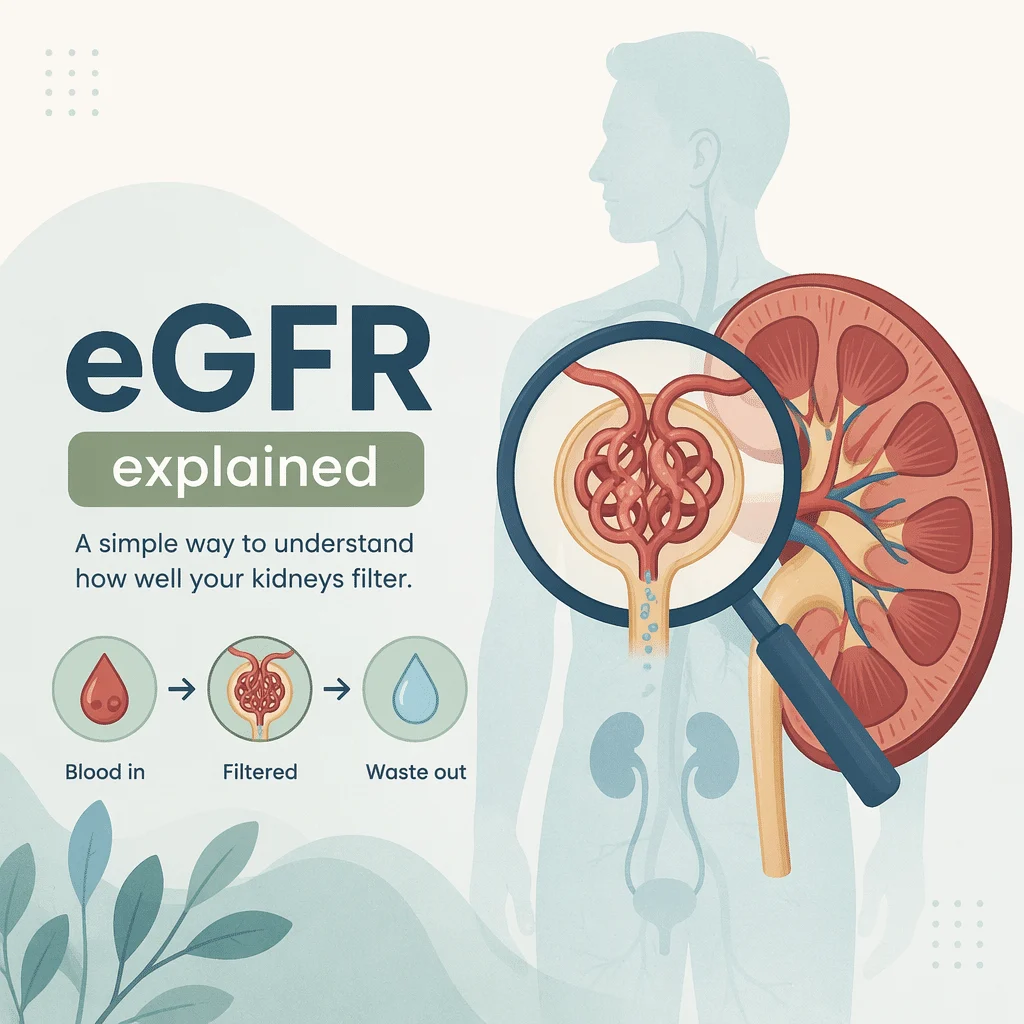
Your kidneys work as two fist-sized filters that clean your entire blood supply many times a day, removing waste and balancing fluids. Inside each kidney sit roughly a million tiny filtering units called nephrons, and each nephron contains a microscopic filter called a glomerulus (the plural is glomeruli). This calculation estimates the combined amount of blood that all of these glomeruli filter in one minute.
Doctors rarely measure this rate directly, because the true test requires injecting a tracing substance and monitoring how quickly the body clears it — an invasive, time-consuming procedure reserved for research or unusual clinical cases. Instead, laboratories estimate the rate using everyday blood work, which is why the result is called estimated glomerular filtration rate rather than measured filtration rate.
Why creatinine drives the calculation
The eGFR calculation relies mainly on creatinine, a waste product that muscles release into the blood at a fairly constant pace. Because healthy kidneys clear creatinine efficiently, a rising creatinine level in the blood usually signals that filtration has slowed. Some labs also test creatinine as a standalone kidney marker, but on its own it does not account for differences in muscle mass, so most reports pair it with an eGFR calculation for a fuller picture.
How labs calculate your eGFR result
To turn a raw creatinine number into a filtration estimate, laboratories apply a mathematical equation that adjusts for age and sex, since muscle mass and creatinine production naturally vary between people. A younger, more muscular person will typically produce more creatinine than an older or smaller person with the same kidney function, so the equation compensates for this before it produces a filtration estimate.
Several equations exist, and the one used can shift your reported number:
- The CKD-EPI equation is the most widely used formula today because it performs consistently across a broad range of kidney function.
- The MDRD formula is an older equation that tends to lose accuracy at higher filtration rates.
- The Cockcroft-Gault formula estimates creatinine clearance rather than true filtration and now appears mainly in specific dosing calculations rather than routine screening.
Your result appears in millilitres per minute per 1.73 square metres (mL/min/1.73m²), a unit that standardises the estimate to an average body surface area so results can be compared fairly across different body sizes.
Why your eGFR test result matters beyond the kidneys
An eGFR reading does more than describe kidney filtration in isolation. Kidneys also regulate blood pressure, help produce red blood cells, activate vitamin D, and keep minerals like potassium and phosphorus in balance, so a change in filtration can ripple into several other body systems. Reading this result alongside a broader kidney function panel often gives a clearer picture than looking at any single number alone.
Before laboratories adopted estimation equations in the 1990s, doctors relied on creatinine levels alone, an approach that could mask declining kidney function, particularly in older adults or people with naturally low muscle mass. An estimated filtration number closes that gap by folding age and sex into the interpretation from the start.
A gradual drop in filtration can remain silent for years, since kidneys have considerable reserve capacity and people can lose a substantial share of their function before symptoms appear. Left unrecognised, declining filtration can contribute to toxin buildup, difficult-to-control blood pressure, anaemia, and weakened bones over time, which is one reason routine screening matters for people with risk factors such as diabetes or high blood pressure.
Clinicians also use eGFR to guide practical decisions. Before a CT scan that uses contrast dye, for example, a doctor checks this value to avoid straining the kidneys, and the dosing of many medications — certain antibiotics, diabetes drugs, and heart medications amongst them — is adjusted based on how well the kidneys are filtering.
Understanding your eGFR test result and CKD stages
Your result typically sits in the kidney or renal function section of a lab report, printed next to a reference range. Reading the number in context, rather than in isolation, is the most useful habit you can build.
Chronic kidney disease (CKD) is staged according to how far filtration has dropped, and the table below outlines how clinicians generally interpret the ranges.
| eGFR range (mL/min/1.73m²) | CKD stage | General interpretation |
|---|---|---|
| 90 or above | G1 (normal)* | Normal or high filtration; CKD only if other markers (such as protein in the urine) are also abnormal |
| 60–89 | G2 (mildly reduced)* | Mildly reduced; often unremarkable on its own, especially with age, but worth tracking over time |
| 45–59 | G3a | Mild-to-moderate reduction; more frequent monitoring is often recommended |
| 30–44 | G3b | Moderate-to-severe reduction; closer follow-up and cause investigation are typical |
| 15–29 | G4 (severe) | Severe reduction; referral to a kidney specialist (nephrologist) is generally advised |
| Below 15 | G5 (kidney failure) | Kidney failure; specialist care and discussion of dialysis or transplant options are typical |
*A single eGFR in the G1 or G2 range is not automatically labelled chronic kidney disease. Current staging combines the eGFR category with a urine albumin test, and both need to persist for at least three months before a CKD diagnosis is generally confirmed.
Physiological ups and downs that do not signal disease
This result is not a perfectly fixed number, and several everyday factors can nudge it temporarily without indicating a problem:
- Age: filtration tends to decline gradually after about age 40, even in people with no kidney disease.
- Hydration: dehydration can concentrate the blood and cause a short-term dip in the estimate.
- Diet: a very protein-rich meal shortly before the blood test can shift the result slightly.
- Physical activity: strenuous exercise close to testing can also influence the number temporarily.
A doctor weighs these factors, along with your BUN (blood urea nitrogen) result and other values, before drawing conclusions about a single reading.
What causes a low eGFR result
A sustained decrease in filtration, rather than a one-off dip, is what generally prompts further evaluation. The most common underlying cause is chronic kidney disease, a gradual and often irreversible loss of filtering capacity.
Diabetes and high blood pressure lead the list
Two conditions account for most cases of chronic kidney disease. Persistently high blood sugar from diabetes damages the small blood vessels within the kidneys over years, while uncontrolled high blood pressure places ongoing strain on the renal arteries. Other causes include glomerulonephritis (inflammation of the kidney’s filtering units) and inherited kidney conditions such as IgA nephropathy. Because protein or blood in the urine often accompanies these conditions, doctors frequently pair this filtration estimate with a urine albumin-to-creatinine ratio to build a fuller picture.
Acute kidney injury is a different, often reversible pattern
Unlike the slow decline of chronic disease, acute kidney injury describes a sudden eGFR drop occurring over days rather than years. Common triggers include severe dehydration, a blocked urinary tract such as a kidney stone, certain infections, or exposure to medications that stress the kidneys. Because the underlying cause is often treatable, acute kidney injury frequently improves once the trigger is addressed, though it still calls for prompt medical attention.
When eGFR is unusually high
An abnormally elevated filtration rate is less common and can appear briefly in early-stage diabetes or during pregnancy, where it is often a normal physiological adjustment. Prolonged hyperfiltration, however, can gradually stress the kidneys over time, so a persistently high reading still merits a conversation with your doctor rather than being dismissed outright.
Recent scientific advances
Two genuinely significant changes have reshaped how eGFR test results are calculated and reported in recent years, and both are worth knowing about if you are comparing an older lab report with a newer one.
First, the equation most U.S. laboratories use to calculate eGFR from creatinine changed in 2021. According to a National Kidney Foundation and American Society of Nephrology laboratory working group, the CKD-EPI 2009 equation, which had included a coefficient adjusting results based on reported race, was replaced with a new race-free version (Miller et al., National Kidney Foundation Laboratory Engagement Working Group, Clinical Chemistry, 2022; DOI: 10.1093/clinchem/hvab278). The task force behind this change concluded that race is a social category rather than a biological one, and that including it in a filtration formula risked over- or under-estimating kidney function for some patients. What this means for you: if your eGFR test result today differs slightly from an older report, and you have not had a real change in kidney health, part of that difference may simply reflect the switch to this newer, race-free formula rather than any change in your kidneys. Real-world studies applying the update have found that most people see only a modest shift in their number, though a minority are reclassified into a different CKD stage as a result, which is one more reason your doctor reads trends over time rather than a single value.
Second, the international guideline that defines how chronic kidney disease is evaluated and staged was substantially updated. The 2024 KDIGO (Kidney Disease: Improving Global Outcomes) Clinical Practice Guideline for the Evaluation and Management of Chronic Kidney Disease, a consensus document built on a broad base of newer evidence, updated the prior 2012 guideline that many clinicians had used for over a decade (Stevens et al., KDIGO 2024 Clinical Practice Guideline, Kidney International, 2024; DOI: 10.1016/j.kint.2023.10.018; executive summary: Levin et al., Kidney International, 2024; DOI: 10.1016/j.kint.2023.10.016). What this means for you: the core eGFR ranges and CKD stages you see on your lab report have not changed dramatically, but the guideline reinforces that a single eGFR reading should always be paired with a urine albumin test and confirmed over at least three months before a chronic kidney disease diagnosis is made — reassuring context if you receive one mildly low reading and feel alarmed. The guideline also emphasises individualised care planning and earlier attention to risk factors, reflecting a broader base of clinical trial evidence than was available when the prior guideline was written.
Research into refining eGFR equations continues. Some newer formulas, still used mainly in research and specialist settings outside the US so far, aim to provide a single continuous equation across all ages rather than switching formulas at certain age cut-offs, which may further improve accuracy for young adults and older adults in future years. None of this changes what you should do today: if your eGFR test result concerns you, discuss it with your doctor, who can place it alongside your full history rather than a formula alone.
When to see a doctor about your eGFR test result
Most people never need to worry about a single mildly abnormal eGFR test result, but certain situations call for a more prompt conversation with a healthcare professional:
- An eGFR below 30, which generally prompts referral to a nephrologist (kidney specialist).
- A rapid or confirmed decline in your eGFR across two or more tests.
- Protein or blood detected in your urine alongside an abnormal eGFR.
- High blood pressure that resists standard treatment.
- Symptoms such as swelling in the legs or ankles, unusual fatigue, foamy urine, or a noticeable drop in how often you urinate.
Your doctor will typically also set a monitoring schedule based on your result: roughly annual checks when eGFR stays above 60 with no other risk factors, more frequent visits as the number drops, and close nephrology follow-up once it falls below 30.
Practical steps to support healthy kidney function
Whether your eGFR test result is reassuring or borderline, a few general habits support kidney health over the long term:
- Stay adequately hydrated, generally around 1.5 to 2 litres of water daily unless your doctor advises otherwise.
- Limit excess salt intake, as it contributes to high blood pressure.
- Favour a balanced diet, such as the Mediterranean pattern, rich in vegetables, whole grains, and lean proteins.
- Stay physically active with regular, moderate exercise.
- Avoid routinely self-medicating with over-the-counter anti-inflammatory drugs, which can strain the kidneys when used long-term.
If you already have a confirmed kidney condition, a renal dietitian can help fine-tune your protein, phosphorus, and potassium intake more precisely than general guidance allows. Reviewing a comprehensive metabolic panel alongside your eGFR can also reveal related shifts in electrolytes worth discussing with your doctor.
Frequently asked questions
What is the difference between eGFR and measured GFR?
An eGFR test provides a reliable, convenient estimate suitable for routine care, calculated from a standard blood draw. Measured GFR, sometimes called mGFR, is a more complex reference technique that involves injecting a specific tracer substance and timing its clearance from the body. Because it is invasive and resource-intensive, measured GFR is reserved mainly for research studies or unusual clinical situations where an especially precise number is needed.
Is the CKD-EPI equation better than the older MDRD formula?
Yes, most laboratories now consider the CKD-EPI equation, and its 2021 race-free update in particular, more accurate than the older MDRD formula, especially at higher filtration levels above roughly 60 mL/min/1.73m². The CKD-EPI approach reduces the risk of a healthy person being misclassified as having reduced kidney function, which is one reason national laboratory guidance recommended replacing older formulas.
Can medications affect my eGFR test result?
Yes, certain medications can alter creatinine levels without truly impairing kidney filtration, which in turn skews the eGFR estimate. Trimethoprim, an antibiotic, and fenofibrate, a cholesterol medication, are examples that can interfere with creatinine measurement. Always share your full medication and supplement list with your doctor so they can account for this when reading your result.
How does eGFR normally change with age?
Filtration tends to decline gradually and predictably with age, by roughly one mL/min/1.73m² per year after about age 40 in many people, reflecting normal changes in kidney structure over time. Because eGFR equations already factor in age, this expected decline is built into how your result is interpreted, so a modestly lower number in an older adult is not automatically a sign of disease.
What does an eGFR between 60 and 89 mean if nothing else is abnormal?
An isolated eGFR test result in this range, without protein in the urine or other abnormal findings, is a common and often unremarkable situation, particularly in older adults. On its own it does not necessarily indicate progressive kidney disease, but it can signal a modestly elevated cardiovascular risk in some people, which reinforces the value of routine monitoring and a heart-healthy lifestyle.
Are small variations in eGFR between two tests something to worry about?
Small fluctuations, generally in the range of five to ten per cent, are expected between two separate tests and rarely mean anything on their own. A larger or unexplained shift is worth discussing with your doctor, who will typically look first for a simple explanation, such as a change in hydration or a recent illness, before concluding that your underlying kidney function has genuinely changed.
Glossary
| Term | Definition |
|---|---|
| eGFR (estimated glomerular filtration rate) | A calculated estimate of how much blood the kidneys filter each minute, based mainly on blood creatinine, age, and sex. |
| Glomerulus (plural: glomeruli) | A microscopic filtering structure inside each nephron in the kidney. Millions of these together perform the kidney’s filtration work. |
| Creatinine | A waste product released by muscles at a fairly steady rate. Because the kidneys clear it from the blood, a rising level often reflects slower filtration. |
| CKD-EPI equation | The formula most laboratories currently use to calculate eGFR from a creatinine result. It was updated in 2021 to remove a race-based adjustment. |
| Chronic kidney disease (CKD) | A long-term, generally gradual reduction in kidney filtration, usually confirmed when reduced eGFR or abnormal urine albumin persists for three months or more. |
| Acute kidney injury (AKI) | A sudden drop in kidney filtration occurring over hours to days, often triggered by dehydration, infection, or a blocked urinary tract, and frequently reversible once treated. |
| KDIGO | Kidney Disease: Improving Global Outcomes, the international organisation whose clinical practice guidelines define how chronic kidney disease is evaluated and staged. |
| Nephron | The basic filtering unit of the kidney. Each kidney contains roughly a million nephrons, each built around a single glomerulus. |
| Measured GFR (mGFR) | A precise, invasive reference method for measuring filtration directly using a cleared tracer substance, reserved mainly for research or specific clinical cases. |
| Urine albumin-to-creatinine ratio (uACR) | A urine test that detects small amounts of the protein albumin leaking from the kidneys, often used alongside eGFR to confirm a CKD diagnosis. |
Sources
- Centers for Disease Control and Prevention (CDC) — Testing for Chronic Kidney Disease: https://www.cdc.gov/kidney-disease/testing/index.html
- Cleveland Clinic — Kidney Function Tests: Types, Results & Follow Up: https://my.clevelandclinic.org/health/diagnostics/21659-kidney-function-tests
- National Kidney Foundation — Know Your Kidney Numbers: Two Simple Tests: https://www.kidney.org/kidney-topics/know-your-kidney-numbers-two-simple-tests
- Miller WG, Kaufman HW, Levey AS, et al. (National Kidney Foundation Laboratory Engagement Working Group) — National Kidney Foundation Laboratory Engagement Working Group Recommendations for Implementing the CKD-EPI 2021 Race-Free Equations for Estimated Glomerular Filtration Rate — Clinical Chemistry, 2022: https://doi.org/10.1093/clinchem/hvab278
- Stevens PE, Ahmed SB, Carrero JJ, et al. — KDIGO 2024 Clinical Practice Guideline for the Evaluation and Management of Chronic Kidney Disease — Kidney International, 2024: https://doi.org/10.1016/j.kint.2023.10.018
- Levin A, Ahmed SB, Carrero JJ, et al. — Executive summary of the KDIGO 2024 Clinical Practice Guideline for the Evaluation and Management of Chronic Kidney Disease: known knowns and known unknowns — Kidney International, 2024: https://doi.org/10.1016/j.kint.2023.10.016
Further reading
- Kidney Function Panel: How to Read Your Renal Blood Tests
- Creatinine: Understanding this blood marker for kidney function
- ACR, Creatinine/Albumin Ratio: Decoding this Renal Marker
- BUN (Urea): Understanding Your Test Results
- Comprehensive Metabolic Panel (CMP): How to Read Your Results
Understand your lab results with AI DiagMe
An eGFR test result rarely tells the whole story on its own — it usually appears alongside creatinine, BUN, and sometimes a urine albumin test, and reading them together is where the real insight lies. AI DiagMe helps you make sense of these related values from your lab report in plain, patient-friendly language, so you can walk into your next appointment with clearer questions. It is built to help you understand your results, not to diagnose you or replace your doctor’s judgement.
Get your results interpreted in minutes