




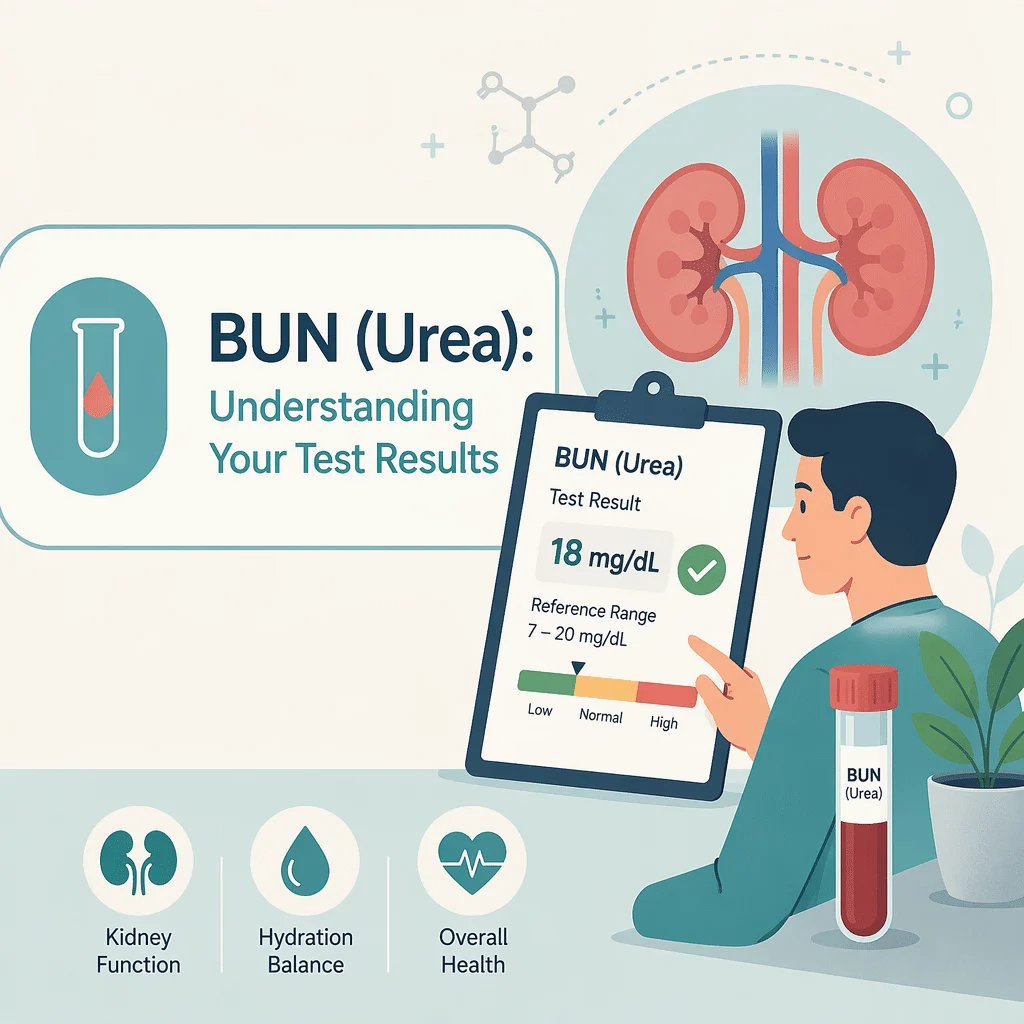
A BUN test measures blood urea nitrogen, a waste product your kidneys filter out of your blood every day. If your recent lab report flagged this value as high or low, that single number can raise more questions than it answers. Urea nitrogen forms in your liver when your body breaks down protein, then travels through your bloodstream until your kidneys remove it in your urine. Because this process depends on your kidneys, your liver, your hydration, and even your diet, a BUN result rarely tells the whole story on its own. In this article, you’ll learn what a BUN test measures, how to read your reference range, the most common causes of high and low results, how doctors use the BUN/creatinine ratio, and when a result is worth a conversation with your doctor.
What does a BUN test measure?
Blood urea nitrogen comes from protein breakdown. When you eat protein, your body uses some of it for energy and tissue repair, and this process releases ammonia, a compound that is toxic in even small amounts. Your liver quickly converts that ammonia into urea, a much safer waste product, which then circulates in your blood until your kidneys filter it out.
Because urea depends on both protein metabolism and kidney filtering, a BUN test gives doctors a window into two systems at once. A rising BUN can point to reduced kidney filtration, while a falling BUN can reflect changes in protein intake or liver function. This is why the test rarely stands alone — it is usually ordered alongside creatinine as part of a broader kidney function panel or a comprehensive metabolic panel.
Why doctors order a BUN test
A BUN test is one of the most common blood tests ordered in routine care. Doctors request it during annual check-ups, before surgery, whilst monitoring chronic conditions such as diabetes or high blood pressure, and when adjusting medication doses that depend on kidney clearance. Because many medications leave the body through the kidneys, knowing how well those kidneys are filtering helps a doctor choose a safe dose and avoid drug build-up.
The result also helps guide next steps. A doctor who sees a moderately high BUN with a normal creatinine will often ask about recent hydration and diet before ordering more tests. When both BUN and creatinine are elevated together, the focus shifts to a fuller evaluation of kidney function, sometimes including an estimated glomerular filtration rate. In cases where two measurements taken days apart show a large jump, doctors also consider an acute cause, such as sudden dehydration or internal bleeding, rather than a slow, chronic process.
BUN test normal ranges
Reference ranges vary slightly between laboratories, but most adult ranges fall within a similar window. Your lab report will always print the specific range used for your sample, since testing methods and local populations can shift the exact cut-offs.
| Population | Typical BUN range | Notes |
|---|---|---|
| Adults | 7–20 mg/dL (2.5–7.1 mmol/L) | Most common reference window used by US labs |
| Children | Generally lower than adults | Paediatric labs use age-specific ranges |
| Older adults | Sometimes slightly higher | Kidney filtering naturally slows with age |
| Pregnancy | Often slightly lower | Reflects normal physiological changes |
A value just outside this window is common and is not automatically a cause for concern. Clinicians weigh a single BUN result against your symptoms, your hydration at the time of the blood draw, and how the number compares with previous tests before drawing any conclusion.
What causes a high BUN level?
An elevated BUN can stem from causes inside the kidney, outside the kidney, or from certain medications. Understanding which category applies often narrows down the explanation quickly.
Kidney-related causes
- Acute kidney injury: a sudden drop in kidney filtering, often triggered by severe dehydration, a major infection, or a drop in blood pressure.
- Chronic kidney disease: a gradual, long-term decline in filtering capacity that raises BUN slowly over months or years.
- Urinary tract obstruction: kidney stones or an enlarged prostate can block urine flow, causing waste products including urea to build up in the blood.
Non-kidney causes
- Dehydration: this is one of the most frequent reasons for a raised BUN, since a lower blood volume concentrates waste products. Rehydrating often normalises the value within a day or two.
- High protein intake: a diet very high in protein, including some supplements, can temporarily raise urea production without any kidney problem.
- Increased tissue breakdown: severe infections, extensive burns, or significant muscle loss all release extra protein that raises BUN.
- Gastrointestinal bleeding: digested blood in the gut adds extra protein for the body to process, which can raise BUN even when creatinine stays normal.
Medications that can raise BUN
Certain medications, including corticosteroids, some antibiotics such as tetracyclines, and select diuretics, can raise BUN as a side effect rather than a sign of kidney damage. Always share your full medication list with your doctor when discussing an abnormal result.
What causes a low BUN level?
A low BUN is less common and usually less concerning than a high one, but it still deserves context.
- Low protein intake or malnutrition: since urea comes from protein breakdown, eating little protein naturally produces less of it.
- Liver disease: because the liver converts ammonia into urea, significant liver dysfunction can reduce BUN production. Other liver-related blood markers are usually abnormal too in this case.
- Overhydration: drinking unusually large amounts of fluid can dilute urea in the blood, lowering the measured value.
- Pregnancy: a mild, physiological drop in BUN is expected due to normal changes in blood volume and kidney filtering during pregnancy.
The BUN/creatinine ratio explained
Doctors often look at BUN alongside creatinine, another waste product cleared by the kidneys, because comparing the two adds diagnostic value that neither number offers alone. Dividing your BUN by your creatinine produces a ratio that helps distinguish between different causes of an abnormal kidney panel.
This ratio is particularly useful because BUN and creatinine do not always move together. Creatinine comes almost entirely from muscle activity and stays fairly stable day to day, whilst BUN is more sensitive to hydration, diet, and blood flow. When a cause outside the kidney, such as reduced blood volume, pushes BUN up faster than creatinine, the ratio rises even though the kidney's own filtering units may still be working normally. This is why a rising ratio with a stable creatinine is often reassuring, whilst a ratio that climbs alongside creatinine deserves closer attention.
| BUN/creatinine ratio | What it can suggest |
|---|---|
| Roughly 10:1 to 20:1 (normal) | Typical balance between the two markers in most healthy adults |
| Above 20:1, with creatinine only mildly changed | Often points to a cause outside the kidney, such as dehydration or reduced blood flow to the kidneys |
| High ratio with creatinine also elevated | Attention turns to the kidney itself as the likely source |
| Below 10:1 | Can reflect low protein intake, liver disease, or certain rarer conditions |
Our detailed guide on the BUN/creatinine ratio and what different levels mean walks through this calculation step by step. If your report shows both markers raised together, our companion article on high BUN and creatinine levels explains what that pattern often means and how doctors investigate it further.
Hydration, diet, and other factors that affect your result
Many everyday factors can shift a BUN value without indicating disease. Recognising these can prevent unnecessary worry over a single test.
- Hydration status: dehydration concentrates urea in the blood, whilst heavy fluid intake dilutes it. This is why doctors often ask about your recent water intake before interpreting a borderline result. You can read more in our guide connecting dehydration to blood pressure and circulation.
- Recent diet: a large, protein-rich meal shortly before a blood test can temporarily raise BUN.
- Physical activity: intense exercise increases protein turnover and can nudge BUN upward for a short period.
- Age and muscle mass: because creatinine, used alongside BUN, reflects muscle mass, very muscular or very frail individuals can show different baseline patterns.
- Certain health conditions: people managing diabetes or high blood pressure are more likely to have their BUN checked regularly, since both conditions are leading causes of long-term kidney strain.
Because dehydration is such a common driver of a high result, and kidney stones can obstruct urine flow and raise waste products in a similar way, ruling out these everyday explanations is often the first step before considering more complex causes. Our guide to kidney stone causes and symptoms covers this obstruction pathway in more detail.
How a BUN test fits into a broader kidney evaluation
Reading a BUN result in isolation can be misleading, which is why most laboratories automatically report it alongside related markers. Looking at the pattern across several values, rather than fixating on one number, is generally the most reliable way to interpret a kidney-focused blood panel.
- Our overview of the kidney function panel and its key markers explains how BUN fits alongside the other tests typically ordered together.
- Creatinine is the marker most often paired with BUN. Our guide to creatinine as a kidney health marker explains what this waste product reveals on its own.
- The estimated glomerular filtration rate, or eGFR, is considered the single best overall measure of kidney filtering. Our explainer on estimated glomerular filtration rate and what it means covers how this calculation works.
- A urine-based test called the albumin-to-creatinine ratio can catch kidney changes even before BUN or creatinine shift. Our guide to the albumin/creatinine ratio as an early renal marker explains why this urine test matters.
- If your blood panel also included protein or blood cells in a urine sample, our urinalysis results interpretation guide can help you make sense of those additional findings.
When to see a doctor
Most abnormal BUN results reflect a temporary, explainable cause such as dehydration or diet. However, certain situations call for prompt medical attention rather than a wait-and-see approach.
- A BUN level that keeps rising across repeated tests, especially alongside creatinine.
- Swelling in the legs, ankles, or around the eyes, which can suggest fluid retention linked to reduced kidney filtering.
- A significant, sudden change between two recent blood tests, which can point to an acute cause such as severe dehydration or internal bleeding.
- New symptoms such as persistent fatigue, nausea, reduced urination, or confusion alongside an abnormal result.
- A family history of kidney disease combined with a borderline or rising BUN.
If any of these apply to you, contact your doctor rather than waiting for your next scheduled check-up. Early evaluation is usually straightforward and can prevent a manageable issue from progressing further.
Recent scientific advances
Research on the BUN/creatinine ratio has continued to expand in recent years, reinforcing its practical value as a bedside screening tool. A 2023 analysis of more than 344,000 patients undergoing knee replacement surgery found that a BUN/creatinine ratio above 20 was a useful marker for identifying people who were dehydrated before their operation, and that this group faced a higher risk of complications such as blood clots and longer hospital stays (Lung et al., 2023, BMC Musculoskeletal Disorders). What this means for you: this large study supports what clinicians already suspected — checking the BUN/creatinine ratio before a planned procedure is a simple way to catch dehydration early and correct it before surgery, which may lower the chance of avoidable complications.
A separate 2025 study using a large intensive care database examined how the BUN/creatinine ratio behaved in patients hospitalised with acute pancreatitis, a sudden inflammation of the pancreas (Wan et al., 2025, European Journal of Medical Research). The researchers found what they called a J-shaped relationship, meaning risk stayed relatively stable at lower ratios but rose sharply once the ratio passed a certain threshold. What this means for you: in seriously ill hospitalised patients, a rising BUN/creatinine ratio can act as an early warning sign that prompts closer monitoring. It is a reminder that this simple ratio carries real clinical weight beyond routine check-ups, though these findings come from critically ill hospital populations and do not mean every high ratio in a healthy outpatient signals similar risk.
Both studies used large, real-world patient databases rather than small trials, which strengthens confidence in the patterns observed. As with any single study, results are most meaningful when confirmed by further research and always interpreted by a clinician alongside your full health picture.
Further reading
- Normal blood test ranges: a complete reference guide
- Abnormal blood test results and what they mean
- How to read your blood test results step by step
- Fasting rules before a blood test
- Urinalysis results interpretation guide
Glossary
| Term | Definition |
|---|---|
| BUN (blood urea nitrogen) | A waste product formed when the body breaks down protein, measured in the blood to help assess kidney function. |
| Creatinine | A waste product from normal muscle activity that the kidneys filter out. Often measured together with BUN. |
| BUN/creatinine ratio | The result of dividing BUN by creatinine, used to help distinguish causes of an abnormal kidney panel. |
| eGFR (estimated glomerular filtration rate) | A calculated estimate of how much blood the kidneys filter each minute, based on creatinine, age, and sex. |
| Acute kidney injury | A sudden decline in kidney function that develops over hours to days, often from dehydration or a severe illness. |
| Chronic kidney disease | A long-term, gradual loss of kidney filtering capacity, generally lasting more than three months. |
| Dehydration | A reduced level of body fluid that concentrates waste products in the blood, one of the most common causes of a raised BUN. |
| Comprehensive metabolic panel | A broader blood test that already includes BUN, creatinine, electrolytes, and other body chemistry markers. |
Frequently asked questions
What does a high BUN mean in a blood test?
A high BUN usually means your body is producing more urea than usual, clearing it more slowly, or both. Common reasons include dehydration, a high-protein diet, or reduced kidney filtering. Doctors look at your creatinine level, your symptoms, and your hydration at the time of testing before deciding whether further evaluation is needed. A single mildly high result is common and often resolves once the underlying cause, such as dehydration, is addressed.
What does a low BUN mean in a blood test?
A low BUN often reflects lower protein intake, pregnancy, or occasionally liver disease, since the liver converts ammonia into urea. Overhydration can also dilute the measured value. Low BUN is generally less concerning than a high result and is rarely a sign of a serious problem on its own, though your doctor will consider it alongside your other lab values and overall health.
How can I lower a high BUN level?
The right approach depends on the cause. If dehydration is responsible, drinking more water often normalises the value within a day or two. If a high-protein diet is contributing, your doctor or a dietitian may suggest moderating protein intake, particularly from animal sources. When an underlying kidney or medical condition is driving the result, treating that condition is the most effective way to bring BUN down over time. Never change your diet or medications significantly without discussing it with your doctor first.
Is BUN the same as a kidney function test?
BUN is one part of kidney function testing, not the whole picture. It is almost always interpreted alongside creatinine and often the estimated glomerular filtration rate, since these markers together give a more complete view of how well your kidneys are filtering waste. A single BUN result, taken on its own, offers useful but incomplete information.
Can dehydration really raise my BUN before a blood test?
Yes, dehydration is one of the most frequent and reversible causes of an elevated BUN. When your body has less fluid, waste products including urea become more concentrated in your remaining blood volume. Drinking water normally in the days before a blood test, unless your doctor has told you otherwise, can help produce a more representative result.
Does a vegetarian or vegan diet change BUN levels?
Yes, people who eat less animal protein often have BUN results in the lower part of the normal range, since urea production depends on protein intake. This pattern is a normal reflection of diet rather than a sign of poor health, and doctors take it into account when interpreting results for people following plant-based eating patterns.
Sources
- Mayo Clinic — Blood urea nitrogen (BUN) test: overview, normal range, and results — Mayo Clinic
- Cleveland Clinic — Blood Urea Nitrogen (BUN) Test: high and low levels and procedure — Cleveland Clinic
- MedlinePlus, National Library of Medicine (NIH) — BUN (Blood Urea Nitrogen) test — MedlinePlus
- Lung B. et al. — The impact of dehydration on short-term postoperative complications in total knee arthroplasty — BMC Musculoskeletal Disorders, 2023 — BMC Musculoskeletal Disorders
- Wan Y. et al. — J-shaped association between blood urea nitrogen-to-creatinine ratio and mortality in critically ill patients with acute pancreatitis — European Journal of Medical Research, 2025 — European Journal of Medical Research
Understand your lab results with AI DiagMe
A BUN result rarely stands alone — it works together with creatinine, eGFR, and sometimes electrolytes to paint a complete picture of your kidney health. AI DiagMe helps you make sense of these values together, turning a page of lab abbreviations into a clear, plain-language explanation you can bring to your next appointment. It is designed to help you understand your results and prepare better questions, not to diagnose a condition or replace your doctor’s judgement.
Get your results interpreted in minutes