





































An ESR blood test, short for erythrocyte sedimentation rate, is one of the oldest and most widely ordered laboratory tests for inflammation. If the letters ESR appear on your lab report next to a value in millimetres per hour, it is natural to wonder what the number means and whether it is a cause for concern. This article explains, in plain language, what the ESR blood test measures, how to read your result against normal ranges for your age and sex, what a high or low value can signal, and how the test compares with other inflammation markers. You will also find a plain-English look at recent research, a glossary, and answers to the questions patients ask most. The goal is understanding, not self-diagnosis: your result is one clue that a clinician reads alongside your symptoms and history.
What is the ESR blood test?
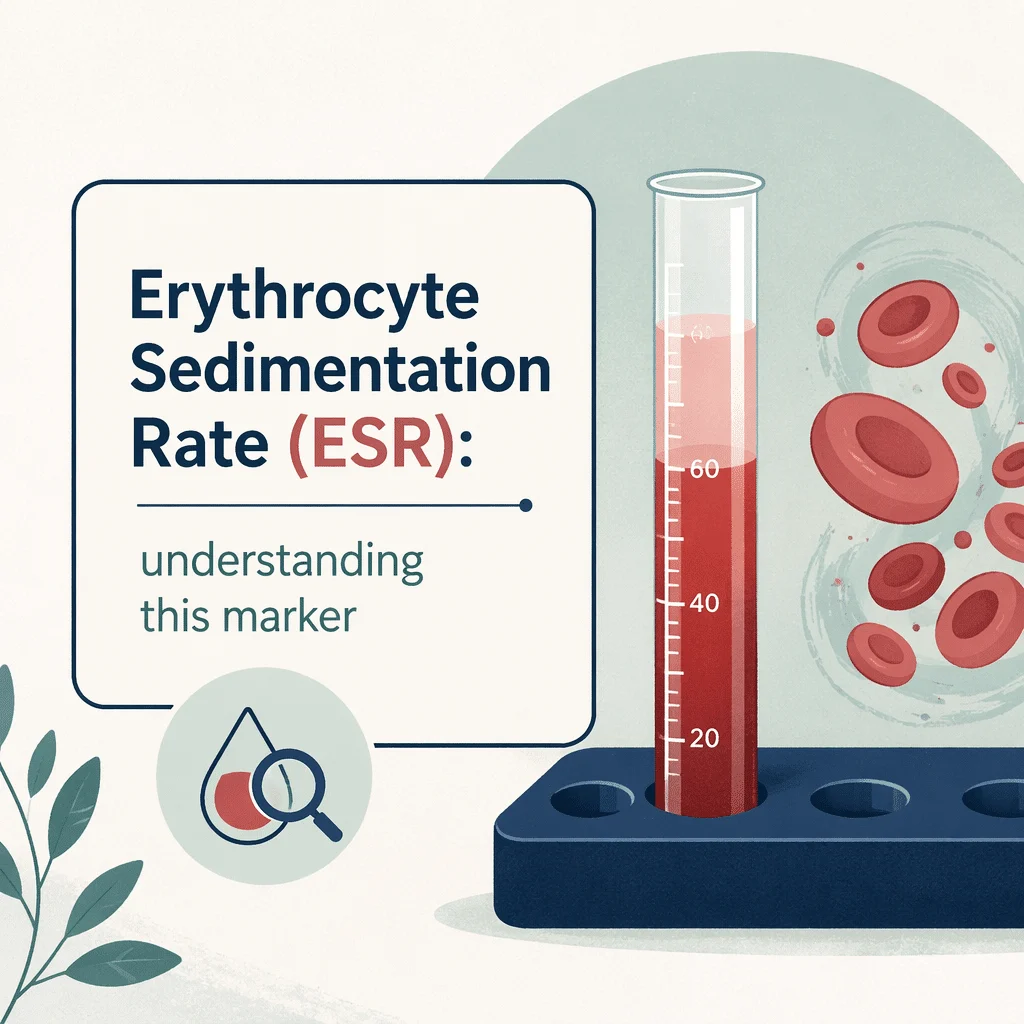
The ESR blood test is a simple, inexpensive measurement of how quickly your red blood cells (erythrocytes) sink to the bottom of a thin tube of blood over one hour. The result is reported in millimetres per hour (mm/hr). On its own, the number does not name a disease. Instead, it acts as a general, or nonspecific, signal that inflammation may be present somewhere in the body. Doctors have relied on this test for more than a century, and it remains common today because it is cheap, quick to run, and helpful for following inflammation over weeks and months.
What the sed rate actually measures
When inflammation is active, the liver and immune system release more of certain proteins into the blood. The two that matter most for the ESR are fibrinogen and immunoglobulins. Fibrinogen is a clotting protein that laboratories also report on a coagulation panel; immunoglobulins are the antibodies your immune system makes. Both proteins coat red blood cells and make them clump into heavier stacks, known as rouleaux, that fall faster than single cells, so the sedimentation rate rises. During inflammation the liver also produces other acute-phase proteins, such as the serum amyloid A protein. Because so many different conditions raise these proteins, a high ESR reliably flags that inflammation is present somewhere without naming its exact source. That is at once the test’s great strength and its main limitation: it is sensitive to inflammation in general, yet blind to any single cause.
How the ESR test is done
A technician draws a small blood sample from a vein, usually in your arm. In the classic Westergren method, still considered the reference technique, the laboratory places the blood in a standardised vertical tube and measures how far the red cells have fallen after 60 minutes. Many laboratories now use automated analysers that produce an equivalent result more quickly. The blood draw itself is a routine procedure, and results are often available the same day or the next. No fasting or special preparation is needed, so you can usually eat and drink normally beforehand. The same settling principle is explained by the MedlinePlus ESR test guide. Because a single number rarely tells the whole story, the ESR is usually ordered together with other markers rather than on its own.
ESR normal range by age and sex
There is no single normal ESR that fits everyone. Values naturally rise with age and tend to run higher in women than in men. The ranges below reflect the Westergren method and are typical adult reference values; your own laboratory may print slightly different limits based on its equipment and local population.
| Group | Typical normal ESR (Westergren method) |
|---|---|
| Newborns | 0–2 mm/hr |
| Children (before puberty) | 3–13 mm/hr |
| Men under 50 | Below 15 mm/hr |
| Men 50 and over | Below 20 mm/hr |
| Women under 50 | Below 20 mm/hr |
| Women 50 and over | Below 30 mm/hr |
A widely used clinical rule of thumb estimates the upper normal limit as age divided by two for men, and age plus ten, divided by two, for women. For an 80-year-old man, that puts the ceiling near 40 mm/hr. These figures are guides, not strict cut-offs: a value just outside the range is common in healthy people and is always read together with your symptoms.
What a high ESR blood test result means
A high ESR blood test result means your red cells are settling faster than expected, which usually reflects inflammation. It does not, by itself, tell you what is inflamed or how serious it is. Doctors interpret a raised value in the context of your symptoms, examination, and other tests.
Common causes of a raised ESR
- Infections, from a chest or urine infection to an infection deep in bone
- Autoimmune and inflammatory conditions such as rheumatoid arthritis, lupus, or inflammatory bowel disease
- Polymyalgia rheumatica and giant cell arteritis, two related conditions in people over 50
- Tissue injury, recent surgery, or a recent heart attack
- Anaemia and older age, which raise the baseline reading even without active disease
- Pregnancy, which naturally lifts the sed rate
Because infection is a frequent cause, doctors sometimes look at other markers as well. When a bacterial infection is suspected, clinicians may add the procalcitonin infection marker, since it responds more specifically to bacteria. Ongoing inflammation can raise other acute-phase proteins too, and a separate guide explains high ferritin levels.
Very high ESR and rarer causes
An ESR above roughly 100 mm/hr is uncommon and tends to prompt a focused search for a specific cause. Markedly high values can accompany serious infections, active autoimmune disease, giant cell arteritis, and certain cancers, including multiple myeloma and lymphoma. Myeloma raises the sed rate because it floods the blood with a single abnormal antibody protein; when that pattern is suspected, a laboratory can run a protein electrophoresis test. A very high ESR is not a diagnosis, but it is a strong prompt for further evaluation.
Can the ESR be high without an infection?
Yes. This is one of the most common points of confusion. Many non-infectious situations raise the sed rate, including autoimmune disease, anaemia, kidney disease, obesity, pregnancy, older age, and even high cholesterol. To look for an autoimmune cause, doctors may request the antinuclear antibodies (ANA) test, and for suspected rheumatoid arthritis they may order the anti-CCP antibody test. In short, a high ESR is a starting point for questions, not the answer to them.
What a low ESR result means
A low ESR is usually not a concern and often needs no action at all. Occasionally, a very low sed rate reflects conditions that keep red cells from stacking normally, such as polycythaemia (too many red cells), sickle cell disease, or changes in red cell shape. Very low blood protein levels can have the same effect. If your ESR is low and you feel well, it rarely carries weight on its own, and your clinician will look at the complete picture rather than at this single number. Because a low result is so often unremarkable, laboratories and doctors pay far more attention to values that are high or that change over time.
ESR versus CRP: how the two inflammation markers compare
The ESR blood test is often ordered alongside C-reactive protein, or CRP, another marker of inflammation. They overlap but are not interchangeable. CRP is a protein made directly by the liver when inflammation flares, whilst the ESR is an indirect measure driven by slower-changing proteins. As a result, CRP rises and falls quickly, and the ESR lags behind. Doctors frequently compare it with the C-reactive protein (CRP) inflammation marker precisely because the two move on different timelines. When inflammation is intense, a companion guide explains high C-reactive protein levels.
| Feature | ESR | CRP |
|---|---|---|
| What it reflects | Indirect: how fast red cells settle, driven by proteins like fibrinogen | Direct: a protein the liver makes during inflammation |
| Speed of change | Slow: rises over days, falls over weeks | Fast: rises within hours, falls quickly |
| Most useful for | Following chronic or long-running inflammation | Detecting new, acute inflammation and infection |
| Common non-inflammatory influences | Age, sex, anaemia, pregnancy, kidney disease | Less affected by age and sex |
| Usual units | mm/hr | mg/L |
Neither test is specific, so results are read together and in context. Sometimes the two disagree, a pattern doctors call discordance, and that mismatch can itself be informative, as newer research described below suggests.
When to see a doctor
An ESR result is not an emergency number, but certain situations deserve prompt medical attention. See a doctor, or contact the clinician who ordered the test, if any of the following apply:
- You are over 50 and develop new, persistent headaches, scalp tenderness, jaw pain when chewing, or sudden vision changes, which can be signs of giant cell arteritis and need urgent care
- You have aching and stiffness in both shoulders or hips that is worse in the morning
- Your ESR is very high, or it keeps rising on repeat testing
- You have unexplained fever, night sweats, weight loss, or lasting fatigue
- Inflammation symptoms persist despite treatment
For everyday, mild elevations without symptoms, your clinician may simply repeat the test later or add a complete blood count. To feel more prepared for that conversation, it helps to learn how to read your blood test results.
Latest scientific advances on the ESR blood test
Research from the last few years has refined how doctors use, and sometimes deliberately avoid, the ESR blood test. Here is what recent studies found, in plain language, and what each may mean for you.
Still central to diagnosing polymyalgia rheumatica
Polymyalgia rheumatica is a common inflammatory condition in people over 50 that causes pain and pronounced morning stiffness in the shoulders, and sometimes the hips and neck. A 2026 clinical review in the New England Journal of Medicine confirmed that a raised ESR, together with CRP, remains part of how doctors recognise it and rule out its more serious relative, giant cell arteritis. What this means for you: if you are over 50 with new shoulder or hip stiffness, an ESR is one of the simple tests a clinician may use to help sort out the cause.
Reading the gap between ESR and CRP
A 2026 study examined a large cohort, meaning a group of patients tracked over time, who had lupus, an autoimmune disease. The ESR mirrored how active the disease was, and comparing ESR with CRP helped flag a hidden infection: because CRP climbs faster than the ESR, a relatively high CRP sitting next to the ESR pointed toward infection rather than a disease flare. What this means for you: when a doctor orders ESR and CRP together, it is often to read the gap between the two numbers, not just each one alone.
Knowing when the ESR is not the right test
Not every situation calls for an ESR. A 2024 hospital project put into practice a national Choosing Wisely recommendation that advises against routinely using the ESR for sudden, undiagnosed inflammation, where CRP usually gives a faster answer. The team safely reduced unnecessary ESR testing without missing problems. What this means for you: if your doctor orders CRP instead of ESR for an acute illness, that reflects current best practice rather than an oversight.
Why age, sex, and even altitude matter
A 2024 analysis of more than 150,000 laboratory records, a cross-sectional study that takes a snapshot at one point in time, confirmed that ESR values run higher in women and in older adults, and that even living at high altitude can nudge the result. The authors argued for interpreting the number against a person’s age, sex, and setting. What this means for you: a value that looks high for a young man may be perfectly normal for an older woman, which is why context matters so much.
One piece of a bigger picture
For a suspected infection around an artificial hip or knee, a serious problem after joint replacement, a 2025 study compared several blood markers. The ESR combined with CRP remained a useful first-line screen, although a newer marker called interleukin-6 detected sudden, acute infections somewhat more reliably. What this means for you: the ESR rarely works alone, and it is best understood as one part of a larger picture that your care team assembles.
Across this research, one theme is consistent: the ESR is most useful when it is read alongside other markers and your clinical story, not in isolation. These findings are informative, but they do not change the basic message that your result needs a professional’s interpretation.
Glossary
| Term | Definition |
|---|---|
| Erythrocyte sedimentation rate (ESR) | How fast red blood cells settle in a tube of blood over one hour; an indirect sign of inflammation. |
| Sed rate | A common short name for the erythrocyte sedimentation rate. |
| Westergren method | The standard laboratory technique for measuring the ESR, used as the reference method. |
| Nonspecific marker | A test that can show a problem exists but cannot identify its exact cause. |
| Acute-phase protein | A protein the liver releases during inflammation, such as fibrinogen or C-reactive protein. |
| Fibrinogen | A clotting protein that rises with inflammation and makes red cells stack, raising the ESR. |
| Immunoglobulins | Antibodies made by the immune system; higher levels can raise the ESR. |
| C-reactive protein (CRP) | An inflammation marker made by the liver that rises and falls faster than the ESR. |
| Giant cell arteritis | Inflammation of medium and large arteries, mainly in people over 50, that can threaten vision and needs urgent care. |
| Polymyalgia rheumatica | An inflammatory condition causing shoulder and hip stiffness in older adults, often with a raised ESR. |
Frequently asked questions
Do I need to fast or prepare for an ESR blood test?
No special preparation is needed for an ESR blood test. You do not have to fast, and you can usually take your regular medications unless your doctor tells you otherwise. The test uses a small blood sample from a vein in your arm and takes only minutes to collect. If your ESR is being checked alongside tests that do require fasting, such as glucose or cholesterol, follow the instructions your laboratory provides. When in doubt, ask the clinic before your appointment.
Should I worry about a mildly high ESR with no symptoms?
Usually not. A mildly raised ESR without any symptoms is common and often has a harmless explanation, such as older age, a recent minor infection, anaemia, or normal variation. Because the ESR is a nonspecific marker, a single slightly high value is rarely meaningful on its own. Doctors typically repeat the test after a few weeks or read it alongside other results before drawing conclusions. If the value keeps climbing, or if symptoms appear, that is when closer evaluation becomes worthwhile.
How quickly does the ESR change after inflammation improves?
The ESR changes slowly. It can take several days to rise after inflammation begins and often several weeks to fall once the underlying problem settles. This lag is normal, and it is one reason doctors sometimes prefer CRP, which responds within hours, to follow a fast-moving illness. When monitoring a chronic condition over months, however, the slower ESR can be useful for spotting longer trends. If your repeat ESR has not dropped as fast as expected, it does not automatically mean treatment is failing.
Can medications affect my ESR result?
Yes. Anti-inflammatory treatments can lower the ESR by calming the inflammation it measures. Corticosteroids and nonsteroidal anti-inflammatory drugs (NSAIDs) are common examples, which is why a normal ESR in someone taking these medicines does not always rule out an underlying problem. Other medications and conditions can raise or lower the value in less predictable ways. Always tell the clinician ordering the test about every medicine and supplement you take, so your result can be read correctly in context.
Can the ESR be normal even if I have inflammation?
Yes, a normal ESR does not completely rule out inflammation. Some inflammatory or infectious conditions produce little change in the sed rate, especially early on or when they are localised. The ESR can also stay normal if you are taking anti-inflammatory medication. This is one reason the test is rarely used alone: doctors combine it with your symptoms, an examination, and other markers such as CRP. If you feel unwell despite a normal ESR, keep talking with your clinician rather than relying on the number.
Does a high ESR mean I have cancer?
Almost always, no. A high ESR most often reflects everyday causes such as infection, autoimmune conditions, anaemia, or ageing, not cancer. While a markedly raised ESR is occasionally linked with certain cancers, such as lymphoma or multiple myeloma, the test cannot diagnose cancer and is not used for screening. A single high value is a prompt to look further with your doctor, not a reason to assume the worst. Context, symptoms, and follow-up testing are what give the number meaning.
Sources
- MedlinePlus, U.S. National Library of Medicine — Erythrocyte Sedimentation Rate (ESR) — medlineplus.gov
- Mayo Clinic — Sed rate (erythrocyte sedimentation rate) — mayoclinic.org
- Cleveland Clinic — Sedimentation Rate (ESR) Test — my.clevelandclinic.org
- Dejaco C, Matteson EL — Polymyalgia Rheumatica — New England Journal of Medicine, 2026 — doi.org/10.1056/NEJMcp2506817
- Wang F, et al. — Clinical significance of erythrocyte sedimentation rate-based stratification in a large retrospective SLE cohort — Frontiers in Immunology, 2026 — doi.org/10.3389/fimmu.2026.1767359
- Fatemi Y, et al. — Reducing Erythrocyte Sedimentation Rate Ordering: De-implementation and Diagnostic Stewardship — Hospital Pediatrics, 2024 — doi.org/10.1542/hpeds.2023-007642
- Abo Mansour A, et al. — Impact of Altitude on Erythrocyte Sedimentation Rate: A Cross-Sectional Study Using National Laboratory Data from Saudi Arabia — Discovery Medicine, 2024 — doi.org/10.24976/Discov.Med.202436191.221
- Zhang X, et al. — Serum Interleukin-6 Exhibits Better Diagnostic Performance Than Serum C-Reactive Protein in Acute Periprosthetic Joint Infection — The Journal of Arthroplasty, 2025 — doi.org/10.1016/j.arth.2025.04.086
Further reading
- Normal blood test ranges and how to read them
- Autoimmune panel: ANA, rheumatoid factor and anti-CCP
- High neutrophils: causes and what they signal
- Gamma globulins and immune-related blood proteins
- Abnormal blood test results and what to do next
Understand your lab results with AI DiagMe
Your ESR is far easier to make sense of when you see it next to the rest of your blood work. AI DiagMe helps you understand results like the erythrocyte sedimentation rate, C-reactive protein, a full blood count, and ferritin in clear, everyday language, so you know which numbers are reassuring and which are worth discussing. It is built to help you understand your results; it does not diagnose conditions or replace your doctor.
Get your results interpreted in minutes