











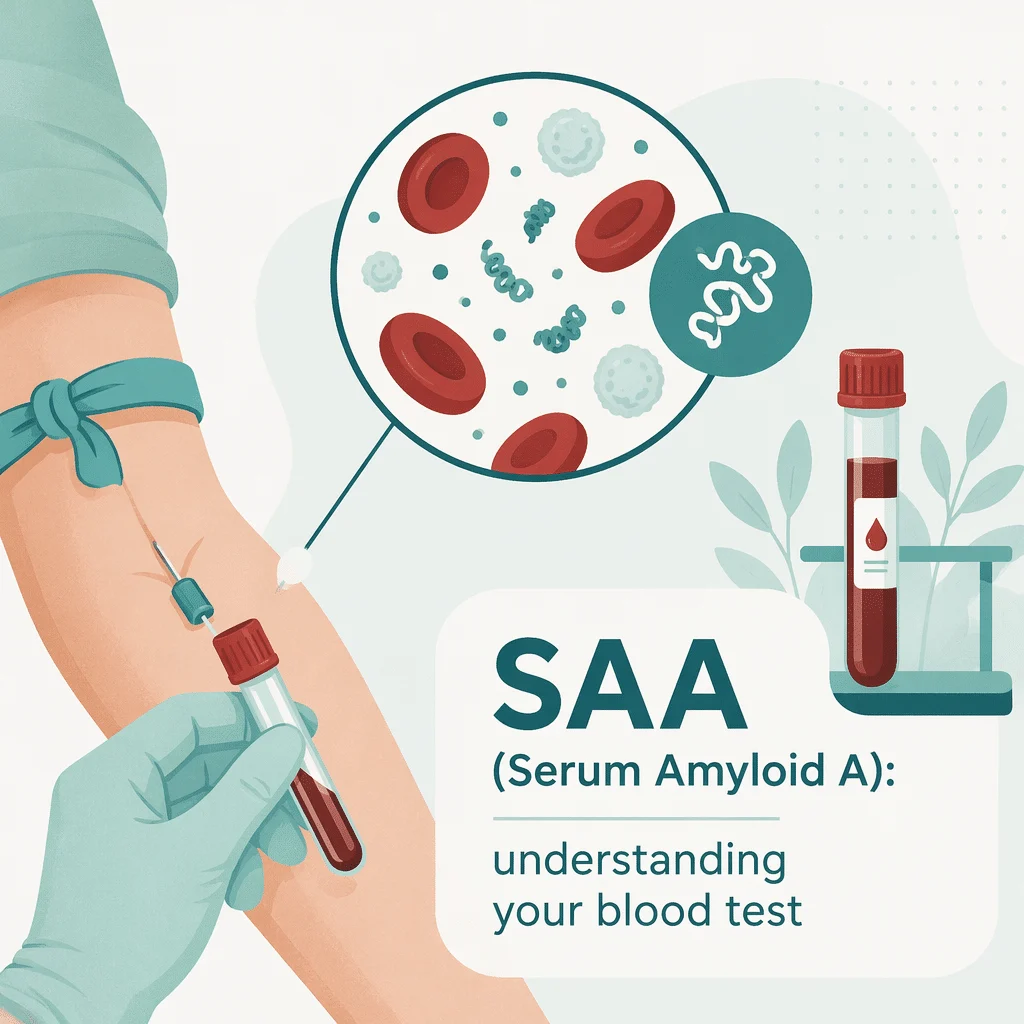
A serum amyloid A blood test measures a protein that your liver releases within hours of inflammation starting. If SAA appears on your lab report above the reference range, it usually means your body is responding to something — very often an ordinary infection that clears up on its own. The number is a signal, not a diagnosis.
In this article you’ll learn what serum amyloid A is, why doctors measure it, and how the sample is taken. You’ll also learn how to read high, normal, and low results, how SAA compares with CRP, why it matters in long-term inflammatory disease and in AA amyloidosis, and which situations are worth a call to your doctor.
What is serum amyloid A, and what is the acute-phase response?
Serum amyloid A (SAA) is a small protein made mainly by your liver. It belongs to a group called acute-phase proteins — proteins whose blood levels change quickly when the body detects an injury, an infection, or another inflammatory trigger.
The acute-phase response in plain terms
When immune cells meet bacteria, a virus, or damaged tissue, they release chemical messengers called cytokines. These messengers travel to the liver and tell it to switch production priorities. Within about 6 to 24 hours, the liver floods the bloodstream with acute-phase proteins, and SAA is one of the fastest and most dramatic responders.
SAA is not alone in this family. Your report may show other proteins that behave in a similar way, and the same family includes the alpha-1 globulins. Because SAA is produced in the liver, doctors sometimes review your liver function tests alongside it.
What serum amyloid A actually does
SAA is not simply a passive alarm bell. Researchers have shown that it helps recruit immune cells towards the inflamed area, working alongside other signalling molecules. It also travels attached to HDL particles — the so-called good cholesterol — and appears to help move cholesterol away from inflamed tissue and back to the liver.
Once inflammation resolves, SAA production drops fast. Levels can fall back towards baseline within a couple of days. That quick rise and quick fall is exactly what makes the marker useful for tracking change over time.
Why doctors order a serum amyloid A blood test
SAA is not part of a routine check-up in most countries. It is usually requested with a specific question in mind.
Spotting and following infection
Because SAA climbs so quickly and so steeply, it can flag an inflammatory process early. Doctors may use it when the clinical picture is unclear, or when they want to watch whether an infection is improving on treatment. In this setting it rarely travels alone: your doctor often orders a complete blood count at the same time, and in suspected bacterial infection may also request the procalcitonin test.
Monitoring chronic inflammatory and autoimmune disease
SAA is particularly valued in long-term conditions where inflammation flares and settles. This includes rheumatoid arthritis, inflammatory bowel disease, and inherited periodic fever syndromes such as familial Mediterranean fever. Here, the trend across several tests matters far more than any single value.
When an autoimmune cause is suspected, your doctor may also request an autoimmune panel to look for specific antibodies. SAA tells you that inflammation is present; it cannot tell you what is causing it.
How the serum amyloid A blood test is done
The practical side is simple and quick.
Before and during the test
A nurse or phlebotomist takes a small blood sample from a vein in your arm, usually the inside of the elbow. The draw takes a minute or two. No fasting is needed for SAA itself, although you may be asked to fast if other tests are booked at the same time. There is no special preparation, and you can go straight back to your normal day afterwards.
Results typically come back within a day. Laboratories measure SAA using immunoassays — tests that use antibodies to detect and quantify a specific protein.
Units and reference ranges
SAA is usually reported in milligrams per litre (mg/L). You may also see micrograms per millilitre (µg/mL), which is numerically identical: 5 µg/mL equals 5 mg/L.
Reference ranges vary between laboratories. Many use an upper limit somewhere between roughly 3 and 10 mg/L for healthy adults. Because the cut-off is not standardised, always compare your value with the range printed on your own report rather than with a figure from elsewhere. If ranges in general are confusing, we explain abnormal blood test results in a dedicated guide.
What high serum amyloid A levels mean
A high SAA result means inflammation is active somewhere in your body. It does not say where, and it does not say why.
Common causes of a raised result
- Acute bacterial or viral infection. This is by far the most common reason, and SAA can rise several hundred-fold within a day or two.
- Surgery, trauma, or a fracture. Any significant tissue injury triggers the acute-phase response.
- Active chronic inflammatory or autoimmune disease, such as rheumatoid arthritis or inflammatory bowel disease.
- Recent intense or unaccustomed physical exertion, which causes a mild, short-lived rise.
- Obesity, which is associated with a modest ongoing elevation.
- Some cancers, which can stimulate SAA production.
How high is high?
Very roughly, a mild elevation of 10 to 30 mg/L often reflects something minor or resolving. Values of 30 to 100 mg/L point to more substantial inflammation worth investigating. Values above 100 mg/L, and especially in the hundreds, usually accompany a significant bacterial infection or a major inflammatory event — and these are almost always cases where you already feel unwell.
These bands are a guide, not rules. A single mildly raised SAA in someone who feels fine and had a cold last week is a very different thing from the same number in someone with persistent joint swelling. Context does the interpreting; your doctor supplies the context.
What normal or low serum amyloid A levels mean
A low SAA level is a good result. Unlike many blood markers, there is no such thing as a worrying low SAA — it simply means no significant acute-phase response is running. There is no deficiency state and nothing to correct.
Two caveats are worth knowing. First, strong anti-inflammatory treatments — corticosteroids, and biologic drugs that block cytokines such as interleukin-6 — lower SAA directly. On these medicines a normal SAA reflects the drug’s effect as well as your disease state, which is exactly why doctors track the marker during treatment.
Second, a normal SAA does not rule out every condition. Inflammation that stays confined to one small area, and some autoimmune diseases such as lupus, can be active while blood markers look reassuring. A normal result lowers the odds of widespread inflammation; it does not close the question.
Serum amyloid A vs CRP: comparing two inflammation markers
CRP, or C-reactive protein, is the marker most people meet first, and the two proteins are close cousins. Both come from the liver, both respond to the same cytokine signals, and their values usually rise and fall together. If you’d like the full picture on the other one, you can read our guide to the CRP blood test.
| Feature | Serum amyloid A (SAA) | C-reactive protein (CRP) |
|---|---|---|
| Where it is made | Liver, in response to cytokines | Liver, in response to the same cytokines |
| Speed of rise | Very fast, within about 6 to 24 hours | Fast, within about 6 to 48 hours |
| Size of rise | Can climb up to about 1,000-fold | Can climb up to about 100 to 500-fold |
| Detecting low-level inflammation | Often more sensitive, useful when CRP looks normal | May miss very mild inflammation |
| Affected by body weight | Yes, higher in obesity | Less affected in some studies |
| Availability and cost | Less widely available, not in every lab | Available almost everywhere, inexpensive |
| Role in AA amyloidosis | Direct precursor, so it is the marker of choice | Indirect, used as a proxy |
The practical summary: SAA tends to be the more sensitive of the two and shines when inflammation is subtle, whilst CRP is cheaper, universally available, and perfectly adequate for most questions. That is why CRP remains the routine choice and SAA is reserved for specific situations. A third marker, the erythrocyte sedimentation rate, moves more slowly and adds a longer-term view. Many people also want to understand high CRP levels once they have seen both numbers side by side.
AA amyloidosis and long-lasting inflammation
This is the reason SAA gets special attention, and it deserves a calm explanation.
Amyloid A (AA) amyloidosis is a rare complication of inflammation that stays switched on for years. When SAA circulates at high levels for a very long time, fragments of the protein can misfold and deposit in organs as insoluble clumps called amyloid. The kidneys are affected most often, which is why doctors monitoring this risk will usually request a kidney function panel as well.
Two points matter here. First, this is uncommon. It affects a small minority of people with poorly controlled chronic inflammatory disease, and modern treatment has made it markedly rarer than it once was. A single high SAA after a chest infection carries no such risk whatsoever.
Second, the risk is driven by sustained elevation over years, not by peaks. That is the logic behind long-term SAA monitoring in conditions like familial Mediterranean fever: keeping the average level low over time is thought to protect the organs. Treatment aimed at controlling the underlying disease is what lowers SAA — the marker is the speedometer, not the engine.
When to see a doctor
Book a routine appointment if:
- Your SAA is mildly raised and you feel well. Ask whether a repeat test in a few weeks makes sense.
- Your SAA stays above the reference range across several tests, even at a modest level.
- You live with a chronic inflammatory condition and your SAA is drifting upward.
Seek medical attention promptly if a raised SAA comes with:
- Fever, shaking chills, or feeling severely unwell
- Unexplained weight loss, drenching night sweats, or persistent fatigue
- New joint swelling, a persistent rash, or ongoing abdominal pain and diarrhoea
- Foamy urine, or swelling of the ankles, legs, or face
- Breathlessness or chest pain
This box helps you judge urgency. It does not replace your doctor’s assessment.
Latest scientific advances in serum amyloid A testing
Research from the last few years has sharpened the picture of where SAA genuinely helps and where it adds little. The studies below are indexed in PubMed and other peer-reviewed databases.
SAA can pick up bowel inflammation that CRP misses
A 2024 study from a German university hospital reviewed more than 300 blood samples from people with inflammatory bowel disease. What was found: SAA levels tracked reliably with other measures of active bowel inflammation, and the marker was most informative in patients whose CRP stayed low despite active disease. What this means for you: if you live with Crohn’s disease or ulcerative colitis and your CRP looks normal whilst you still feel unwell, SAA may add a useful second opinion. This was a retrospective study — one that looks back at records already collected — so the findings need confirmation in studies that follow patients forward.
For sepsis, SAA works best as part of a panel
A 2026 study measured four inflammation markers in nearly 200 patients to see which best identified sepsis, a dangerous body-wide reaction to infection. What was found: SAA performed roughly on a par with CRP, whilst procalcitonin performed somewhat better; combining markers was more accurate than any single one. What this means for you: no one number diagnoses a serious infection. If you are being assessed for sepsis, your team is reading several markers together alongside your symptoms.
For inherited periodic fevers, CRP holds its own
A 2024 French study followed adults with systemic auto-inflammatory diseases, including familial Mediterranean fever, and compared SAA with CRP for telling flare-ups apart from quiet periods. What was found: both markers separated flares from calm phases about equally well, but only CRP gave results that were not skewed by body weight. What this means for you: this is a useful counterweight to the idea that SAA is always superior. In these conditions, widely available CRP may serve just as well — a reminder that a more sensitive test is not automatically the better test.
Pairing SAA with CRP helps sort out childhood pneumonia
A 2025 study of around 200 hospitalised children asked whether SAA and CRP could distinguish bacterial from viral pneumonia, a decision that determines whether antibiotics are needed. What was found: each marker performed well on its own, and combining them with clinical signs such as fever made a bacterial cause much more certain when the tests agreed — though the combination also missed more cases. What this means for you: for parents, this explains why doctors weigh blood results together with examination findings rather than treating on a number alone. Larger multi-centre studies are still needed before this becomes standard practice.
A promising screening tool for infected joint replacements
A 2025 study looked at just over 100 patients having revision hip or knee replacement surgery, where telling an infected implant from a mechanical problem is notoriously difficult. What was found: SAA identified infection more accurately than the sedimentation rate or fibrinogen, and about as accurately as CRP, with the advantage of a fast turnaround. What this means for you: if you are being assessed for a problem with a joint replacement, SAA may be one of the tests used. This was a single-centre study of modest size, so the results remain preliminary and need confirmation elsewhere.
Glossary
| Term | Definition |
|---|---|
| Acute-phase protein | A protein whose blood level changes sharply within hours of inflammation starting. SAA and CRP are two examples. |
| Acute-phase response | The body’s rapid, coordinated reaction to infection or injury, which includes the liver releasing acute-phase proteins. |
| AA amyloidosis | A rare complication of very long-lasting inflammation, in which fragments of SAA build up in organs, most often the kidneys. |
| Biomarker | Anything measurable in the body that gives information about health, disease activity, or response to treatment. |
| Cytokine | A chemical messenger released by immune cells that tells other parts of the body, including the liver, to react. |
| Reference range | The span of values seen in most healthy people at a given laboratory. It varies from lab to lab. |
| Sensitivity | How good a test is at picking up a condition when it is truly present. A sensitive test rarely misses cases. |
| Specificity | How good a test is at staying negative when a condition is absent. A specific test rarely raises false alarms. |
| Subclinical inflammation | Low-grade inflammation that shows up in blood tests but causes few or no noticeable symptoms. |
| Retrospective study | Research that looks back at records already collected, rather than following people forward over time. |
Frequently asked questions
Do I need to fast before a serum amyloid A blood test?
No. SAA is not affected by food or drink, so you can eat and drink normally before the sample is taken. The only reason you might be asked to fast is if other tests are booked at the same appointment — a cholesterol panel or a fasting glucose, for instance. Check the instructions your laboratory or doctor gives you, since they cover the whole request rather than SAA alone. If nothing is specified, carry on as usual.
Can intense exercise raise my serum amyloid A level?
Yes, and it is completely normal. Hard or unaccustomed exercise creates small amounts of muscle damage, and your body responds with a mild, temporary acute-phase response. A marathon, a heavy gym session, or a long hike can nudge SAA upward for a day or two. The rise is usually modest and settles on its own. If you have a planned blood test and want to avoid this effect muddying the picture, it is sensible to avoid heavy training for two to three days beforehand, and to mention any recent hard exertion to your doctor.
What units is serum amyloid A reported in?
Most laboratories report SAA in milligrams per litre (mg/L). Some use micrograms per millilitre (µg/mL). The two are interchangeable — the numbers are identical, so 8 µg/mL is exactly the same as 8 mg/L. This means you can compare results across reports even when the units look different, as long as both are in one of these two formats. What you cannot safely compare is your value against another laboratory’s reference range, because the cut-offs genuinely differ between labs.
Can my medications change my serum amyloid A result?
Yes, and this is important to know. Corticosteroids, non-steroidal anti-inflammatory drugs, and biologic medicines that block cytokines such as interleukin-6 all lower SAA. Some of them lower it substantially, which can make a result look reassuring while low-grade inflammation continues underneath. This is not a flaw — it is often the whole point, since falling SAA is one way doctors confirm a treatment is working. Always give your doctor a complete list of what you take, including over-the-counter painkillers and supplements, so your result is read correctly.
Which laboratories offer the serum amyloid A test?
SAA is a specialised test rather than a routine one, so availability varies. Large reference laboratories in the United Kingdom generally offer it, and many hospital labs can run it or send the sample out. Smaller community labs may not. Because it is not a standard screening test, it usually needs to be specifically requested by a doctor with a clinical reason, and insurance coverage can depend on that reason. If your doctor wants the test, the practice will know where to send it.
Why is serum amyloid A used in familial Mediterranean fever?
Familial Mediterranean fever is an inherited condition causing recurring bouts of fever and inflammation. Between attacks, some people continue to have low-grade inflammation with no symptoms at all — and over many years, that sustained elevation is what drives the risk of AA amyloidosis. SAA is sensitive enough to reveal this quiet background activity, so specialists use it to check whether treatment is truly controlling the disease rather than just suppressing the obvious attacks. Recent research suggests CRP may perform comparably in this role, so practice varies between centres.
Sources
- MedlinePlus, National Library of Medicine — C-Reactive Protein (CRP) Test — MedlinePlus Medical Test, 2024 — https://medlineplus.gov/lab-tests/c-reactive-protein-crp-test/
- National Institute of Diabetes and Digestive and Kidney Diseases (NIDDK) — Amyloidosis and Kidney Disease — NIDDK Health Information, 2024 — https://www.niddk.nih.gov/health-information/kidney-disease/amyloidosis
- National Institute of Arthritis and Musculoskeletal and Skin Diseases (NIAMS) — Rheumatoid Arthritis: Symptoms, Causes and Risk Factors — NIAMS Health Topics, 2024 — https://www.niams.nih.gov/health-topics/rheumatoid-arthritis
- Stute M. et al. — Serum Amyloid A as a Potential Biomarker in Inflammatory Bowel Diseases, Especially in Patients with Low C-Reactive Protein — International Journal of Molecular Sciences, 2024 — https://consensus.app/papers/details/a86e21fe59f95a2aac08a5dc24debab7/
- Kim M. et al. — Evaluation of serum amyloid A as a biomarker for sepsis diagnosis compared with C-reactive protein, procalcitonin, and presepsin — Laboratory Medicine, 2026 — https://consensus.app/papers/details/da78bfa6e76851778709233448efb6b3/
- Parentelli A.-S. et al. — C-reactive protein is more suitable than Serum Amyloid A to monitor crises and attack-free periods in Systemic Auto-Inflammatory Diseases — European Journal of Internal Medicine, 2024 — https://doi.org/10.1016/j.ejim.2024.04.024
- Cheng J. et al. — C-reactive protein and serum amyloid A protein as complementary biomarkers in differentiating viral and bacterial community-acquired pneumonia in children — BMC Pediatrics, 2025 — https://doi.org/10.1186/s12887-025-05770-x
- Zhang X. et al. — Serum Amyloid A Is a Promising Tool for Screening Periprosthetic Joint Infection — Clinical Orthopaedics and Related Research, 2025 — https://doi.org/10.1097/CORR.0000000000003547
Further reading
- Start here if your report feels impenetrable — we walk you through reading your blood test results.
- Compare your values against normal blood test ranges.
- See which tests a check-up usually covers in our overview of the full blood panel.
- Learn how labs separate the blood proteins in protein electrophoresis results.
- Explore another marker that rises with inflammation — we explain high ferritin levels.
Reading an inflammation marker in isolation rarely tells you much. Serum amyloid A, CRP, the ESR, and a full blood count each add a piece, and the picture only comes together when you see them next to each other and next to how you actually feel. AI DiagMe turns that cluster of numbers into plain language you can bring to your appointment. It helps you understand your results and prepare better questions — it does not diagnose, and it does not replace your doctor.
Understand your lab results with AI DiagMe
Get your results interpreted in minutes