









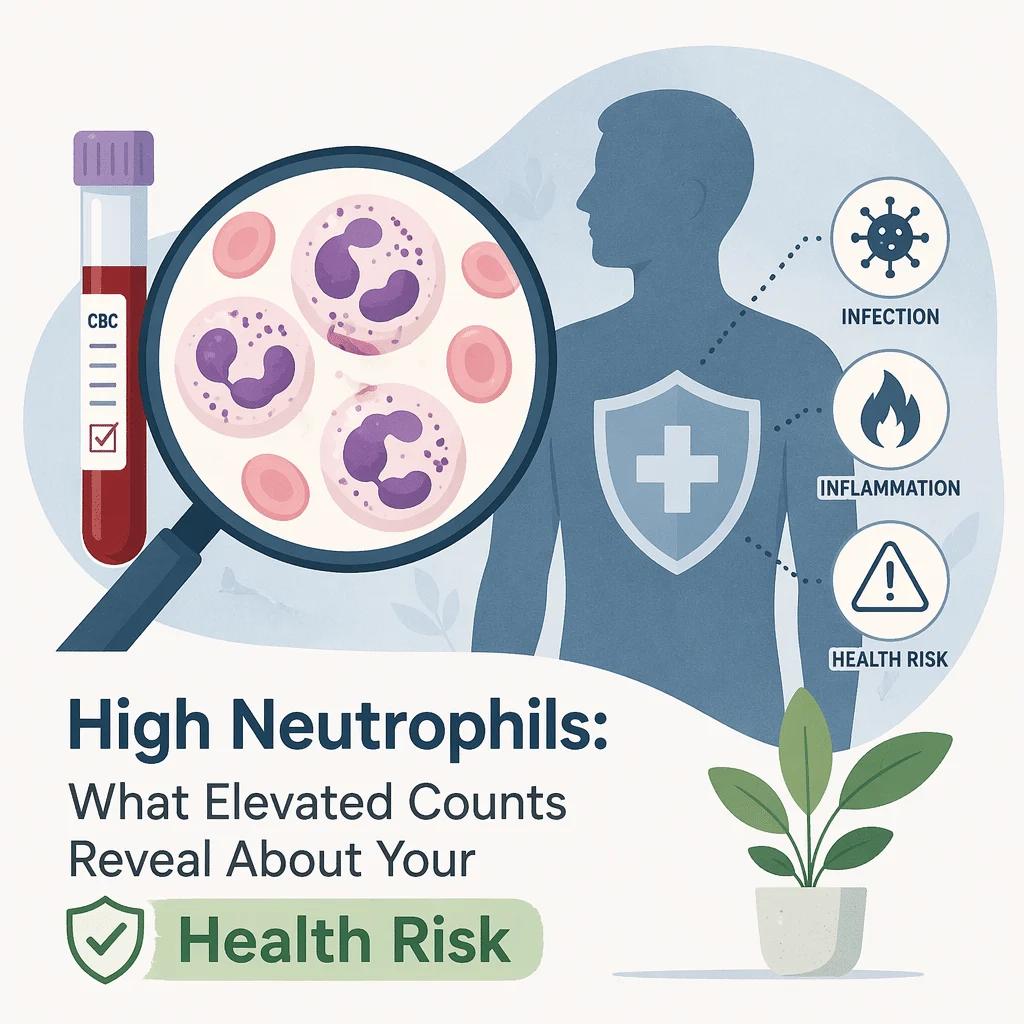
Seeing high neutrophils on a blood test result can feel alarming, especially when the report offers little explanation. Neutrophils are the most common type of white blood cell, and your body ramps up their production whenever it senses infection, injury, or inflammation. Most of the time, an elevated count is a normal, temporary reaction rather than a sign of serious disease. This article explains what high neutrophils mean, the common causes behind a raised count, whether the finding tends to produce symptoms, how doctors interpret the number alongside the rest of your blood work, and the warning signs that deserve prompt medical attention. You will also learn about the neutrophil-to-lymphocyte ratio, a simple figure researchers increasingly use to gauge inflammation.
What do high neutrophils mean on a blood test?
Neutrophils are white blood cells that act as your immune system’s first responders. They circulate in the bloodstream ready to travel to any site of infection or tissue damage, where they surround and destroy bacteria and other invaders. Because each cell lives only a few hours to a couple of days, your bone marrow produces them constantly and releases more into circulation when demand rises.
The medical term for a raised count is neutrophilia. It simply means the number of neutrophils in your blood sits above the usual range. On its own, neutrophilia is not a diagnosis; it is a signal that something has prompted your body to send out more of these cells. Finding that underlying trigger is what matters, which is why a single number is always read in context. To see how these cells fit alongside the other results on your report, you can read our dedicated neutrophils blood test guide.
What counts as a high neutrophil count?
Neutrophils are reported two ways on a full blood count with differential: as a percentage of all white blood cells and as an absolute number, called the absolute neutrophil count. Both figures appear on the panel detailed in the MedlinePlus blood differential test. In most adults, neutrophils make up roughly 40 to 70 per cent of white blood cells, and the absolute count typically falls between about 1,500 and 7,700 cells per microlitre of blood. Laboratories set their own reference ranges, so the figures printed beside your result are the ones to compare against.
Doctors generally describe the count as high when the absolute neutrophil count rises above the top of that range. A closely related term, leukocytosis, refers to a high total white blood cell count, which is often driven by neutrophils; a total above roughly 11,000 cells per microlitre is considered elevated, a threshold explained in the Cleveland Clinic overview of leukocytosis. The absolute number usually carries more meaning than the percentage, because the percentage can shift simply when another cell type rises or falls. For a plain-language walkthrough of the wider panel, see our explainer on the full blood count with differential.
What causes high neutrophils?
The causes of high neutrophils range from everyday, harmless triggers to conditions that need treatment. In healthy people, the count can climb for a few hours after intense exercise, a large meal, or an anxious morning. These short-lived rises reflect neutrophils shifting from the vessel walls into the flowing blood rather than a true jump in production, and they settle quickly. Many common triggers are also gathered in the Mayo Clinic overview of a high white blood cell count.
Infections
Bacterial infections are the most common medical reason for a raised count. Pneumonia, appendicitis, urinary tract infections, skin infections, and abscesses all push the bone marrow to release extra neutrophils that fight the invading bacteria. This rise often comes with fever and can climb quickly. When a serious bacterial infection is suspected, doctors may add the companion test described in our procalcitonin infection marker guide. Many viral infections raise other white cells instead, although some viral and fungal infections can lift neutrophils too.
Inflammation and chronic conditions
Ongoing inflammation keeps neutrophil production elevated. Conditions such as rheumatoid arthritis, inflammatory bowel disease, gout, and vasculitis are common culprits, as are recent heart attacks and other events that damage tissue. Doctors often confirm inflammation with extra markers, so you can compare your result with the pattern shown in our high C-reactive protein guide or track the slower timing captured by the erythrocyte sedimentation rate. These tests do not name the cause by themselves, but together they help build a picture.
Physical and emotional stress
Surgery, burns, injuries, heart attacks, and even childbirth are physical stressors that raise neutrophils as part of the body’s repair response. Strenuous exercise produces a brief spike, and intense emotional stress or panic can do the same through a surge of adrenaline. Pregnancy naturally lifts the count, particularly in the third trimester, and levels climb further during labour. These are expected, temporary changes rather than warning signs.
Medications, smoking, and other triggers
Certain medicines increase neutrophils. Corticosteroids such as prednisolone are the best-known example, and lithium and a few other drugs can have a similar effect. Smoking is a frequently overlooked cause of a chronically raised count, and it can take months after quitting for levels to normalise. Obesity and long-term stress also nudge the count upward. Because so many ordinary factors are involved, a mildly high result in someone who feels well is often nothing to worry about.
Less common but serious causes
Occasionally, a persistently and markedly high count points to a problem in the bone marrow itself. Blood cancers such as chronic myeloid leukaemia, and a group of conditions called myeloproliferative disorders, cause the marrow to overproduce neutrophils. These causes are uncommon, and they are usually suspected only when the count is very high, keeps climbing, or is paired with other abnormal results, such as changes in red cells, platelets, or immature cells on the differential. A high neutrophil count alone does not mean you have cancer, and most raised counts have a far more ordinary explanation. Even so, a count that stays elevated without a clear reason deserves medical review.
The table below groups the most frequent triggers and the pattern each one tends to produce, so you can see where an everyday cause ends and a reason for closer review begins.
| Category | Typical examples | Usual pattern |
|---|---|---|
| Infection | Bacterial infections such as pneumonia or a urinary tract infection | Rapid rise, often with fever |
| Inflammation | Rheumatoid arthritis, inflammatory bowel disease, gout | Steady, longer-lasting elevation |
| Physical stress | Surgery, injury, burns, heart attack | Temporary rise during recovery |
| Everyday triggers | Exercise, emotional stress, pregnancy, smoking | Mild and usually reversible |
| Medications | Corticosteroids, lithium | Rises whilst the drug is taken |
| Bone marrow disorders | Chronic myeloid leukaemia, myeloproliferative disorders | Very high or steadily climbing; uncommon |
Do high neutrophils cause symptoms?
A raised neutrophil count does not usually cause symptoms of its own. When people feel unwell, it is almost always the underlying condition, not the neutrophils, producing the complaints. A bacterial infection may bring fever, chills, pain, or swelling; an inflammatory disease may cause aching joints and fatigue; and a strong stress response may leave you feeling drained. Because the count so often rises quietly, many cases are found by chance on routine blood tests ordered for another reason.
Any symptoms that do appear therefore point toward the cause rather than the count itself. Fever with a productive cough may suggest a chest infection, whilst burning on urination points to the urinary tract. Paying attention to what else you feel, and for how long, gives your clinician far more useful information than the neutrophil figure alone. When the opposite problem occurs and the count instead falls too low, the concerns are different, and you can explore that situation in our low absolute neutrophil count guide.
Understanding the neutrophil-to-lymphocyte ratio
The neutrophil-to-lymphocyte ratio, or NLR, is a simple number from your blood count that reflects the balance between two immune cell types. It is worked out by dividing the absolute neutrophil count by the number of lymphocytes, another group of white blood cells. Because inflammation and physical stress tend to raise neutrophils whilst lowering lymphocytes, a higher ratio broadly signals a greater degree of stress or inflammation in the body.
Researchers have taken a growing interest in the ratio because it uses information already sitting in a standard full blood count, so it costs nothing extra to calculate. In healthy adults it commonly sits somewhere around 1 to 3, although there is no single agreed cutoff. It is best thought of as a general gauge rather than a specific test: it can flag that inflammation is present without saying where or why. To understand the other half of the equation, you can review the immune cells described in our lymphocytes explainer, and see how a persistently reduced count is handled in our low lymphocytes guide.
How doctors interpret a high neutrophil count
Clinicians never read high neutrophils in isolation. The first step is to look at the whole full blood count: the total white cell count, the other cell types on the differential, and the red cells and platelets. A rise limited to neutrophils with an obvious trigger, such as a recent infection, is reassuring. A rise combined with other abnormalities, or with no clear cause, prompts more questions.
Timing matters just as much as the number. A single high reading is often repeated after a week or two, because many triggers fade on their own. If the sample was taken during an illness, surgery, or a stressful event, your doctor will usually want to recheck it once you have recovered. Patterns, such as a sudden spike versus a slow, steady climb, help separate a passing reaction from something that needs investigation.
When the picture stays unclear, further tests are guided by your history and physical examination. These might include cultures to find an infection, inflammatory markers, imaging, or a closer look at the blood cells under a microscope. Comparing neutrophils with the other white cells, such as the monocytes covered in our high monocytes guide, can also help point towards a cause. The aim is always to explain high neutrophils, not simply to lower the count.
When to see a doctor about high neutrophils
Most mildly raised counts, especially in someone who feels well, do not need urgent action and are simply rechecked later. Some situations, however, warrant prompt medical attention. Contact a healthcare professional if a high count is found together with any of the warning signs below, or if it stays elevated on repeat testing without an obvious explanation.
- A high fever, shaking chills, or signs of a severe infection such as confusion, a racing heart, or difficulty breathing
- Unexplained weight loss, drenching night sweats, or fatigue that persists for more than a couple of weeks
- Easy bruising or bleeding, or repeated infections, which can point to a bone marrow problem
- Severe pain, especially in the abdomen, or a rapidly spreading area of redness and swelling
- A neutrophil count that keeps climbing across several tests, or that is very high with no clear cause
Seek emergency care for signs of a serious, spreading infection, because a very high count with fever and a rapid heartbeat can be an early clue to sepsis. Whenever you are unsure what a result means, professional interpretation is the safest route.
Latest scientific advances
Recent research has focused less on high neutrophils alone and more on the neutrophil-to-lymphocyte ratio as a window on inflammation. According to several analyses indexed in PubMed, this simple ratio, taken from a routine blood count, appears to track how the body is coping across a range of serious conditions. Each study below pools many earlier ones, which makes the overall signal more reliable, though they look at people who are already ill rather than the general public.
In a 2024 review that combined 12 studies of adults with sepsis, a life-threatening reaction to infection, patients with a higher neutrophil-to-lymphocyte ratio tended to have poorer outcomes. What this means for you: in the setting of a severe infection, doctors may use the ratio as one extra clue about who needs closer monitoring, not as a stand-alone verdict.
A 2025 analysis pooling twenty-nine studies and more than one hundred thousand patients found that a higher ratio was linked to a greater chance of acute kidney injury, a sudden drop in kidney function, and to worse outcomes once it developed. What this means for you: the same everyday blood count may hold early hints about strain on organs beyond the immune system, which is one reason doctors read it alongside your other results.
Researchers have also examined the ratio in cancer. A 2025 review of thirty-seven melanoma studies reported that people whose ratio was higher before treatment generally faced a tougher course than those with a lower ratio. What this means for you, and it is an important caveat: these findings apply to people already diagnosed with the disease, so a raised neutrophil count on its own is not a sign of cancer. The ratio is a research and monitoring tool, still being refined, and no single cutoff yet fits everyone.
Glossary of key terms
| Term | Definition |
|---|---|
| Neutrophils | The most common white blood cells; the immune system’s first responders against bacteria and other invaders. |
| Neutrophilia | The medical term for a neutrophil count that is above the normal range. |
| Absolute neutrophil count | The actual number of neutrophils per microliter of blood, rather than their percentage of white cells. |
| Full blood count | A common blood test that measures red cells, white cells, and platelets; the differential breaks the white cells into types. |
| Leukocytosis | A high total white blood cell count, which neutrophils often drive. |
| Neutrophil-to-lymphocyte ratio | The neutrophil count divided by the lymphocyte count; a simple gauge of inflammation and stress. |
| Lymphocytes | White blood cells central to the immune response, including the cells that make antibodies. |
| Bone marrow | The soft tissue inside bones where blood cells, including neutrophils, are produced. |
| Sepsis | A dangerous, body-wide reaction to infection that needs emergency care. |
Frequently asked questions
What is considered a high neutrophil count?
In most adults, the absolute neutrophil count is high when it rises above the top of the laboratory range, often around 7,000 to 7,700 cells per microliter, though each lab prints its own reference values. The percentage of neutrophils can also read high, but the absolute number is more meaningful because a percentage can shift when another cell type changes. A single reading that is only slightly high, in someone who feels well, is usually rechecked rather than treated.
When should I be worried about high neutrophils?
A mildly raised count with a clear, temporary cause, such as a recent infection or intense exercise, is rarely a concern and often settles on its own. It is more worthy of attention when the count is very high, keeps rising across several tests, or appears with warning signs like an unexplained fever, weight loss, night sweats, easy bruising, or frequent infections. In those situations, ask a healthcare professional to review the result and decide whether further tests are needed.
Can high neutrophils mean cancer?
Most of the time, no. The vast majority of raised counts come from infection, inflammation, stress, pregnancy, smoking, or medication rather than cancer. Rarely, a blood cancer such as chronic myeloid leukaemia can drive the count up, but this is usually suspected only when the count is very high or steadily climbing and other results are abnormal too. A high neutrophil count by itself is not a diagnosis of cancer, and it should be interpreted alongside your full blood picture and symptoms.
What does it mean to have high neutrophils and low lymphocytes?
This combination often reflects an active stress or inflammatory response, and it is common during bacterial infections, after surgery, or during a flare of an inflammatory condition. It also pushes the neutrophil-to-lymphocyte ratio higher, which is why that number is used as a rough gauge of inflammation. On its own the pattern does not identify a specific disease; doctors weigh it against your symptoms, history, and the rest of the blood count before drawing any conclusions.
Can high neutrophils return to normal on their own?
Yes, and they frequently do. When the count rises because of a passing trigger, such as an infection that clears, a healed injury, exercise, or short-term stress, it typically drifts back into range once the trigger is gone. That is why a single high result is often simply repeated after a week or two. A count that stays elevated without an obvious reason is the one that calls for a closer look.
Do high neutrophils always mean a bacterial infection?
No. Bacterial infection is the most common medical cause, but it is far from the only one. Inflammation, physical or emotional stress, pregnancy, smoking, corticosteroid medicines, and strenuous exercise can all raise the count without any infection at all. Because the list of triggers is so broad, the number is always interpreted together with your symptoms and the rest of your results rather than being read as proof of infection.
Sources
- MedlinePlus, U.S. National Library of Medicine – Blood differential test – medlineplus.gov
- Mayo Clinic – High white blood cell count: Causes – mayoclinic.org
- Cleveland Clinic – Leukocytosis (High White Blood Cell Count): Causes and Symptoms – my.clevelandclinic.org
- Wu H, Cao T, Ji T, et al. – Predictive value of the neutrophil-to-lymphocyte ratio in the prognosis and risk of death for adult sepsis patients: a meta-analysis – Frontiers in Immunology, 2024 – doi.org/10.3389/fimmu.2024.1336456
- Wei W, Yang B, Zhu Y, et al. – Predictive and prognostic value of the neutrophil-to-lymphocyte ratio for acute kidney injury: a systematic review and meta-analysis – Clinical and Experimental Medicine, 2025 – doi.org/10.1007/s10238-025-01746-4
- Yang Y, Fang H, Cai Z, Xu Q – Prognostic significance of the neutrophil-to-lymphocyte ratio in melanoma: a systematic review and meta-analysis – Journal of Surgical Oncology, 2025 – doi.org/10.1002/jso.70039
Further reading
- Compare the two core blood panels in our CBC and CMP comparison
- Get to know the allergy-linked white cells in our eosinophils blood cell guide
- Read what the rarest white cells reveal in our basophils blood test guide
- Learn what a raised result means in our high lymphocytes guide
- Track inflammation with the companion test in our CRP inflammation marker guide
Understand your lab results with AI DiagMe
A high neutrophil count is far easier to make sense of when you can see it next to the rest of your bloodwork. AI DiagMe reads your complete blood count, your white blood cell differential, and inflammation markers such as C-reactive protein, then explains what each value means in clear, everyday language. It is built to help you understand your results and prepare for a conversation with your clinician; it does not diagnose conditions and does not replace professional medical care.
Get your results interpreted in minutes