Hemoglobin levels are one of the most common numbers you will see on a blood test, and they answer a simple question: how well is your blood carrying oxygen? Hemoglobin is the iron-rich protein inside your red blood cells that picks up oxygen in your lungs and delivers it to every tissue in your body. In this article you’ll learn what hemoglobin does, how to read your specific result against the reference range on your report, what a low or high value can mean, and what has changed in how doctors define these thresholds. Whether your report flagged a value or you are simply curious, this guide gives you a clear, factual starting point.
A result just under the range is not always harmless — see why a borderline low hemoglobin can still matter.
What is hemoglobin and why does it matter?
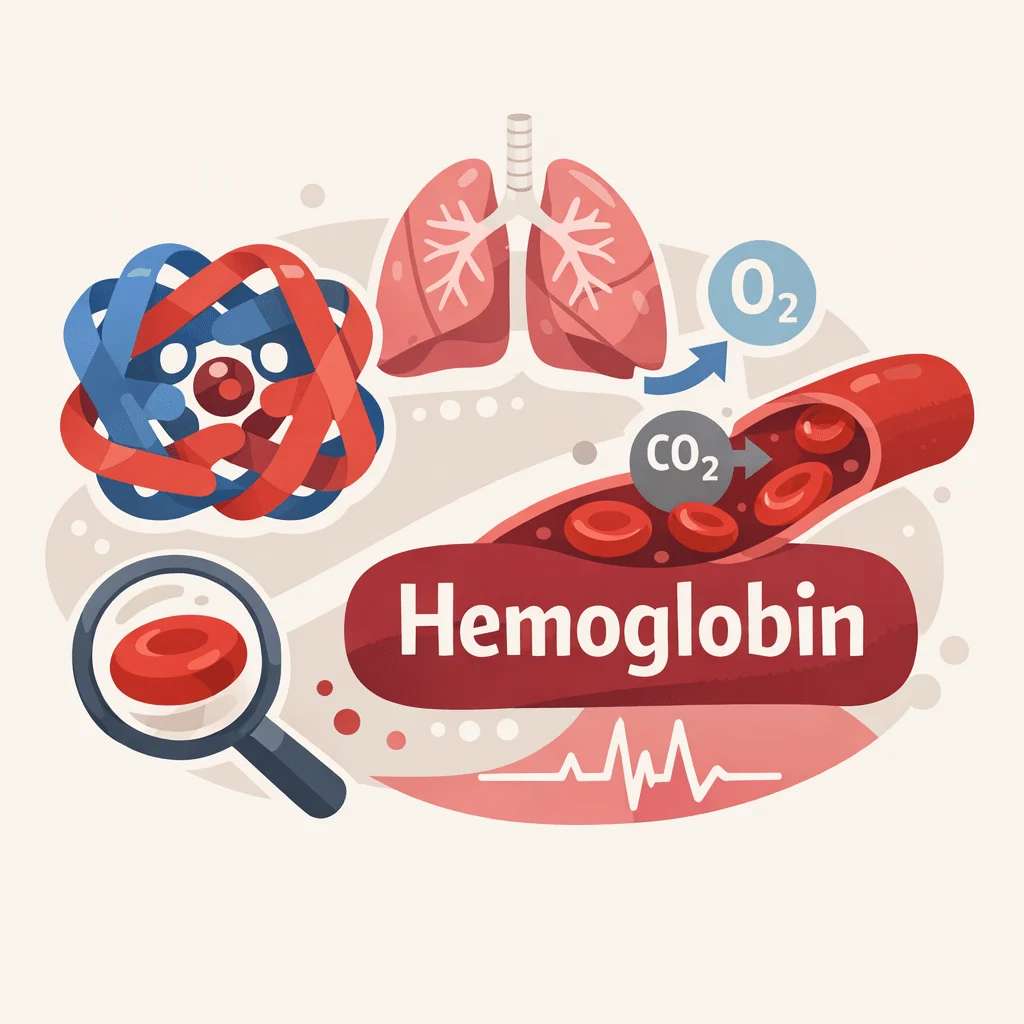
Hemoglobin (often abbreviated Hb or Hgb) is a protein packed inside your red blood cells. Each hemoglobin molecule is built from four chains, and each chain holds a ring-shaped structure called a heme group with an iron atom at its center. That iron is what gives blood its red color, and it is also the part of the molecule that actually grabs onto oxygen.
Your bone marrow, the soft tissue inside your bones, manufactures hemoglobin continuously. The process depends on a steady supply of iron, vitamin B12, and folate (vitamin B9). Without enough of these building blocks, the marrow cannot produce hemoglobin at a normal rate, which is one reason nutrition plays such a large role in maintaining healthy levels.
Think of hemoglobin as a fleet of delivery trucks. Red blood cells are the trucks, hemoglobin molecules are the drivers, and oxygen molecules are the packages picked up at a central warehouse (your lungs) and dropped off at every address in the body (your organs and tissues). On the return trip, the same drivers collect a waste product, carbon dioxide, and bring it back to the lungs to be exhaled. A single hemoglobin molecule can carry up to four oxygen molecules at once.
Because virtually every cell in your body depends on this oxygen delivery service, hemoglobin is one of the most frequently ordered values in a blood panel. It is usually measured as part of a complete blood count, and this guide explains how to read a complete blood count alongside your hemoglobin result.
How to read your hemoglobin result
On a lab report, hemoglobin usually sits in the complete blood count section, listed as “Hb,” “Hgb,” or “Hemoglobin.” Next to your number, you will see a reference range that looks something like this:
| Group | Typical reference range |
|---|---|
| Adult men | 13.5 to 17.5 g/dL |
| Adult women (non-pregnant) | 12.0 to 16.0 g/dL |
| Pregnant women, first trimester | around 11.0 g/dL or higher |
| Children (varies by age) | approximately 11.0 to 14.0 g/dL |
Most US labs report hemoglobin in grams per deciliter (g/dL), though some use grams per liter (g/L). A value marked with a down arrow, an asterisk, or highlighted in red usually means it falls outside the reference range for your age and sex. That flag is a starting point for a conversation with your doctor, not a diagnosis on its own.
Reference ranges are built from population studies of healthy people, and by design they cover about 95 percent of that population. This means roughly 1 in 20 healthy people will have a result just outside the printed range without anything being wrong. Context, including your symptoms, your history, and your other blood values, always matters more than a single number sitting slightly outside the line.
Several factors shift what counts as a normal hemoglobin level for you specifically. Sex is the biggest factor, since men typically run higher than women. Age matters too, especially in childhood and after menopause. Altitude also plays a role: people who live at high elevation tend to have naturally higher hemoglobin, because the body makes more red blood cells to compensate for thinner air.
A simple checklist for reading your own result
- Find your hemoglobin value and confirm the unit (g/dL or g/L).
- Locate the reference range for your sex and age on the same report.
- Note how far your value sits from the range, not just whether it is flagged.
- Check related values on the same report, since a rise or fall in your hematocrit percentage usually mirrors your hemoglobin trend.
- Compare with any previous results to see whether the number is stable, rising, or falling.
Understanding low hemoglobin (anemia)
A hemoglobin level below the reference range is called anemia. It is one of the most common findings in laboratory medicine, and it has several distinct causes that a doctor will try to distinguish.
Iron-deficiency anemia is the most frequent type worldwide. When the body’s iron stores run low, the bone marrow cannot build enough functional hemoglobin, and the red blood cells it does produce tend to be smaller than normal. Typical symptoms include persistent tiredness, a racing heartbeat, breathlessness during light activity, and pale skin. To confirm this, doctors typically order an iron studies panel that checks ferritin and transferrin saturation together.
Vitamin B12 or folate deficiency produces anemia through a different route. These vitamins are needed to help red blood cells mature properly, so a shortage leads to fewer, larger, and less effective cells (a pattern called macrocytic anemia). People with this type may also notice tingling in the hands or feet alongside the usual fatigue, and this site’s guide covers the specific symptoms and treatment of folate deficiency in more depth.
Hemolytic anemia happens when red blood cells are destroyed faster than the bone marrow can replace them. The marrow itself works normally, but the cells simply do not survive long enough. Elevated bilirubin and a marker called LDH often point clinicians toward this cause.
Anemia linked to chronic illness is also common. Long-term conditions such as kidney disease, ongoing inflammation, or certain cancers can quietly suppress red blood cell production even when iron stores look adequate on paper.
Understanding high hemoglobin
A hemoglobin level above the reference range is less common than anemia but still worth understanding. Doctors sometimes call the underlying condition erythrocytosis, or polycythemia when there is a true excess of red blood cells.
Dehydration is the most frequent and least worrying cause. When you lose fluid, your plasma volume shrinks while your red blood cells stay the same in number, which concentrates them and pushes the hemoglobin percentage up temporarily. This corrects itself once you rehydrate.
Secondary polycythemia describes a situation where the body is producing extra red blood cells for a legitimate reason: to compensate for low oxygen levels. Common triggers include chronic lung disease such as COPD, sleep apnea, long-term heavy smoking, or living at high altitude. In these cases, the hormone erythropoietin, which stimulates red blood cell production, is often elevated as well.
Polycythemia vera is a rarer bone marrow condition in which red blood cells are overproduced independent of the body’s actual oxygen needs. It is linked to a mutation in a gene called JAK2 and can raise the risk of blood clots. A bone marrow test and genetic testing for this mutation help confirm the diagnosis, and the hormone driving normal red blood cell production is explained further in this guide to erythropoietin and what your EPO test result means.
Latest scientific advances
Two recent developments are reshaping how doctors think about hemoglobin numbers, and both are directly relevant to how your own result gets interpreted.
The first is a large-scale revision of the thresholds used to define anemia. For decades, the World Health Organization’s cutoffs for “too low” hemoglobin were based on statistical estimates from research conducted more than 50 years ago. A major 2024 analysis pooled health data from thousands of people across the United States, England, Australia, China, and several other countries to recalculate these thresholds using modern, representative population samples. The researchers confirmed that hemoglobin thresholds are similar between men and women during childhood, then diverge at puberty, when male thresholds become meaningfully higher than female ones. A companion review published the same year in The Lancet, co-authored by global anemia researchers including Sant-Rayn Pasricha, laid out why getting these cutoffs right matters so much: anemia affects roughly a quarter of the world’s population, and inaccurate thresholds can mean both under-diagnosing people who need treatment and over-diagnosing people who do not.
What this means for you: if your hemoglobin sits close to the edge of the reference range on your report, the exact cutoff your lab uses may eventually be refined as these updated, evidence-based thresholds make their way into clinical guidelines. This is a slow, careful process, not an overnight change, and it does not affect anyone with a clearly high or clearly low result.
The second development concerns a pattern doctors increasingly recognize: normal hemoglobin does not always mean normal iron. A comprehensive 2025 review in JAMA on iron deficiency in adults highlighted that a large share of people, particularly women of reproductive age, can have depleted iron stores and related symptoms such as fatigue, difficulty concentrating, or restless legs syndrome, even while their hemoglobin still falls within the normal range. The review explains that iron deficiency typically progresses in stages, starting with low iron stores and only later, if unaddressed, tipping into anemia. An aside on jargon: researchers describe this earlier stage as “nonanemic iron deficiency” — simply meaning low iron stores that have not yet dragged hemoglobin below the cutoff.
What this means for you: if you have symptoms that sound like anemia, such as ongoing fatigue or breathlessness, but your hemoglobin comes back normal, it does not automatically rule out an iron-related cause. Ask your doctor whether checking ferritin (your iron stores) alongside hemoglobin makes sense for your situation, since the two tests answer different but related questions. This site’s guide to low ferritin explains this exact “normal hemoglobin, low iron” pattern in more detail. This is an active area of clinical guidance, still being refined, so treat it as useful context for a conversation with your doctor rather than a reason to self-diagnose.
When to see a doctor
Most mildly abnormal hemoglobin results are not emergencies, but some situations call for prompt medical attention rather than simple monitoring.
- Your hemoglobin has dropped by more than 2 g/dL compared with a previous test, without an obvious explanation.
- You have low hemoglobin along with significant shortness of breath, chest pain, or a racing heartbeat.
- Your hemoglobin remains persistently high even after you have addressed hydration, which may warrant a hematology referral.
- You are pregnant and your hemoglobin is unusually high for your trimester, since this can occasionally relate to other pregnancy-related changes that your provider will want to check.
- You need surgery soon and your hemoglobin is well below normal, since very low levels can affect how your body handles the procedure.
If your result is only slightly outside the range, has no accompanying symptoms, and is stable compared with earlier tests, simple monitoring on the schedule your doctor recommends is usually appropriate.
A quick decision guide
| Your situation | Suggested next step |
|---|---|
| Slightly low, no symptoms | Recheck in 2 to 3 months as your doctor advises |
| Moderately low, with fatigue | Schedule a visit within the next couple of weeks |
| Severely low or sudden large drop | Seek prompt medical care |
| Slightly high, likely dehydration | Rehydrate and recheck in a few weeks |
| Persistently high, no clear cause | Discuss further testing with your doctor |
Supporting healthy hemoglobin levels
If low hemoglobin is linked to a nutritional gap, simple dietary steps can help alongside any treatment your doctor recommends. Iron-rich foods include lean red meat, poultry, beans, lentils, and iron-fortified cereals. Pairing these with a source of vitamin C, such as citrus fruit or bell peppers, improves how much iron your body actually absorbs. Drinking tea or coffee with meals can reduce iron absorption, so many people find it helpful to space these out from iron-rich meals. Foods rich in vitamin B12, mainly animal products, and folate, found in leafy greens and legumes, support the vitamin side of red blood cell production.
Certain groups warrant closer attention to hemoglobin. Endurance athletes sometimes develop mild, harmless drops linked to training adaptations, but persistent fatigue should still be checked. People following vegan or vegetarian diets benefit from monitoring iron and B12 intake, since the most absorbable forms of both nutrients come mainly from animal sources. Women with heavy menstrual periods lose iron steadily and may need evaluation for the underlying cause. Older adults with unexplained low hemoglobin are sometimes screened for hidden gastrointestinal bleeding, since this becomes a more common cause with age. If your report also flags a low average cell size, this site explains what a low MCH result adds to the hemoglobin picture.
Frequently asked questions
What is considered a dangerously low hemoglobin level?
A hemoglobin level below about 8 g/dL is generally considered severe and usually prompts urgent medical evaluation, though the exact threshold your doctor uses depends on how quickly the level dropped and whether you have symptoms. A slow decline to a low number can sometimes be tolerated better than a sudden drop to the same value, because the body has time to adapt. Any very low result should be discussed with a healthcare provider rather than interpreted alone.
Can hemoglobin levels change naturally during the day?
Yes, hemoglobin can fluctuate slightly, typically by around 0.5 to 0.7 g/dL, over the course of a day. Levels tend to be a little higher in the morning and lower later in the day, largely due to shifts in hydration. If you are tracking your hemoglobin over time, having blood drawn at a similar time of day each visit makes the comparisons more reliable.
Why is my hemoglobin normal even though I feel constantly tired?
A normal hemoglobin does not rule out every cause of fatigue. Early iron deficiency, before it lowers hemoglobin enough to count as anemia, is one possibility, alongside conditions such as an underactive thyroid, poor sleep, or low mood. It is also possible for your value to sit at the lower end of the normal range, which may not be enough for your particular needs, especially if you are very active or live at altitude. Persistent, unexplained fatigue is always worth discussing with your doctor.
How does altitude affect hemoglobin?
At higher altitudes, where the air holds less oxygen, your body responds by producing more erythropoietin, the hormone that drives red blood cell production. This adaptation typically becomes noticeable above about 5,000 feet and more pronounced above 8,000 feet. Staying at altitude for several weeks can raise hemoglobin by roughly 1 to 3 g/dL. If you have recently traveled to or moved to a high-altitude location, mentioning this to your doctor helps them interpret your result correctly.
Can medications change hemoglobin levels?
Yes, several common medications can influence hemoglobin. Nonsteroidal anti-inflammatory drugs, including ibuprofen or high-dose aspirin, can cause small amounts of digestive bleeding over time, which may gradually lower hemoglobin. Chemotherapy often affects the bone marrow directly, reducing red blood cell production. On the other end, erythropoietin-based medications, sometimes used in kidney disease, are designed to raise hemoglobin. If you take regular medication and notice a change in your levels, your doctor can help determine whether the drug is a likely factor.
Do regular blood donors need to watch their hemoglobin?
Yes. Blood donation centers check hemoglobin before every donation and require a minimum level, since donation temporarily reduces your red blood cell count. Frequent donors can gradually deplete their iron stores even if hemoglobin stays technically normal between donations, so some donation centers also monitor ferritin for regular donors. Eating iron-rich foods around donation days and spacing out donations as recommended can help maintain healthy levels.
Understand your lab results with AI DiagMe
Hemoglobin rarely tells the full story on its own. Your doctor typically reads it alongside related complete blood count values such as hematocrit and MCV, plus iron-related tests like ferritin, to understand what is really happening. AI DiagMe helps you make sense of these results together, translating your hemoglobin, hematocrit, and iron panel into plain language so you can prepare better questions for your appointment. This tool is designed to help you understand your lab report, not to diagnose you or replace your doctor’s judgment.
Get your results interpreted in minutes
Glossary
| Term | Definition |
|---|---|
| Anemia | A condition in which hemoglobin or red blood cell numbers fall below the normal range, reducing the blood’s oxygen-carrying capacity. |
| Erythropoietin (EPO) | A hormone made mainly by the kidneys that signals the bone marrow to produce more red blood cells. |
| Ferritin | A protein that stores iron inside cells; a low blood level usually points to depleted iron stores. |
| Hematocrit | The percentage of your total blood volume made up of red blood cells. |
| Hemoglobin | The iron-containing protein inside red blood cells that carries oxygen from the lungs to the rest of the body. |
| Meta-analysis | A study that statistically combines results from many separate studies to reach a more reliable overall conclusion. |
| Polycythemia | A condition marked by an abnormally high number of red blood cells, which can thicken the blood. |
| Reference range | The span of values considered typical for a healthy population, set individually by each laboratory. |
| Transferrin saturation | A lab measurement showing what percentage of the iron-carrying protein transferrin is currently occupied by iron. |
Further reading
- This guide pairs well with our overview explaining the symptoms, causes, and diagnosis of anemia.
- For a deeper look at the vitamin side of red blood cell production, read about interpreting your vitamin B12 test results.
- If you are curious about the size of your red blood cells, this guide explains what your MCV result reveals about cell size and anemia type.
- Pregnant readers may also want to understand which blood tests are checked at each stage of pregnancy.
- For context on your red blood cells themselves, see our guide to reading your red blood cell count results.
Sources
- Hemoglobin test — Mayo Clinic
- Hemoglobin Test — MedlinePlus (National Library of Medicine, NIH)
- What Is Anemia? — NHLBI, National Institutes of Health
- Braat S, et al. Haemoglobin thresholds to define anaemia from age 6 months to 65 years: estimates from international data sources. The Lancet Haematology, 2024. View study
- Pasricha SR, et al. Measuring haemoglobin concentration to define anaemia: WHO guidelines. The Lancet, 2024. View study
- Auerbach M, DeLoughery TG, Tirnauer JS. Iron Deficiency in Adults: A Review. JAMA, 2025. DOI: 10.1001/jama.2025.0452