



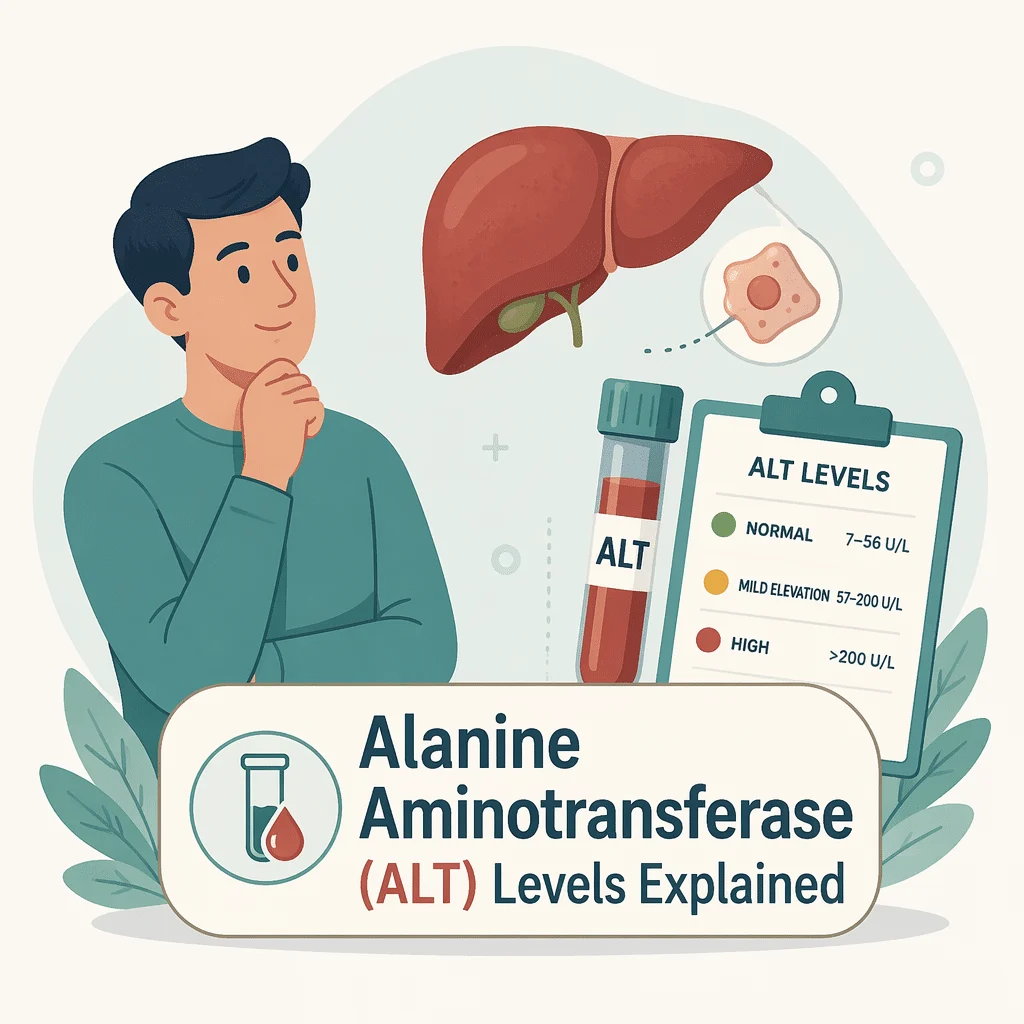
A high ALT usually means liver cells have released more of this enzyme than normal into your blood, which can be a sign of liver stress or injury. Most of the time a high ALT reflects something common and manageable, such as fatty liver, alcohol, or a medication, rather than an emergency. Still, the number is worth understanding, because a large or rising ALT can point to a problem that needs prompt care. In this article you will learn what counts as a high ALT, the usual causes, the symptoms that can go with it, and when it is time to see a doctor.
What a high ALT result means
ALT, or alanine aminotransferase, is an enzyme that lives mainly inside liver cells, where it helps process amino acids. When those cells are inflamed or damaged, ALT leaks into the bloodstream, so a higher blood level generally signals that the liver is under strain. Because ALT is fairly specific to the liver, it is one of the most useful markers of hepatocellular injury, and it can rise before any symptoms appear. For the basics of the test itself, our pillar guide covers normal ALT ranges.
What counts as a high ALT level?
There is no single universal cutoff. Many laboratories set the upper limit of normal near 40 U/L, but healthy-population studies suggest a lower threshold, roughly 30 U/L for men and 19 U/L for women. Your report will show the reference range your lab uses, and the size of the elevation matters more than the exact number. The table below is a general guide, not a diagnosis.
| Degree of elevation | Roughly | Common context |
|---|---|---|
| Mild | Up to about 3 times the upper limit | Fatty liver, alcohol, medicines, recent intense exercise |
| Moderate | About 3 to 10 times the upper limit | Active hepatitis, drug-related injury, autoimmune liver disease |
| Marked | More than about 10 to 15 times the upper limit | Acute liver injury from toxins, acute viral hepatitis, or poor blood flow, needing prompt evaluation |
This framing answers the common question of whether a specific number is worrying. A result in the 50 to 100 range is usually a mild elevation and often has a benign, reversible cause, while a value in the many hundreds or thousands signals significant, sudden liver injury and calls for urgent assessment. Trends matter too: a stable, slightly high ALT is interpreted differently from one that is climbing.
What causes high ALT?
Fatty liver (MASLD)
Metabolic dysfunction-associated steatotic liver disease (MASLD), the current name for most fatty liver, is now the leading cause of mildly elevated liver enzymes in the United States. It is linked to excess weight, type 2 diabetes, high triglycerides, and metabolic syndrome, and it often produces a modest, persistent ALT rise with no symptoms.
Alcohol
Alcohol is processed by the liver and is directly toxic at higher doses, so regular or heavy drinking commonly raises ALT. Reducing or stopping alcohol is often one of the most effective ways to bring the number down.
Medications and supplements
Many everyday medicines can nudge ALT upward, including statins and acetaminophen, along with some antibiotics and herbal or vitamin supplements such as high-dose vitamin A. Always tell your clinician about everything you take, including over-the-counter products.
Viral and autoimmune hepatitis
Hepatitis A, B, and C inflame the liver and can raise ALT substantially, and autoimmune hepatitis does the same when the immune system attacks liver cells. These causes usually need specific testing and treatment.
Muscle and exercise
ALT is present in muscle as well as liver, so a hard or unaccustomed workout can lift the number temporarily. Repeating the test after a few days of rest often clears up this kind of change.
Less common causes
Bile-flow blockages, iron overload (hemochromatosis), celiac and thyroid disease, poor blood flow to the liver, and, rarely, tumors can also raise ALT. This is why the number is always interpreted in context rather than on its own.
High ALT with normal AST, and what the pattern means
Doctors rarely read ALT alone. They compare it with a related enzyme, so it helps to read your result next to your AST level. A high ALT with a normal or lower AST is a typical fatty-liver pattern, whereas an AST that runs higher than ALT more often points toward alcohol-related injury or advanced scarring. The balance between the two is captured by the AST/ALT ratio, and both enzymes usually appear together on a full liver panel grouped as standard liver function tests.
Symptoms that can go with a high ALT
Many people with a high ALT feel completely well, which is why it is often found by chance on routine bloodwork. When symptoms do appear, they can include fatigue, loss of appetite, nausea, abdominal discomfort on the upper right side, itching, dark urine, pale stools, or yellowing of the skin and eyes (jaundice). Jaundice or persistent vomiting alongside a high ALT deserves prompt medical attention.
When to worry about a high ALT
A single, mildly high ALT is common and usually not an emergency, but some situations call for quicker action. Contact a healthcare professional promptly if your ALT is very high (many times the upper limit), if it keeps rising on repeat testing, or if it comes with jaundice, confusion, severe abdominal pain, or ongoing vomiting. You should also seek advice sooner if you have risk factors such as heavy alcohol use, known hepatitis exposure, diabetes, or a medication known to affect the liver. Early evaluation is the best way to catch a treatable problem before it causes lasting damage.
What to do about a high ALT
The first step is to find and address the cause, which often means reviewing your medications, alcohol intake, and metabolic health, then repeating the test after a few weeks to see the trend. For fatty liver, gradual weight loss and better blood sugar control frequently lower ALT; for a drug-related rise, your clinician may adjust or stop the medication. For a step-by-step plan, our companion guide walks through practical ways to lower ALT levels.
Latest scientific advances
Recent research has focused on how much a mildly high ALT really matters, especially for fatty liver. Here is what it adds, in plain terms.
A 2024 editorial argued that even a repeatedly high-normal ALT, a value near the top of the normal band rather than clearly above it, can be an early signal of new MASLD. Part of the debate is where normal should end: the traditional 40 U/L cutoff was set using populations that likely included undiagnosed liver disease, and many experts now favor a lower healthy threshold of about 30 U/L for men and 19 for women. What this means for you is that a number your lab calls normal is not always fully reassuring if you carry metabolic risk factors.
A 2024 study of more than 1,300 people having routine health checks found that an ALT above 30 U/L, together with fatty liver, was linked to significant liver scarring, particularly in adults aged 65 and older. In everyday language, a modestly high ALT is worth taking seriously rather than dismissing, especially later in life. At the same time, a 2021 analysis cautioned that liver enzymes alone are imperfect and that risk is best judged by combining ALT with other factors and, when needed, imaging. These findings continue to be refined, but the shared message is that a high ALT is a prompt to look closer, not a verdict on its own.
Glossary
- ALT (alanine aminotransferase): a mainly liver-based enzyme that rises in the blood when liver cells are injured.
- AST (aspartate aminotransferase): a related enzyme, found in liver and muscle, often measured alongside ALT.
- Upper limit of normal (ULN): the top of a laboratory’s reference range for a test.
- MASLD: metabolic dysfunction-associated steatotic liver disease, the current name for most fatty liver disease.
- Hepatitis: inflammation of the liver, from viruses, alcohol, medicines, or autoimmune disease.
- Jaundice: yellowing of the skin or eyes from a buildup of bilirubin.
- AST/ALT ratio: the balance between the two enzymes, which helps point to a cause.
Frequently asked questions
Is an ALT of 70 or 80 high? Yes, both sit above most reference ranges, but they are usually mild elevations. Common explanations include fatty liver, alcohol, medications, or recent hard exercise, and your clinician will look at the trend and your risk factors.
What does an ALT over 100 mean? It is a clearer elevation that warrants evaluation to find the cause. It is still often reversible, but higher and rising values, especially in the hundreds, need prompt medical review.
What medications can raise ALT? Statins, acetaminophen, some antibiotics, and certain herbal and vitamin supplements can all raise ALT. Never stop a prescribed medicine on your own; discuss any concern with your prescriber.
Can a high ALT go back to normal? Often yes. When the cause is treated, such as losing weight for fatty liver or cutting back on alcohol, ALT frequently returns toward normal over weeks to months.
Does a high ALT mean liver disease? Not necessarily. It signals liver stress, but the reason ranges from harmless and temporary to serious, which is why it is interpreted with other tests and your history.
Should I fast before an ALT test? Fasting is not usually required for ALT alone, but follow your lab’s instructions, particularly if other tests are drawn at the same time.
Further reading
- ALT levels: meaning, causes, and normal ranges
- How to lower ALT levels
- AST normal range explained
- Liver function tests overview
- SGPT: the same enzyme by another name
Sources
- MedlinePlus, NIH National Library of Medicine. ALT Blood Test. https://medlineplus.gov/lab-tests/alt-blood-test/
- Cleveland Clinic. Elevated Liver Enzymes. https://my.clevelandclinic.org/health/symptoms/17679-elevated-liver-enzymes
- Mayo Clinic. Elevated liver enzymes: Causes. https://www.mayoclinic.org/symptoms/elevated-liver-enzymes/basics/causes/sym-20050830
- Moyana TN. Metabolic dysfunction-associated steatotic liver disease: long-term high-normal ALT as a screening test. World J Gastroenterol, 2024. https://consensus.app/papers/details/086c5d3017ff599a8b78b83163865351/
- Nakano M, et al. Profiles associated with significant hepatic fibrosis: ALT >30 U/L, exercise habits, and MASLD. Hepatology Research, 2024. https://consensus.app/papers/details/9c3a790b3683520a906bc7e71fa7d2b1/
- Forlano R, et al. Liver function tests and metabolic-associated fatty liver disease: changes in upper normal limits. World J Hepatol, 2021. https://consensus.app/papers/details/0891a16133ff59b583590dd405acbb09/
Understand your lab results with AI DiagMe
A high ALT makes more sense when you can see it next to your AST, GGT, bilirubin, and metabolic markers. AI DiagMe reads your uploaded lab report and explains what your ALT and related liver numbers may mean, in plain language, so you know which questions to raise with your doctor. It helps you understand your results; it does not diagnose disease or replace medical care.
Get your results interpreted in minutes